

When you type "family counseling near me" into a search bar, you're doing more than just looking for a service—you're taking a courageous first step toward a stronger, healthier family. Here at reVIBE Mental Health, we understand that. With five locations across the Valley—in Chandler, Scottsdale, Tempe, and two in Phoenix—we're right here in your community, ready to help your family connect and thrive.
Why More Phoenix Families Are Turning to Counseling
Life in a vibrant, fast-growing place like Phoenix comes with its own unique flavor of chaos and pressure. It’s no surprise that families are looking for better ways to manage it all. Seeking professional guidance isn't a sign of failure anymore; it's a smart, proactive move to build resilience and improve how you relate to the most important people in your life. You're definitely not alone in this.
This isn't just a local trend. Across the country, the U.S. Family Counseling & Crisis Intervention Services industry has grown to a staggering USD 71.3 billion. What does that number mean? It means families everywhere are realizing that investing in their mental and emotional well-being is essential. If you're curious, you can read the full report on this expanding market to see just how much the demand has grown.
The Real-World Struggles We See Every Day
While every family's situation is unique, we see a lot of common themes walk through our doors. The constant hustle in places like Scottsdale, Chandler, and Tempe can easily magnify the little stresses of daily life, creating real distance and friction at home.
Here are a few of the challenges that bring local families to us:
- Constant Miscommunication: It starts with small misunderstandings but snowballs into the same arguments over and over, leaving everyone feeling frustrated and unheard.
- Blending Families: Bringing two families together is a delicate dance. It's tough to navigate all the new roles, emotions, and logistics without a little help.
- The Digital Dilemma: Battles over screen time, the pressures of social media, and keeping kids safe online have become a huge source of conflict for modern parents.
- Troubling Behavior in Kids and Teens: When a child is acting out, withdrawing, or struggling with anxiety, it's often a sign that something bigger is going on within the family dynamic.
Therapy offers a safe space where everyone gets a voice and no one is to blame. The goal isn’t to point fingers, but to untangle the patterns and find new, healthier ways to connect with each other.
Think of It as a Tune-Up for Your Family
The best time to work on your family relationships is before they reach a breaking point. Think of counseling like a regular check-up for your family’s emotional health. It gives you the tools to handle disagreements constructively and strengthens the very foundation you’re built on.
Our therapists at reVIBE Mental Health—whether you see us in Phoenix, Deer Valley, or Paradise Valley—are here to provide that supportive, non-judgmental environment. We're here to help you turn your family's biggest challenges into your greatest opportunities for growth.
Your Guide to Finding the Right Local Therapist
Realizing your family needs support is a huge first step. Now comes the part that can feel daunting: actually finding the right person to help. A generic search for "family counseling near me" often dumps a mountain of overwhelming and irrelevant results on your screen. A better approach is to get specific.
Think about what your family is really up against. If you’re in the East Valley and your teenager is struggling with school, a search like “child psychologist Chandler” or “teen anxiety therapy Tempe” will immediately narrow the field to therapists with that exact specialty. If communication with your partner has broken down, trying “couples counseling Scottsdale” will connect you with professionals focused on relationship dynamics.
This journey—from feeling the pressure to finding the right professional support—is a common one for families.
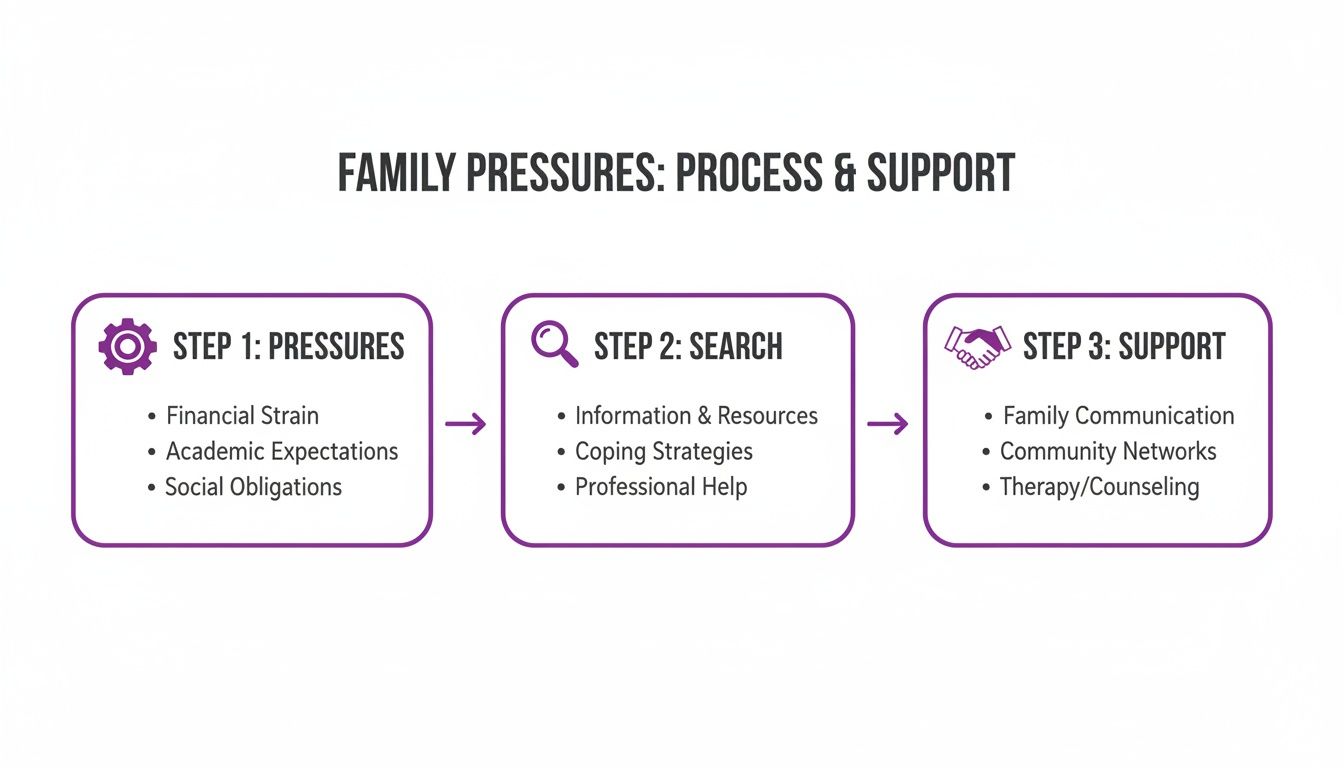
It shows how those everyday challenges can be the starting point for building a much healthier, more connected family life once you find the right help.
Where to Look for Phoenix-Area Therapists
Once you know what you’re looking for, you need to know where to look. While a quick Google search is fine, there are a few directories that are much more helpful for finding qualified therapists.
- Psychology Today: This is probably the most comprehensive directory out there. You can filter for therapists in Phoenix, by your specific insurance plan, their specialties (like family conflict or EMDR), and even their gender. Their profiles give you a great feel for their personality and approach before you even pick up the phone.
- Your Insurance Provider's Portal: This is your best bet for finding someone in-network. Log in to your insurance company’s website and find their behavioral health or provider directory. It’s the most accurate way to avoid surprise out-of-pocket costs and lets you filter by who’s closest to your home or work.
The goal here isn’t to find the one perfect therapist right away. It's to build a shortlist of 3-5 promising options you can vet more closely.
This simple process takes you from feeling lost in a sea of names to having a clear, manageable list of qualified professionals. It’s a powerful step that puts you back in the driver's seat.
Finding a Convenient Location Near You
Let’s be realistic—if getting to the therapist’s office is a major hassle, you’re less likely to stick with it. When you’re juggling work, school pickups, and after-school activities, a long commute just adds more stress. That's why having a convenient office matters so much.
At reVIBE Mental Health, we’ve intentionally opened offices across the Phoenix metro area to make therapy more accessible for busy families. You can find maps and directions on our reVIBE Mental Health clinic locations page, but here’s a quick overview of where you can find us.
Find a reVIBE Location Near You!
We currently have five locations for your convenience. (480) 674-9220
reVIBE Mental Health – Chandler
3377 S Price Rd, Suite 105, Chandler, AZ
reVIBE Mental Health – Phoenix Deer Valley
2222 W Pinnacle Peak Rd, Suite 220, Phoenix, AZ
reVIBE Mental Health – Phoenix PV
4646 E Greenway Road, Suite 100, Phoenix, AZ
reVIBE Mental Health – Scottsdale
8700 E Via de Ventura, Suite 280, Scottsdale, AZ
reVIBE Mental Health – Tempe
3920 S Rural Rd, Suite 112, Tempe, AZ
Whether you're in the East Valley, North Phoenix, or near Old Town Scottsdale, we have a comfortable and welcoming space waiting for you. Our team is ready to help at any of our 5 locations.
How to Choose a Counselor That Fits Your Family
You’ve put in the time and effort, and now you have a shortlist of potential therapists. That’s a huge step forward. But the next part is arguably the most important: finding the one professional who genuinely clicks with your family's personality and the specific challenges you're facing. This goes way beyond credentials on a wall—it's all about connection and trust.
When you're searching for "family counseling near me," the 'fit' is everything. A therapist might have an amazing resume, but if your teenager feels judged or you feel like you’re not being heard, making real progress is going to be an uphill battle. The goal is to find a professional who creates a safe, non-judgmental space where every single person in the room feels seen and valued.

Decoding a Therapist’s Profile
Before you even think about making a call, a therapist's online profile can give you a ton of insight. Look past the professional headshot and the list of degrees. Dig into their biography and "About Me" sections, scanning for keywords that resonate with your family’s unique situation.
Do they specifically mention experience with things like:
- Blended family adjustments if you’re trying to merge households and build new bonds?
- Teen anxiety and depression if your high schooler is withdrawn and struggling?
- Trauma-informed care or specialized techniques like EMDR for dealing with past painful events?
- Communication breakdown if it feels like every conversation turns into an argument?
When a therapist explicitly names your family’s core struggle right there on their profile, it’s a great sign. It shows they have direct experience and a real interest in helping families just like yours. This initial screening can save you a lot of time and help you zero in on the most promising candidates from the start.
Questions for Your Initial Consultation Call
Most therapists offer a free, brief phone consultation, usually lasting about 10-15 minutes. This is your opportunity to interview them. Don't feel hesitant to ask questions—you’re the one seeking a service, and this is a significant investment in your family’s future.
Coming prepared with a few key questions will help you make the most of this short call. The conversation should feel natural and reassuring, not like a formal interrogation.
Think of this initial call as a vibe check. You're not just gathering information; you're getting a feel for their personality and communication style. Does this person sound like someone your family could trust?
A good therapist will be happy to answer your questions and will make you feel comfortable. It's also good to know that sometimes, a therapist may work as part of a larger team to provide more comprehensive care. For example, understanding how a psychiatric mental health practitioner can collaborate with a therapist might be relevant for your family's needs.
What to Ask a Potential Family Counselor
Here’s a practical list of questions to have ready for your consultation calls. You don’t have to ask all of them, but pick the ones that are most important to you.
-
"Can you tell me about your experience working with families like ours?"
- This question is more direct and insightful than just asking if they've worked with similar families. It encourages them to share real-world examples related to issues like teen defiance, grief, or co-parenting conflicts.
-
"What does a typical first session with a new family look like?"
- This helps you get a clear picture of what to expect. Their answer will tell you if they start by exploring family history, jumping right into goal-setting, or simply focusing on making everyone feel comfortable enough to talk.
-
"What is your therapeutic approach to family counseling?"
- You don't need to be an expert on different therapy models. Listen for phrases like "Family Systems," "Cognitive-Behavioral Therapy (CBT)," or "Strengths-Based." The important part is asking them to explain what that actually means for your family in simple, everyday language.
-
"How do you engage children or teenagers who are reluctant to participate?"
- This is a crucial question if you're worried about getting your kids on board. A skilled family therapist will have specific strategies for connecting with hesitant family members and helping them feel like part of the solution, not the problem.
Choosing the right counselor is a foundational step in your family’s journey toward healing. Taking the time now to carefully vet your options ensures you find a professional who can truly guide you toward building a healthier, more peaceful home life.
Sorting Out Insurance and Your First Appointment
You've put in the effort to find a few therapists who seem like a great fit for your family. That's a huge step! Now comes the part that often feels like the most confusing hurdle: figuring out insurance and scheduling that first meeting.
Let's break down these practical details. It’s not as complicated as it seems, and getting it right from the start makes everything else run smoothly.
Cracking the Insurance Code
Before you commit to a therapist, you need a clear picture of what your insurance plan actually covers for mental health. Taking ten minutes to do this now can save you from a major financial headache later.
When you look at your plan or call your provider, you'll hear a few key terms. Understanding them is your first win.
- In-Network: This is gold. It means a provider, like reVIBE Mental Health, has a direct contract with your insurance company. You’ll almost always pay significantly less by staying in-network.
- Deductible: Think of this as the amount you have to pay out-of-pocket for healthcare before your insurance company starts chipping in.
- Copay: This is the flat fee you pay for each session once your deductible is met. For example, a common copay is $30 per visit.
- Coinsurance: Some plans use this instead of a copay. You'll pay a percentage of the session's cost (say, 20%), and the insurance company covers the rest.
Once you know these figures, you’ll have a clear idea of what to expect financially for each therapy session. No surprises.
What to Say When You Call Your Insurance Company
I get it—calling insurance companies can feel like a chore. But if you go in with a plan, you can get the answers you need in minutes. Grab your insurance card, find the "Member Services" or "Behavioral Health" phone number on the back, and use this as your guide:
"Hi, I'm looking for family counseling near me and need to check my outpatient mental health benefits. Could you tell me what my deductible is and how much has been met so far this year? Also, what will my copay or coinsurance be for each session after the deductible is paid?"
This simple, direct approach cuts right to the chase. It’s also a good idea to ask if you need any kind of pre-authorization, though that's become less common for routine therapy.
Getting Ready for Your First Session
With the insurance details handled and an appointment scheduled, you can finally focus on the first meeting. This initial session is often called an intake appointment. Don't expect to dive into deep therapeutic work right away. It's more of a get-to-know-you session where the therapist gathers information and starts building a connection with your family.
Your therapist will want to understand your family's background, what prompted you to seek help, and what everyone hopes to get out of the process. To help things go smoothly, you might jot down a few notes ahead of time, like any relevant medical history or medications for each family member.
And if you’re opting for virtual counseling, it's smart to confirm the video service they use is secure. Therapists should be using HIPAA compliant video conferencing platforms to protect your family's privacy.
How to Talk to Your Kids and Teens About Therapy
This is a conversation that worries a lot of parents. How do you bring up therapy without making your child feel like they're the problem? The key is to frame it as a team effort.
Keep the language positive and inclusive. Avoid any hint of blame.
You could try saying something like:
- "We're going to meet with someone who's like a coach for families. They help us learn how to talk and listen to each other better so we can all get along."
- "Things have felt a little stressful at home lately, and I want us all to feel happier. I found someone who can give our family some new tools to work better together."
When you present counseling as a supportive resource for the entire family, it takes the pressure off any one person. Your calm, optimistic attitude sets the stage for them to be more open to the idea.
What to Expect From the Counseling Process
Deciding to start family counseling is a huge step, and it really helps to have a roadmap for what the journey looks like. It's completely normal to want a quick fix, but real, lasting change doesn't happen overnight. Think of it as a series of small, consistent steps that build on each other over time.
One of the biggest misconceptions is that therapy is about finding who's to blame. It's not. It’s a team effort where your therapist acts more like a coach, helping everyone see the unhelpful patterns you've fallen into and work together to build healthier ways of relating.

The First Few Sessions
Think of the first few meetings as laying the groundwork. Your counselor will focus on getting to know each person, hearing their side of the story, and understanding the family's history and unique dynamics.
This initial phase is all about creating a safe space where everyone feels they can speak up without judgment. Together, you’ll start to outline what you want to achieve—clear, realistic goals that everyone can agree on.
The most important outcome of these early sessions is simply feeling heard. That feeling of validation is often the very first sign that things can actually get better.
Getting familiar with some basic therapeutic communication techniques ahead of time can give you a head start. These are the tools you'll be using to build better conversations, both in the therapy room and at home.
The Middle Phase: Building New Skills
Once that foundation of trust is there, the real work begins. This is when your family starts actively practicing new ways of communicating and interacting. Your therapist will introduce specific tools and strategies designed to help you meet your goals.
You can expect to work on things like:
- Active Listening: Learning how to truly hear someone instead of just waiting for your turn to talk.
- Conflict Resolution: Shifting from damaging arguments to productive discussions that actually solve problems.
- Expressing Needs Clearly: Finding the words to say what you feel and need in a way that others can hear and respond to.
This part of the process requires everyone to jump in. Don't be surprised if your therapist gives you "homework," like trying out a new communication strategy at the dinner table. It’s all about taking what you learn in the session and applying it to your real life.
Long-Term Outcomes and Lasting Change
After a while, you’ll start to see the payoff. The constant arguments that used to blow up over nothing might become less frequent, or you might find you can resolve them much faster. You'll likely notice a deeper sense of connection and understanding between family members.
While many families come to us during a crisis, it’s becoming much more common to seek therapy proactively. Statistics show that attitudes are shifting—some estimates suggest that roughly 40% of U.S. families will seek therapy at some point. It’s a sign that people are recognizing the value of these services.
The real goal of finding "family counseling near me" isn’t just about putting out the current fire. It’s about giving your family the tools and resilience to handle whatever life throws at you, long after you’ve finished your sessions.
Take the Next Step With a Phoenix Family Therapist
You've done the research. You know why families in Phoenix often need a little extra support, you know how to find a good local therapist, and you have a solid idea of what to expect. The search for "family counseling near me" has led you here, and now it's time for the most crucial part: actually reaching out.
Taking that step isn't admitting defeat. Far from it. It's a proactive, powerful choice to build a stronger, more connected family. You have the information; now it's just about connecting with a professional who can help you put it all into practice.
Your Local Partner in Family Wellness
Here at reVIBE Mental Health, we’ve worked hard to make that first step as easy and stress-free as possible. Our team gets the unique pressures that Phoenix families are under, and we’ve designed our entire practice to feel welcoming from the very first call.
We provide a safe, non-judgmental space where everyone gets to be heard. Our real goal is to help you untangle those complicated family dynamics and give you practical tools that will stick with you long after our sessions are over. To get a better feel for our approach, you can explore our family therapy services and see how we help families just like yours.
Reaching out for counseling is a testament to your family's strength. It shows a commitment to growth and a willingness to create a happier, healthier future together.
Find a reVIBE Location Near You!
We currently have five locations for your convenience. (480) 674-9220
reVIBE Mental Health – Chandler
3377 S Price Rd, Suite 105, Chandler, AZ
reVIBE Mental Health – Phoenix Deer Valley
2222 W Pinnacle Peak Rd, Suite 220, Phoenix, AZ
reVIBE Mental Health – Phoenix PV
4646 E Greenway Road, Suite 100, Phoenix, AZ
reVIBE Mental Health – Scottsdale
8700 E Via de Ventura, Suite 280, Scottsdale, AZ
reVIBE Mental Health – Tempe
3920 S Rural Rd, Suite 112, Tempe, AZ
Your family’s journey toward a more peaceful and connected life starts with a simple conversation. Give our team a call at (480) 674-9220 today. We're here to answer any questions you have and get your first appointment on the calendar.
Answering Your Lingering Questions About Family Counseling
Even with a clear path forward, it's natural to have a few more questions pop up. We get it. Let’s walk through some of the most common things families ask us before they get started.
How Long Will We Be in Counseling?
This is probably the number one question we hear, and the honest answer is: it depends entirely on your family’s unique needs and what you want to achieve.
Some families come to us to navigate a specific, short-term crisis. In those cases, we can often make significant headway in just 4-6 weeks. Other families are working to unravel deeper, long-standing communication issues, and that journey might take several months. The key is that we're not trying to create a long-term dependency. We're here to give you the tools you need to thrive on your own.
Is What We Say in Therapy Kept Private?
Absolutely. Confidentiality is the foundation of everything we do. Our therapists are bound by strict ethical codes and privacy laws like HIPAA, which means what you share in the room, stays in the room.
Your family's story is safe with us. We create a space where everyone can feel secure enough to speak their mind without worrying about their words leaving the session.
The only exceptions are legally mandated. As therapists, we are required by law to report any credible threats of harm to oneself or others, as well as any disclosures of child or elder abuse. This is a standard practice designed to keep everyone safe.
What if Someone in the Family Won’t Come?
This happens all the time, particularly with teenagers or a spouse who isn't quite on board yet. You can't force someone into therapy, and a good therapist won't even try.
Instead, we encourage the family members who are willing to come to start the process. It's amazing what can happen when even part of the family system begins to change. Often, the reluctant person sees the positive shifts in communication and mood and becomes curious enough to join in later. The important thing is just to start.
Are Our Problems "Bad Enough" for Therapy?
Many people wait until they hit a breaking point, but you don’t have to. There's no "bad enough" requirement to get help. If you feel stuck, disconnected, or caught in a cycle of arguments, that’s more than enough reason to reach out.
Think of it like preventative maintenance for your family’s well-being. Proactively learning better communication skills and strengthening your relationships before small cracks become major fractures is one of the smartest investments you can make.
Your journey to a healthier family dynamic starts with a single conversation. The team at reVIBE Mental Health is here to guide you with compassion and expertise. Reach out today to schedule your first appointment at one of our five convenient Phoenix-area locations. Learn more at revibementalhealth.com.