
Do you ever feel like a painful memory is stuck on repeat, replaying with the same raw intensity as the day it happened? That's a common experience for people dealing with trauma. The real power of EMDR therapy lies in its ability to reprocess these "stuck" memories, dialing down their emotional volume and letting your brain's natural healing process finally take over. It helps turn what feels like a constant, present-day threat into what it actually is: a memory from the past.
What Is EMDR and How Does It Help Your Brain Heal?
Think of your brain like a highly organized filing system. Most of your daily experiences get processed and filed away neatly into long-term memory—the "history" cabinet, if you will. But when something traumatic happens, it's like the system gets overloaded. Instead of being filed properly, the memory gets shoved into the "immediate danger" drawer, along with all the intense emotions, sounds, and physical sensations. Every time something reminds you of that event, that drawer flies open, and it feels like you're right back there again.
Eye Movement Desensitization and Reprocessing (EMDR) is like a specialized process for reorganizing that mental filing cabinet. It doesn't erase the memory—you won't forget what happened. Instead, it provides a safe, guided way to take that memory out of the "danger" drawer and file it correctly in the history cabinet. The goal is to let your brain finally recognize that the threat is over.
Unlocking Your Brain's Own Healing System
Your brain is hardwired to heal itself from emotional pain, just like your body knows how to heal a cut. This internal system is called the Adaptive Information Processing (AIP) model, which is the core concept behind EMDR. The AIP model basically says our brains are designed to take our experiences, learn from them, and store them in a way that helps us navigate the future.
Trauma throws a wrench in that system. The sheer stress of a traumatic event can overwhelm the brain, preventing it from processing the memory correctly. So it gets stuck, frozen in time, keeping the original sights, feelings, and body sensations locked in place.
EMDR therapy isn't about adding something new to your brain; it’s about kick-starting the natural healing process that got interrupted. Using bilateral stimulation (like guided eye movements), it helps get that internal processing system unstuck and moving again.
How Does Bilateral Stimulation Work?
The most distinct part of EMDR is bilateral stimulation (BLS). This is just a technical term for activating the left and right sides of your body in a rhythmic pattern. Most often, this is done by following a therapist's finger or a light with your eyes, but it can also involve alternating sounds in headphones or gentle tapping on your hands.
This back-and-forth stimulation seems to help the emotional and logical parts of your brain connect and communicate more effectively. It creates a state of "dual awareness," where you can access the distressing memory without losing your connection to the safety of the present moment. As you hold both the memory and the present in your mind, guided by the gentle rhythm of BLS, a few amazing things start to happen:
- Desensitization: The memory starts to lose its emotional punch. The sharp edges soften.
- Reprocessing: Your perspective can shift. You might gain new insights or form healthier beliefs about yourself and the event.
- Integration: The memory gets stored properly as something that happened in the past, no longer an active source of distress.
Ultimately, EMDR therapy helps you put the past where it belongs—in the past. It gives you the freedom to live your life without being defined or controlled by what happened to you.
The Science-Backed Benefits for PTSD and Trauma Recovery
When it comes to healing from trauma, Eye Movement Desensitization and Reprocessing (EMDR) therapy isn't just another option—it's one of the most powerful and well-researched approaches we have. It’s particularly effective for people wrestling with the echoes of Post-Traumatic Stress Disorder (PTSD), whether it comes from a single, life-altering event or from years of living in a distressing situation.
Think of it this way: a traumatic memory is like a corrupted file on a computer. Instead of being properly saved and filed away, it’s stuck in your brain's "danger is happening now" system. This is why the memory keeps popping up, triggering flashbacks, anxiety, and a constant feeling of being on high alert.
How EMDR Helps Reprocess Stuck Memories
The magic of EMDR lies in a technique called bilateral stimulation—things like guided eye movements or alternating taps on your hands. This gentle, rhythmic input gets both sides of your brain talking to each other more effectively. It’s like running a repair program on that corrupted memory file.
During a session, your therapist will guide you to briefly bring up the traumatic memory while you focus on the bilateral stimulation. This dual-awareness keeps you grounded in the present while allowing your brain to finally process the memory without getting overwhelmed. The memory can then move out of the "danger" system and into your long-term memory, where it belongs.
The result is a profound shift. The memory itself doesn't vanish, but its emotional power is neutralized. It loses its paralyzing grip, letting you recall what happened without having to relive the intense fear, pain, or helplessness that came with it.
This infographic breaks down the core goals of the EMDR process.
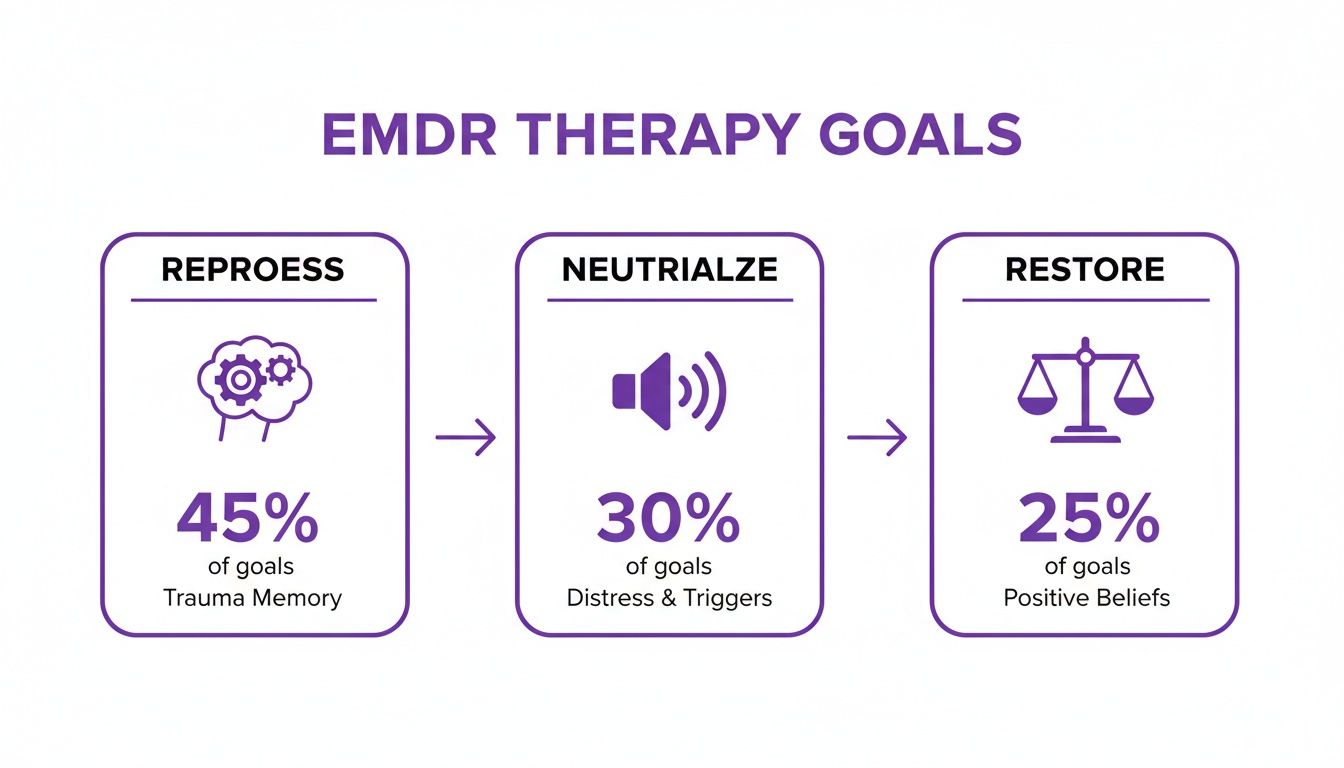
As you can see, the aim is to help your brain reprocess the information, dial down the distress it causes, and build back a healthier, more positive belief system about yourself and the world.
Evidence-Based Success and Efficiency
One of the most incredible things about EMDR is just how effective and efficient it is. It's not some fringe idea; it's recognized as a top-tier treatment for trauma by major organizations like the World Health Organization and the American Psychiatric Association. And unlike some talk therapies that can stretch on for years, EMDR often delivers life-changing results in a much shorter period.
The research backing EMDR is solid and extensive. Take a look at some of the key findings from clinical studies.
EMDR Effectiveness for PTSD at a Glance
| Study Finding | Success Rate / Outcome | Number of Sessions |
|---|---|---|
| Single-Trauma Victims (Controlled Trials) | 84-90% no longer met PTSD criteria | Just 3 (90-minute) sessions |
| Combat Veterans Study | 77% achieved full remission from PTSD | As few as 12 sessions |
| Single-Trauma vs. Multiple-Trauma Study | 100% of single-trauma & 77% of multiple-trauma survivors achieved full remission | An average of 6 (50-minute) sessions |
These numbers aren't just statistics; they represent real people finding real relief, often much faster than they ever thought possible.
What Does This Mean for You?
If you feel trapped by your past, this data is about more than just clinical success—it’s about hope. The benefits of EMDR therapy for trauma recovery go far beyond just managing symptoms; they're about truly getting your life back. By helping your brain properly file away those painful memories, EMDR can lead to:
- A huge drop in flashbacks, nightmares, and intrusive thoughts. As the memory loses its emotional charge, these symptoms often just fade away.
- Less anxiety and hypervigilance. You can finally start to feel safe in your own skin and in your environment, instead of constantly bracing for danger.
- A stronger sense of self and a more positive outlook. EMDR helps you challenge the negative beliefs that trauma creates (like "I'm worthless" or "I'm not safe") and replace them with ones that are true and empowering.
- Better control over your emotions. As your nervous system calms down, you'll find it's easier to handle everyday stress without feeling overwhelmed.
Ultimately, EMDR offers a clear, structured path from just surviving to actually thriving. It gives your brain the tools it needs to do what it's naturally designed to do: heal itself. This philosophy is at the heart of our trauma treatment programs at reVIBE Mental Health, where our goal is to guide you toward lasting recovery.
How EMDR Alleviates Anxiety and Depression
While EMDR is famous for its incredible results with PTSD, its benefits don’t stop there. This approach is also a powerful tool for conditions like anxiety, depression, and even persistent grief—issues that are so often tangled up in past negative experiences.
Think of it this way: unresolved memories can create limiting beliefs about ourselves and the world. They act like the hidden roots of a stubborn weed. While some therapies focus on managing the symptoms—just trimming the top of the weed—EMDR goes deeper. It helps you get to the root of the problem, offering a path to genuine, long-term relief.

Unraveling the Knots of Anxiety
Anxiety rarely comes out of nowhere. More often than not, it’s tied to specific past events that taught our nervous system to stay on high alert. A humiliating moment in grade school might now fuel social anxiety, or a past health scare could be the real source of recurring panic attacks. These foundational memories become a kind of blueprint, shaping how we react when we encounter similar situations today.
EMDR therapy helps us find and reprocess those specific life events. Using bilateral stimulation, the therapy allows your brain to revisit the memory without being flooded by the original fear and panic. As the emotional charge of these old memories gets neutralized, the anxiety symptoms tied to them naturally begin to fade.
This process can bring significant relief for different kinds of anxiety:
- Generalized Anxiety: By resolving the underlying memories that keep you in a constant state of worry, EMDR can help calm your nervous system and bring back a sense of safety.
- Panic Attacks: The therapy can target the initial events that triggered the panic response, which helps reduce the fear of future attacks and puts you back in control.
- Social Anxiety: By reprocessing memories of rejection or embarrassment, EMDR helps dismantle the negative beliefs that make social situations feel so threatening.
By getting to the source, EMDR offers a real path toward lasting resilience. If you're wondering how this might work for you, you can learn more about our specialized EMDR therapy for anxiety and how we adapt it to fit your unique needs.
Lifting the Weight of Depression
Depression is often deeply connected to feelings of worthlessness, hopelessness, or helplessness that are rooted in past experiences. Events like loss, neglect, or repeated failures can install powerful negative beliefs, like "I'm not good enough" or "Nothing will ever get better." These beliefs become the lens through which you see the world, filtering out anything positive and reinforcing the cycle of depression.
EMDR works by directly challenging and changing these core negative beliefs. It does this by processing the very memories that created them in the first place. When the original memory is reprocessed and stored in a healthier way, the negative belief tied to it loses its power. You don’t just tell yourself you’re worthy; you start to feel it on a much deeper level.
This approach offers more than a temporary fix—it helps build lasting resilience against future episodes. By healing the old wounds that fuel depressive thinking, EMDR creates a more stable and positive emotional foundation for you to build on.
The clinical evidence backs this up. Research shows that EMDR not only significantly reduces symptoms of depression but also lowers the chances of relapse. For instance, one study found that 74% of patients who received EMDR for depression were still relapse-free a full 12 months later—a rate that surpasses many traditional antidepressant or CBT studies. Another trial reported an immediate remission rate of 71% right after EMDR treatment, which stabilized at nearly 55% after six months, still showing impressive long-term results compared to conventional methods.
What to Expect in Your EMDR Therapy Sessions
Starting any new kind of therapy can bring up a lot of questions. What will it actually be like? Will I have to talk about things I don't want to? It's completely normal to feel a bit uncertain.
The good news is that EMDR isn't a mysterious or unpredictable process. It’s a highly structured therapy that unfolds over eight distinct phases. Your therapist is there to guide you through this roadmap, making sure you feel safe and in control from start to finish. This isn't about aimless conversation; it's a focused journey toward healing.

Before you ever dive into difficult memories, the first priority is building a solid foundation. The initial sessions are all about getting to know you, establishing trust, and equipping you with the tools you'll need for the work ahead.
The Foundational Phases: History and Preparation
The first step is Phase 1: History and Target Planning. This is where you and your therapist at reVIBE simply talk. You’ll share your story, identify the specific memories that are still causing you pain, and set clear goals for what you want to achieve. This is a collaborative effort to make sure the therapy is laser-focused on what matters most to you.
Next up is Phase 2: Preparation, and it's one of the most crucial parts of the entire process. Your therapist will explain exactly how EMDR works and, more importantly, teach you a set of powerful grounding and relaxation skills. Think of it as building your personal toolkit for emotional regulation, ensuring you can manage any tough feelings that might surface, both in our sessions and outside of them.
A core principle of EMDR therapy is that you are always in the driver's seat. Your therapist acts as a skilled guide, ensuring the pace is comfortable and you feel completely safe and grounded before moving into deeper processing work.
The Active Processing Phases
Once you and your therapist agree you're ready, you’ll move into the phases where the reprocessing happens. This is where the magic of EMDR really comes alive. It typically flows like this:
- Phase 3: Assessment: You'll be asked to access a specific target memory. Your therapist will help you pinpoint the negative thought that's tied to it (like, "I'm not good enough"), the positive thought you’d rather believe ("I am worthy"), and any emotions or physical sensations that come up.
- Phase 4: Desensitization: This is the part most people think of as "doing EMDR." While you hold the memory in your mind, your therapist will start the bilateral stimulation (BLS)—this could be eye movements, handheld tappers, or sounds. You don’t have to talk much here; your brain does the heavy lifting as it starts to form new, healthier connections around the memory.
- Phase 5: Installation: After the emotional charge of the memory has faded, the focus shifts. You’ll work on strengthening that positive belief you identified earlier. You’ll continue with BLS while holding both the old memory and the new belief, cementing it until it feels genuinely true.
- Phase 6: Body Scan: Our bodies often hold onto stress long after our minds have moved on. In this phase, you'll scan your body for any residual tension connected to the memory. If anything is there, you’ll use more BLS to release it until you feel calm.
Busting a Common Myth
Many people think EMDR forces you to relive your trauma by talking about it over and over. That couldn't be further from the truth. Unlike some talk therapies, the power of EMDR is in the internal processing. You just need to hold the memory in your mind while the BLS helps your brain do the rest.
The Final Phases: Closure and Re-evaluation
Every single session ends with Phase 7: Closure. No matter where you are in the process, your therapist will make sure you leave feeling grounded and stable, using the coping skills you learned at the very beginning. The goal is always to have you feel better walking out than you did walking in.
Finally, at the start of your next appointment, you'll begin with Phase 8: Re-evaluation. You'll check in on the memory you worked on last time to make sure the positive changes have stuck. This confirms the healing is holding and helps you and your therapist decide what to focus on next, keeping you on a steady path toward your goals.
Is EMDR Therapy the Right Choice for You?
Choosing to start therapy is a big decision, and it’s natural to wonder which approach will actually work for you. EMDR can be an incredibly powerful tool for healing, but it's not a one-size-fits-all solution. The key is figuring out if it aligns with your specific needs and what you hope to achieve.
Simply put, EMDR often brings profound relief to people who feel haunted by their past. If you find yourself stuck in cycles of anxiety, fear, or sadness that seem directly tied to specific things that happened to you, there's a good chance EMDR could be a great fit. It’s particularly effective for unpacking the lasting effects of both single-event traumas and more complex, long-term difficult experiences.
Who Typically Benefits from EMDR
EMDR can be a life-changing therapy for a whole host of issues. You might be a strong candidate if you’re currently dealing with:
- Post-Traumatic Stress Disorder (PTSD): This is what EMDR is most known for treating. It directly addresses the flashbacks, nightmares, and constant sense of being on-edge that PTSD causes.
- Anxiety Disorders and Phobias: So many anxieties and fears are rooted in past events that taught our nervous system to overreact. EMDR helps retrain those responses.
- Persistent Grief: When the pain from a loss feels frozen in time and keeps you from moving forward, EMDR can help your brain process the grief in a healthier way.
- Depression: If your depression is connected to deep-seated feelings of worthlessness or hopelessness that started with negative life experiences, EMDR can get to the root of those beliefs.
While in therapy, many people also find it helpful to explore complementary tools for managing day-to-day symptoms. Things like weighted blankets for anxiety can provide a sense of calm and grounding between sessions.
When Extra Support May Be Needed
While the benefits of EMDR therapy are vast, our first priority at reVIBE Mental Health is always your safety and well-being. Sometimes, EMDR is most effective when it's combined with other types of support, or after we've spent some time building up your internal resources.
For instance, if someone is experiencing severe dissociation or is in the midst of active substance use, we might need to build a foundation of coping skills first. This makes sure that when you do the deep processing work in EMDR, it feels safe and manageable, not overwhelming. The best way to figure this out is to have a chat with a trained therapist who can help create a plan that’s tailored just for you.
A Quick Self-Reflection Checklist
Does any of this ring a bell? Ask yourself these questions to get a feel for whether EMDR might match your own experience:
- Do you feel "stuck" on a past event, constantly replaying it in your mind?
- Do you have intense emotional or physical reactions that feel out of proportion to what's happening now?
- Do you go out of your way to avoid certain people, places, or situations that trigger painful memories?
- Do you carry negative beliefs about yourself (like "I'm not safe" or "I'm worthless") that you can trace back to something that happened?
One of the most encouraging things about EMDR is how well people stick with it. It’s not an easy process, but it’s manageable. In fact, research shows that EMDR therapy has very low dropout rates. One major meta-analysis found 92% completion rates in controlled trials for PTSD. This tells us that people not only find it effective, but they also find it tolerable enough to see it through to the end. You can dig into more of the research behind EMDR's effectiveness if you're curious.
Find an EMDR Therapist at a reVIBE Location Near You
If you've read this far, you might be thinking that EMDR could be the right path for you. Taking that next step is a big deal, and we want to make it as straightforward and supportive as possible. At reVIBE Mental Health, our entire focus is on creating a space where you feel safe and understood, right from your very first call.
We know that practical concerns, like insurance, can be a major roadblock. That's why our team is here to help you figure out your coverage. We accept most major insurance plans and will gladly do the legwork to verify your benefits, clearing one less thing from your plate so you can focus on your healing. For clinics, using a good patient appointment scheduler can make a world of difference in keeping this process smooth for clients.
Our Five Convenient Arizona Locations
We have five offices across the Phoenix metro area to make therapy more accessible, no matter where you live. You can choose to meet with us in person or opt for the convenience of secure telehealth sessions—either way, you'll be connected with a skilled, EMDR-trained therapist ready to support you.
Find a reVIBE Location Near You!
We currently have five locations for your convenience. (480) 674-9220
reVIBE Mental Health – Chandler
3377 S Price Rd, Suite 105, Chandler, AZ
reVIBE Mental Health – Phoenix Deer Valley
2222 W Pinnacle Peak Rd, Suite 220, Phoenix, AZ
reVIBE Mental Health – Phoenix PV
4646 E Greenway Road, Suite 100, Phoenix, AZ
reVIBE Mental Health – Scottsdale
8700 E Via de Ventura, Suite 280, Scottsdale, AZ
reVIBE Mental Health – Tempe
3920 S Rural Rd, Suite 112, Tempe, AZ
Get Started Today
Deciding to start therapy is a brave first step, and we're here to walk the rest of the way with you.
Give our team a call at (480) 674-9220. We’re happy to answer any questions you have about EMDR or help you book your first appointment. You can also see details about all our reVIBE Mental Health locations online to find the one that works best for you.
Your EMDR Questions, Answered
Taking that first step toward healing is a big deal, and it's completely normal to have questions. We want you to feel comfortable and clear on what to expect, so let’s walk through some of the things people often ask about EMDR therapy.
Does EMDR Hurt or Make Trauma Worse?
This is a common and important concern, and the short answer is no. Your safety is the absolute priority. Before you ever begin processing difficult memories, your therapist works with you to build a toolbox of coping skills.
You'll establish a mental "safe place" and other techniques to make sure you always feel grounded and in control. The entire process is paced to your comfort level, ensuring you never feel overwhelmed. The whole point is to lessen your distress, not add to it.
How Many Sessions Does EMDR Take to Work?
One of the great things about EMDR is how efficient it can be. While everyone's healing journey looks a little different, many people dealing with a single, specific trauma start to feel significant relief in as few as 6-12 sessions.
Of course, for those who have experienced more complex or long-term trauma, it might take a bit longer. Your therapist will work closely with you to map out a timeline that feels right for your specific needs and goals.
Do I Have to Talk About My Trauma in Detail?
This is where EMDR really differs from traditional talk therapy. You don't have to relive the traumatic event by telling the story in detail over and over again.
Instead, you'll briefly call the memory to mind while the bilateral stimulation (like eye movements) gets to work. This lets your brain do the heavy lifting of reprocessing the memory internally, which many people find far less draining than recounting the experience verbally.
Is EMDR Covered by My Insurance?
Most of the time, yes. EMDR is a well-established, evidence-based treatment for PTSD, anxiety, depression, and other conditions. Because it’s so effective and widely recognized, the vast majority of major insurance plans provide coverage for it.
The team here at reVIBE Mental Health can help you figure out the specifics of your plan and verify your coverage, making it that much easier to get started.
Ready to explore if EMDR could be the right path for you? The team at reVIBE Mental Health is here to guide you and answer any other questions you might have. Let's start the conversation about your healing. Find a reVIBE Location Near You!