
When you find yourself typing "couples counseling near me" into a search bar, you're not just looking for a service—you're taking a courageous first step toward making your relationship stronger. For couples across Phoenix, Scottsdale, Tempe, and Chandler, that help is close by at reVIBE Mental Health, where our therapists create a safe, supportive space for you to heal and reconnect.
Recognizing When It’s Time for Couples Counseling
So many people think therapy is the last-ditch effort, the emergency room for relationships already on life support. But that's a huge misconception. In reality, couples counseling is one of the best proactive tools you can have. It’s for growth, not just for crisis management.
Most couples wait far too long to get help. By the time they walk into an office, minor disagreements have often ballooned into major resentments. Learning to spot the early warning signs gives you the power to reinforce your foundation before serious cracks appear.
Think of it less as admitting failure and more like bringing your car in for a crucial tune-up. It keeps everything running smoothly for the long haul.
The Subtle Signs You Might Benefit from Therapy
The need for counseling isn't always a five-alarm fire. More often, it's a quiet, slow drift. The connection just feels… off. You might not be having blowout fights, but the spark and warmth that once defined your relationship have dimmed.
Do any of these situations feel familiar?
- You've entered the "roommate phase." You live together, share bills, and manage a household, but the emotional and physical intimacy is gone. Conversations feel transactional, centered on logistics like who’s picking up the kids or what’s for dinner. You’re great business partners, but the romance is a distant memory.
- Everything is suddenly irritating. Those little quirks you used to find charming now grate on your nerves. This low-grade, constant annoyance is often a red flag for deeper issues simmering just below the surface.
- You're tiptoeing around tough conversations. If you find yourselves actively avoiding certain topics—money, sex, in-laws—because you know it will end in a fight, your communication has broken down. Having a neutral expert in the room can make those conversations feel safe and productive again.
When Arguments Go Nowhere
All couples argue. It’s a normal part of sharing a life with someone. But it’s how you argue that really matters. When your conflicts become unproductive, it's a huge sign that you need a new set of tools.
"It feels like you’re having the same fight over and over again, just with a different script. One day it’s about the credit card bill, the next it’s about who does more chores. But the underlying pattern—the blame, the defensiveness, the shutting down—is always the same. Nothing ever truly gets resolved."
That cycle is draining. It chips away at the trust and emotional safety that a relationship needs to thrive. A therapist can help you break out of that destructive loop and learn new, constructive ways to handle disagreements.
The data backs this up. A staggering 99% of couples in therapy report it had a positive impact on their relationship. The sad part? While 68% of people agree it’s best to start before serious problems arise, only 18% actually do. You can dig deeper into the positive outcomes of relationship therapy by checking out this research from Verywell Mind.
How to Find the Right Therapist in the Phoenix Area
Once you and your partner have decided to seek support, the next step—actually finding the right professional—can feel a bit daunting. A quick search for “couples counseling near me” often returns a wall of options, but breaking it down makes the process much more manageable.
You've got a few solid ways to start your search, and the best path really depends on what you're comfortable with.
Where to Start Your Search
So, where do you even begin? There are several tried-and-true methods for finding a great local therapist. Each has its own benefits and drawbacks, so consider what feels right for you as a couple.
Here’s a quick comparison of the most common approaches:
Comparing Methods for Finding a Couples Counselor
| Method | Pros | Cons |
|---|---|---|
| Referrals (Doctor, Friends) | Highly trusted, pre-vetted recommendations from sources you know. | May have limited options; friend's therapist might not be a good fit for you. |
| Online Directories | Extensive search filters (specialty, insurance, location), profiles to review. | Can be overwhelming; requires more research to vet candidates yourself. |
| Insurance Provider List | Guarantees the therapist is in-network, simplifying payment. | Lists can be outdated or lack detail about a therapist's specialties. |
| Direct Search (Google) | Quick and easy to find practices in your immediate area. | Top results may not be the best fit; requires careful evaluation. |
Ultimately, the goal is to find someone you both feel comfortable with. Many couples find success using a combination of these methods—for example, getting a referral and then checking their profile on an online directory to learn more.
Look for the Right Credentials
When you're sifting through profiles, keep an eye out for specific credentials. This isn't just about alphabet soup after a name; it tells you a lot about their specialized training. For couples work, you'll want to look for designations like Licensed Marriage and Family Therapist (LMFT) or Licensed Clinical Social Workers (LCSW).
Why does this matter? An LMFT, for instance, is trained to see your relationship issues through a systemic lens. Instead of just focusing on one person's "fault," they look at the patterns, communication cycles, and dynamics that keep you stuck. They have the right tools for the job.
Sometimes, a couple's challenges are tangled up with one partner's individual mental health. In these situations, understanding the role of a psychiatric mental health practitioner can also be helpful, as they can address underlying conditions that might be impacting the relationship.
This simple flowchart can help you decide if it’s time to bring in a professional.
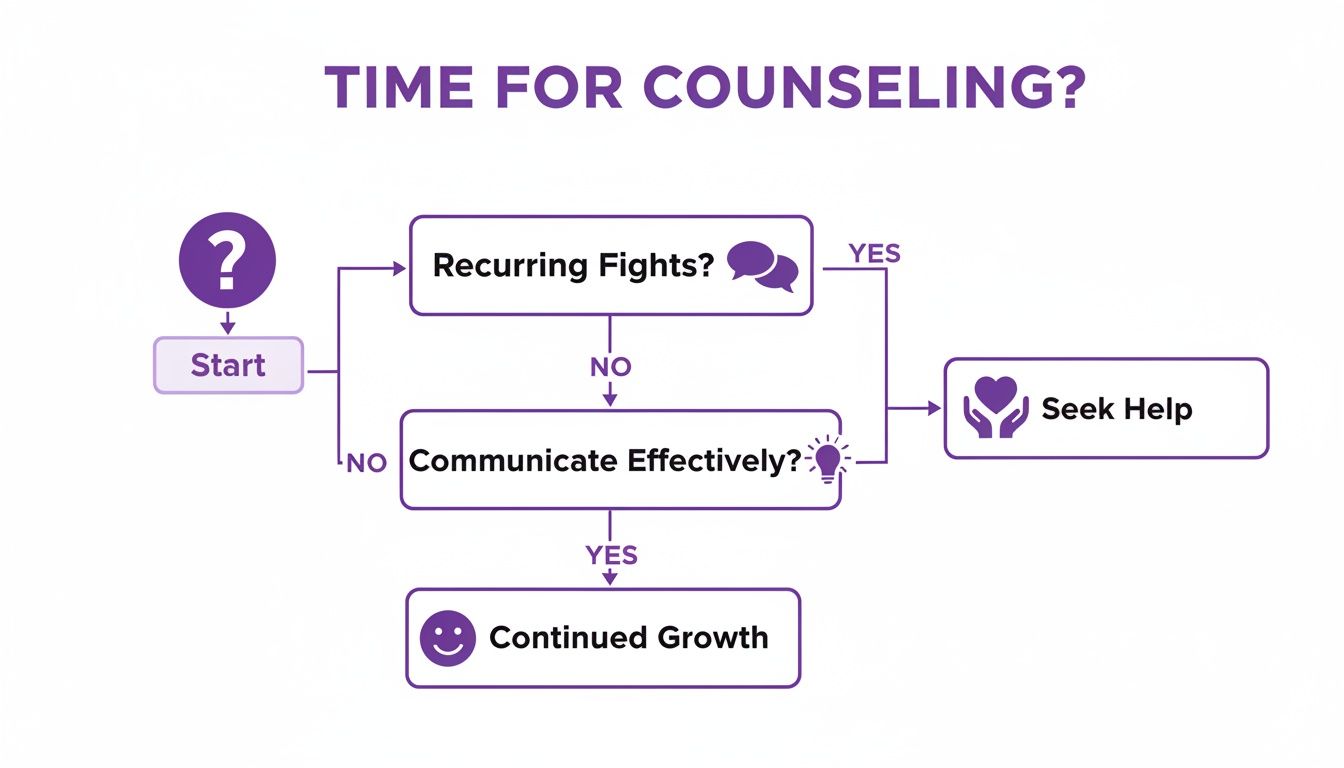
As the visual shows, if you're stuck in the same unresolved arguments, professional guidance can make all the difference. While the journey of finding a therapist is personal, some universal strategies for finding a mental health professional can provide a helpful framework.
Simplify Your Search in the Phoenix Metro
Let's be real: therapy is a commitment. If getting to the office is a huge hassle, you're less likely to stick with it. That’s why accessibility is key. For those of us in the Valley, multi-location practices like reVIBE Mental Health are a game-changer, giving you options across the Phoenix metro instead of tying you to one spot.
Finding a therapist shouldn't add more stress to your life. The goal is to find high-quality, accessible care that fits seamlessly into your routine, removing barriers so you can focus on your relationship.
reVIBE offers compassionate, expert couples counseling at five convenient locations, making it easier to find an office near your home or work. You can call (480) 674-9220 to get started and find the right fit. It's no secret that more people are seeking therapy—interest in couples counseling alone jumped 39% in 2024. This growing demand just highlights how important it is to have accessible, high-quality services available right here in our community.
Find a reVIBE Location Near You!
We currently have five locations for your convenience. (480) 674-9220
reVIBE Mental Health – Chandler
3377 S Price Rd, Suite 105, Chandler, AZ
reVIBE Mental Health – Phoenix Deer Valley
2222 W Pinnacle Peak Rd, Suite 220, Phoenix, AZ
reVIBE Mental Health – Phoenix PV
4646 E Greenway Road, Suite 100, Phoenix, AZ
reVIBE Mental Health – Scottsdale
8700 E Via de Ventura, Suite 280, Scottsdale, AZ
reVIBE Mental Health – Tempe
3920 S Rural Rd, Suite 112, Tempe, AZ
Key Questions to Ask Before Your First Session
Think of finding the right therapist like dating—you're looking for the right fit, and it's perfectly okay to "interview" a few candidates before you commit. That initial consultation call is your chance to get a real sense of who they are beyond their polished online bio.
This is your opportunity to gauge their style, their expertise, and frankly, their personality. You're searching for a guide you both can trust on this journey, so feeling comfortable and confident in your choice is everything. It's the foundation for the real work ahead.
What's Their Approach to Therapy?
Every therapist has a different toolbox. Some methods are fantastic for certain relationship issues, while others might not be what you need right now. Asking about their therapeutic approach helps you understand how they’ll actually run the sessions.
For instance, you might hear terms like Emotionally Focused Therapy (EFT), which is all about rebuilding your emotional connection and bond. Or maybe they use the Gottman Method, which is based on decades of research and gives couples practical, structured tools for better communication and conflict resolution.
Don't be shy about asking them to break it down for you. Here are a few ways to start that conversation:
- "Could you tell us a bit about the main therapeutic models you use for couples?"
- "What's your experience with couples who are dealing with issues like ours, such as [infidelity, a communication breakdown, or disagreements about parenting]?"
- "How do you make sure both of us feel heard and that sessions are balanced?"
Let's Talk Logistics and Cost
The practical stuff matters just as much as the therapy style. Getting all the details about scheduling, fees, and insurance ironed out from the get-go saves a ton of headaches later. This way, you can walk into your first session focused on your relationship, not on billing surprises.
Getting clarity on costs and policies before you start is non-negotiable. It removes a huge layer of potential stress, freeing you up to focus completely on the work you're there to do.
This is also the perfect time to bring up insurance. We know it can feel like a maze, but a good practice should make it simple. At reVIBE, for example, our team makes a point to verify your benefits before you even start, so there are no surprises about your coverage.
Make sure you cover these bases:
- How long does a typical session last?
- What happens if we need to cancel or reschedule?
- Do you take our insurance?
- If we're paying out-of-pocket, what are your session fees?
Here at reVIBE Mental Health, our integrated care model is a big part of how we support couples. It means your therapist can easily collaborate with other specialists on our team, like our EMDR therapists or psychiatric professionals, especially when one partner's individual struggles are impacting the relationship. It's always worth asking if that kind of deeper, collaborative support is available.
What to Expect in Your First Counseling Sessions
Walking into that first couples counseling session can feel like a big deal. It’s completely normal to have a mix of hope and anxiety swirling around. But the good news? That initial meeting is really just a gentle introduction—a space for you to get comfortable and for the therapist to start understanding your story.
So, forget any dramatic scenes you've seen in movies. The first session isn't about confrontation; it's about connection. The main goal is for the three of you to start building a foundation of trust.

The Intake and Storytelling Phase
A good portion of your first meeting is dedicated to what we call the "intake process." This is where the therapist gets to know you, not just as a couple, but as individuals. You’ll likely talk about the history of your relationship, from the very beginning to the challenges that brought you here.
Think of it as telling your story, together. The therapist will guide the conversation with open-ended questions to get a sense of:
- Your Relationship Timeline: How did you two meet? What have been the major milestones, both good and bad?
- The Current Issue: What specific problems are causing friction? When did you notice them starting?
- Your Hopes for Therapy: What would a successful outcome look like for each of you individually and as a couple?
This is never an interrogation. It’s simply a conversation to give the therapist a full picture of your unique dynamic. A great counselor will make sure this feels balanced, giving each of you equal time to share your perspective without judgment or interruption.
Creating a Safe and Balanced Space
One of the most critical jobs for a therapist in that first session is to establish the therapy room as safe, neutral ground. They aren't there to take sides or play referee. In couples counseling, the relationship itself is the client.
The therapist is more of a facilitator, guiding tough conversations in a way that feels productive, not destructive. Their role is to help you both feel seen and heard—often for the first time in a long while—and create an environment where you can both be vulnerable.
For instance, if one partner tends to do most of the talking, the therapist will gently guide the conversation to ensure the quieter partner also has space to speak. This modeling of healthy, balanced communication is one of the very first skills you’ll start absorbing.
This early work sets the stage for digging into your core conflict patterns in later sessions. To see more about how we approach this, feel free to explore our couples therapy services.
Here at reVIBE, we’ve put a lot of thought into our office spaces. We want them to feel more like a comfortable living room than a sterile clinic, because we know that a warm, welcoming environment makes all the difference in building the trust you need to start this journey.
Making Therapy Accessible in Phoenix and Online
Deciding to start couples counseling is a huge step. The last thing you need are practical hurdles like scheduling conflicts or a long commute getting in your way. When you search for "couples counseling near me," what you're really looking for is a solution that fits your actual life—one that’s convenient and doesn't add more stress.
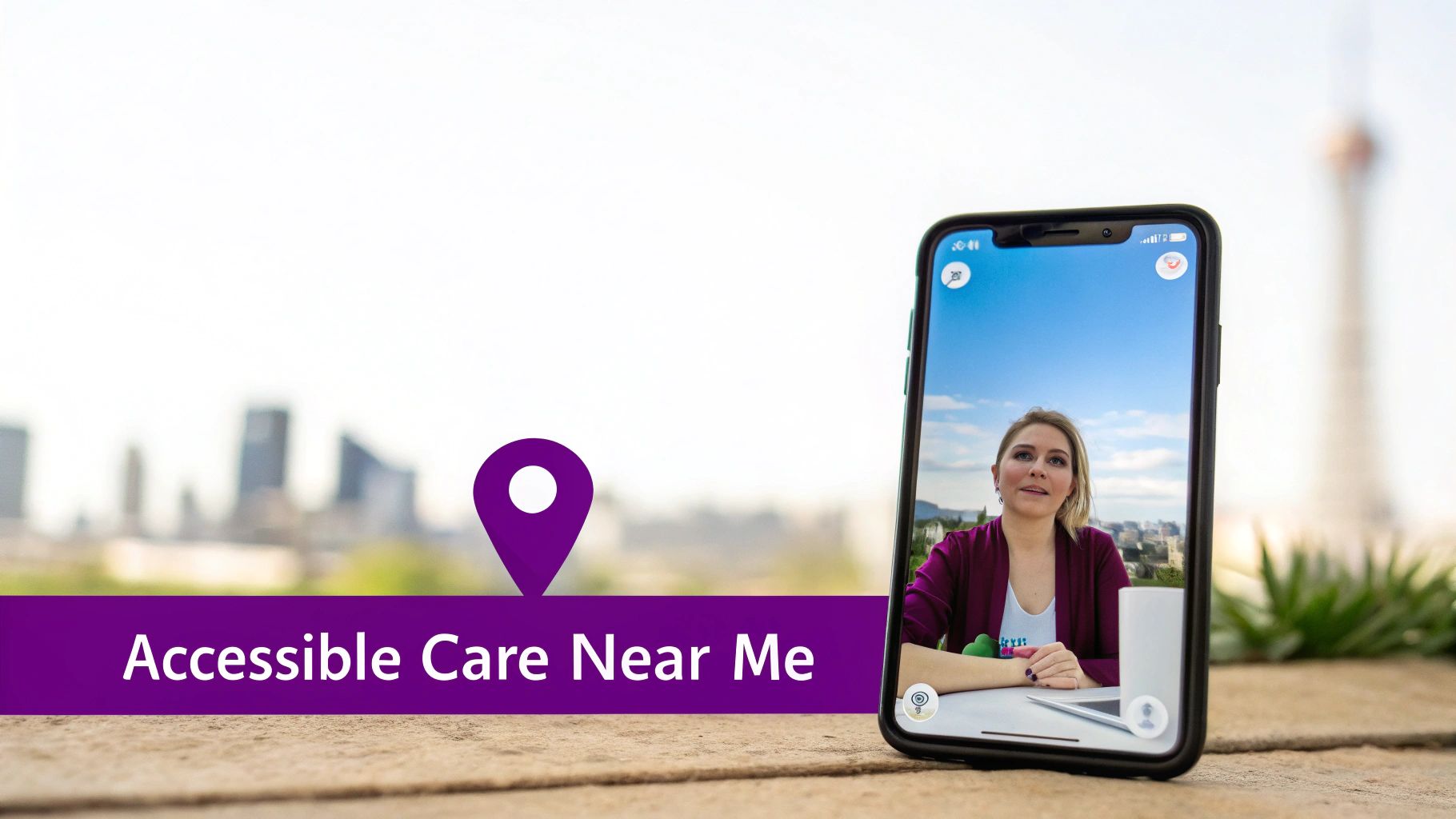
Thankfully, therapy has changed a lot over the years. You're no longer limited to just one way of doing things. With both in-person sessions and telehealth becoming mainstream, you can find a format that works for your unique situation.
In-Person vs. Online Counseling
So, what’s the right call—meeting a therapist face-to-face or virtually? It really comes down to what you and your partner prefer and what your daily life looks like. Each has its own perks.
- In-Person Therapy: Some couples just feel more connected when they're physically in the same room. Being present allows a therapist to pick up on the subtle non-verbal cues—a glance, a shift in posture—that say so much about a relationship's dynamics.
- Online Therapy (Telehealth): Let's be real, life is busy. If you're juggling demanding jobs, kids' schedules, or a brutal commute across the Valley, telehealth can be a lifesaver. It cuts out travel time and lets you log in from wherever you're comfortable. For many, exploring different at-home therapy options is what makes counseling possible in the first place.
Ultimately, consistency is what makes therapy work. The best choice is whichever format makes it easiest for both of you to show up for your relationship week after week.
Finding a Convenient Phoenix Location
If you've decided that in-person sessions are for you, location matters. A lot. At reVIBE Mental Health, we’ve intentionally opened offices all over the Valley so that high-quality care is never far away. And with appointments available seven days a week, we make scheduling as painless as possible.
You can find our welcoming, professional spaces in:
- reVIBE Mental Health – Chandler (3377 S Price Rd, Suite 105)
- reVIBE Mental Health – Phoenix Deer Valley (2222 W Pinnacle Peak Rd, Suite 220)
- reVIBE Mental Health – Phoenix PV (4646 E Greenway Road, Suite 100)
- reVIBE Mental Health – Scottsdale (8700 E Via de Ventura, Suite 280)
- reVIBE Mental Health – Tempe (3920 S Rural Rd, Suite 112)
By having multiple offices, we take the guesswork out of your search. You can check out all our Phoenix-area reVIBE locations to see which one works best for you.
We also do our best to simplify the financial part. We accept most major insurance plans and will even help you verify your benefits, making sure your care is both accessible and affordable. The first step is a simple phone call to (480) 674-9220.
Got Questions About Couples Counseling? You're Not Alone.
It's completely normal to have some lingering questions, even after you’ve made the big decision to get help. For most people, walking into a therapist’s office is a brand-new experience, and knowing what to expect can really help calm those last-minute nerves.
Getting straight answers ahead of time helps you show up to that first session feeling less anxious and more prepared to dive in. Let's tackle some of the most common questions we hear from couples just starting out.
How Long Does This Actually Take?
This is usually the first thing people ask, and the honest-to-goodness answer is: it really depends. There’s no magic number of sessions that works for everyone. The timeline is shaped entirely by your unique situation, what you hope to achieve, and the kinds of challenges you're working through together.
Some couples come in with a very specific, contained issue—maybe a recurring argument you can’t seem to solve. You might find you have the tools you need in as few as 8-12 sessions. For others, navigating deeper-seated patterns or rebuilding after a major breach of trust, a longer-term approach is often more realistic and beneficial.
The goal isn’t to keep you in therapy forever. It's to give you the skills and communication tools to handle life's curveballs on your own, long after you've left our office.
Here at reVIBE, your therapist works with you to map out your goals and a plan that makes sense for you. We'll also check in regularly on how things are going to make sure the sessions stay focused and you can actually see the progress you’re making. It’s a partnership.
What if My Partner Is Dragging Their Feet?
This is so common. Often, one person is ready to jump in while the other is still warming up to the idea. If your partner is hesitant, the key is to approach the conversation with empathy, not pressure.
Try framing it as a positive step for "us" and the health of your partnership, rather than a mission to "fix" them.
A few ideas that might help:
- Suggest just one session. Proposing a single, low-commitment "meet and greet" can make the whole thing feel a lot less intimidating.
- Talk about shared goals. Remind them of what you both want for your future. Frame counseling as a practical tool to help you get there together.
- Focus on the skills. Mentioning that therapy teaches communication skills that are useful everywhere—at work, with family, with kids—can make it feel more like practical coaching than just talking about problems.
Most of the time, that reluctance comes from a fear of the unknown or a worry that they'll be blamed for everything. Once they experience a session with a neutral, supportive professional, that anxiety almost always melts away. A good therapist’s job is to create a safe space for both of you.
Will the Therapist Pick a Side?
Absolutely not. A skilled, ethical couples counselor isn't on Team A or Team B—they are on the side of the relationship. Think of them as a neutral facilitator whose only goal is to help you both communicate better and understand where the other is coming from, without judgment.
In our world, the "client" is the partnership itself.
Your therapist is trained to keep the conversation balanced, making sure both of you feel equally heard and respected. It should never feel like a courtroom where one of you is on trial. The whole point is to shift from a cycle of blame to a place of mutual understanding and teamwork.
Is Everything We Say Kept Private?
Yes, 100%. Confidentiality isn't just a promise; it's a cornerstone of therapy, protected by both ethics and law. Licensed therapists are bound by strict privacy rules like HIPAA to protect everything you share in your sessions. This is what creates the safety needed for you to be truly open and honest.
There are a few very rare legal exceptions, like if there’s an immediate risk of harm to yourself or someone else, which your therapist will clearly explain in your first meeting.
It’s also worth noting that most couples counselors have what’s called a "no secrets" policy. This just means they won’t keep a secret for one partner from the other within your joint sessions. It’s a simple rule that ensures everyone is on the same page and maintains trust in the therapy process itself.
Your relationship is worth investing in. At reVIBE Mental Health, our compassionate therapists are here to give you the support and guidance you need to build a stronger, healthier connection. With five convenient locations in Chandler, Phoenix, Scottsdale, and Tempe, expert couples counseling is right around the corner.
Take the next step. Call us at (480) 674-9220 or visit https://revibementalhealth.com to schedule a consultation.