

Finding the right psychiatrist isn’t just about opening a directory and pointing. It’s about being methodical. The best way to start is by creating a solid list of potential providers, which you can build by tapping into your insurance network, getting a referral from your primary care doctor, and digging into reputable online directories. Once you have that list, you can start narrowing it down to find a specialist who truly fits what you need.
Starting Your Search in a Challenging Landscape
Let's be honest: looking for a psychiatrist can feel intimidating. The news is full of stories about provider shortages and long waitlists, and that can make the whole process seem impossible before you even start. This isn't just noise; the data backs it up. The demand for mental healthcare has skyrocketed, and the supply of professionals hasn't kept pace.
If you're looking for support for a younger family member, knowing how to determine if a child needs a mental health professional is a critical first step in its own right.
The Reality of the Psychiatrist Shortage
At the heart of the issue is a simple, widening gap between the number of people who need help and the number of psychiatrists available to provide it. Projections show the U.S. could be short anywhere from 12,000 to 21,000 psychiatrists by 2030. That's a significant deficit.
This isn't some far-off problem, either. Back in 2022, nearly half of all Americans (47%) lived in areas officially designated as having a mental health workforce shortage. By March 2023, that number had jumped to 160 million people. To close that gap today would require adding more than 8,000 practitioners to the field.
Acknowledging these challenges isn’t meant to discourage you. It’s about setting realistic expectations and empowering you to be smarter and more persistent in your search.
Four Key Starting Points for Your Psychiatrist Search
Even with these hurdles, you have several excellent starting points. Instead of casting a wide, random net, you can focus your energy on a few proven methods that will connect you with qualified professionals much more efficiently.
Here’s a quick breakdown of the most effective ways to kick off your search.
| Search Method | What It Is | Best For |
|---|---|---|
| Primary Care Physician | Your family doctor or general practitioner. | Getting a trusted, personalized referral to a psychiatrist they know and respect. |
| Insurance Provider | The list of in-network doctors provided by your health insurance company. | Finding a psychiatrist whose services are covered by your plan to keep costs down. |
| Online Directories | Verified databases like those from the APA or Psychology Today. | Browsing multiple provider profiles to compare specialties, locations, and approaches. |
| Local Resources | Community clinics, university health centers, or hospital outpatient services. | Accessing care that is often lower-cost or tailored to the specific needs of your community. |
These avenues—your doctor, your insurance plan, professional directories, and local health systems—are your most reliable pathways.
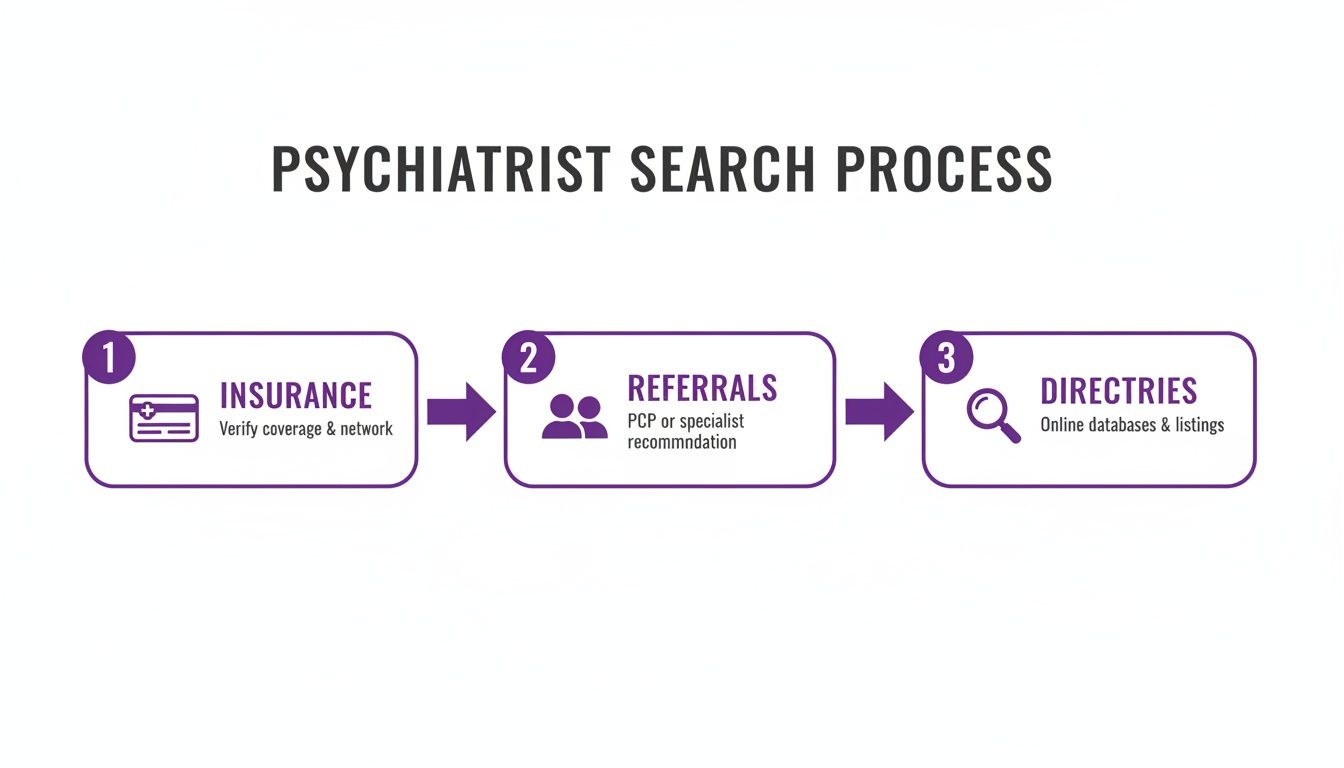
By starting here, you build a strong foundation for finding a psychiatrist who not only has the right clinical expertise but also fits your logistical needs, like insurance and location.
Vetting Credentials and Finding the Right Specialty

Once you've got a list of potential names, it’s time to do a little homework. You'll want to look closer at their qualifications, because not all mental health professionals are created equal. Understanding the differences is absolutely crucial, especially if you think medication might be part of your treatment.
The biggest distinction to make right away is between a psychiatrist and other providers. A psychiatrist is a full-fledged medical doctor—either an MD (Doctor of Medicine) or a DO (Doctor of Osteopathic Medicine). They’ve gone through medical school and completed years of specialized residency training in psychiatry. This medical background is exactly why they can prescribe and manage medication.
On the other hand, professionals like psychologists, therapists, and counselors are experts in talk therapy, but they can't write prescriptions. So, if medication is on the table for you, your search needs to focus on a psychiatrist or a qualified psychiatric mental health nurse practitioner.
Verifying Professional Qualifications
Okay, so you've confirmed they're a psychiatrist. What's next? You need to verify that they are highly qualified. The real gold standard in this field is board certification.
A board-certified psychiatrist has voluntarily gone through an incredibly tough process of testing and peer evaluation run by the American Board of Psychiatry and Neurology (ABPN). It’s not a requirement, but it’s a huge indicator of their commitment to excellence and staying current in their field. Think of it as a seal of approval from their most respected colleagues.
You can usually check a psychiatrist’s board certification on the ABPN website or through your state’s medical board database. Most doctors are proud of this achievement and will list it right on their professional profiles.
Why Specialization Matters in Your Search
You wouldn’t go to a cardiologist for a broken ankle, right? The same logic applies here. Psychiatry is a massive field, and assuming every psychiatrist is an expert in your specific struggle is a common mistake. Finding someone whose expertise truly aligns with your needs can make a world of difference in your recovery.
Just think about these scenarios:
- Struggling with panic attacks? A psychiatrist who specializes in anxiety disorders will be on top of the latest, most effective medications and treatment approaches for exactly that.
- Dealing with past trauma? A trauma-informed psychiatrist has a deep understanding of PTSD and can skillfully combine medication with therapies like EMDR.
- Experiencing postpartum depression? A specialist in reproductive psychiatry knows how to safely manage mental health during and after pregnancy, a highly specialized skill.
Finding the right specialty ensures the care you receive is not just qualified but also deeply relevant to your life experiences. It’s about matching the provider’s focused expertise to your unique challenges.
This is even more important when you consider the global shortage of mental health workers—with only 13 professionals per 100,000 people, according to the World Health Organization.
Here in the U.S., the problem is just as real. In 2021, a staggering 37% of Americans (122 million) lived in areas with a severe shortage of psychiatrists. This scarcity really highlights why it’s so important to find a properly trained medical doctor (MD/DO) for medication, since less than half of all mental health providers are licensed to prescribe.
To get a better handle on all the professionals who can be part of your care team, you can learn more about the role of a psychiatric mental health practitioner.
Sorting Out Insurance and Making Sure You Can Actually Get In
You’ve found a few psychiatrists who seem like a great fit. That's a huge win! But now comes the part that trips a lot of people up: dealing with the practical stuff like insurance, cost, and just getting an appointment on the books.
It’s easy to get bogged down by confusing terms like “in-network,” “deductible,” and “copay.” But figuring this out upfront is non-negotiable if you want to avoid surprise bills and make sure you can stick with treatment long-term.
If you don't have health insurance yet, that's your first priority. Getting a handle on that process is much easier with a practical guide on how to get health insurance—it’ll give you the foundation you need before you start your search.
Once you’re covered, your insurance company’s website becomes your new best friend. Look for their "Find a Doctor" tool. Seriously, this is the single best way to find a list of in-network psychiatrists near you, which is exactly what you want to keep your costs down.
The Must-Ask Insurance Questions
Before you even think about booking an appointment, you need to make a couple of calls—one to the psychiatrist’s office and another to your insurance provider. Having a specific list of questions ready will save you a world of hurt later.
- "Are you in-network with my specific plan, [Your Insurance Plan Name]?" Never, ever assume. Always confirm this directly.
- "What will my copay be for a specialist appointment?" This is the flat fee you’ll pay every time you have a session.
- "Do I still need to meet my deductible?" If you haven't met it yet for the year, you could be on the hook for the full cost of your first few visits.
- "Does my plan require a pre-authorization for mental health services?" Some insurance companies need to approve your care before they agree to pay for it.
Getting a handle on the money side of things is absolutely critical. The stress of finding a psychiatrist is already high, especially with a national shortage of providers making things even tougher. A big reason for this shortage? Low insurance reimbursement rates that push good doctors out of the field, which just makes the whole situation worse for patients.
Think of it this way: navigating your insurance isn't just bureaucratic busywork. It's what makes your mental healthcare sustainable. A practice that actually helps you with this part is worth its weight in gold.
Some practices get this and will handle the entire insurance verification process for you. This is an incredible service. For example, in the Phoenix area—where families are often dealing with high rates of anxiety and depression—a group like reVIBE Mental Health really shines. They take most major insurance plans and, more importantly, they verify your coverage for you. That completely removes the guesswork and financial stress. The psychiatrist workforce challenges across the country make finding clinics like this a genuine game-changer.
Finding Care That Actually Fits Your Life
Accessibility isn’t just about what you can afford; it's also about finding care that doesn't require you to turn your life upside down. This is where telehealth has been a massive help for so many people. Virtual appointments mean no commute, less time off work, and often more flexible scheduling options.
Beyond that, look for practices that offer more than just the standard 9-to-5. Multiple locations and extended hours are another huge plus. For instance, reVIBE Mental Health gets this, offering appointments seven days a week, both online and in-person, across several different offices.
Find a reVIBE Location Near You!
We currently have five locations for your convenience. (480) 674-9220
reVIBE Mental Health – Chandler
3377 S Price Rd, Suite 105, Chandler, AZ
reVIBE Mental Health – Phoenix Deer Valley
2222 W Pinnacle Peak Rd, Suite 220, Phoenix, AZ
reVIBE Mental Health – Phoenix PV
4646 E Greenway Road, Suite 100, Phoenix, AZ
reVIBE Mental Health – Scottsdale
8700 E Via de Ventura, Suite 280, Scottsdale, AZ
reVIBE Mental Health – Tempe
3920 S Rural Rd, Suite 112, Tempe, AZ
Asking the Right Questions Before Your First Appointment

That first conversation with a potential psychiatrist? It’s not just a formality. Think of it as an interview—where you're the one doing the hiring. This is your chance to get a real feel for their communication style, their approach to care, and whether their philosophy clicks with what you need.
Finding the right psychiatrist goes way beyond their credentials. It’s about connection. Feeling genuinely heard, respected, and understood is the foundation of any successful treatment. So, walk into that conversation prepared with a few key questions.
Questions About Their Treatment Philosophy
Before you even think about booking a follow-up, you need to understand how they practice. A psychiatrist's core philosophy shapes every single decision they make, from the medications they suggest to the therapy they might recommend.
Here’s what you can ask to get a better sense of their perspective:
- How do you see the role of medication in a treatment plan? You're looking for a balanced answer here. A good psychiatrist views medication as one important tool in the toolbox, not the only solution. They should be open to talking about its role alongside therapy, lifestyle changes, and other supports.
- Do you collaborate with therapists or other doctors? This is a big one. If you already have a therapist, you need a psychiatrist who sees themselves as part of your team and is willing to coordinate care.
- What does "success" look like to you? Their answer should be about more than just symptom reduction. Listen for someone who talks about your overall well-being, ability to function in daily life, and general quality of life as the real goals.
Questions About Medication and Practical Details
The nuts and bolts of treatment, especially when it comes to medication, are just as important. Getting clear answers upfront can save you a lot of stress and confusion later on.
The goal is to find a partner in your health journey—someone who explains their reasoning, listens to your concerns, and makes decisions with you, not for you.
When discussing medications, for example, ask how they manage side effects or dosage changes. This is especially critical for conditions that require careful, ongoing management. Some psychiatrists are also well-versed in therapies that work hand-in-hand with medication. You might want to ask how something like EMDR therapy for anxiety could fit into a holistic treatment plan.
To get a feel for their day-to-day practice, try asking these questions:
- What's your process for starting, adjusting, or tapering off medication? You want to hear about a thoughtful, methodical approach—not someone who rushes into making big changes.
- How do you handle patient questions or concerns between appointments? Find out their policy on phone calls or patient portal messages. Knowing their typical response time helps set clear expectations.
Getting answers to these questions will give you a much clearer picture of what it would be like to work with them, helping you find a psychiatrist who is truly the right fit for your long-term health.
Finding Compassionate Care in the Phoenix Area
If you're looking for a psychiatrist in the Phoenix metro area, you know how quickly the search can become frustrating. Between long waitlists and the headache of verifying insurance, finding the right person can feel like a full-time job. This is exactly why integrated, multi-location practices are becoming such a lifeline for people who just want consistent, high-quality care without the runaround.
Think of it this way: instead of making a dozen separate calls and starting from scratch each time, you connect with one central organization. From there, they can match you with the right professional, drawing from a team that spans multiple specialties and locations.
An Integrated Approach to Mental Wellness
So, what does an "integrated practice" actually mean for you? It means you get a whole team of mental health professionals who are all on the same page, collaborating on your care. Your psychiatrist, who focuses on medication, can easily work with your therapist, who might specialize in something like talk therapy or EMDR. This kind of teamwork ensures your treatment plan is cohesive, not disjointed.
For instance, reVIBE Mental Health uses this exact model across the Valley. They bring together a team of therapists and licensed psychiatric professionals to offer accessible care for everything from anxiety and depression to trauma and relationship issues. They’ve simplified the process by offering talk therapy, EMDR, and psychiatry with medication management all under one roof.
Choosing a practice that coordinates care internally saves you from being the middleman between different providers, allowing you to focus completely on your healing.
Making Care Accessible Where You Are
The quality of care is paramount, but let's be realistic—logistics matter. A practice with multiple offices makes it so much easier to get to your appointments consistently, which is a huge part of making progress. It also means you have far more scheduling options, a major advantage when many clinics are booked out for months.
For anyone trying to find a good psychiatrist in Arizona, having choices in your own community is a game-changer. You can find a convenient reVIBE location near you in:
- Chandler (3377 S Price Rd, Suite 105)
- Phoenix Deer Valley (2222 W Pinnacle Peak Rd, Suite 220)
- Phoenix PV (4646 E Greenway Road, Suite 100)
- Scottsdale (8700 E Via de Ventura, Suite 280)
- Tempe (3920 S Rural Rd, Suite 112)
By offering appointments seven days a week, both in-person and through secure online sessions, this model helps get you matched with a provider who fits your goals, preferences, and insurance—all without the unnecessary delays. It’s a practical, local solution that gives you a clear and immediate next step right here in your community.
Common Questions About Finding the Right Psychiatrist
It’s completely normal to have a lot of questions when you’re looking for a psychiatrist. The whole process can feel a bit overwhelming, but getting clear answers can make all the difference. Let’s tackle some of the most common things people wonder about.
Psychiatrist vs. Therapist: What’s the Real Difference?
This is probably the most frequent question people ask, and it's a crucial one. Think of it this way: a psychiatrist is a medical doctor (MD or DO) who went to medical school. Because of their medical training, they can diagnose conditions, prescribe and manage medications, and understand how your physical health impacts your mental well-being.
A therapist, on the other hand, is a broader term for professionals trained in psychotherapy, or "talk therapy." This includes licensed clinical social workers (LCSW), licensed professional counselors (LPC), and psychologists (PhD or PsyD). Their expertise is in helping you build coping skills, work through life events, and change thought patterns. They cannot prescribe medication.
For a lot of people, the best approach actually involves seeing both. Your psychiatrist can handle the medication side of things, while your therapist provides that essential space for talking things through. It’s a powerful combination.
How Long Am I Going to Have to Wait for an Appointment?
Honestly, this one varies—a lot. Wait times can be anywhere from a few days to a few months, and it really depends on where you live, who your insurance provider is, and how full a particular doctor's schedule is. The nationwide psychiatrist shortage is a real thing, and it has unfortunately made longer waits more common.
But don't get discouraged. Some practices are set up to get you in sooner. Larger clinics with multiple locations and doctors on staff usually have more flexibility in their schedules. Practices that lean heavily into telehealth often have better availability, too. When you call an office for the first time, one of the best questions you can ask is, "What's your current wait time for new patients?"
It's completely normal and okay to seek a second opinion or switch providers if you don't feel a strong connection. A good therapeutic relationship is crucial for successful treatment. Don't be discouraged; finding the right fit is a key part of the process, and it's worth the effort to find someone you trust and feel comfortable with.
What if I Just Don’t Vibe With the First Psychiatrist I See?
This happens more often than you’d think, and it’s perfectly okay. The connection you have with your psychiatrist is a professional partnership, and it absolutely has to be built on trust and comfort. If you walk away from the first few appointments feeling like you weren't really heard or respected, it is 100% acceptable to look for someone else.
Don't see it as a failure or a sign that treatment won't work for you. Think of it like trying to find a good mechanic or family doctor—sometimes the personality or communication style just doesn't click. A good psychiatrist will understand and even support your decision to find someone who's a better fit. Your well-being comes first, and feeling safe with your provider is non-negotiable.
Are Online Appointments Actually as Good as in Person?
Yes, for many people and many situations, they are incredibly effective. The growth of telepsychiatry has been a huge win for mental health care, making it so much easier for people to get help. Study after study has confirmed that for things like medication management, initial evaluations, and follow-up care, virtual appointments work just as well as seeing someone in person.
Telehealth has some real, practical perks:
- It’s convenient. No commute, no waiting rooms. You can have your appointment from the privacy of your own home.
- It’s accessible. This is a game-changer for people in rural areas or for anyone who has trouble traveling.
- It promotes consistency. It’s much easier to stick to your appointments when you don’t have to rearrange your whole day to get there.
Ultimately, whether you choose in-person or online care is up to you. Many practices now offer a hybrid approach, so you can mix and match depending on your needs.
Ready to take the next step with a team that prioritizes your comfort and makes finding care simple? reVIBE Mental Health offers compassionate, expert psychiatry and therapy services across the Phoenix area, with appointments available seven days a week, both in-person and online. Visit us at https://revibementalhealth.com to get matched with a provider and start your journey today.