
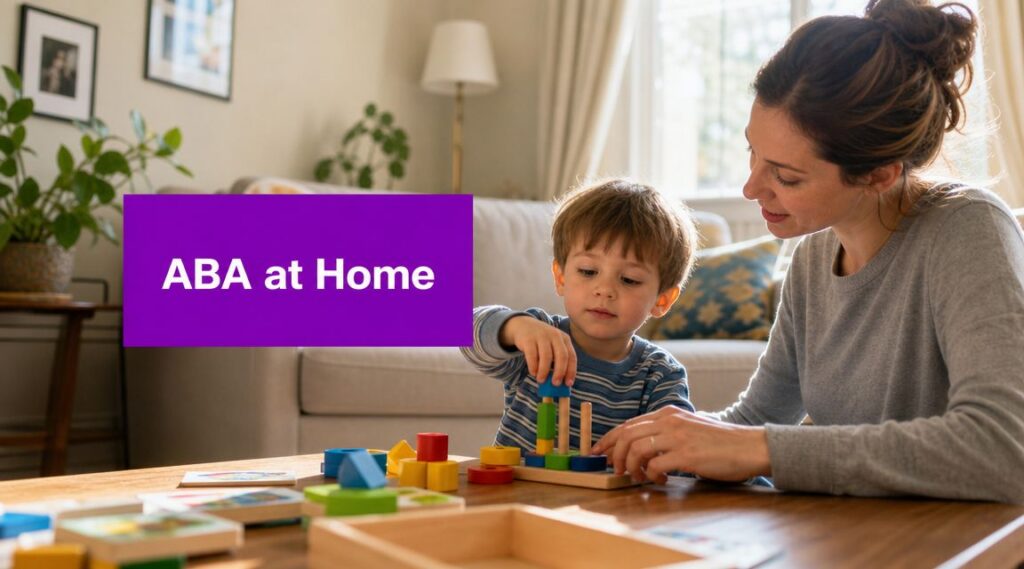
You've probably typed something like ABA therapy near me in home after a long stretch of worry, phone calls, and too many tabs open. You want help that fits real life, not just a service that sounds good on a website. You also want to know what happens when therapy moves into your living room, your kitchen, and your family routine.
That's the part many pages skip. They tell you in-home ABA is available. They don't always tell you what it asks of your child, your time, your space, and your consistency.
This guide is for Arizona parents who want a clearer picture before they commit.
Understanding In-Home ABA Therapy
ABA stands for Applied Behavior Analysis. In plain language, it's a structured way to teach skills and reduce behaviors that interfere with daily life by paying close attention to what happens before a behavior, what the behavior looks like, and what happens after it.
A simple way to think about it is this. ABA works like a teaching map. If a child struggles with asking for help, following a routine, or tolerating transitions, the clinician doesn't treat that as one big problem. They break it into smaller teachable steps, track what helps, and adjust the plan based on what the child does.

The modern foundation of ABA grew out of behavior analysis research linked to B. F. Skinner's work in the mid-20th century and was adapted into autism treatment in the 1960s and 1970s. That history is one reason home-based ABA focuses on observable behavior, reinforcement, and measurable goals rather than talk therapy alone. In major U.S. autism policy, ABA became a core insurance-covered service after all states and Washington, D.C. enacted autism insurance reform laws over time, and many states expanded coverage in the 2000s and 2010s. Current home-based ABA providers commonly serve children from 18 months up to 13 years according to this overview of home-based ABA services.
Parents sometimes wonder whether ABA means something is “wrong” with their child. That's not a helpful frame. A better question is whether your child needs support learning specific skills in a way that is consistent, observable, and practical.
Practical rule: If the hardest moments happen at home, treatment in the home often gives the team the clearest place to teach replacement skills.
What makes the home model different
Clinic-based therapy can be useful. So can school-based support. But in-home ABA has a different strength. It teaches skills where your child already lives those moments.
That matters when goals involve:
- Communication in daily routines like asking for snacks, requesting a break, or answering simple questions during meals
- Self-care tasks such as dressing, toileting routines, handwashing, or bedtime steps
- Behavior regulation at home when transitions, sibling conflict, or denied access tend to trigger distress
- Family participation because parents and caregivers can watch, ask questions, and learn how to respond in the moment
Signs in-home ABA may fit your family
In-home care is often a good fit when the natural environment is the point of intervention. For example, if your child can do something in a clinic but not in the bathroom, kitchen, carport, or bedroom at home, that gap matters.
It may also fit if your child becomes overwhelmed by transitions to unfamiliar spaces or if your biggest goals involve family routines instead of tabletop tasks.
If you're still sorting out whether behavior-focused support is the right lane, this overview of behavioral disorders and treatment approaches can help you place ABA in the bigger picture.
What ABA is not
ABA is not just “getting a child to comply.” Good in-home ABA should look purposeful, individualized, and respectful. It should target meaningful skills, not random drills. It also shouldn't treat parents like bystanders.
If a provider can't explain what skill they're teaching, why it matters at home, and how they'll know if it's working, keep looking.
Your Search for Local ABA Providers
Most parents start with Google, but a better approach is to build a master list from several places at once. That gives you options if one provider has a waitlist, doesn't take your insurance, or isn't a good clinical fit.
Start with the fastest filter. Your insurance directory. If your plan covers ABA-related services, the directory can help you avoid spending days calling agencies that aren't in network. Make a short spreadsheet with the provider name, phone number, whether they offer in-home care, and whether they serve your ZIP code.
Then widen the search.
Where to build your list
Use more than one channel so you don't rely on a single referral source.
- Insurance directory first. This is your practical starting point because payment questions can shape every later decision.
- Pediatrician or developmental specialist referrals. These clinicians often know which agencies communicate well with families and which ones struggle with follow-through.
- Arizona state and community resources. Families often look through state developmental disability pathways, community support networks, and autism-related directories when they need more than a search result.
- Parent support groups. These can help you learn what day-to-day service feels like, not just how a company markets itself.
What to ask on the first call
Don't use the first phone call to tell the whole story. Use it to screen.
Ask:
- Do you provide in-home ABA in my area
- What age groups do you currently serve
- How does intake work
- Who completes the assessment
- What is the expected caregiver role
- Do you offer parent training as part of the plan
A good first call should leave you with a clear next step. It shouldn't leave you more confused than when you started.
For Phoenix-area families, geography matters more than people expect. Scheduling reliability can be affected by travel time, traffic, and whether a provider can consistently staff your neighborhood. If you live in or around Chandler, Tempe, Scottsdale, Deer Valley, Paradise Valley, or central Phoenix, ask directly whether the team already serves nearby families. That usually gives you a more honest answer than asking whether they serve “the whole Valley.”
How to Choose the Right ABA Provider
A provider can sound polished and still be a poor fit for your child. The agencies worth considering will answer direct questions without becoming defensive, vague, or overly sales-focused.
One of the most important technical issues is treatment intensity. Evidence-based ABA programs for children with autism are often delivered at high weekly hours, and systematic reviews have found that more intensive early intervention is associated with larger improvements in adaptive behavior and IQ, although outcomes vary widely based on baseline skills, parent involvement, and fidelity of implementation. The same overview also notes common pitfalls, including inconsistent caregiver follow-through and poor generalization outside sessions, in this summary of home ABA treatment considerations.
Verify credentials before you interview
If someone will help design or supervise your child's care, verify their credential status. ABA titles matter because the role affects who assesses, who writes programs, who supervises, and who delivers direct services.
Here's the basic breakdown:
- BCBA. A Board Certified Behavior Analyst typically leads assessment, treatment planning, supervision, and plan updates.
- BCaBA. An assistant-level certification that works under supervision.
- RBT. A Registered Behavior Technician who usually provides direct therapy under supervision.
You can ask the provider for the full names and credentials of the people assigned to your case, then verify them through the BACB registry on your own. That extra step is worth it.
Coverage questions matter too, especially if your child needs multiple services across mental health and developmental care. This guide to understanding therapy insurance coverage can help you prepare better questions before you authorize anything.
Questions that reveal how an agency actually works
Some agencies are organized and clinically grounded. Others are held together by marketing and staffing luck. The difference usually shows up in the interview.
| Category | Question to Ask | What You're Looking For |
|---|---|---|
| Clinical leadership | Who completes the initial assessment and writes the plan? | A clear answer that a qualified clinician leads assessment and treatment design |
| Supervision | How often does the supervising clinician observe sessions and update goals? | A concrete supervision process, not “as needed” language |
| Parent role | What do you expect from caregivers during a typical week? | Honest discussion of participation, practice, and communication |
| Goal setting | How do you choose targets for home-based treatment? | Goals tied to daily routines, not generic skill lists |
| Data tracking | How do you measure progress and decide when to change the plan? | A specific data process and examples of how decisions are made |
| Staffing | What happens if an RBT leaves or sessions are missed? | A realistic continuity plan |
| Generalization | How do you help skills transfer outside the session? | Caregiver coaching and routine-based practice |
| Behavior support | How do you respond when a child is distressed or refusing? | Calm, individualized strategies rather than rigid scripts |
| Scheduling | How do you handle consistency when families have siblings, school, and appointments? | Flexibility with structure, not chaos |
| Fit | What kinds of children tend to do well in your in-home model, and when do you recommend another setting? | A thoughtful answer that admits in-home ABA is not ideal for every child |
What usually works and what usually doesn't
What works is a provider who can connect every goal to a real moment in your child's day. Not “improve compliance.” More like “ask for help during dressing” or “tolerate ending screen time with fewer escalations.”
What doesn't work is a plan that lives on paper. If caregivers don't know how to use the strategies, if goals don't match the family routine, or if sessions feel detached from daily life, the quality of the plan won't matter much.
The strongest ABA plans are rarely the flashiest. They are the ones a tired parent can still carry out on an ordinary Tuesday.
Red flags to take seriously
Watch for these patterns early:
- Promises that sound too certain. No ethical provider can predict exact outcomes.
- Weak explanation of parent training. In-home ABA isn't meant to replace the family.
- Heavy emphasis on availability, little emphasis on method. Convenience matters, but it isn't the same as quality.
- No clear answer about supervision or data. If they can't explain the process clearly, that's a concern.
- Goals that don't sound like your child. Cookie-cutter plans usually produce cookie-cutter problems.
Preparing Your Home and Family for Success
The therapist is due soon. Breakfast dishes are still on the counter. A sibling is watching a loud show. Someone can't find a shoe. That's closer to real in-home ABA than the tidy photos on provider websites.
Families often aren't told how much operational effort home-based services require. Public-facing local pages tend to emphasize convenience and flexibility, but they often leave out the day-to-day burden of caregiver participation, space setup, scheduling consistency, privacy concerns, and the effect of the home environment itself. That gap is described well in this discussion of what in-home ABA requires from families.

Set up a workable space, not a perfect one
You don't need a dedicated therapy room. Most families don't have one. You need a predictable spot where the child can focus and where the therapist can move materials in and out without turning the home upside down.
That might be one end of the dining table, a corner of the living room, or a cleared section of the floor with a small basket of preferred items.
What helps:
- Consistency over perfection. Use the same area often enough that your child recognizes the routine.
- Reduced distractions. Lower TV noise, put away a few tempting items, and keep pets out if they derail focus.
- Simple access to reinforcers. Have a small bin ready with toys, snacks approved by you, and familiar activity items.
Build the schedule around real life
The best session time isn't the one that looks ideal on paper. It's the one your family can protect most weeks.
If your household already runs on visual lists, shared calendars, or routine blocks, keep using them. Some parents find it helpful to borrow ideas from resources on how Everblog helps manage mom's schedule because the challenge isn't just therapy time. It's therapy time plus meals, pickups, naps, sibling transitions, and everyone else's life.
Try to choose a session window when your child is usually fed, awake, and not coming straight off a difficult transition.
Prepare siblings without making therapy mysterious
Siblings notice everything. If a therapist starts showing up and nobody explains why, they'll fill in the blanks themselves.
Keep the explanation simple and age-appropriate. You might say that the therapist is helping their brother or sister practice skills that make home feel easier, like talking, waiting, or staying calm. Let siblings know what may change during session time and what stays the same.
A few practical moves help:
- Name the boundary. Tell siblings when they can join and when they need to play elsewhere.
- Protect one-on-one time. If one child is receiving a lot of adult attention, the others will feel that.
- Avoid resentment language. Don't frame therapy as special treatment or extra rewards “for no reason.”
Expect adjustment, not instant smoothness
The first weeks can feel awkward. The therapist is learning your child. Your child is learning a new person. You are learning when to step in, when to hang back, and how much communication the team really needs.
That doesn't mean it isn't working. It means the home is becoming part of the treatment process, which is exactly what in-home ABA is supposed to do.
The In-Home ABA Therapy Process Explained
Once services start, many parents expect either constant drills or a therapist who somehow fixes everything in the background. In reality, the process is more collaborative and more structured than that.

In-home ABA is typically built around a functional, data-driven workflow. A BCBA completes the initial assessment, identifies measurable target behaviors, and designs prompts, reinforcement schedules, and caregiver training so gains carry into home routines. Home delivery also allows family members to observe sessions and give real-time feedback, which supports skill transfer in communication, self-care, and behavior regulation, as described in this overview of in-home ABA services.
What the first phase usually looks like
The opening stage is assessment. The BCBA gathers information about your child's strengths, current challenges, triggers, motivators, and daily routine. This isn't just paperwork. It shapes what gets taught and how.
After that, the treatment plan is built around specific targets. Those goals should be measurable and relevant to home life.
Then direct sessions begin, often with an RBT implementing the plan while the BCBA supervises and adjusts as needed.
What happens in a typical session
A session often includes a mix of structured teaching and natural opportunities. The therapist might practice communication during snack, transitions during clean-up, or waiting during play.
Parents should expect to play an active role at times. That doesn't mean you have to sit in every minute. It means the team should show you how to respond in ways your child can use after the therapist leaves.
Helpful background reading can make those goals feel more concrete, especially when you're trying to understand building daily living skills with ABA in ordinary routines like dressing, washing hands, or moving through bedtime.
If you never learn what strategy the therapist is using, the plan won't transfer well to real life.
What progress review should feel like
You should hear more than “things are going okay.” A solid team can tell you what skills are improving, where your child still struggles, and what changes they're making to the plan.
That review should feel practical. You should walk away knowing what to keep doing, what to stop doing, and what the team will target next.
Integrating ABA with Your Life and Arizona Resources
The families who get the most from in-home ABA usually don't treat it as a separate island. They connect it to school, home expectations, and the rest of the child's support system.
If your child has an IEP, share relevant goals with the ABA team and ask for a simple summary you can bring back to school staff. The point isn't to make every setting identical. It's to reduce contradictions. If school is teaching one communication approach and home is reinforcing another, children often end up doing extra work just to keep up.
Keep home and school moving in the same direction
A useful rhythm looks like this:
- Share priority goals with both teams so everyone knows what matters most right now
- Bring examples, not just opinions when discussing behavior patterns across settings
- Ask for overlap where it helps such as transition language, prompting style, or simple visual supports
Some families also use telehealth strategically. It can be helpful for caregiver coaching, follow-up conversations, or supervision when an in-person meeting is harder to coordinate. It's usually not a replacement for all hands-on care, but it can support consistency.
For parents in the Phoenix metro area who are trying to sort out next steps, one practical starting point is identifying a local practice that can help with broader behavioral and emotional needs while you build your child's care plan. reVIBE offers in-person and online support across multiple service lines, and families can review mental health services in Arizona when they need a local entry point for evaluation, therapy, or coordinated care.
If you want local options on your radar, reVIBE Mental Health has offices in Chandler, Phoenix Deer Valley, Phoenix Paradise Valley, Scottsdale, and Tempe. For some families, the first useful step isn't choosing an ABA provider on day one. It's getting organized, clarifying concerns, and talking through what kind of support makes sense for the whole child.
If you're in the Phoenix area and need a starting point, reVIBE Mental Health offers in-person and online care for children, teens, and families across Chandler, Phoenix, Scottsdale, Paradise Valley, and Tempe. A thoughtful evaluation can help you sort out what your child needs now, what questions to ask ABA providers, and how to build a care plan that fits your family's daily life.