
CBT is the most strongly supported therapy for anxiety, and a 2024 review of 65 studies involving 5,048 adults found that only CBT retained long-term effectiveness after higher-risk studies were removed. In health anxiety, CBT produced a 66% response rate and a 48% remission rate, with benefits largely sustained 12–18 months after treatment.
You may be searching for anxiety and therapy after another restless night, a difficult meeting, or a panic symptom that made ordinary plans feel unsafe. Perhaps you've tried breathing exercises, reassurance, or avoiding triggers, only to find that relief fades and the same fears return.
That pattern doesn't mean you're failing. Anxiety is treatable, but the most useful approach depends on the type of anxiety you have, the symptoms driving it, and whether you can access care consistently.
Why Anxiety Is Treatable and What Therapy Actually Does
Maya checks her phone repeatedly before sending a simple work email. Her chest feels tight, her shoulders stay raised, and her mind runs through every possible criticism. She knows the email is ordinary, but knowing that doesn't switch off the alarm. By evening, she's exhausted from arguing with thoughts that keep producing new questions.
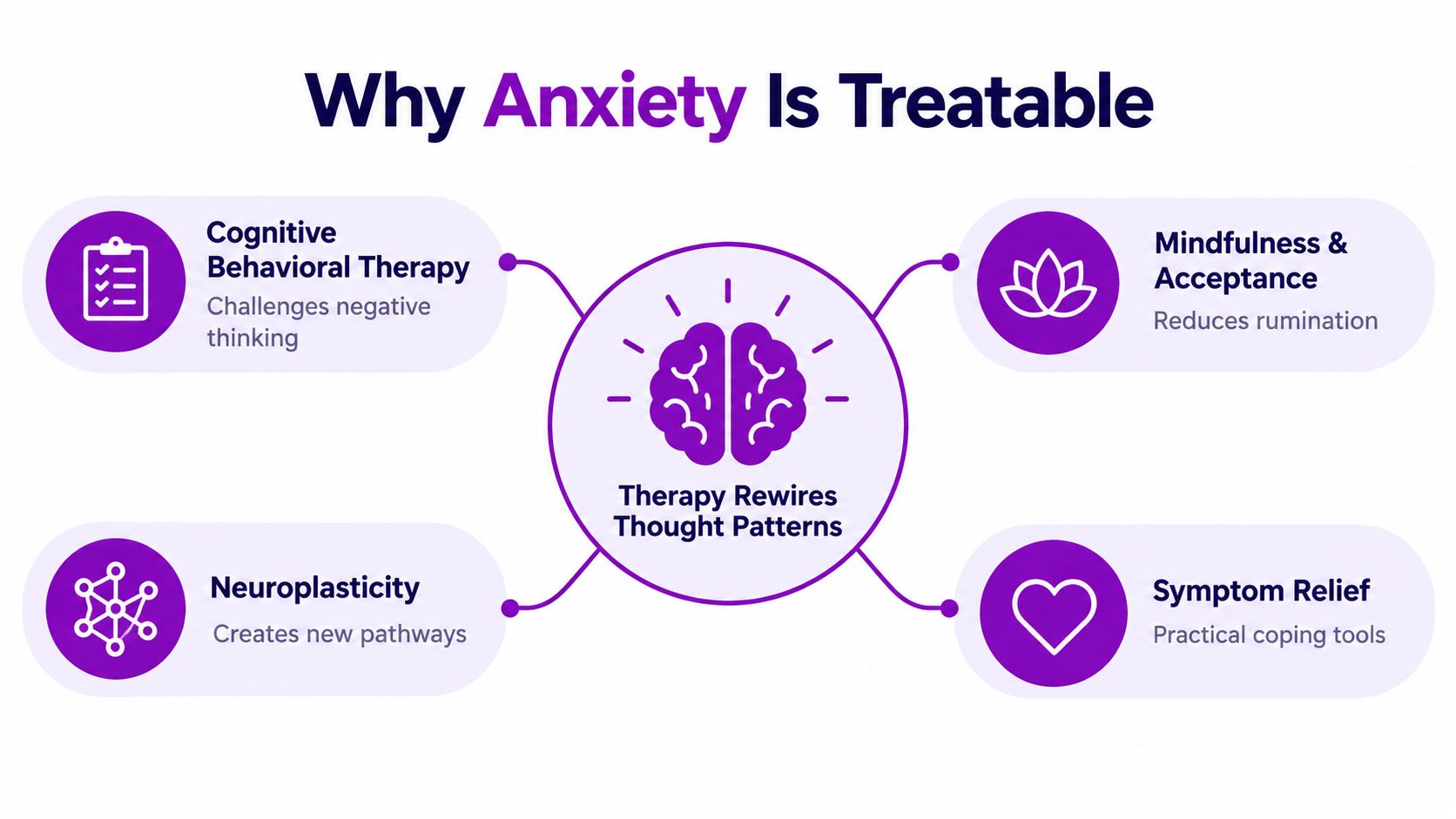
Therapy doesn't treat anxiety as a character flaw or ask you to “just think positively.” Anxiety involves patterns in how the brain detects and regulates threat. Research describes anxiety in relation to amygdala hyper-responsiveness, reduced prefrontal control, and heightened drive from the locus coeruleus, a system involved in arousal and alertness. Therapies that combine repeated contact with feared cues and stronger cognitive control may reduce threat reactivity by improving top-down regulation, rather than merely hiding symptoms. Research on the neurobiology and treatment of anxiety describes this relationship and reports standardized mean differences of about 0.28 to 0.44 across large psychotherapy meta-analyses, with CBT for social anxiety showing medium effects around 0.72 and 0.56 in some analyses.
Therapy changes the pattern, not just the feeling
A therapist might help Maya identify the prediction beneath her fear: “If this email isn't perfect, people will decide I'm incompetent.” She can then examine evidence, consider more than the worst possible outcome, and practice sending messages without endless checking. Over time, the brain gets new experiences. The feared event may not happen, and even when discomfort appears, Maya learns that she can tolerate it and respond effectively.
Cognitive behavioral therapy often combines thought evaluation, behavioral experiments, and gradual exposure. Acceptance-based methods teach a person to make room for uncomfortable sensations while choosing actions guided by personal values. Mindfulness can help someone notice rumination without treating every thought as an urgent instruction.
Talk therapy can take different forms, so learning what talk therapy involves can make the first appointment feel less mysterious. The central principle remains practical: structured treatment gives the brain repeated opportunities to update its threat predictions.
A useful way to think about recovery: The aim isn't to eliminate every anxious thought. It's to reduce anxiety's control over your choices.
Understanding the Main Therapy Approaches for Anxiety
“Therapy for anxiety” describes a family of treatments, not one interchangeable service. A person with generalized worry may need a different emphasis from someone whose main difficulty is panic, social fear, or trauma-related distress.
Cognitive behavioral therapy
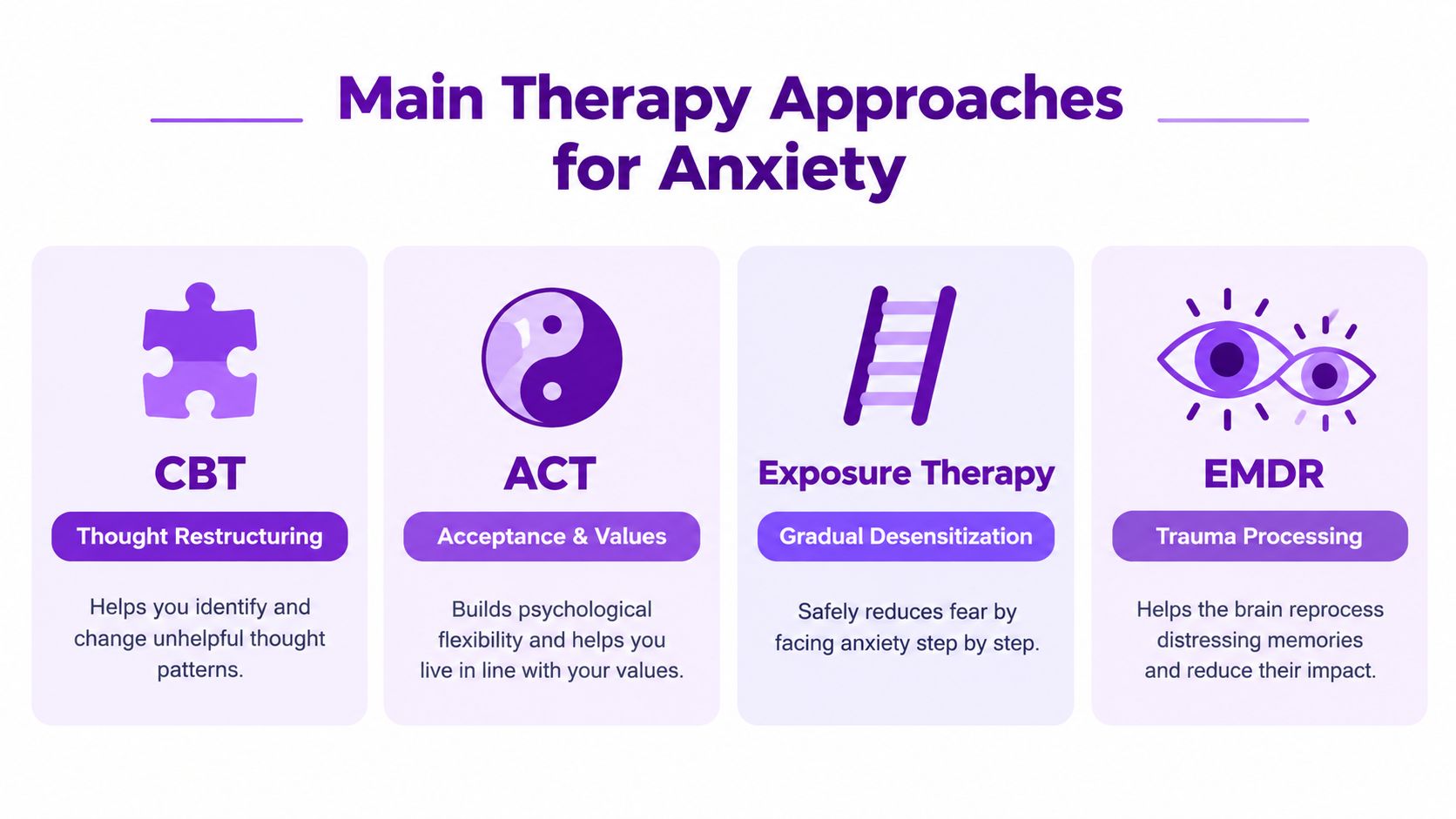
CBT works with the connection between thoughts, feelings, body sensations, and actions. A therapist may help you test catastrophic predictions, reduce reassurance-seeking, and approach situations you've been avoiding. For generalized anxiety, CBT can address the cycle in which worry feels like preparation but keeps your attention locked onto uncertain threats.
A 2024 systematic review and network meta-analysis found that CBT, third-wave CBT approaches, and relaxation therapy outperformed treatment as usual for generalized anxiety disorder. After researchers removed studies with a high risk of bias, only CBT and third-wave CBT remained superior, and only CBT retained long-term effectiveness. The full network meta-analysis supports CBT as a particularly strong option when lasting improvement matters.
Acceptance and commitment therapy
ACT doesn't require you to win an argument with every anxious thought. Instead, it helps you notice thoughts and sensations, reduce the struggle with them, and take meaningful action even when discomfort is present. For someone who has organized life around avoiding uncertainty, ACT might focus on reconnecting with relationships, work, health, or creativity while anxiety is still present.
ACT belongs to the broader family of third-wave CBT approaches. It can be useful when trying to suppress anxiety has become its own exhausting routine, although treatment selection should still reflect the person's diagnosis and goals.
Exposure therapy
Exposure therapy involves carefully approaching feared situations, sensations, memories, or objects instead of using avoidance and safety behaviors to escape them. The process should be collaborative and paced. A therapist might help someone with social anxiety speak briefly in a meeting, or help someone with a specific fear remain near the trigger long enough to learn that anxiety can rise and fall without catastrophe.
Exposure isn't a dare, and it shouldn't be forced. Its appropriateness depends on the anxiety subtype and the clinical formulation. A 2025 evidence map found strong support for CBT across generalized anxiety, panic, and social anxiety, but it also found that exposure therapy, EMDR, and virtual-reality exposure therapy weren't supported for panic disorder in the existing evidence base. That finding doesn't mean no individual with panic can benefit from a particular intervention. It does mean broad claims that one method works equally well for every anxiety diagnosis can mislead people.
EMDR
Eye movement desensitization and reprocessing, or EMDR, is a structured approach often considered when distress is connected to traumatic or disturbing experiences. It is not just informal conversation about the past. The therapist follows a defined sequence, prepares the client, identifies target memories, and supports processing within a safe treatment plan.
The right question isn't “Which therapy is most popular?” It's “Which therapy matches my symptoms, diagnosis, preferences, and practical circumstances?” A clear discussion with a qualified clinician can help distinguish a good fit from a familiar label.
For a more detailed comparison, see types of therapy for anxiety.
What to Expect From Your First Sessions and Ongoing Therapy
The first session usually begins with understanding what brought you in, how anxiety appears in daily life, and what you want to change. You might discuss sleep, physical sensations, avoidance, relationships, work, previous treatment, medication, and any safety concerns. You don't need a perfectly organized story. A therapist's job is to help organize the information with you.
CBT may begin by identifying a recent anxiety episode and mapping the thoughts, sensations, and behaviors around it. ACT may focus more on the cost of avoidance and the values you want to move toward. Exposure planning tends to involve a careful hierarchy, preparation, and agreement about the pace. These approaches can overlap, but they don't ask you to do exactly the same work.
EMDR follows a specific sequence
EMDR uses an eight-phase protocol:
- Phase 1 involves history-taking, including relevant experiences, current symptoms, strengths, and treatment goals.
- Phase 2 focuses on preparation, such as developing grounding and stabilization skills.
- Phase 3 assesses the target memory, including the distressing image, beliefs, emotions, and body sensations connected with it.
- Phases 4 through 7 process the memory toward a more adaptive resolution.
- Phase 8 evaluates and re-evaluates progress at the beginning of the next session.
The sequence matters because it gives the work structure. You shouldn't assume that discussing a painful memory will happen immediately or without preparation. A responsible therapist will consider readiness, stability, and the effects of processing between sessions.
Progress should become observable
Therapy isn't successful only when you feel calm in the office. You and your therapist might track whether you sleep more consistently, attend events you previously avoided, spend less time checking, recover faster from anxious sensations, or return to activities that matter to you.
If you're comparing different ways to begin care, a guide to BetterHelp alternatives 2026 may help you think through online platforms, human therapists, and other formats. Whatever setting you choose, ask how the provider measures progress, what happens if the first approach isn't helping, and how appointments will continue when life becomes busy.
Practical preparation can also reduce uncertainty. Writing down your main symptoms, treatment history, current medications, and two or three goals can give the first appointment a useful starting point. Preparing for your first therapy session can help you arrive with questions rather than pressure to perform.
Signs You Should Consider Seeking Professional Therapy
You don't need to wait for a crisis before asking for help. Anxiety disorders are among the most common mental health conditions worldwide. The World Health Organization reported that about 470 million people were living with an anxiety disorder in 2023, representing an estimated 5.8% of the global population, and reported 301 million people living with anxiety disorders in 2019. The WHO overview of anxiety disorders places individual distress within a broad public health need.
Look at what anxiety is changing
Professional support may be appropriate when:
- Daily functioning is shrinking: Anxiety disrupts work, school, household responsibilities, relationships, or decisions.
- Your body remains on alert: Sleep disruption, persistent tension, racing heart sensations, stomach distress, or exhaustion continue and are difficult to manage.
- Avoidance controls your calendar: You decline invitations, postpone healthcare, avoid travel, stop speaking up, or limit ordinary activities because of fear.
- Self-help hasn't been enough: Breathing exercises or reassurance may provide short relief, but the underlying cycle keeps returning.
- You feel trapped in repetition: Worry, checking, rumination, or panic takes up attention even when you understand that the fear may be excessive.
The key question is not whether your anxiety looks dramatic to someone else. Ask whether it causes meaningful distress or keeps you from living in the ways you value.
A therapist can also help clarify whether symptoms fit generalized anxiety, panic, social anxiety, health anxiety, trauma-related distress, or another concern. That clarification matters because treatment choice should follow the symptom pattern rather than a broad internet label.
Realistic Outcomes and What Research Shows About Recovery
Good treatment can create substantial change, but recovery rarely means you never feel anxious again. A more realistic goal is that anxiety becomes less intense, less frequent, and less influential. You may still notice fear before a difficult conversation, but you can attend the conversation instead of canceling it. You may still experience a physical sensation, but you no longer interpret it as proof of imminent danger.
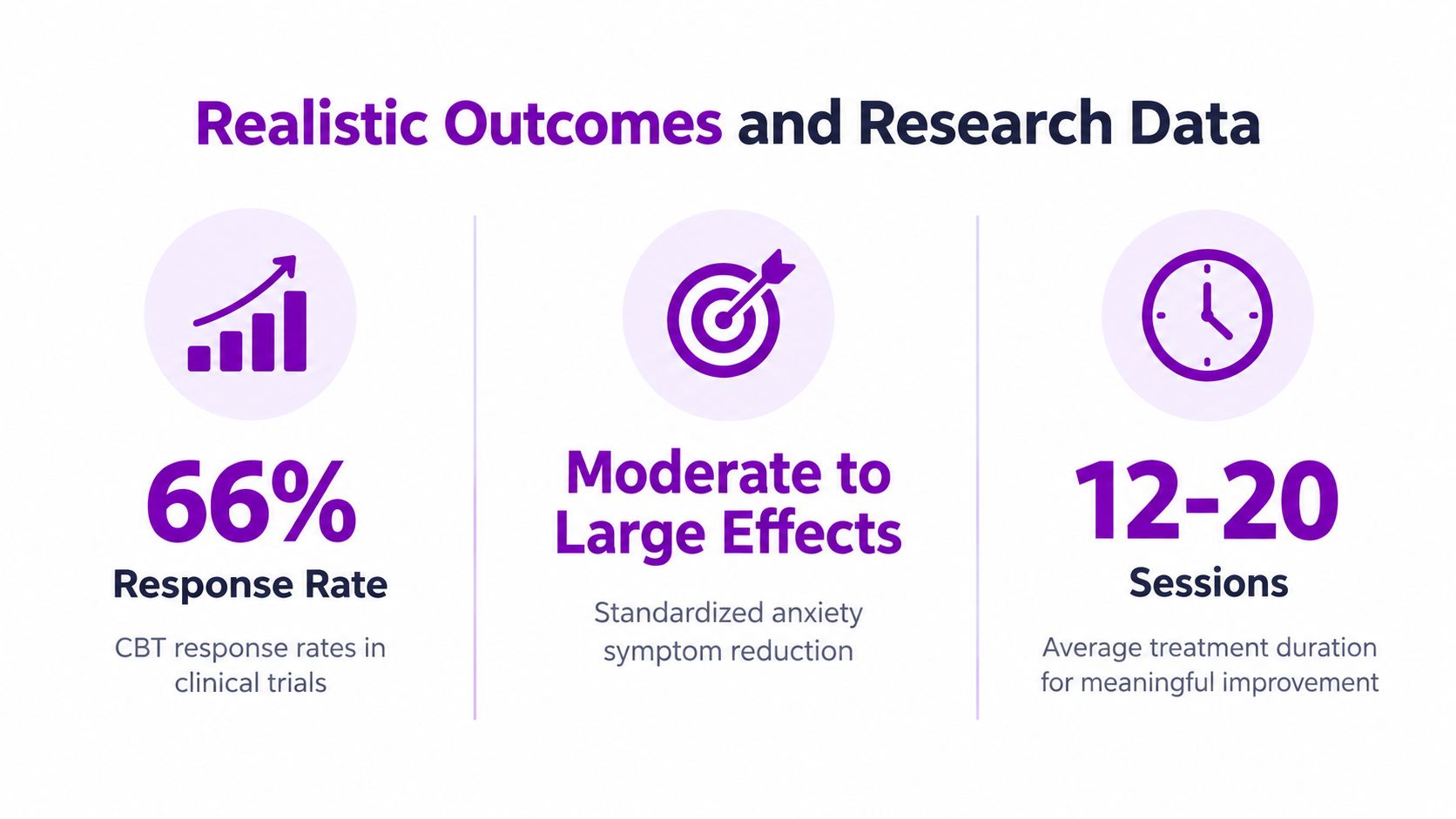
The evidence for CBT is substantial. A systematic review of 69 randomized clinical trials involving 4,118 patients found better anxiety outcomes than control conditions within 12 months after treatment completion. A separate meta-analysis of 41 placebo-controlled trials involving 2,843 people found a moderate effect on target anxiety symptoms, with Hedges' g of 0.56, and an odds ratio of 2.97 for treatment response compared with placebo. These figures come from the large-scale review of CBT for adult anxiety disorders.
Health anxiety shows why durability matters
For health anxiety, a systematic review of 19 randomized controlled trials found a pooled between-group effect of g = 0.79. Effects were largely sustained 12–18 months after treatment, while the pooled CBT response rate was 66% and the remission rate was 48%, according to the same health anxiety treatment analysis.
Those outcomes don't predict exactly what will happen for one person. Diagnosis, severity, therapeutic relationship, readiness to practice new skills, co-occurring conditions, and the quality of continuity all influence progress.
Access can determine whether evidence becomes help
Many people don't struggle because therapy is ineffective in principle. They struggle to find a provider, afford ongoing appointments, deal with insurance, maintain medication follow-up, or stay connected when licensure and scheduling rules disrupt care. Telepsychiatry has expanded access to specialized support, but licensure restrictions and limited in-network availability can still create interruptions. Reviews of generalized anxiety care also describe treatment changes, discontinuation, and gaps that make consistent progress harder.
That reality changes the practical question from “Does therapy work?” to “Can I find a treatment that fits my diagnosis and keep attending long enough to use it?” Digital CBT, app-based tools, and AI-assisted coaching may support access, but they shouldn't automatically be treated as equivalent to structured therapy. Evidence is more uneven for brief app-based mindfulness programs than for established, structured treatment.
Recovery is measured by restored choices. The goal is to have more room for work, relationships, rest, and ordinary uncertainty.
How reVIBE Mental Health Makes Getting Help Easier
Finding a suitable therapist is only the beginning. People also need appointments they can attend, clear insurance guidance, and a setting where discussing anxiety doesn't feel intimidating. reVIBE Mental Health offers in-person and secure online care, with therapy and psychiatric support that can include CBT, ACT, mindfulness-based approaches, EMDR, and medication management when appropriate.
The practice serves Arizona communities through locations in Chandler, Phoenix Deer Valley, Phoenix PV, Scottsdale, and Tempe. It accepts most major insurance plans and provides verification guidance, which can make the financial and administrative steps easier to understand. A welcoming, non-judgmental environment can also help clients speak openly about symptoms that they've been hiding.
If you live elsewhere or need to compare formats, you can also browse Canadian online counselling options as part of your broader search. The important criteria remain the same: a qualified provider, a treatment plan suited to your anxiety subtype, and a realistic way to maintain continuity.
Find a reVIBE Location Near You
We currently have five locations for your convenience. (480) 674-9220
reVIBE Mental Health – Chandler
3377 S Price Rd, Suite 105, Chandler, AZ
reVIBE Mental Health – Phoenix Deer Valley
2222 W Pinnacle Peak Rd, Suite 220, Phoenix, AZ
reVIBE Mental Health – Phoenix PV
4646 E Greenway Road, Suite 100, Phoenix, AZ
reVIBE Mental Health – Scottsdale
8700 E Via de Ventura, Suite 280, Scottsdale, AZ
reVIBE Mental Health – Tempe
3920 S Rural Rd, Suite 112, Tempe, AZ
reVIBE Mental Health offers compassionate anxiety therapy, EMDR, psychiatry, and medication management through in-person and secure online appointments. Visit reVIBE Mental Health to explore care options, verify coverage, and take the next step toward treatment that fits your symptoms and goals.