You open a notebook because your mind feels crowded. You want relief, clarity, maybe just a place to put the thoughts that keep circling. Then you see the blank page and freeze.
That reaction is common. A blank page can feel like a demand when what you need is support. If you're anxious, low on energy, emotionally flooded, or tired, coming up with what to write can feel like one more task you can't quite start.
That's why so many people find guided journaling easier to stick with. Instead of asking you to create structure from scratch, it offers a path. One question. One prompt. One gentle opening.
The best guided journals don't ask you to perform insight on command. They help you begin. And for many people, beginning is the hardest part.
From Blank Page to Gentle Reflection
A lot of people try journaling at the exact moment they most need comfort. They've had a hard conversation. Their chest feels tight. They can't turn off their thoughts before bed. They sit down to write, hoping the page will calm them, and instead they feel more pressure.
A guided journal changes that first moment. It doesn't fix everything, but it softens the start. Rather than asking, “What's wrong with me?” or “Where do I even begin?” it might ask, “What feels heaviest today?” That's a very different invitation.
If you like the ritual of writing by hand, the physical feel of the notebook matters too. Some people do well with a structured guided journal, while others want a simple, well-made notebook for therapist-recommended prompts. If that's your style, a premium journal for home offices can make the practice feel more grounded and intentional.
Why the blank page feels so hard
The blank page seems neutral, but it often isn't. It asks you to organize feelings, choose a topic, find words, and decide where to stop. When you're already overwhelmed, that's a lot.
Guided journaling lowers that first barrier. It turns writing into a series of small choices instead of one big emotional leap.
Sometimes the most helpful form of reflection is the one that asks the least of you at the start.
For people learning emotional regulation skills, guided prompts can work well alongside simple calming tools. If you need help settling your body before you write, these self-soothing strategies can make journaling feel safer and more manageable.
What gentle reflection looks like
It usually doesn't look profound. It looks simple.
- A short answer: “Right now I feel tense and tired.”
- A small observation: “I notice I'm expecting too much from myself today.”
- A practical next step: “Tonight I need rest more than productivity.”
That's enough. Journaling doesn't have to be deep every time to be helpful. Often, the best guided journals earn their place by making reflection feel possible on ordinary, hard, and messy days.
What Makes a Guided Journal Different
A guided journal isn't just a prettier notebook. It's a different tool.
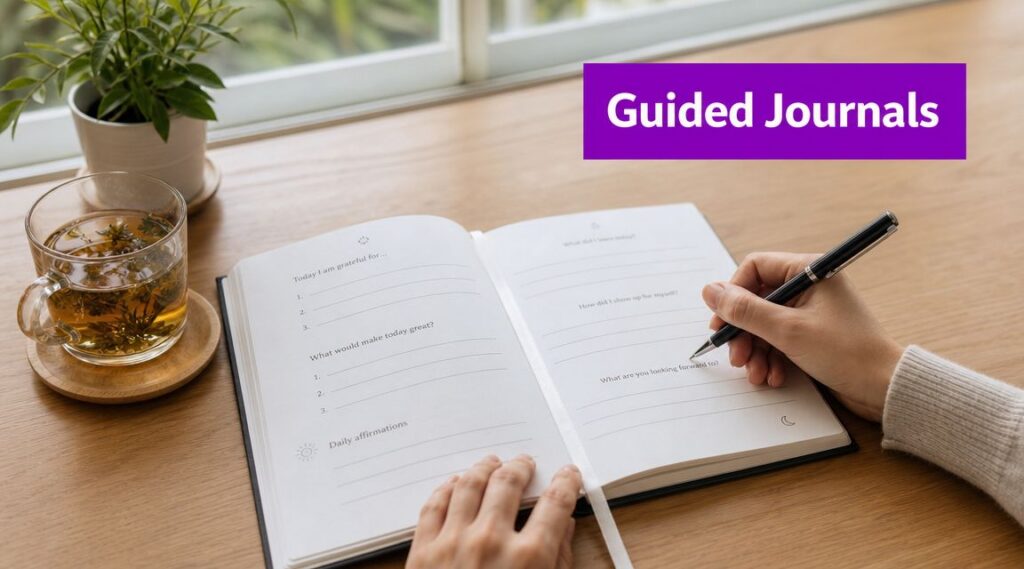
A blank journal gives you freedom. That freedom can feel creative, but it can also feel overwhelming. A guided journal gives you structure through prompts, questions, and page-by-page exercises. That structure is the point.
According to this explanation of guided journals, a guided journal is distinct from a blank journal because it uses structured prompts, questions, and exercises on each page to reduce the cognitive load of deciding what to write next. In everyday terms, it helps you spend less energy figuring out how to begin and more energy noticing what's going on inside.

Blank journal versus guided journal
Here's the practical difference most readers care about.
| Format | What you face when you open it | Best fit for |
|---|---|---|
| Blank journal | Unlimited choice, no direction | People who enjoy free writing and already know how they want to reflect |
| Guided journal | A prompt, question, tracker, or structured exercise | People who want support getting started and staying consistent |
A blank journal says, “Go anywhere.”
A guided journal says, “Start here.”
That second option is often easier when your thoughts feel scattered.
What's usually inside
The best guided journals vary in style, but most include some combination of the following:
- Daily prompts that help you name feelings, stressors, or intentions
- Reflection questions that guide you beyond surface thoughts
- Trackers for mood, habits, sleep, or energy
- Theme-based exercises focused on anxiety, gratitude, self-worth, or goals
- Repeatable structure so you don't have to relearn the format each time
Some readers get confused here and assume guided means rigid. It doesn't have to. Structure can create more emotional room because you're not spending your limited energy inventing a process.
Why structure helps habits
When people say they “can't journal consistently,” they often mean one of two things. Either they forget, or opening the journal feels like work. A guided format helps with the second problem.
If the page already contains a few focused questions, you're more likely to answer one than compose a full entry from nowhere. That's why many people who give up on blank notebooks do better with prompts. The support is built into the page.
Practical rule: If your main obstacle is getting started, choose more structure, not less.
The Mental Health Benefits of Structured Journaling
Guided journaling has shifted in recent years from a niche self-help practice into a mainstream wellness category closely tied to mental health, anxiety, and emotional wellbeing. By 2025–2026, multiple consumer and wellness publishers were using “best guided journals” as a search category, reflecting how established this format had become in mental health conversations, as noted by Lifestance's overview of guided journals for mental health.
That shift makes sense. Structured journaling gives people a way to slow down and observe what they're feeling without having to build a process from scratch. It's simple, but not trivial.

For anxiety
Anxiety often creates speed. Your thoughts jump ahead. Your body reacts before your mind catches up. A guided prompt can interrupt that momentum.
Questions like “What am I predicting right now?” or “What feels uncertain?” help move thoughts from an internal swirl onto paper. Once the thought is visible, it often becomes easier to examine rather than obey.
For readers who want a broader look at journaling to support mental health, that perspective can be a useful companion to a prompt-based practice. If you also want a steadier daily grounding habit, this guide to mindfulness in everyday life pairs well with journaling.
For depression
Depression can flatten motivation and make reflection feel heavy. In that state, open-ended writing may feel impossible. Structured journaling can help by narrowing the task.
A brief check-in such as “What took energy today?” or “What is one thing I completed?” helps you notice lived reality instead of only the harsh story depression tells. The goal isn't forced positivity. The goal is contact with what is true.
For self-understanding
Mental health support isn't only about crisis reduction. It's also about pattern recognition.
Over time, guided entries can help you notice:
- Triggers that show up before emotional spirals
- Protective habits that help you feel steadier
- Recurring beliefs that shape your reactions
- Needs you often ignore until they become urgent
Writing can turn vague distress into something more workable. Not because the feeling disappears, but because it becomes clearer.
That clarity is one reason the best guided journals can play a meaningful role in healing. They won't replace therapy, diagnosis, medication, or trauma treatment. They can, however, support the larger work by making your inner experience easier to track, name, and bring into conversation.
How to Choose the Right Guided Journal for Your Needs
The best guided journals aren't “best” in the abstract. They're best when they match your current emotional bandwidth, your goals, and the kind of support you need.
That last part matters. A beautiful journal with thoughtful prompts won't help much if the format feels too demanding to open. Guided journaling is often designed around a narrow target such as anxiety, mood tracking, gratitude, or goal-setting. Some themed journals are also built for 1–3 month use cycles to create quick wins and improve adherence, according to this overview of guided journaling benefits. In practice, that means a focused journal often works better than a general one when you want behavior change.
Start with your goal, not the cover
Ask yourself a simple question first. “What do I want this journal to help me do?”
Not “Which one looks inspiring?”
Not “Which one is popular?”
What do you need help doing?
The answer changes what you should buy.
| Your Goal | Look For in a Journal | Example Prompt Focus |
|---|---|---|
| Reduce anxiety | Repeating prompts, thought-checking questions, grounding space | “What am I assuming, and what do I actually know?” |
| Track depression patterns | Low-effort daily check-ins, mood and energy logs, simple reflection | “What felt hardest today, and what helped even a little?” |
| Support trauma recovery | Gentle pacing, strong boundaries, present-focused prompts, optional depth | “What helps me feel safe in this moment?” |
| Improve self-esteem | Self-talk prompts, strengths reflection, evidence-based reframing | “What did I do today that reflects effort or courage?” |
| Strengthen a relationship | Shared reflection pages, repair questions, communication prompts | “What do I wish I'd said more clearly?” |
| Support teen self-discovery | Short prompts, flexible format, less pressure for long writing | “What felt most like me today?” |
| Support eating disorder recovery | Weight-neutral language, body respect prompts, emotion awareness | “What does my body need from me right now?” |
What works well for anxiety, depression, and trauma
For anxiety, look for a journal that repeats a familiar structure. Predictability is soothing. Too much variety can feel like one more decision.
For depression, avoid journals that demand long essays or upbeat performance. Short entries, check boxes, and mood tracking often work better because they respect low energy.
For trauma, be careful. A journal that pushes deep processing too quickly can feel activating. The best fit is usually one that emphasizes grounding, present-moment awareness, and choice. A trauma-sensitive journal should let you skip, pause, or stay close to the present.
A good journal should challenge you gently, not flood you.
Other needs people often overlook
Some people need a journal for more specific situations.
- For couples work: Choose prompts that focus on communication, repair, appreciation, and conflict patterns.
- For teens: Look for shorter, less clinical prompts and a format that feels private and approachable.
- For eating disorder recovery: Avoid journals centered on control, body criticism, or rigid “wellness” language. Look for compassion, body neutrality, and emotional awareness.
A simple buying filter
If you're stuck between options, use this short filter:
- Can I imagine using this on a bad day?
- Do the prompts match my actual struggle?
- Does the format feel supportive rather than demanding?
If the answer is yes, you're probably close to the right fit. The best guided journals don't win because they impress you in the store. They win because you keep reaching for them when life feels difficult.
How to Pair Your Journal with Professional Therapy
A guided journal becomes more useful when it's part of a larger care plan. That's especially true for anxiety, trauma, depression, burnout, and medication support. The journal doesn't need to do all the work. It needs to help you carry the work between sessions.
A major gap in many “best guided journals” roundups is that they focus on aesthetics and prompt style but rarely ask which format helps people keep going over time, especially when someone is dealing with anxiety, depression, trauma, or burnout. As Feisty Life Media notes, the decision is often about lowest friction and highest likelihood of continued use, not just the nicest prompts.

In talk therapy
Talk therapy often helps people notice patterns, challenge beliefs, and practice emotional honesty. A guided journal can make those sessions richer.
You might bring in notes about:
- Repeated triggers from the week
- Conflicts that left you stuck or ashamed
- Moments of relief so you can identify what helped
- Questions you didn't know how to say out loud in session
That way, therapy doesn't have to begin with “I don't know where to start.” You already have a few threads to follow.
Around EMDR and trauma treatment
If you're doing EMDR or trauma-focused therapy, journaling should stay contained and intentional. The goal usually isn't to force yourself into deep memory work alone. It's to track what's happening between sessions.
Helpful prompts might include present-focused questions such as:
“What came up after therapy?”
“What helped me feel grounded today?”
“What do I want my therapist to know next time?”
That kind of writing can help you notice body sensations, emotions, and aftereffects without pushing yourself beyond your window of tolerance.
With psychiatry and medication management
A guided journal can also help if you're tracking mood, sleep, appetite, focus, or side effects. You don't need a perfect log. A few consistent observations can make it easier to describe your week accurately.
Instead of saying “I've been all over the place,” you may be able to say:
- Mood: lower in the mornings, steadier by evening
- Sleep: restless several nights in a row
- Energy: dipped after stressful workdays
- Appetite or focus: changed noticeably this week
That kind of record can support more precise conversations with a prescriber.
Bring patterns to therapy, not polished conclusions.
A safe way to use journaling in treatment
The most effective approach is usually simple.
- Keep entries brief. A few sentences are enough.
- Mark what stands out. Circle one phrase or feeling.
- Bring only what feels useful. You don't have to share every page.
- Tell your therapist what happens when you journal. If it helps, say so. If it stirs you up, say that too.
If you're still looking for a clinician who fits your needs, this guide on finding the right therapist can help you think through what kind of support would feel most effective.
Your First Week of Guided Journaling
Starting small works better than starting intensely. Many individuals don't need a dramatic journaling reset. They need a routine that feels easy enough to repeat.
Guided journaling is a structured form of journaling that uses prompts, and contemporary consumer guides often present 25 prompts as a practical starting point for building the habit because a preset sequence makes it easier to begin, as described in Erin Condren's guided journaling overview.
A low-pressure plan for seven days
Try this for your first week:
- Choose one time of day: evening works well for many people, but morning is fine if that feels calmer.
- Keep it short: aim for a brief check-in, not a major life review.
- Use the same pen and place: repetition helps cue the habit.
- Stop before you're drained: ending while it still feels manageable makes it easier to come back.
If you miss a day, nothing has gone wrong. Just return the next day.
Seven gentle prompts
Use one prompt each day, or repeat the one that helps most.
- What am I carrying today?
- What felt harder than it looked from the outside?
- What did I need that I didn't give myself?
- When did I feel most tense?
- What helped me feel even slightly more grounded?
- What am I judging myself for right now?
- What would a kinder response sound like?
These prompts are simple on purpose. You're not trying to impress the page. You're trying to build contact with yourself.
What to do on resistant days
Some days you won't want to write. That's normal. Resistance doesn't always mean avoidance. Sometimes it means you're tired, overstimulated, or worried that writing will open more than you can handle.
On those days, scale down.
- Write one line only: “Today feels heavy.”
- Answer in fragments: full sentences aren't required.
- Switch to observation: note body sensations, not a full story.
- Set a gentle stop point: close the journal after a few minutes
If writing more makes you feel worse, write less and stay closer to the present moment.
A good first week should leave you feeling supported, not exhausted. That's the rhythm you want to protect.
When Journaling Is Not Enough Find Support Nearby
Guided journaling can be a steady companion. It can help you name feelings, track patterns, prepare for therapy, and create small moments of order when life feels emotionally noisy. That matters.
Still, there are times when a journal isn't enough. If your symptoms feel persistent, your relationships are suffering, your trauma symptoms are intensifying, or journaling leaves you more activated than relieved, it may be time for professional support. A journal can hold your thoughts. It can't assess safety, provide diagnosis, process trauma with you in real time, or build a treatment plan.
If you're in the Phoenix area and want in-person support, these locations make it easier to find care nearby.
Find a reVIBE Location Near You!
| Location | Address |
|---|---|
| reVIBE Mental Health Chandler | 3377 S Price Rd, Suite 105, Chandler, AZ |
| reVIBE Mental Health Phoenix Deer Valley | 2222 W Pinnacle Peak Rd, Suite 220, Phoenix, AZ |
| reVIBE Mental Health Phoenix PV | 4646 E Greenway Road, Suite 100, Phoenix, AZ |
| reVIBE Mental Health Scottsdale | 8700 E Via de Ventura, Suite 280, Scottsdale, AZ |
| reVIBE Mental Health Tempe | 3920 S Rural Rd, Suite 112, Tempe, AZ |
If reaching out feels hard, keep it simple. You don't need the perfect explanation. You only need to say that you're struggling and want support.
If you're ready for more than self-guided coping, reVIBE Mental Health offers compassionate care for anxiety, depression, trauma, burnout, relationship concerns, eating disorders, and more. Their team provides talk therapy, EMDR, and psychiatry with medication management across Chandler, Phoenix, Scottsdale, and Tempe, with in-person and online options available. You can also call (480) 674-9220 to find the location that fits you best and take the next step toward feeling more supported.