

When your child is struggling, it’s natural to feel like you need an outside expert to "fix" the problem. But what if the most powerful healing tool was already in your home? What if it was you? That’s the core idea behind Child Parent Relationship Therapy (CPRT), an approach that puts parents at the very center of their child's emotional healing.
Instead of positioning a therapist as the primary agent of change, this model trains you in therapeutic skills. The goal is to equip you to strengthen your bond and foster healing through dedicated, specialized play sessions right in your own living room.
So, What Exactly Is Child Parent Relationship Therapy?

Think of CPRT less like traditional therapy and more like a coaching program designed specifically for parents. It’s built on a simple yet profound belief: the relationship between a parent and child is the single most important factor in a child’s emotional development and well-being.
By making that connection stronger, more secure, and more attuned, you can get to the root of behavioral issues, dial down conflict, and build a lasting foundation of trust. This approach moves the focus from managing behaviors to truly understanding the feelings that are driving them. Instead of just reacting to a meltdown, you learn to see it as a child's way of communicating an unmet need.
Becoming Your Child's Emotional Coach
At its heart, CPRT teaches you how to become your child's "emotional coach." It’s not about controlling them; it’s about guiding them through their big, often overwhelming, feelings with a clear and supportive playbook.
This coaching involves learning and practicing a few key skills:
- Reflecting Feelings: Acknowledging what your child is feeling without judgment. For instance, "Wow, you seem really frustrated that the block tower fell down."
- Setting Gentle Limits: Creating clear boundaries that provide safety without shaming. A great example is, "I know you want to throw the blocks, but they are for building, not for throwing."
- Building Self-Esteem: Using specific encouragement rather than generic praise to foster resilience. Think, "You worked so hard to figure that puzzle out all by yourself!"
These aren't just abstract concepts. You learn them in a structured, supportive process, often alongside other parents in a group led by a trained therapist who guides you every step of the way.
The real goal of CPRT isn't just to stop "bad behavior." It's to build a relationship where your child feels so safe, seen, and understood that they no longer need to act out to get their emotional needs met.
The Power of "Special Playtime"
The cornerstone of the entire CPRT process is what's known as "special playtime." This is a dedicated 30-minute period each week where you engage in 100% child-led play, using the specific skills you've learned.
This isn’t just hanging out—it's a structured interaction designed to be a safe harbor for connection. In this space, your child is free to express their worries, joys, and frustrations through their most natural language: play. It's an incredibly powerful concept, which you can read more about in our guide to play therapy for kids.
These weekly sessions become a sacred ritual. Your child learns they can count on you as a consistent, accepting, and understanding presence. Over time, this focused attention transforms everyday moments into opportunities for deep healing and strengthens your relationship for years to come.
Key Principles of Child Parent Relationship Therapy
To make this a bit more concrete, here’s a quick breakdown of the core pillars of CPRT. This table can serve as a handy reference for understanding its foundational concepts.
| Principle | What It Means for Parents | Goal for the Child |
|---|---|---|
| Child-Led Play | You follow your child's lead, allowing them to direct the play and express themselves freely. | To feel in control, build confidence, and communicate their inner world without pressure. |
| Empathetic Listening | You listen for the feelings behind your child's words and actions and reflect them back. | To feel heard, understood, and validated, which reduces the need for acting-out behaviors. |
| Limit Setting | You set clear, consistent, and gentle boundaries to ensure physical and emotional safety. | To learn self-control and feel secure knowing that a capable adult is in charge. |
| Encouragement | You focus on your child's effort and choices rather than just the outcome or performance. | To develop a strong sense of self-worth and internal motivation, independent of praise. |
These principles work together to create a new dynamic—one where connection, not correction, is the primary goal. By mastering these skills, you're not just changing your child's behavior; you're changing the entire emotional climate of your family.
How CPRT Can Heal Your Whole Family
When you start child-parent relationship therapy, you’re usually focused on fixing one specific relationship. But the amazing thing is, the healing doesn't stop there. The positive changes you create with one child almost always ripple outward, bringing a sense of calm and strength to your entire household.
Imagine your family dynamic is a mobile hanging from the ceiling. If you pull on just one piece, the whole thing tilts and becomes unbalanced. Tension in a single parent-child relationship throws the entire family system off-kilter. CPRT works to gently bring that one piece back into alignment, which naturally restores balance to the whole structure.
Changing the Day-to-Day Vibe at Home
The skills you learn in CPRT—like really hearing what your child is feeling and setting boundaries with kindness—start to become second nature. This completely changes the emotional atmosphere in your home, shifting it away from constant correction and conflict toward genuine connection.
A squabble between siblings is no longer just a fire to put out. Instead, it becomes a chance to show both kids you understand ("It sounds like you're furious he took your toy, and you're frustrated that she won't share"). When children feel truly seen and heard, their need to act out or compete for your approval often just melts away.
A secure bond with a parent is the bedrock of a peaceful home. When a child feels safe, connected, and understood, it naturally reduces challenging behaviors, lowers parental stress, and makes the whole house feel more harmonious.
The effect on you as the parent is huge, too. As you get more confident in handling tough situations, your own stress levels drop. You feel more in control and less likely to react out of frustration, which frees you up to be a calmer, more present parent for all of your kids. That peace is contagious.
A Family Transformation: Before and After
Take a family I worked with, the Millers. Before CPRT, their evenings were a chaotic mess. Seven-year-old Leo would have epic meltdowns over his homework. His mom, Sarah, would get completely overwhelmed, and his older sister, Mia, would hide in her room to escape the noise. The tension was so thick you could cut it with a knife.
Through our sessions, Sarah learned a new way to handle Leo’s homework frustration. Instead of getting into a power struggle, she started sitting with him and simply naming his feelings: "Math is so frustrating sometimes. It feels like you'll never get it, doesn't it?" She also carved out dedicated "special playtime" with him, filling his cup with the connection he was craving.
The shift was noticeable within weeks. Leo’s meltdowns became shorter and less frequent. Because the home was so much calmer, Mia started hanging out with the family again. Sarah felt a massive weight lift off her shoulders. By zeroing in on her relationship with Leo, she ended up healing the entire family.
The Research Proves It Works
This ripple effect isn't just something we see in our offices; the research backs it up. A key study in the Journal of Marital and Family Therapy looked at CPRT's wider impact and found that 6 families showed statistically significant improvements in their overall family dynamics.
What's more, 7 out of 8 families reported feeling greater satisfaction as a family, noting real improvements in their communication, flexibility, and sense of closeness. This shows that when you invest in strengthening one core relationship, you really are lifting up everyone in the process. You can read more about the study's findings on family therapy.
CPRT gives parents and kids a shared language for navigating big emotions. It often weaves in social emotional learning activities that do more than just fill time—they build the essential life skills that help everyone in the family grow.
Signs Your Family Could Benefit from CPRT
Let's be honest, figuring out when parenting challenges cross the line from "just a phase" to something that needs more support can be tough. Every family hits rough patches. But when those difficult patterns become your day-to-day reality, it’s a good sign that a new approach might be needed. This is exactly where Child parent relationship therapy (CPRT) comes in, helping you break frustrating cycles and get back to a place of connection.
Thinking about therapy isn't about admitting you've failed; it's about wanting a more peaceful, joyful relationship with your child. Many parents find their way to CPRT when they feel like their home has turned into a constant battleground, or when they just feel worlds apart from their child, even when they’re sitting in the same room.
Constant Power Struggles
Does every simple request turn into a debate? If getting your child to put on their shoes, brush their teeth, or come to the table feels like a daily tug-of-war, you’re probably stuck in a power struggle. This isn't just about a defiant kid; it often points to a child's need for some control and independence not being met in a healthy way.
This dynamic is draining for everyone involved. You feel like you're always the "bad guy," and your child feels like they're constantly being micromanaged. CPRT gives you the tools to step out of this stand-off. You'll learn how to offer choices and set firm limits in a way that respects your child’s growing independence while keeping your family's structure intact.
Big Emotional Meltdowns Over Small Things
Sure, all little kids have tantrums. But when the meltdowns become frequent, explosive, and are set off by seemingly tiny things, it’s usually a clue to something deeper. A child who completely loses it because their sandwich was cut the wrong way isn't just being difficult—they're showing you they're emotionally overwhelmed. Their "emotional bucket" is already full to the brim, and one more drop makes it overflow.
These outbursts aren’t the sign of a "bad kid." They're the sign of a child who hasn't yet learned how to handle big, scary feelings. CPRT creates a safe space for them to work through these emotions with play, while you learn how to meet their distress with empathy instead of punishment. It’s a process that helps them build emotional regulation skills they'll use for the rest of their lives.
Feeling Disconnected or Checked Out
Sometimes, the loudest sign isn't conflict at all—it's silence. It's that quiet, growing distance between you and your child. You might feel like you're just going through the motions of parenting—making dinner, running to activities, getting through the day—without any real, meaningful connection. You miss the easy laughter you used to share, and most of your interactions feel more like tasks to be checked off a list.
This feeling of disconnection is a critical signal. When the parent-child bond is strained, both parent and child can feel isolated and misunderstood, which often leads to more behavioral challenges down the road as the child seeks connection in less constructive ways.
For parents who are also navigating their own emotional challenges, being fully present can feel impossible. Learning how to manage your own mental health is a crucial first step. Addressing common struggles like dealing with postpartum anxiety is vital for being emotionally available for your child. Child parent relationship therapy helps rebuild that bridge, turning everyday moments back into opportunities for genuine connection and strengthening the very foundation of your family.
Your CPRT Journey: What to Expect in Sessions
Thinking about starting child-parent relationship therapy is a big step, and it’s natural to wonder what it actually looks like. Let's pull back the curtain. Knowing what to expect can make the whole idea feel less intimidating and a lot more manageable. The process is a supportive, structured journey designed to give you practical, real-world skills week by week, not just abstract theories.
Most CPRT programs follow a well-tested, 10-week model. This isn't your typical therapy where a child meets one-on-one with a therapist. Instead, you—the parent—join a small, supportive group of other parents who are navigating similar challenges, all guided by a trained CPRT therapist.
There's a real power in that group setting. It creates a built-in community where you can celebrate wins, talk through tough moments, and quickly realize you aren't the only one going through this. Your therapist acts as a coach and a guide, teaching new skills each week in a warm, non-judgmental space.
Building Your Skills, Week by Week
The CPRT curriculum is intentionally designed to build on itself. Each session introduces a new tool that you get to practice at home before the next meeting. It’s a bit like learning a new language—the language of deep, emotional connection with your child.
The first few weeks are all about laying the foundation. You’ll learn the core principles of child-centered play, like how to follow your child’s lead and create an environment of complete acceptance. From there, you'll start mastering specific communication skills that can change everything.
- Reflecting Feelings: This goes way beyond just saying, "You seem sad." It’s about learning to accurately hold up a mirror to your child's inner world. For instance, when your child’s block tower tumbles and they stomp their foot, you might say, "You are so angry that tower fell after you worked so hard on it!" This small shift validates their feelings and makes them feel truly seen.
- Setting Limits Without Shame: This skill is a total game-changer for ending those exhausting power struggles. Instead of a sharp, "Stop throwing that!" you'll learn a gentle but firm approach. Something like, "I know you want to throw the blocks, but the blocks are for building. You can choose to throw this soft ball instead." It teaches self-control while protecting your child's dignity.
If you want to feel more prepared for the therapy process in general, our guide on how to prepare for your first therapy session has some great tips.
The Heart of CPRT: Special Playtime
Everything you learn in your weekly group sessions comes to life during one key activity: a 30-minute "special playtime" that you have with your child at home each week. This is where the real magic happens.
For thirty minutes, you give your child your complete, undivided attention. The phone is off, the to-do list is put away, and you just enter their world of play. Your only job is to use the skills you’re learning—reflecting what they’re feeling, encouraging their efforts, and setting those gentle limits when you need to.
This dedicated playtime becomes a sacred space for connection. It sends a powerful message to your child: "You are important. I see you. I hear you. And I love being with you." It’s this consistent, positive interaction that rebuilds and strengthens your bond from the ground up.
What If I'm Worried?
It’s completely normal to feel a little hesitant at first. So many parents worry they'll feel awkward or "do it wrong." That’s okay! The group is a safe place to talk about those feelings, and your therapist is there to guide you every step of the way.
Another common concern is finding the time for the 30-minute play sessions. The key is to reframe it. This isn't just another task on your to-do list; it's a powerful investment in your family’s emotional health. Scheduling it like any other important appointment helps it happen consistently, creating the predictability your child craves. Before you know it, these sessions will feel less like a chore and more like the best part of your week.
This diagram shows the common emotional path that often leads families to seek this kind of support.
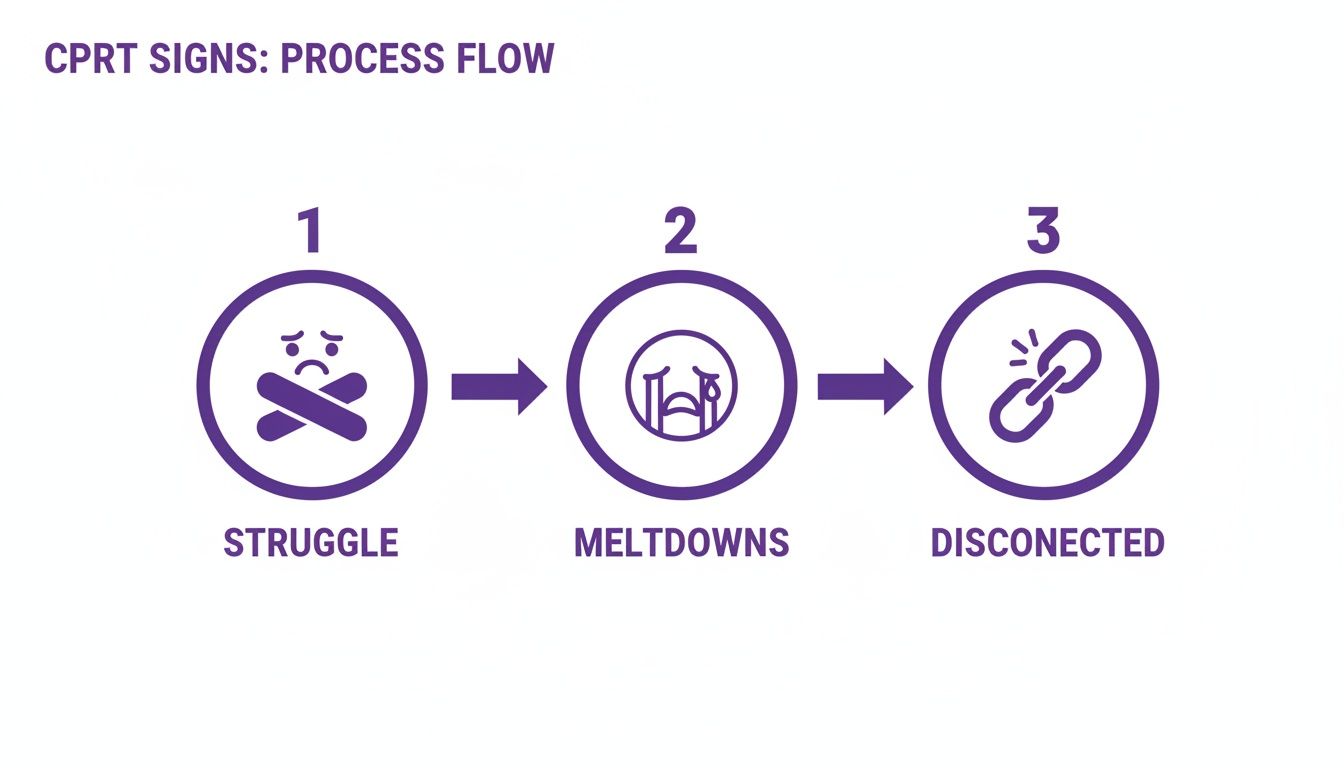
As you can see, feelings of constant struggle and frequent meltdowns can lead to a sense of disconnection. CPRT is designed specifically to heal that gap and bring you closer together.
How CPRT Supports All Kinds of Families

Families don't come in one shape or size, and neither should effective therapy. The real power of Child Parent Relationship Therapy (CPRT) lies in its adaptability—it has proven successful across a huge range of family structures, cultural backgrounds, and unique challenges.
At its heart, CPRT is all about strengthening the fundamental human need for secure connection. That’s a goal that resonates with every family, no matter what it looks like. This flexibility makes it a powerful tool for families right here in the Phoenix metro area, whether you're navigating the dynamics of a blended family, co-parenting after a divorce, or raising a child with specific emotional needs.
A Healing Approach for Adoptive Families
Families formed through adoption often face a distinct set of challenges rooted in attachment and trust. A child who has experienced early loss or instability can find it difficult to feel secure, leaving parents feeling stressed and unsure of how to bridge that emotional gap. This is where CPRT shines.
It directly addresses these core issues by teaching parents how to become a consistent source of empathy and safety during dedicated "special playtime." This isn't just about playing games; it's about giving parents a concrete way to show their child, "I'm here for you. I can handle your big feelings. You are safe with me." Over time, this process helps rewire a child's internal sense of security, building the trusting bond that allows a family to truly thrive.
The results speak for themselves. A key dissertation study from the University of North Texas looked at 61 adoptive parents and found that CPRT led to a significant drop in child behavior problems, lowered parent-child relationship stress, and boosted parental empathy. It shows just how well CPRT can equip parents with the specific skills needed to foster deep healing. You can dig into the research behind CPRT for adoptive families to learn more.
CPRT honors the unique journey of every family. By focusing on the universal principles of empathy, connection, and secure attachment, it provides a flexible framework that can be tailored to meet your family's specific history, culture, and needs.
Universal Principles for Your Unique Family
No matter your family's background, the core skills you learn in CPRT are designed to strengthen your connection. The principles are universal, but the application is deeply personal.
- For Blended Families: CPRT can help a parent and stepchild build a brand-new, secure bond based on trust and understanding, creating a positive dynamic all their own.
- For Single-Parent Households: The approach empowers single parents, helping reduce feelings of isolation while providing effective tools to manage stress and build a strong, resilient relationship.
- Across Cultural Backgrounds: The skills of empathetic listening and child-led play are respectful and adaptable. Families can easily integrate them in a way that feels authentic to their own cultural values and communication styles.
Ultimately, CPRT operates on the belief that you are the expert on your child. The therapy doesn't hand you a rigid set of rules. Instead, it offers a proven roadmap and empowers you to become the confident, attuned "emotional coach" your child truly needs.
Find a reVIBE Location Near You!
Taking that first step to strengthen your family’s bond is a huge deal. It’s a brave move, and finding the right professional support nearby is absolutely key to making it work. For families here in Arizona, reVIBE Mental Health offers a warm, judgment-free space where your child parent relationship therapy journey can begin.
We believe professional help should make your life easier, not add another layer of stress. That's why we have five convenient locations across the Phoenix metro area. Whether you need support close to home, work, or your child's school, our clinics are situated to make your visit as simple as possible.
Your Local reVIBE Mental Health Centers
We currently have five locations for your convenience. (480) 674-9220
reVIBE Mental Health – Chandler
3377 S Price Rd, Suite 105, Chandler, AZreVIBE Mental Health – Phoenix Deer Valley
2222 W Pinnacle Peak Rd, Suite 220, Phoenix, AZreVIBE Mental Health – Phoenix PV
4646 E Greenway Road, Suite 100, Phoenix, AZreVIBE Mental Health – Scottsdale
8700 E Via de Ventura, Suite 280, Scottsdale, AZreVIBE Mental Health – Tempe
3920 S Rural Rd, Suite 112, Tempe, AZ
Care That Fits Your Family's Life
We get it—modern family life is a whirlwind. Juggling school, work, and after-school activities can make finding time for therapy feel next to impossible. To make sure every family can get the care they need, reVIBE offers flexible scheduling, with appointments available seven days a week.
We also offer both in-person sessions and secure online telehealth appointments. This flexibility is a game-changer for approaches like CPRT. In fact, research on online child parent relationship therapy for kids aged 3-10 shows it’s just as effective at reducing challenging behaviors, bringing high-quality support right into your home. Learn more about the success of online CPRT delivery.
Your family’s well-being is our top priority. Our integrated team—from play therapists to psychiatrists—works together to create a personalized plan that meets you right where you are. We also accept most major insurance plans to make sure care is as affordable as it is effective.
Our whole goal is to make things seamless, right from your first call. We're here to help you sort out insurance, match you with the right therapist, and build a plan that empowers your family to reconnect and thrive. If you're looking into different ways to strengthen your family unit, you might find our guide on family counseling options helpful, too.
Frequently Asked Questions About CPRT
Starting any new therapy journey naturally comes with questions. When you're considering something as important as child parent relationship therapy for your family, getting clear answers helps you feel confident and ready for what's ahead.
We’ve gathered some of the most common questions we hear from parents just like you. Our aim is to give you straightforward, practical information so you can make a well-informed decision for your child and your family.
What Is the Best Age for a Child to Start CPRT?
CPRT really hits its stride with children between the ages of 3 and 10 years old. This window is ideal because young kids communicate and understand their world through play—it's their natural language.
Since the entire therapy model is built around parent-led play sessions, it meets children right where they are developmentally. In that playful space, kids can work through big feelings they don't have the words for yet, making the process feel both organic and incredibly powerful.
How Is CPRT Different from Just Sending My Child to Therapy?
This is a great question, and the difference is key. Traditional play therapy focuses on the bond between the therapist and the child, which can absolutely be helpful. CPRT, however, does something unique: it puts you, the parent, at the very heart of the healing process.
Rather than having an expert work with your child for an hour a week, CPRT empowers you to become the therapeutic agent in your child’s life. You're not learning temporary fixes; you're building lifelong connection skills that strengthen your bond long after you've finished the program.
How Will I Know If CPRT Is Working for My Family?
You'll start to see progress not in grand, overnight changes, but in small, meaningful shifts in your everyday interactions. It’s less about just stopping a specific behavior and more about a positive change in the emotional atmosphere of your home.
Keep an eye out for progress in these areas:
- In Your Child: You might notice that big emotional outbursts happen less often or aren't as intense. Your child may become more cooperative and start using their words to tell you what’s wrong instead of acting out.
- In Your Relationship: Those constant power struggles may start to dissolve, making way for more enjoyable, positive moments together. Many parents say they feel a much deeper connection and understanding with their child.
- In Yourself: You'll likely feel more confident and less stressed as a parent. When challenging moments do come up, you’ll feel better equipped to handle them with a sense of calm and empathy.
These changes tend to build on each other, creating a ripple effect that strengthens your whole family and brings a sense of peace back into your home.
Ready to explore how child parent relationship therapy can bring healing and connection to your family? The compassionate team at reVIBE Mental Health is here to support you with five convenient locations across the Phoenix area. We offer flexible scheduling and accept most major insurance plans to make getting started as simple as possible. Learn more and book an appointment at https://revibementalhealth.com.