
A 34-year-old professional walks out of a routine meeting with her chest tight and her thoughts racing. One pointed comment has become evidence that she's failing, disappointing everyone, or about to lose control of her career. She replays the exchange through lunch, snaps at her partner that evening, then lies awake feeling guilty, ashamed, and exhausted.
The reaction may seem disproportionate from the outside, but it feels immediate and physically convincing from within. This cycle, escalation, behavioral fallout, rumination, and a crash, can affect work, relationships, sleep, and self-image. Intelligence and effort don't necessarily stop it because the problem isn't a lack of insight. It's often a problem of regulation, and regulation is a skill set that can be assessed and strengthened.
When Your Feelings Run the Show
Adults living with emotional dysregulation often recognize the pattern only after the intensity has passed. During the moment, the body reacts first. A message feels threatening, a change of plans feels rejecting, or a small criticism lands like a verdict. The person may raise their voice, send several texts, withdraw completely, or make an impulsive decision before they have time to consider the consequences.
By evening, the original event may be over, but the nervous system is still reviewing it. The mind searches for additional proof, reconstructs the conversation, and predicts what will happen next. That rumination keeps the emotional system activated, which makes another outburst or shutdown more likely.
The pattern beneath the reaction
The outward behavior can vary widely. One adult becomes visibly angry. Another becomes tearful, restless, sarcastic, or numb. Someone else appears calm at work and then releases the accumulated tension at home, where the consequences feel safer but the damage can be greater.
Common effects include:
- Work strain: Feedback feels personal, conflict becomes difficult to repair, and concentration drops after emotionally charged interactions.
- Relationship tension: A partner may experience rapid shifts between closeness, anger, withdrawal, and urgent reassurance-seeking.
- Sleep disruption: Replaying conversations and anticipating rejection can keep the body alert long after the immediate trigger has ended.
- Self-criticism: The crash after an outburst can produce shame, hopelessness, and the belief that something is wrong with you.
A more useful interpretation: The reaction may reflect a nervous system that needs better regulation tools, not a person with a defective character.
Emotional dysregulation in adults is also not limited to people who appear visibly reactive. Some adults suppress emotion until it becomes overwhelming. Others overexplain, people-please, avoid difficult conversations, or disconnect from their bodies. The common thread is difficulty adjusting emotional intensity and behavior to the demands of the moment.
This pattern can persist because avoidance, reassurance-seeking, anger, and withdrawal provide short-term relief. They may reduce distress briefly, while creating longer-term problems that become new triggers. Learning to interrupt that loop takes practice, support, and an accurate understanding of what drives it.
What Emotional Dysregulation Means
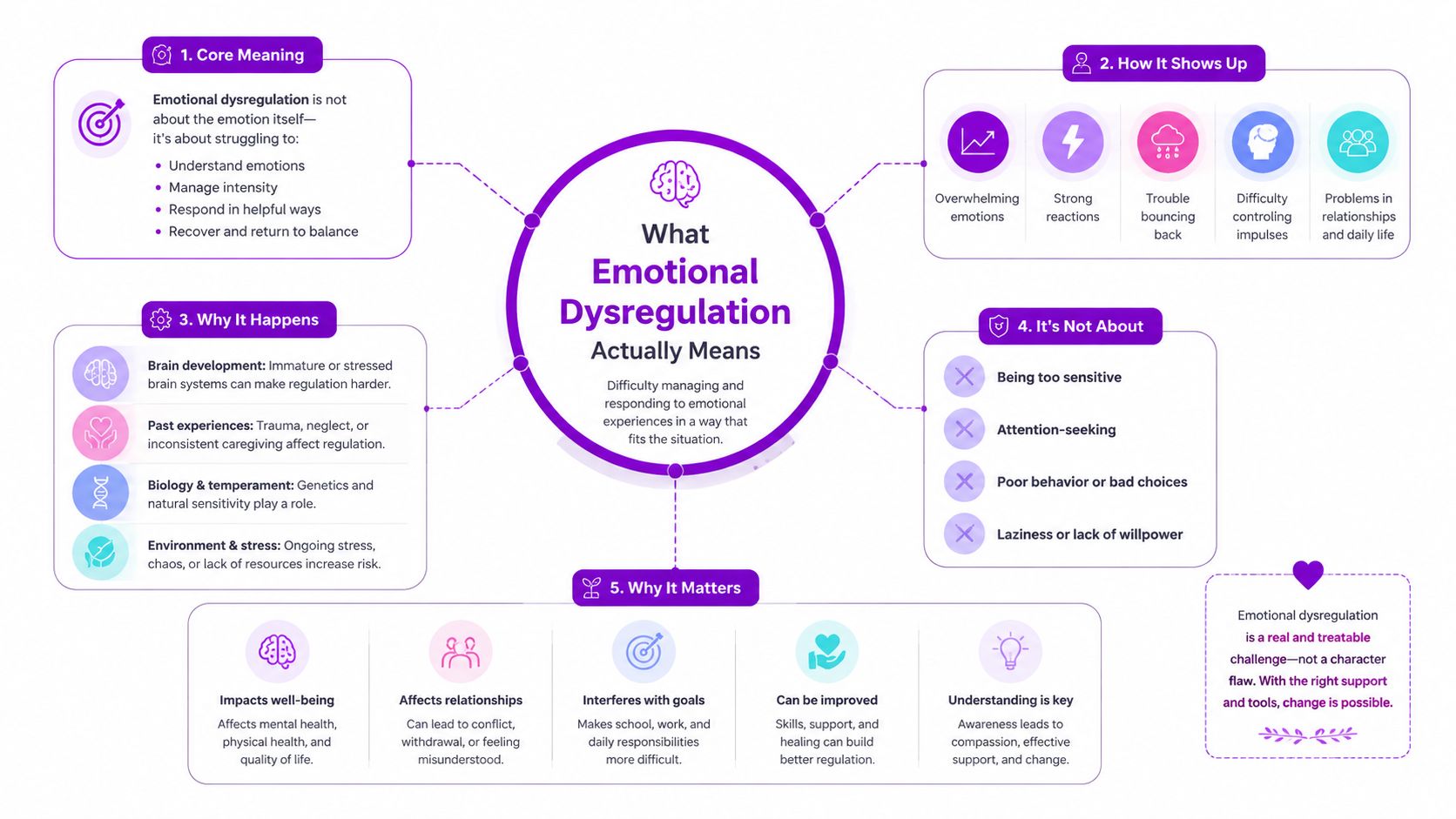
Emotional dysregulation describes difficulty managing emotions and the behaviors that follow them. It is a symptom pattern, not a standalone diagnosis. Clinical sources describe it as a brain-related difficulty that can continue from childhood into adulthood and often appear alongside mental-health or neurodevelopmental conditions. Cleveland Clinic's overview of emotional dysregulation explains it in practical terms: emotional responses become difficult to manage, along with the actions they prompt.
The pattern has several dimensions: emotional intensity, speed, duration, and expression. A strong reaction can still be part of ordinary regulation if it settles as the situation changes. Dysregulation becomes more likely when a response escalates rapidly, lasts well beyond the trigger, leads to unwanted behavior, or repeatedly disrupts important goals.
Six mechanics clinicians look for
The Gratz and Roemer framework gives clinicians and adults a more precise vocabulary for examining the pattern:
- Awareness: You may sense that something is wrong without identifying the emotion or its bodily signals.
- Clarity: Anger, fear, shame, sadness, disappointment, and rejection may feel difficult to separate.
- Acceptance: Judging an emotion as unacceptable can add shame and urgency to the original feeling.
- Strategies: You may understand that calming down would help but lose access to effective tools as arousal rises.
- Goal-directed behavior: Distress may interfere with continuing a task, communicating clearly, or making a measured decision.
- Impulse control: You may respond quickly through texting, spending, substance use, self-harm, aggression, or abrupt withdrawal.
The model is also summarized through four broader abilities: noticing emotions, understanding and accepting them, accessing adaptive strategies, and pursuing goals while distressed. The six domains offer more detail about where regulation tends to break down. A plain-language discussion of the Gratz and Roemer model explains why regulation involves more than just “calming down.”
A thermostat analogy
Emotional regulation works like a thermostat. A regulated system detects a change, adjusts its response, and gradually returns toward its set point. A dysregulated system may detect too much, react too fast, apply too much force, or take too long to settle.
State dysregulation may arise during an acute stressor, recent trauma, sleep disruption, medication change, or major loss. Trait dysregulation is more persistent and may appear across relationships, settings, or developmental periods. These labels are not self-diagnoses. They help a provider consider whether the pattern is situational, longstanding, or both.
A cross-cultural study of 9,238 adults aged 18 to 59 across 10 societies identified a distinct dysregulated group in every society. Prevalence ranged from 6.1% to 12.7%, with a mean of 9.2%. The finding supports emotional dysregulation as a broad adult mental-health concern that can travel across diagnoses rather than belonging to one condition alone. The study's PubMed record provides the population and prevalence details.
What Causes It and What It Shows Up Alongside
The same outward reaction can come from very different internal pathways. A person who becomes furious after a delayed reply may be responding to rejection sensitivity associated with ADHD, a trauma-based expectation of abandonment, anxiety-driven threat interpretation, unstable mood, or exhaustion from poor sleep. The behavior alone doesn't identify the cause.
Childhood adversity and complex trauma can shape the way a person detects threat and interprets relationships. A nervous system trained by repeated danger may respond to ambiguity as though it signals immediate harm. Trauma can also produce dissociation, emotional numbing, sudden flooding, or intense efforts to regain safety.
Borderline personality disorder is strongly associated with emotion regulation difficulties, but dysregulation can also accompany other personality patterns. In adult ADHD, emotional impulsivity, low frustration tolerance, and rejection sensitivity may appear alongside attention and executive-function difficulties. A review reported emotional dysregulation in about 30% to 70% of adults with ADHD, while a clinic-based study of 536 adults found that 32% met a defined threshold for emotion dysregulation. The adult ADHD review details these findings.
Why the upstream driver matters
Bipolar-spectrum conditions can intensify emotional reactivity during mood episodes. Anxiety disorders and PTSD can keep the body in a state of hyperarousal. Depression may blunt emotion for a period and then leave the person vulnerable to sudden waves of despair, irritability, or anger. Sleep disorders, substance use, hormonal changes, and chronic medical conditions can amplify an existing vulnerability or create a new one.
Emotional dysregulation is therefore transdiagnostic, meaning it can travel across ADHD, bipolar disorder, autism, personality disorders, depression, trauma-related conditions, anxiety, and sleep-related problems. A recent review also describes different treatment responses across these presentations, including medication, DBT, CBT, schema therapy, ACT, mindfulness-based work, biofeedback, and family-system interventions. The review of emotion dysregulation across conditions supports assessing the pattern rather than assuming one universal explanation.
Treating the visible reaction without identifying its driver can bring partial relief while leaving the main cycle intact.
Adults who notice intense fear of abandonment, rapid relational shifts, or repeated reassurance-seeking may also find it useful to review abandonment issues symptoms in adults as a starting point for reflection, not as a substitute for assessment.
| Condition or Driver | Distinctive Signature | Treatment Implication |
|---|---|---|
| Trauma or PTSD | Threat sensitivity, flooding, avoidance, nightmares, or dissociation | Trauma-informed therapy and stabilization before deeper processing |
| ADHD | Rapid emotional shifts, impulsivity, frustration intolerance, or rejection sensitivity | ADHD assessment, executive-function support, skills training, and possible medication evaluation |
| Bipolar spectrum | Reactivity linked with distinct mood episodes, energy changes, or reduced need for sleep | Psychiatric assessment and mood-focused treatment |
| Anxiety disorders | Worry, hypervigilance, physical arousal, and threat-focused interpretation | CBT, exposure-based work, medication evaluation, and regulation skills |
| Depression | Low mood, withdrawal, rumination, irritability, or emotional shutdown | Depression treatment, behavioral activation, psychotherapy, and prescriber support |
| Sleep, substances, hormones, or medical conditions | Symptoms fluctuate with sleep loss, use, withdrawal, physical illness, or hormonal changes | Medical review and treatment of the amplifying condition |
How Providers Assess and Diagnose It
A thoughtful evaluation begins with the person's timeline, not with a label. The clinician will usually ask what happens before the reaction, how quickly it rises, what the person does during it, how long recovery takes, and what consequences follow. Specific examples are more useful than a general statement such as “my emotions are out of control.”
The interview may include developmental history, family mental-health history, trauma exposure, mood symptoms, anxiety, substance use, medication changes, physical health, and sleep. A provider may ask whether intense reactions occur only in certain relationships or settings, whether they appear in episodes, and whether there are periods of unusually high energy, reduced need for sleep, or impulsive behavior that require evaluation for bipolar-spectrum involvement.
Questionnaires support judgment
Validated measures can organize the assessment, but they aren't pass-fail tests. Common tools include:
| Tool | What It Measures |
|---|---|
| DERS-16 | Difficulties with emotional awareness, clarity, acceptance, strategies, impulse control, and goal-directed behavior |
| PCL-5 | PTSD symptoms and trauma-related distress |
| PHQ-9 | Depressive symptoms and their functional effects |
| GAD-7 | Generalized anxiety symptoms |
| ASRS | Adult ADHD symptoms and related impairment |
The provider interprets scores alongside the interview, medical context, observed behavior, and functional impact. A high score can identify an area for discussion. It doesn't establish a diagnosis by itself.
When integrated care matters
Active self-harm, recent trauma, dissociation, co-occurring substance use, or unstable mood can make a coordinated treatment plan especially important. The clinician may recommend therapy, psychiatric care, medical evaluation, or crisis support rather than treating emotional reactivity in isolation.
The clinical note may document emotional dysregulation as a transdiagnostic feature, while the billable diagnosis reflects the underlying condition being evaluated or treated. That distinction can feel confusing, but it helps providers communicate that the symptom is real while avoiding the assumption that it represents one standalone disorder.
Evidence-Based Treatments Worth Knowing
Treatment selection works better when it follows the dominant pattern. The question isn't “Which therapy is most popular?” It's “What keeps happening, and which intervention directly targets that mechanism?”
Dialectical Behavior Therapy, or DBT, is a strong fit when emotions shift rapidly and distress leads to self-harm urges, explosive behavior, or relationship crises. It combines mindfulness, distress tolerance, emotion regulation, and interpersonal effectiveness. Adults who want a deeper overview can read about what dialectical behavior therapy involves.
Cognitive Behavioral Therapy, or CBT, focuses on the thoughts and interpretations that intensify emotion. It may help when rumination, catastrophic predictions, mind-reading, or rigid self-judgments keep the body activated. CBT doesn't argue that feelings are irrational. It examines whether the thoughts attached to them are accurate, useful, and flexible.
EMDR may fit trauma-rooted reactivity, especially when present-day situations trigger vivid body memories, fear, shame, or a sense of being back in the original danger. Trauma treatment usually requires careful pacing and stabilization. Processing isn't the first step for every person who has experienced trauma.
Matching the approach to the pattern
Acceptance and Commitment Therapy, or ACT, helps adults notice painful internal experiences without allowing those experiences to dictate every action. It can be useful when avoidance has narrowed a person's life and values-based behavior needs to continue even while distress is present.
Schema therapy addresses long-standing emotional patterns connected with early relationships, such as abandonment, defectiveness, mistrust, or emotional deprivation. It may be particularly relevant when the same relationship cycle repeats across many years.
Medication can support treatment when an underlying condition calls for it. SSRIs and SNRIs may be considered for anxiety or depression. Mood stabilizers or atypical antipsychotics may be considered in bipolar-spectrum presentations or selected borderline presentations. Stimulants or non-stimulants may be evaluated when ADHD co-occurs. A prescriber should make these decisions after reviewing symptoms, medical history, current medications, sleep, substance use, and mood patterns.
A 2024 updated review found beneficial effects from both medication and psychotherapy for emotional dysregulation, and reported that digital delivery of non-pharmacological interventions may be as effective as in-person delivery in the reviewed contexts. The updated review of interventions also reflects the field's move toward targeted treatment rather than generic coping advice.
Biofeedback and neurofeedback may serve as adjuncts for selected adults, particularly when learning to notice arousal and practice physiological regulation. They shouldn't replace a full assessment or evidence-based treatment for serious symptoms.
Skills You Can Start Practicing This Week
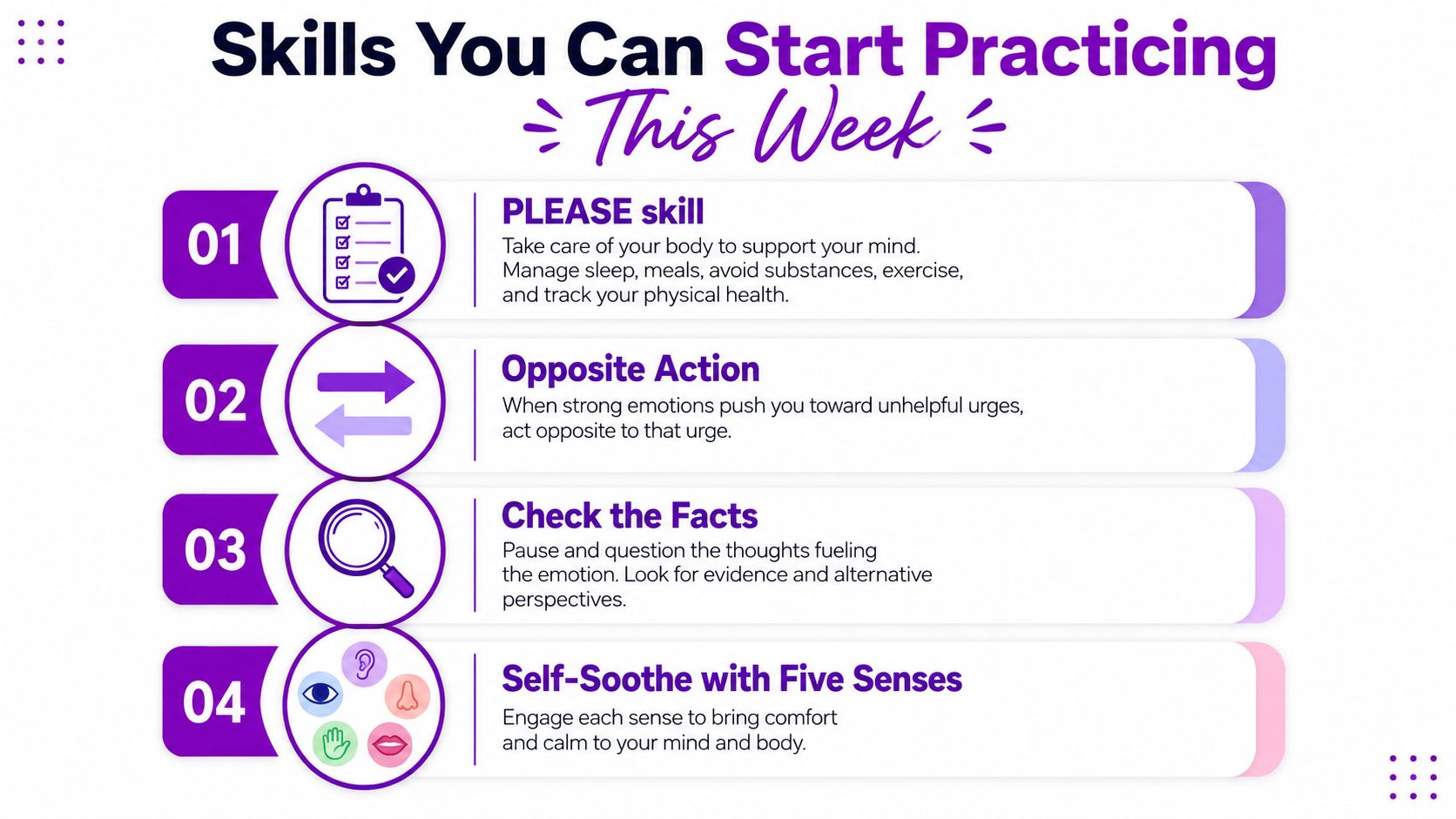
Treat these practices as experiments, not tests you can fail. The aim is to notice whether a small change gives your nervous system more room to choose a response.
Start with PLEASE, a DBT reminder to reduce biological vulnerability. Protect sleep, eat regularly, avoid substances that worsen reactivity, move your body in a manageable way, and attend to physical illness or health changes. A tired, hungry, intoxicated, withdrawing, or physically unwell body has fewer resources available for emotional control.
Try opposite action when an emotion urges you toward a behavior that doesn't fit the facts or your long-term goals. If fear tells you to avoid a safe conversation, a measured approach may be to prepare what you want to say and remain present. If shame tells you to isolate, a small act of appropriate connection may interrupt the cycle.
Work inside your window
The window of tolerance is the range in which you can feel emotion and still think, communicate, and make choices. Notice early signs that you're moving outside it, such as clenched muscles, racing thoughts, numbness, a hot face, or the urge to send an immediate message.
Paced breathing can help slow the physical escalation. Cold-water orienting, such as briefly holding a cool cloth to your face or noticing the temperature of water on your hands, can give attention a concrete sensory anchor. These are short-term tools, not ways to erase the reason you became upset.
Practice sentence: “I'm noticing fear and urgency. I can feel both without making the next decision from them.”
ACT-style emotion labeling can reduce fusion with the feeling. Instead of “I'm rejected,” try “I'm noticing a fear of rejection.” Instead of “I'm furious and must respond,” try “Anger is present, and it's pushing me toward immediate action.”
Skills may reduce the frequency or intensity of episodes, but they won't remove every trigger. Seek professional care when reactions involve dissociation, self-harm, substance misuse, repeated relationship-damaging outbursts, or persistent impairment. A crisis response is appropriate when you may hurt yourself or someone else.
For a broader foundation, learning how to build emotional intelligence can complement therapy by strengthening emotional vocabulary, self-awareness, and interpersonal skills.
Finding the Right Provider Near You
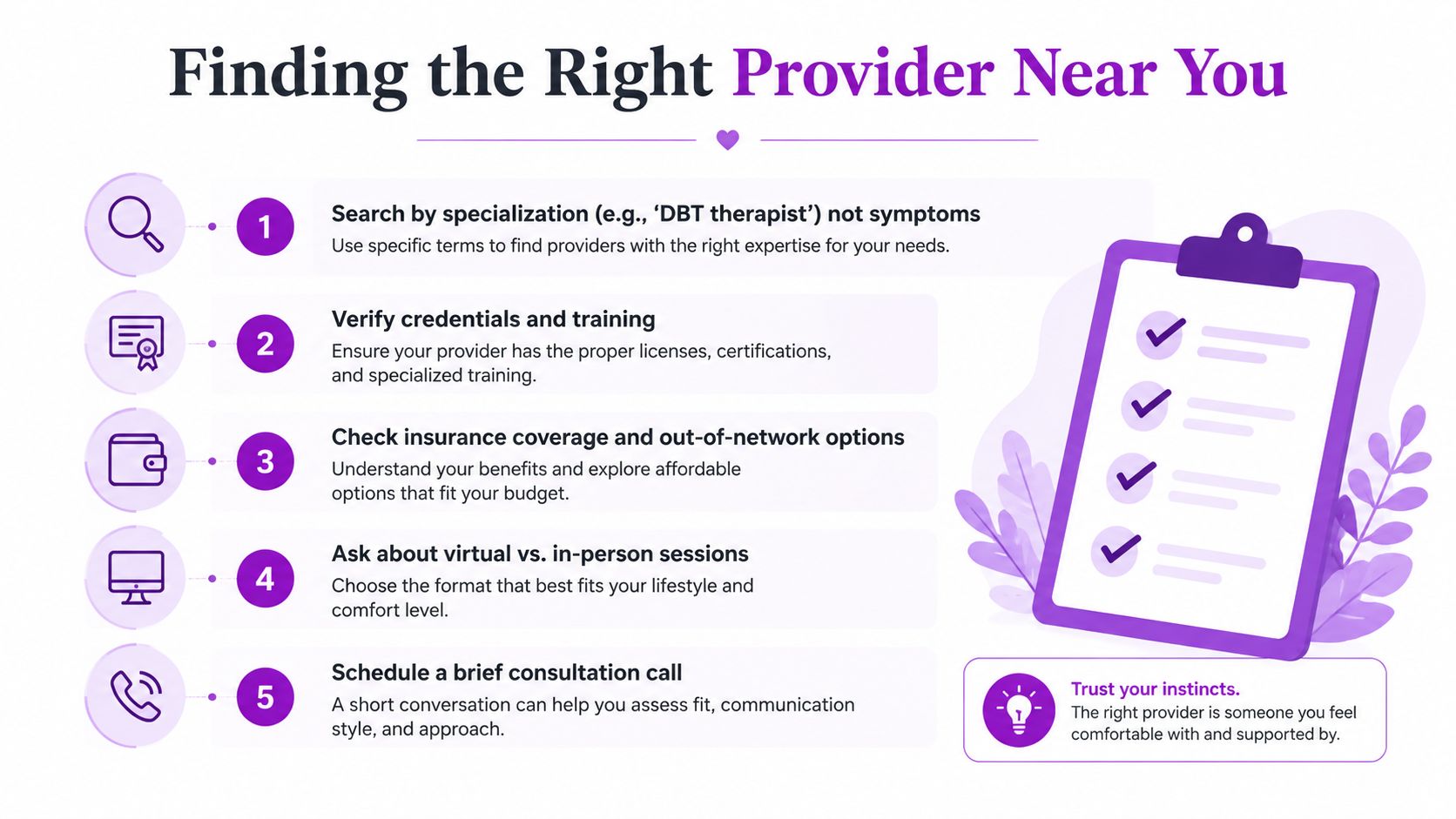
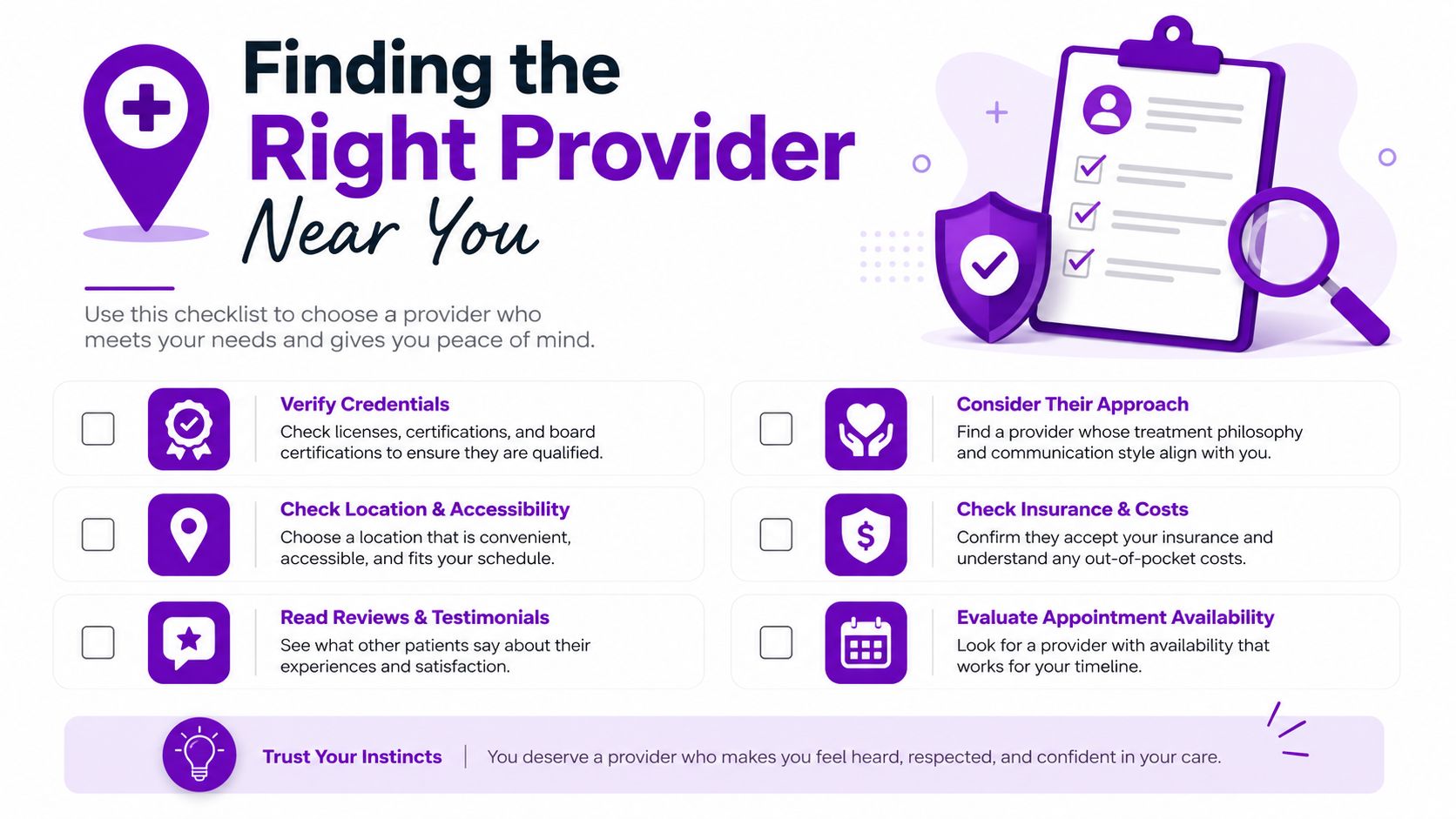
Search by the treatment approach or clinical pattern, not only by the symptom. Terms such as DBT therapist, EMDR therapist, trauma-focused therapist, ADHD specialist, or schema therapist will usually produce more relevant results than a broad search for “anger” or “mood swings.”
Before scheduling, ask direct questions:
- Training: What credentials and formal training does the clinician have in DBT, EMDR, CBT, ACT, or schema therapy?
- Format: Do they offer individual sessions, groups, family work, or psychiatric coordination?
- Frequency: What session schedule do they typically recommend at the beginning?
- Safety: What crisis protocol applies outside office hours?
- Coordination: Can the therapist communicate with a psychiatrist or primary-care clinician when appropriate?
Insurance verification deserves specific attention. Ask whether the provider is in-network, which services and CPT codes are covered, what deductible or coinsurance applies, and whether out-of-network benefits are available. If coverage is limited, ask about sliding-scale options, payment plans, or a referral to a clinician with a different fee structure.
Telehealth and in-person care
Telehealth can make care easier to attend, particularly when transportation, work schedules, or privacy create barriers. State licensure rules still apply, so confirm that the clinician can legally provide care where you are located during the session.
In-person treatment may be useful when trauma work involves strong physical reactions, when dissociation needs close monitoring, or when the therapeutic relationship feels difficult to establish online. Neither format is automatically better. The practical choice depends on safety, access, preference, and clinical fit.
reVIBE Mental Health provides therapy, EMDR, psychiatry, and medication management through an integrated team serving the Phoenix metro area. Its locations offer in-person care, secure online sessions, and help with insurance verification, which can simplify the process of finding therapy and psychiatric support in one practice.
A Clear Path Forward
Emotional dysregulation is a signal, not an identity. It tells you that emotions, attention, threat responses, behavior, or recovery are becoming difficult to manage. It doesn't tell you that you're dramatic, broken, or destined to repeat the same reactions.
The right next step depends on the driver. DBT may fit rapid escalation and self-harm urges. CBT may address rumination and interpretations. EMDR may be appropriate for trauma-linked activation. ACT and schema therapy may help when avoidance or long-standing relationship patterns keep the cycle going. Medication can be part of care when anxiety, depression, ADHD, bipolar-spectrum symptoms, or another condition warrants a prescriber's evaluation.
Progress is usually gradual, and setbacks are part of learning. Choose a clinician who understands emotional regulation and can adjust the plan as the pattern becomes clearer. This week, schedule one intake call, bring two or three specific examples, and ask about training, safety, format, insurance, and coordination. That call doesn't need to solve everything. It can be the point at which change becomes practical.
reVIBE Mental Health offers therapy, EMDR, psychiatry, and medication management for adults dealing with emotional dysregulation, anxiety, depression, ADHD-related concerns, and trauma. Visit reVIBE Mental Health to explore in-person and secure online care, review available locations, and schedule an intake conversation.