

A small disagreement at home rarely stays small. One person asks about dishes, homework, money, curfew, or a missed text. Someone else hears criticism. Voices sharpen. A child goes quiet or starts yelling. A teenager slams a door. By the end of the night, nobody is arguing about the original issue anymore.
That spiral is exhausting, but it doesn't mean your family is broken. It usually means your family is caught in a pattern. Patterns feel personal when you're inside them. They can also be changed.
Conflict is common. In England and Wales, government data for 2019 to 2020 showed that 12% of children in couple-parent families lived with a parent reporting relationship distress according to the parental conflict indicator. That matters because many families assume they should be able to fix conflict with one good conversation. In practice, family conflict resolution usually takes more than good intentions. It takes structure, timing, and a better understanding of what the argument is really about.
Understanding Why Family Conflict Feels So Overwhelming
Family conflict hits differently from conflict at work or with acquaintances because the stakes feel higher. Home is where people expect safety, loyalty, and relief. When tension shows up there, people don't just feel irritated. They feel let down, exposed, and often misunderstood.
A parent may think, "Why is everyone fighting me on basic responsibilities?" A child may think, "Nobody listens unless I explode." A partner may think, "I'm carrying too much and getting blamed anyway." All three can be happening in the same room.
Conflict touches identity, not just behavior
In families, arguments often attach themselves to deeper meanings:
- A request becomes a judgment: "Please help more" gets heard as "You're failing."
- A limit becomes rejection: "Not tonight" gets heard as "You don't matter."
- A disagreement becomes a threat: "I see this differently" gets heard as "We're not on the same team."
That's why calm advice can feel useless in the moment. The nervous system reacts before the thoughtful part of the brain catches up. If your family keeps having the same fight in different forms, that usually isn't because nobody cares. It's because everyone is protecting something important, and they're doing it poorly.
Practical rule: If the reaction looks bigger than the issue, the real issue is probably underneath the conversation you're hearing.
Daily pressure makes this worse. Work schedules, caregiving, school demands, commute fatigue, and constant device interruptions leave families with less patience than they think they have. If your household already feels stretched, practical support outside the therapy room can matter too. For readers juggling overloaded calendars, this guide for busy professionals to master schedule offers useful ideas for reducing pressure that often spills into family interactions.
Family systems make conflict feel contagious
One tense exchange rarely stays between two people. It moves through the household. A disagreement between parents can change a child's mood. A child's distress can increase tension between adults. A teen's withdrawal can pull everyone into worry, criticism, or pursuit. That's one reason a family systems perspective is so useful. It helps families stop looking for one person to blame and start looking at how the whole system reacts.
A lot of families feel ashamed about conflict. That shame gets in the way. Family conflict resolution works better when people treat conflict as a sign that something needs attention, not as proof that love is gone. The goal isn't a home with zero disagreement. The goal is a home where disagreement doesn't keep turning into damage.
Identifying Conflict Triggers Beyond the Obvious
Most families can name the topic of the fight. Fewer can name the driver behind it.
The topic might be screen time, chores, curfew, parenting decisions, spending, or who said what at dinner. The driver is often something less visible, and more powerful.

The argument you see is not always the problem you have
Family counseling guidance notes that recurring arguments are often fueled by hidden stressors such as unresolved grief, major life transitions, sibling rivalry, and trauma recovery needs in the family counseling overview from North Shore Family Counseling. That matches what many families experience. They keep trying to solve the surface disagreement while the underlying strain stays untouched.
A few examples make this easier to spot:
| Surface conflict | Possible hidden driver |
|---|---|
| Constant fights about mess or lateness | One adult feels unsupported and overextended |
| Arguments about a child's behavior | The family is still adjusting to separation, remarriage, or loss |
| Repeated tension between siblings | Competition for attention during a stressful season |
| Harsh reactions to small mistakes | Trauma history, burnout, or chronic emotional overload |
| Parent-teen power struggles | A teen's need for autonomy colliding with a parent's fear |
Sometimes a family says, "We just need better communication." Sometimes they do. But "communication problem" is often too shallow a diagnosis. If someone is grieving, panicked about money, carrying old trauma, or feeling invisible in the household, communication skills alone won't fix it.
Intergenerational patterns often run the show
People usually bring their first conflict training from the homes they grew up in. Some learned that the loudest person wins. Some learned that anger is dangerous, so they shut down. Some learned that apologies never come. Others learned to smooth things over quickly without ever repairing the underlying hurt.
Those patterns show up in adult relationships and in parenting. A parent who was criticized as a child may become unusually reactive to a teenager's tone. A partner raised in a home where nobody talked about feelings may see emotional conversations as attacks. Attachment patterns can shape this too. If you're trying to understand why closeness and conflict can feel tangled together, this explanation of insecure attachment in psychology gives helpful context.
Families often make more progress when they stop asking, "Why are we fighting about this again?" and start asking, "What does this conflict protect, express, or repeat?"
A better diagnostic question
Before trying to resolve a conflict, ask:
- What changed recently: loss, transition, school pressure, job strain, health issues?
- Who feels unheard: not theoretically, but in day-to-day decisions?
- What old story is getting activated: "I don't matter," "I'm alone in this," "I'm failing," "Nobody respects me"?
- What pattern repeats across generations: avoidance, yelling, criticism, triangling, silent treatment?
Family conflict resolution becomes more useful than generic advice. It moves from "say it nicer" to "understand what this fight is carrying."
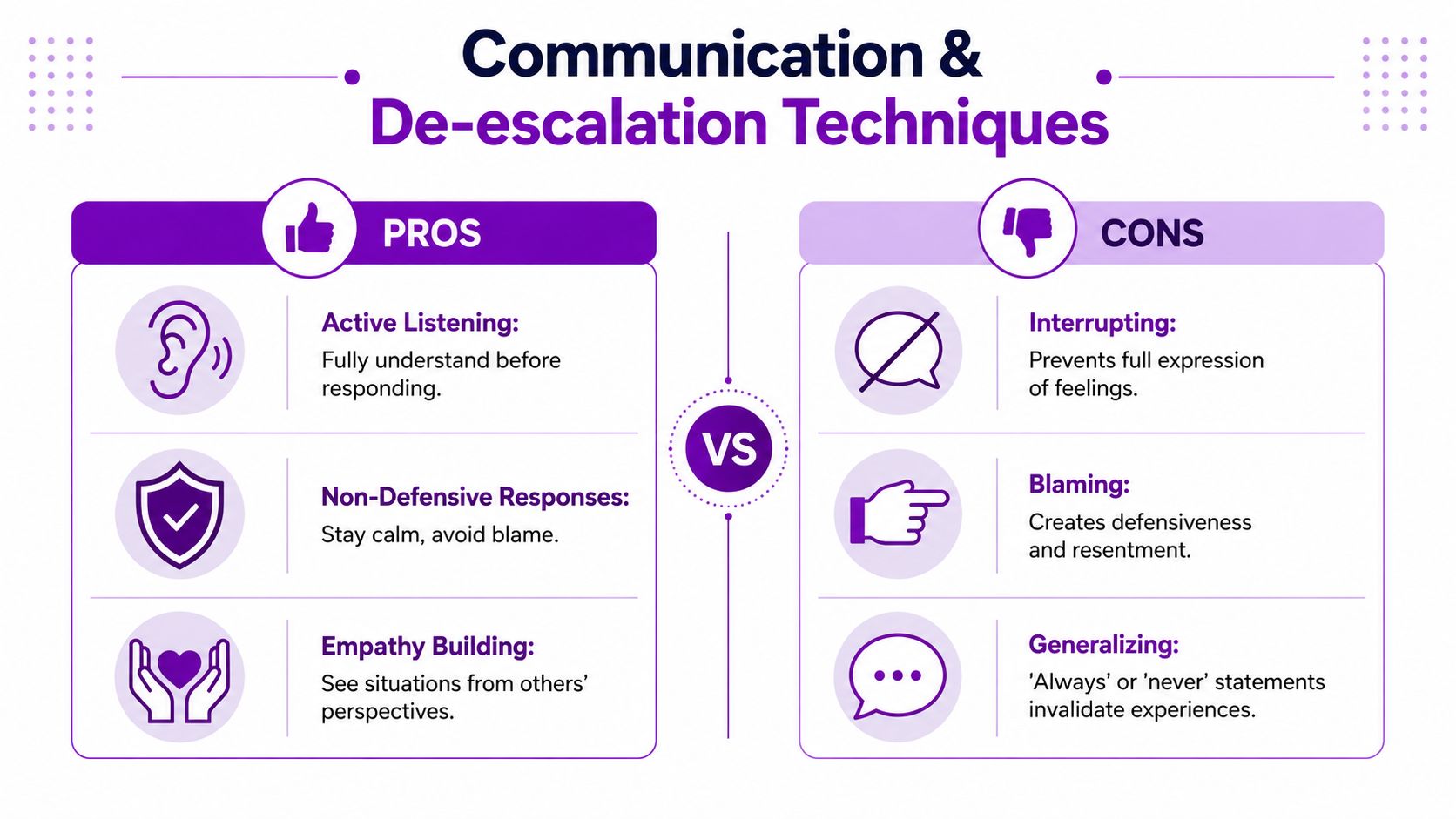
Mastering Communication and De-escalation Techniques
Communication skills matter. They just aren't magic. A calm sentence won't solve a conversation that isn't safe, balanced, or ready to happen.
That matters because a lot of advice assumes both people can participate honestly and regulate themselves enough to listen. In some families, that's true. In others, one person interrupts, dominates, intimidates, or weaponizes vulnerability. In those situations, standard advice falls apart.
Start with regulation, not persuasion
Most family arguments get worse because each person tries to prove their point while the other person is already flooded. When emotion is high, persuasive talking usually sounds like pressure.
Use this sequence instead:
Name the temperature of the moment.
Say, "We're both getting activated," or "This isn't going well right now."Slow the pace.
Lower your voice. Shorten your sentences. Ask one question at a time.Reflect before responding.
Try, "What I'm hearing is that you felt dismissed when I decided without you."Respond to the feeling before the content.
If someone feels embarrassed, ignored, or cornered, address that first.Come back to one issue.
Don't pull in last month, last year, or every related grievance.
Useful de-escalation phrases include:
- To pause without abandoning: "I want to keep talking, and I need ten minutes so I don't make this worse."
- To reduce defensiveness: "You may be right about part of that."
- To show effort without fake agreement: "I don't see it the same way yet, but I want to understand your side."
- To keep the issue contained: "Let's stay with tonight's problem."
Repair matters more than winning
Guidance on family relationships highlights that power imbalances and safety are often overlooked, and that effective conflict work may require repair, boundaries, pausing dialogue, or involving a neutral third party rather than simple compromise, as discussed in the Clay Center's article on the positive value of conflict. That distinction is important.
Repair means reconnecting after harm. It isn't just ending the fight. It includes acknowledging impact, clarifying what happened, and checking whether trust needs to be rebuilt.
A repair attempt can sound like this:
"I was too harsh. I can see that I shut you down. I want to try again and hear what you were saying."
Notice what's missing. No excuse. No "but." No hidden counterattack.
When direct conversation isn't the right tool
Family conflict resolution doesn't always mean sitting everyone down together right away. Sometimes that causes more harm.
Use a different approach when:
- One person is afraid to speak freely
- The conversation turns cruel or mocking
- Someone refuses every boundary
- Past harm makes direct discussion unsafe or unproductive
In those cases, the next best step may be a written exchange, staggered conversations, clear limits on topic and time, or a neutral facilitator. Pausing isn't avoidance when the goal is to prevent further damage. It's often the most responsible move in the room.
A Structured Approach to Solving Problems Together
Families do better when they have a process. Without one, every difficult conversation becomes improvisation under stress. That's when people interrupt, jump topics, and leave with different ideas about what was decided.
A structured approach doesn't make conflict robotic. It makes it fairer.
Use a meeting format, not a hallway argument
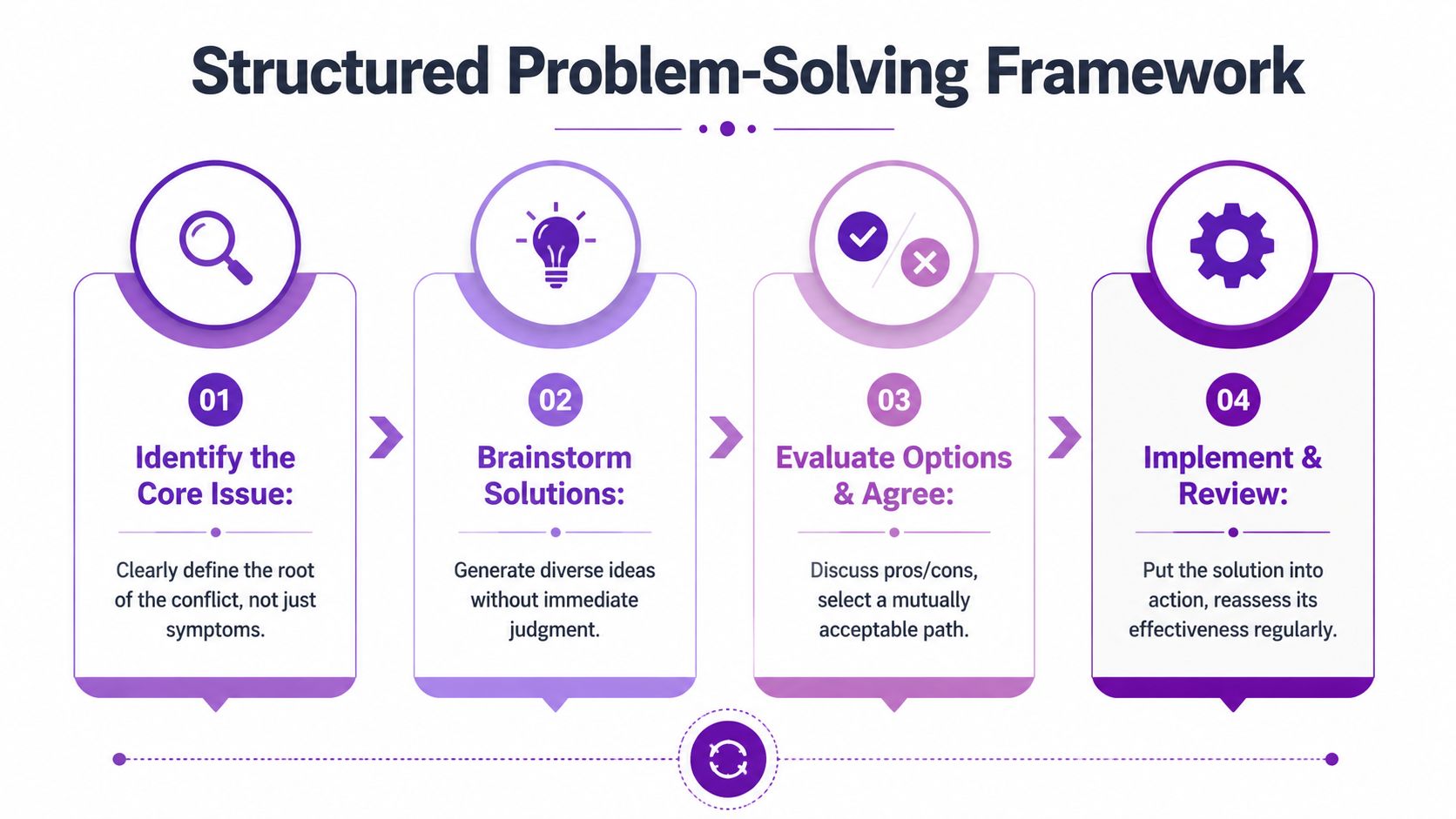
Iowa State Extension recommends a six-phase process for conflict management: initiate dialogue, involve all parties, assimilate facts and feelings, reinforce agreements before negotiating disagreements, rank disputes by starting with the easiest, and solidify the final agreement with a clear commitment in its six-phase conflict method. That sequence works well for families because it slows down the rush to blame.
A practical family version looks like this:
- Set the container: Pick a time when nobody is rushing out the door. Agree on one topic.
- Include the right people: If someone is affected by the outcome, they should have a voice that fits their age and role.
- Gather facts and feelings: What happened, and how did each person experience it?
- Name points of agreement first: Even small ones. "We both want mornings to feel less chaotic."
- Choose one solvable piece: Start where success is possible.
- Lock in the plan: Who will do what, by when, and how you'll review it.
A sample script that keeps the conversation moving
You don't need polished language. You need language that lowers threat.
Try this opener:
"We've been getting stuck on this. I don't want another argument. I want a plan that feels workable for everyone."
Then move through these prompts:
- What does each person think the problem is?
- What part is hardest for each person?
- What has already been tried?
- What would make this situation slightly better this week?
- What can each person realistically commit to?
Collaborative problem-solving holds significant importance. Families often improve faster when they stop debating intentions and start testing small agreements. For readers who want a simple outside perspective on building this skill, Playz problem-solving insights offer practical ways to think about breaking problems into manageable parts.
Keep agreements concrete
Vague agreements fail fast. "Be more respectful" sounds good and changes nothing. "No yelling after 9 p.m., and if voices rise, either person can call a ten-minute break" gives people something specific they can do.
Use this checklist before ending a family meeting:
| Question | Why it matters |
|---|---|
| Who is responsible for what | Prevents future "I thought you meant…" arguments |
| When does it start | Turns intention into action |
| What happens if someone slips | Keeps one mistake from becoming another blowup |
| When will we revisit it | Builds accountability and flexibility |
Family conflict resolution gets stronger when families treat agreements as working drafts. Review them. Adjust them. Keep what helps. Drop what doesn't.
Adapting Your Approach for Children and Teens
A good conflict strategy for adults can fail badly with kids if it ignores development. Children and teens don't process language, emotion, power, and responsibility the same way adults do. If you use one style with everyone in the house, you'll either overwhelm younger children or unnecessarily provoke older ones.
Younger children need help naming what happened
With small children, stay concrete. Long explanations usually miss them. So do lectures delivered after everyone is upset.
More useful options include:
- Label the feeling: "You were mad when your sister took the game."
- Describe the behavior separately: "Hitting isn't okay."
- Offer a simple repair path: return the item, help fix the damage, try the words again
- Use turn-taking tools: a timer, a visual chart, or one object that shows whose turn it is to talk
Children learn conflict by watching adults. If a parent snaps and later says, "I was too loud. I'm sorry. I'll try that again," that teaches more than a long speech about respect.
School-age children can practice guided problem-solving
Older children can do more than many adults expect, but they still need structure. Ask shorter questions than you would ask an adult. Give two or three options, not ten. Help them separate fairness from preference.
A useful rhythm is:
- What happened from your view?
- What do you think the other person felt?
- What needs to happen now to make it better?
That last question matters. It shifts the child from defense to responsibility.
A child doesn't need a perfect family. A child needs adults who notice harm, repair it, and make the home predictable enough to feel safe.
Teens need respect, voice, and clear limits
Teen conflict often intensifies when adults confuse control with guidance. Teens are developing independence. If every disagreement becomes a status battle, they stop hearing the content and react to the power struggle.
With teens, family conflict resolution works better when adults:
- State the concern directly: don't circle the point for twenty minutes
- Explain the reason for the limit: not to justify yourself endlessly, but to make expectations coherent
- Invite input on the plan: curfews, phone use, school routines, transportation, privacy
- Separate negotiation from fixed boundaries: safety rules aren't the same as preferences
If a teen says, "You never trust me," the most useful reply usually isn't a counterargument. It's something like, "I can hear that trust is the issue for you. My concern is safety. Let's talk about what would build more trust on both sides."
Research adds urgency here. A longitudinal study found a bidirectional link between family conflict and child mental health. Higher family conflict at age 6 predicted increased anxious-depressed symptoms at age 8, and higher anxious-depressed symptoms at age 6 also predicted increases in family conflict, according to this study on family conflict and child symptoms. That doesn't mean every conflict causes lasting harm. It does mean families shouldn't assume children are unaffected just because they're not speaking up.
When to Seek Professional Help for Your Family
Some family conflicts improve with better habits, better timing, and more honest repair. Some don't. When conflict becomes repetitive, intense, or emotionally unsafe, outside help can shorten the cycle and protect everyone involved.
Common signs it's time to get support include frequent blowups, long periods of withdrawal after arguments, a child taking on the role of mediator, recurring parent-child standoffs that never resolve, or a household climate that feels tense even on "good" days. If intimidation, threats, violence, or fear are present, the priority is safety, not joint communication exercises.

Therapy helps when the family can't hold the structure alone
Independent guidance describes a practical family-conflict process that includes acknowledging the conflict, creating a calm setting, letting all sides speak, brainstorming solutions, agreeing on actions, and following up, and notes that a therapist can facilitate the process when families can't complete those steps on their own, as outlined in this structured family-conflict protocol.
That's often the value of family therapy. The therapist isn't there to declare a winner. The therapist helps slow the conversation down, identify patterns, protect fairness, and keep the work from collapsing into the same old loop.
Practical outside support can also reduce pressure around parenting and routines. For some families, childcare relief is part of what makes calmer communication possible. This comprehensive guide to nanny benefits can help parents think through whether added support would ease strain at home.
Finding support in the Phoenix area
If you're looking for family counseling near you, one local option is reVIBE Mental Health, which offers family therapy for issues that include family conflict and parent-child conflict, with in-person and telehealth care available.
For Arizona families who want to take the next step, reVIBE Mental Health can be reached at (480) 674-9220 and has offices in:
- Chandler at 3377 S Price Rd, Suite 105, Chandler, AZ
- Phoenix Deer Valley at 2222 W Pinnacle Peak Rd, Suite 220, Phoenix, AZ
- Phoenix PV at 4646 E Greenway Road, Suite 100, Phoenix, AZ
- Scottsdale at 8700 E Via de Ventura, Suite 280, Scottsdale, AZ
- Tempe at 3920 S Rural Rd, Suite 112, Tempe, AZ
Getting help isn't an admission that your family failed. It's often the point where the family stops fighting the same battle alone and starts building a different pattern with support.
If conflict at home keeps repeating, reVIBE Mental Health offers family therapy, child and teen support, trauma treatment, psychiatry, and counseling across Chandler, Phoenix, Scottsdale, and Tempe. Reaching out can be the first step toward calmer conversations, clearer boundaries, and a home that feels more stable for everyone in it.