

When you're dealing with both anxiety and depression, it often feels like being caught in a frustrating, never-ending loop. The key to breaking free isn't about finding one single magic bullet, but rather weaving together a few core strategies: techniques to ground you in the moment, daily habits that build a stable foundation, and knowing when to reach out for professional support. Think of it as building a toolkit—one that helps you manage the immediate storm while also reinforcing your long-term resilience. Taking that first step to understand the connection between these conditions is how you start to find your balance again.
Understanding the Vicious Cycle of Anxiety and Depression
Living with both anxiety and depression can feel like being pulled in two opposite directions at once. You have the racing thoughts and frantic energy of anxiety clashing with the crushing weight and exhaustion of depression. It's an incredibly common, yet deeply isolating, experience.
These two aren't just roommates in your mind; they actively feed off each other. The persistent worry from anxiety can make you avoid social situations or new experiences. That avoidance then creates the perfect breeding ground for depression's feelings of isolation and hopelessness. On the flip side, the complete lack of motivation that comes with depression makes it nearly impossible to muster the energy to challenge anxious thoughts or do the very things that might bring you a sliver of peace.

It’s this tangled relationship that makes it all feel so impossible. Anxiety keeps your nervous system revved up with a constant stream of "what ifs," while depression whispers, "what's the point?" Simply recognizing this pattern for what it is—a vicious cycle—is the first, most crucial step toward learning how to break it.
You Are Far From Alone in This
If you're struggling, it's easy to feel like you're the only one. The reality is this challenge is far more widespread than most people imagine. Globally, over a billion people are living with a mental health condition, and anxiety and depression are at the top of that list.
Right here in the U.S., a staggering 22.8% of adults—that's nearly 57 million people—experienced mental illness in 2021. Yet, there’s a huge gap between who needs help and who gets it. Only about 47% of people with these conditions ever seek professional support, often held back by stigma or a simple lack of available care.
This isn’t a personal failing or a character flaw; it's a legitimate health issue. Knowing you're part of a massive community facing the same fight can be incredibly validating. It helps chip away at the isolation and empowers you to get the support you deserve.
A Three-Pillar Approach to Managing Symptoms
To untangle the knot of anxiety and depression, it helps to have a clear plan. Instead of feeling overwhelmed by trying to fix everything at once, we can focus on three core areas that work together. This framework gives you a practical roadmap for moving forward, one small, manageable step at a time.
Here's a quick look at the core strategies we'll be exploring.
A Three-Pillar Approach to Managing Symptoms
| Strategy Pillar | What It Involves | Why It Helps |
|---|---|---|
| Immediate Relief | Using grounding techniques and controlled breathing to manage acute symptoms in the moment. | Calms your nervous system during panic or overwhelm, providing instant, tangible relief. |
| Lifestyle Habits | Building consistent routines around sleep, gentle movement, and nutrition to create a stable foundation. | Improves physical health, which directly supports mental resilience and reduces symptom severity over time. |
| Professional Support | Seeking guidance from therapists, psychiatrists, or specialized programs like EMDR. | Offers evidence-based tools, personalized strategies, and medical support to address root causes. |
Learning about all the factors that influence your mental state is a powerful part of the process. For example, many people are surprised to learn about the intricate food-mood connection and how what we eat can affect our emotional well-being. By combining these pillars, you create a comprehensive support system that addresses both the immediate distress and the long-term recovery, giving you the confidence to navigate the road ahead.
Finding Calm in Moments of Overwhelm
When your thoughts are racing or a wave of sadness hits hard, long-term strategies feel a world away. What you need in those intense moments are practical, on-the-spot tools to anchor you back to the present and calm your nervous system. Think of these techniques as your first line of defense, ready to be used anywhere, anytime—whether you're at your desk at work or wide awake in the middle of the night.
The goal here isn't to magically erase the feeling, but to interrupt its momentum. By shifting your focus from the storm inside to the world around you, you create a crucial pocket of space. It’s a chance to breathe and regain a bit of control, which is the very first step in learning to manage anxiety and depression when they feel all-consuming.

Engage Your Senses with Grounding Techniques
Grounding is simply the practice of pulling your focus out of your head and into your physical body and surroundings. It's incredibly effective when anxiety has your mind spinning with "what-ifs" or depression makes you feel disconnected from everything. One of the most straightforward methods I recommend is the 5-4-3-2-1 technique.
It’s easy to remember and you can do it anywhere.
- 5 – See: Pause and look around. Deliberately name five things you can see. Don't overthink it—the pattern on the rug, a pen on your desk, a cloud in the sky.
- 4 – Touch: Now, bring your attention to what you can feel. Find four things. Maybe it's the texture of your jeans, the cool surface of a glass, or your feet firm on the floor.
- 3 – Hear: Listen closely and pinpoint three distinct sounds. You might hear the hum of the refrigerator, a distant siren, or your own breathing.
- 2 – Smell: What can you smell? Try to pick out two scents, even if they're subtle, like the soap on your hands or the fresh air from an open window.
- 1 – Taste: Finally, focus on one thing you can taste. This could be the last sip of your coffee or just the neutral taste in your own mouth.
This simple exercise forces your brain to switch gears from abstract worry to concrete, sensory details, which can be enough to short-circuit an anxiety spiral.
Regulate Your Nervous System with Box Breathing
When panic starts to set in, our breathing often becomes shallow and fast, sending even more "danger!" signals to our brain. You can directly counteract this physical response with controlled breathing. Box breathing, a technique used by everyone from Navy SEALs to yoga instructors, is a powerful yet simple way to restore calm.
Just imagine drawing a box with your breath.
- Inhale slowly through your nose for a count of four.
- Hold your breath for a count of four.
- Exhale slowly through your mouth for another four seconds.
- Hold the exhale for a final count of four.
Repeat this cycle four or five times. The steady, rhythmic pattern helps regulate your autonomic nervous system, which in turn lowers your heart rate and eases those jarring physical symptoms of anxiety.
By focusing on the count and the physical sensation of breathing, you give your mind a single, calming task. This can be especially helpful for managing trauma responses, which often involve a feeling of being overwhelmed. For those interested in deeper therapeutic approaches, learning about therapies like EMDR for anxiety can provide further insight into processing these experiences.
Build Your Personalized Coping Kit
Having your own go-to resources within arm's reach can make all the difference. A "coping kit" is just a personal collection of items that comfort you and help you ground yourself when you're feeling distressed. This could be a real box you keep in your room or even a digital folder on your phone—whatever works for you.
To get started, think about things that engage your senses and offer a positive distraction.
Examples for a Physical Kit:
- A small, smooth stone or a stress ball to hold
- A vial of essential oil with a calming scent like lavender or peppermint
- A soft piece of fabric or a small, weighted object
- A card with a few powerful affirmations or a comforting quote
- A few pieces of sour candy—the strong taste can be a powerful distraction
Ideas for a Digital Kit:
- A playlist of calming or uplifting songs
- A photo album of people, pets, or places you love
- Links to your favorite guided meditation videos
- A note with the phone numbers of a few trusted friends
- A simple, absorbing game on your phone
The trick is to put your kit together when you're feeling calm and clear-headed. That way, it’s ready and waiting for you when you need it most. To find even more great ideas for your toolkit, check out these 10 Powerful Mindfulness Exercises for Anxiety.
Building Resilience with Daily Habits
When you're trying to find your footing again, it's the small, daily habits that truly build lasting strength. Grand gestures are overwhelming, but tiny, consistent actions can create a powerful sense of stability. Think of these routines as an anchor in the storm of anxiety and depression—they give you something predictable to hold onto when everything else feels chaotic.
Let's be real: the inertia of depression can make getting out of bed feel like climbing a mountain. At the same time, anxiety can make even thinking about a to-do list feel paralyzing. The secret is to focus on steps so small they feel almost silly. It's about gently pushing back, not launching a full-scale assault.

Counteract Inertia with Behavioral Activation
One of the most effective strategies I've seen in my practice is a therapeutic approach called behavioral activation. The idea is refreshingly simple: action changes mood. Instead of waiting to feel good enough to do something, you intentionally do something small to kickstart a better mood.
Depression is a thief; it steals your interest and pleasure in things, causing you to pull away from the very activities that used to light you up. That withdrawal only makes the sadness and isolation worse. Behavioral activation is about reversing that cycle by deliberately reintroducing positive, or even just neutral, experiences back into your day.
The key is to start with things that feel ridiculously easy. This isn't about productivity; it's about proving to yourself that you can act.
Here are a few real-world examples to get you started:
- Listen to one song. Just one. Put on a track you used to love and just listen, without doing anything else.
- Walk for five minutes. Don’t worry about how far or how fast. Just step outside and move your body for five minutes. That’s it.
- Make your bed. It's a simple, tangible win that gives you a sense of order to start your day.
- Drink a full glass of water. A single, health-affirming action that takes less than a minute.
Every tiny win builds momentum. You're essentially collecting evidence that directly contradicts that nagging voice of depression that insists, "I can't do anything."
Nourish Your Mind by Nurturing Your Body
You simply can’t separate your physical and mental health—they're deeply intertwined. Things like poor sleep, an imbalanced diet, or a sedentary lifestyle can pour fuel on the fire of both anxiety and depression. The flip side is also true: small, consistent improvements in these areas can have a massive positive ripple effect.
Think of it this way: your body is the vessel that carries your mind through the world. When that vessel is well-cared-for, your mind is in a much better position to navigate emotional storms.
The goal here is progress, not perfection. Trying to force yourself into some intense, rigid new health regimen is a recipe for burnout. Focus on gradual, compassionate adjustments that actually feel doable for you right now.
Prioritize Restorative Sleep
The relationship between sleep and mental health is a two-way street. Anxiety often sends your thoughts racing right when your head hits the pillow. Depression, on the other hand, can make you sleep too much or cause debilitating insomnia. Improving your sleep hygiene—the habits and environment around your sleep—can help break this exhausting cycle.
Practical Sleep Tips That Actually Work:
- Create a "wind-down" routine. An hour before bed, put screens away. Dim the lights. Do something calming like reading a book (a real one!), gentle stretching, or listening to quiet music. This signals to your brain that it's time to power down.
- Stick to a schedule (mostly). Try to go to bed and wake up around the same time each day, even on weekends. This helps regulate your body’s internal clock.
- Optimize your bedroom. Make it a sanctuary for sleep: dark, quiet, and cool. Blackout curtains, a white noise machine, or earplugs can be game-changers.
Incorporate Gentle Movement
When you’re stuck in the mud of depression, the idea of an intense workout can feel completely out of reach. Here's the good news: you don't need to run a marathon to feel better. Often, gentle and mindful movement is far more effective.
Things like a slow walk in the sun, some light stretching, or a beginner yoga video can release endorphins, lower stress hormones, and calm a nervous system that's on high alert. Find something that feels good for your body, not like a punishment. A 10-minute walk can be just as powerful for your mood as a 60-minute gym session if it’s what you can manage that day.
Remember, every small habit you build is another brick in the foundation of your resilience. It's about creating a lifestyle that actively supports your mental well-being, one gentle action at a time.
Untangling the Knots: Changing Your Relationship with Difficult Thoughts
Daily routines and grounding techniques are your foundation, but to really make headway against anxiety and depression, we have to go to the source: your thoughts. Both conditions are master illusionists. They whisper convincing, automatic negative thoughts that twist reality until you feel completely trapped. This internal monologue can be relentless, fueling a vicious cycle of worry and hopelessness.
But you don't have to believe everything you think.
With a few practical tools, many of them inspired by Cognitive Behavioral Therapy (CBT), you can learn to step back, question, and ultimately reshape your relationship with these difficult thoughts. This isn't about slapping on a fake smile or forcing "positive vibes." It's about slowly, intentionally cultivating a more balanced, realistic, and compassionate inner voice.
First, Spot the Mental Traps (Cognitive Distortions)
Cognitive distortions are like faulty filters on your perception. They’re common, almost reflexive, patterns of thinking that convince you of things that just aren't true. Simply learning to spot them as they happen is the first step to disarming them.
You might recognize a few of these common culprits:
- All-or-Nothing Thinking: Seeing everything in stark black-or-white terms. You make one tiny mistake at work and immediately think, "I'm a total failure." There's no room for nuance.
- Catastrophizing: Your mind immediately leaps to the worst possible conclusion. A friend doesn't text back right away, and you think, "They're mad at me. Our friendship is probably over."
- Personalization: You take the blame for things that are completely out of your control. A team project hits a snag, and your first thought is, "This is all my fault," conveniently ignoring all the other factors at play.
- The Mental Filter: You zoom in on a single negative detail and let it color your entire experience. You get a performance review full of praise, but you can only fixate on the one minor suggestion for improvement.
Just recognizing these patterns is a huge win. It creates a sliver of space between you and the thought, allowing you to say, "Ah, that's just a thought, not necessarily a fact."
If you find yourself caught in these thought patterns, you're in good company—it's a major reason why depression rates are so high. Recent Gallup data shows the U.S. depression rate has hit a historic peak of 18.3%, affecting nearly 48 million Americans. Despite this, only about 40% of people with depression ever access therapy. That's a shame, because we know that integrated care combining therapy and medication management can boost recovery chances by 60-80%. You can read more about these important mental health trends on Gallup.com.
A Practical Exercise: How to Reframe a Thought
Once you can name a negative thought, you can start to challenge it. Think of yourself not as an opponent arguing with your brain, but as a curious detective looking for evidence.
Let’s walk through a real-world example.
The Scenario: You’ve been invited to a party, but just thinking about it sends a wave of anxiety and dread through you. Your automatic negative thought (ANT) pops up: "I shouldn't go. I'll just be awkward and stand in a corner. No one will want to talk to me anyway."
Let’s put that thought on the stand.
-
Examine the Evidence
Start by asking some gentle, probing questions.- What proof do I have that I’ll definitely be awkward? Have there been times I’ve gone out and had a decent time?
- Is it really 100% certain that not one single person will talk to me?
- Am I mistaking a feeling for a fact? I feel like I’ll be awkward, but that doesn't make it a guaranteed outcome.
-
Look for Another Angle
Now, try to see the situation from a different perspective.- What would I tell a friend who was having this exact same thought? I’d probably be much kinder to them.
- Is there a more compassionate way to view this? Maybe something like, "It's totally normal to feel nervous about social stuff, especially when I'm already feeling down."
- What's the cost of believing this thought? I'll miss out on seeing people and will probably end up feeling even more isolated.
-
Create a More Balanced Reframe
Finally, you craft a new thought. It doesn't have to be sunshine and rainbows—just more realistic and helpful.- Old Thought: "I'll just be awkward, and no one will want to talk to me."
- Balanced Reframe: "I’m feeling really anxious about this party, and social events are hard right now. I might feel a little awkward at first, but it's also possible I’ll have a nice chat with someone. I can always give myself permission to leave early if I feel overwhelmed."
See the difference? The reframed thought validates your feelings without accepting the negative prediction as gospel. It gives you an out, which makes the whole situation feel far less daunting.
You Are Not Your Thoughts: The Power of Mindfulness
Another game-changing practice is mindfulness. At its core, mindfulness teaches you to become an observer of your thoughts, watching them drift into your awareness and then float away without getting tangled up in them.
Imagine you're sitting by a stream, watching leaves float by. Each leaf is a thought. You can notice a leaf, acknowledge it ("Oh, there's that worry-thought again"), and simply let it continue downstream. You don't have to jump into the water and chase after it.
This practice helps you build a profound realization: You are not your thoughts. They are just temporary mental events. By creating that little bit of separation, you rob them of their power and give yourself the freedom to choose how you want to respond.
When and How to Seek Professional Support
Making the decision to get professional help is a huge act of self-care. It’s also often the hardest step to take. While coping strategies and daily routines are fantastic tools, sometimes they just aren't enough to manage the constant weight of anxiety and depression.
If you're at that point, please know this: acknowledging you might need more support is not a sign of failure. It's a sign of incredible strength.
Still, the whole process can feel overwhelming. Who do you even call? What kind of therapy is best? We want to help clear up the confusion and provide some straightforward, stigma-free guidance so you can feel confident finding the care you deserve.
The flowchart below shows a framework for working with difficult thoughts—a skill you can build and strengthen with the help of a good therapist.
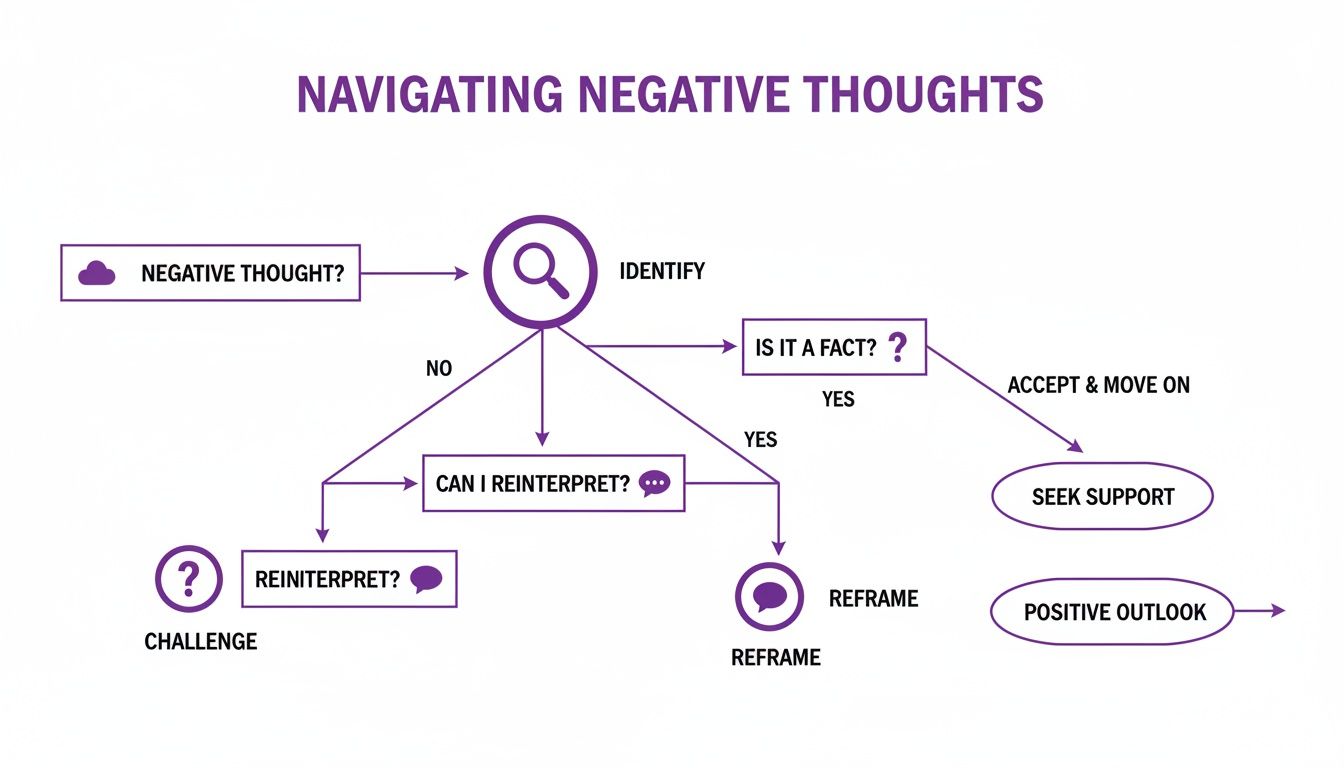
This is a core concept in cognitive therapy. It’s all about learning to identify those automatic negative thoughts, challenge their validity, and reframe them in a way that doesn't have so much power over your emotions.
Recognizing the Signs It's Time for Help
So, how do you really know it's time to reach out? There’s no single answer that fits everyone, but there are definitely some common signs that professional support could dramatically improve your quality of life.
It might be time to call someone if you notice:
- Daily functioning is a struggle. Getting out of bed, going to work, or even just showering feels like climbing a mountain.
- Your relationships are feeling the strain. Maybe you're pulling away from loved ones, arguing more, or just feeling totally disconnected from the people you care about most.
- Your old coping skills aren't cutting it. The things that used to help you feel better just aren't working anymore, leaving you feeling completely stuck.
- You're leaning on unhealthy habits. This could look like drinking too much, using substances, or engaging in other behaviors that you know are causing more harm than good.
- You're having thoughts of self-harm or suicide. If this is happening, it is critical to get help right away. You can call or text the 988 Suicide & Crisis Lifeline anytime, day or night.
Understanding Your Options for Care
The mental health world has a lot of different titles and acronyms, which can be confusing. Let’s break down the main types of professionals so you can make an informed choice.
- Therapists (LCSW, LPC, MFT): These are the experts in psychotherapy, or "talk therapy." They're trained to help you explore your thoughts and behaviors, develop new coping skills, and work through emotional challenges in a safe space.
- Psychologists (PhD, PsyD): Psychologists also provide talk therapy, but they can also conduct psychological testing and assessments. They often have advanced, specialized training in specific types of therapy.
- Psychiatrists (MD) and Psychiatric Nurse Practitioners (PMHNP): These are medical professionals. They can diagnose mental health conditions and, importantly, prescribe medication. They frequently work alongside a therapist to provide a complete, wrap-around treatment plan.
The right choice often comes down to whether you feel you need support with talk-based strategies, medication management, or a combination of both. To get a clearer picture, you can learn more about the role of a psychiatric mental health practitioner and see how they fit into a comprehensive care plan.
Don't just take our word for it—the data shows this works. Studies have found that when people get counseling, depression remission rates can reach 50-60% within just a few months. Even better, integrated therapies can reduce anxiety symptoms by up to 70%. These aren't small numbers; they represent real people getting their lives back.
Find a reVIBE Location Near You!
We currently have five locations for your convenience. (480) 674-9220
reVIBE Mental Health – Chandler
3377 S Price Rd, Suite 105, Chandler, AZ
reVIBE Mental Health – Phoenix Deer Valley
2222 W Pinnacle Peak Rd, Suite 220, Phoenix, AZ
reVIBE Mental Health – Phoenix PV
4646 E Greenway Road, Suite 100, Phoenix, AZ
reVIBE Mental Health – Scottsdale
8700 E Via de Ventura, Suite 280, Scottsdale, AZ
reVIBE Mental Health – Tempe
3920 S Rural Rd, Suite 112, Tempe, AZ
No matter where you are in your journey, reaching out is a brave first move. We're ready to listen when you're ready to talk.
Ready to Start Feeling Like Yourself Again?
Making that first call for help is often the hardest part of dealing with anxiety and depression. It's also the most courageous. It's you, deciding that you're ready to find your way back to balance and feel good again. Here at reVIBE Mental Health, we get it, and we're here to walk that path with you in a space that feels safe, supportive, and completely free of judgment.
Our team of therapists and psychiatric specialists helps adults, couples, and families all over the greater Phoenix area. We know life doesn’t stop, so we've built our entire practice around being accessible and genuinely compassionate. With appointments available seven days a week, you won’t have to turn your life upside down just to take care of your mental health.
We Meet You Where You Are
We believe getting support shouldn't be another source of stress. Our goal is to remove the common hurdles that can get in the way of feeling better, which is why we offer a couple of different ways to connect.
- In-Person Sessions: Come see us at one of our five locations. We’ve designed them to feel more like a comfortable, welcoming home than a sterile clinic.
- Secure Online Therapy: If you'd rather talk from your own space, you can access the same professional care through our secure telehealth platform.
And don't worry about the financial side of things. Our admin team is fantastic and will help you figure out your insurance, making sure you can use your benefits and focus on what really matters—your healing. We're in-network with most major insurance plans because quality care should be within reach.
You don't have to figure this all out by yourself. Recovery isn't about navigating a complicated system alone; it's about finding a trusted guide who can offer the right tools and unwavering support.
A Plan That’s Actually for You
No two people experience anxiety and depression the same way, so why should their treatment plan be identical? It shouldn't. We take a collaborative approach, matching you with a provider who truly gets your goals, personality, and what you need right now. Together, you’ll create a personalized roadmap to help you rediscover your strength.
Time and again, research shows that a blend of therapy and, when it makes sense, medication is one of the most effective ways to treat these conditions. If you want to dig a little deeper into how we work, our guide to professional depression treatment explains more about the methods we know can make a real difference.
It all starts with a simple conversation.
You are not alone in this, and you absolutely can feel better. Contact reVIBE Mental Health today to talk with someone who cares and start your journey back to you. https://revibementalhealth.com