

The first step to fixing just about any relationship problem is moving away from blame and toward collaboration. This means you have to create a safe space to talk, swap out accusatory language for "I feel" statements, and actually focus on the root of the conflict, not just the argument of the day. When you get this right, arguments stop being battles and start becoming opportunities to connect and heal.
Opening Up Without Shutting Down
You know that silence between fights? It can feel even heavier than the yelling. That's where partners really start to drift apart, each silently stewing in their own frustrations.
Honestly, the hardest part of fixing things is often just starting the conversation without it immediately turning into another fight. The fear of saying the wrong thing makes you say nothing at all, and that’s when resentment really takes root.
The trick is to reframe the talk before it even starts. Don't think of it as a confrontation. See it as a joint project—your mission is to improve the life you share. This isn't about scoring points or proving you're right; it's about getting on the same page and finding a path forward, together.
Timing is Everything
Let's be real: picking the right moment to talk is half the battle. If you bring up a heavy topic the second your partner walks in the door from a brutal day at work, you're practically asking for a defensive reaction. Trying to solve a major issue when you're both exhausted late at night is just as bad—it's a fast track to miscommunication and hurt feelings.
Find a time when you’re both calm, rested, and can actually focus. You might even have to schedule it, like after dinner on Tuesday or on a lazy Saturday morning.
By intentionally setting aside time, you send a powerful message: "You and I are a priority, and I’m committed to this." This simple act can lower the tension before you even say a word about the issue.
Moving from Accusation to Expression
The words you choose will either build a bridge or a wall. When you start sentences with "You…"—as in "You always…" or "You never…"—you're basically pointing a finger. It immediately puts your partner on the defensive, and the conversation is over before it even starts.
This is where "I feel" statements come in. It’s a simple but powerful shift. Instead of focusing on what you think your partner did wrong, you talk about your own emotional experience. It's a way to express your hurt or frustration without making them feel attacked.
This infographic breaks down the core principles for kicking off a healthy, productive conversation.
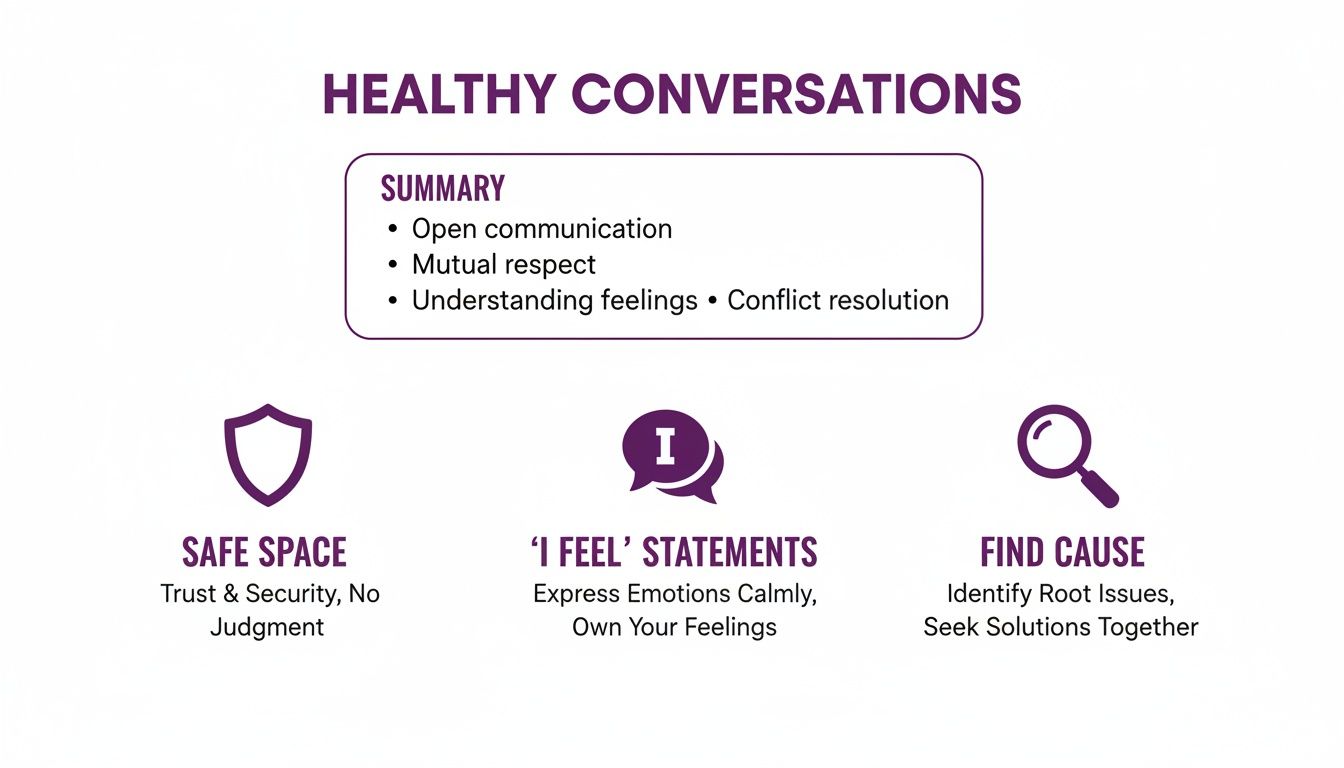
It really comes down to creating that safe environment, framing things from your perspective, and being willing to dig a little deeper to find out what's really going on.
Small changes in how you talk can make a huge difference. Here’s how to replace common negative habits with positive alternatives.
Shifting from Destructive to Constructive Communication
| Instead of This Destructive Habit | What It Sounds Like | Try This Healthier Alternative |
|---|---|---|
| Blaming/Accusing | "You never listen to me." | Using "I" Statements "I feel unheard when…" |
| Generalizing | "You always leave a mess." | Being Specific "When the dishes are left in the sink…" |
| Assuming Intent | "You did that just to annoy me." | Asking for Clarification "Can you help me understand why…?" |
| Bringing Up the Past | "This is just like that time you forgot…" | Staying on Topic "Let's focus on what happened today." |
| Shutting Down | "I don't want to talk about this anymore." | Taking a Mindful Pause "I need a 20-minute break before we continue." |
These shifts aren't always easy, especially in the heat of the moment, but they steer the conversation away from a fight and toward a resolution.
Uncovering the Real Issue
Most of the time, the things we bicker about—chores, money, being five minutes late—are just symptoms. The real problem is usually buried underneath. A fight about dirty dishes is rarely just about the dishes. It might be about feeling unappreciated, invisible, or like your partner doesn't respect your home.
To get past the surface stuff, you have to ask better questions. Try open-ended ones that invite vulnerability.
- "When I forget to do the dishes, what story does that tell you?"
- "Help me understand why this feels so important to you right now."
- "What's the bigger feeling for you underneath the frustration about this?"
Questions like these open the door for real honesty. They create a space where you can both share what’s truly on your mind, which is the only way to genuinely repair the problem and reconnect.
Learning to Actually Hear Each Other

If you think talking more is the solution to your relationship problems, you might be surprised. Often, it just creates more noise. The real breakthrough happens when we learn to listen with a different intention. Most of us are guilty of listening just to form a reply, to defend our position, or to correct what we think is wrong. We rarely listen simply to understand.
When communication grinds to a halt, it's almost always because one or both partners feel completely and utterly unheard. You end up having the same fight over and over because the raw emotion behind the words never gets addressed. This is where we have to move beyond vague advice like "communicate better" and into specific, practical skills that force us to slow down and truly connect.
It’s no wonder that a staggering 65% of couples point to poor communication as their biggest hurdle, making it a primary reason for seeking therapy. Everyday misunderstandings can easily spiral into deep resentments if you don’t have the right tools. You can discover more insights from relationship studies and see just how common these challenges are.
The Power of Active Listening
Active listening isn't just about staying quiet while your partner talks—it's about fully concentrating on what's being said to grasp the meaning, feeling, and importance behind their words. This one technique can single-handedly transform a heated debate into a productive dialogue, making your partner feel truly seen.
One of the best ways to practice this is through reflection, or what some call "mirroring." After your partner shares something, you simply paraphrase what you heard back to them. The goal isn't to repeat their words like a parrot, but to show you're trying to process their meaning.
Let's say your partner says: "I'm so overwhelmed. It feels like I'm handling all the household planning, and it's just exhausting."
Your instinct might be to defend yourself ("I do plenty!"). Instead, try reflecting: "It sounds like you're feeling completely burned out and that the weight of managing everything is falling on your shoulders. Is that right?"
That simple shift can de-escalate tension almost instantly. It proves you're not just waiting for your turn to talk—you're genuinely trying to get it.
Validating Feelings Without Agreeing
Validation is, without a doubt, one of the most powerful tools in a relationship. It's the act of acknowledging that your partner's feelings are real and important, even if you don't agree with their conclusion. You can validate the emotion without validating the logic or behavior.
You're not saying, "You're right." You're saying, "I understand why you feel that way." This distinction is absolutely critical for stopping a fight in its tracks and rebuilding emotional safety.
Imagine your partner is upset because you made plans with a friend without checking in first.
- An invalidating response: "It's not a big deal. Why are you overreacting?"
- A validating response: "I can see why you feel hurt and left out. It makes sense that my making plans without talking to you would make you feel like I don't consider you."
The first response slams the door shut. The second one opens it up for a real conversation about how to do things differently next time.
Conversation Starters for Tough Topics
Let's face it: some subjects are emotional minefields. Finances, intimacy, in-laws—just bringing them up can feel like walking on eggshells. Having a few thoughtful conversation starters in your back pocket can help you approach these topics with empathy instead of frustration.
Here are a few prompts you can make your own:
- For finances: "I've been thinking about our financial goals, and I'd love to just dream with you about our future for a bit. Can we set aside some time to talk about what we both want and how we can get there as a team?"
- For intimacy: "I feel most connected to you when we [share a specific activity]. I really miss that feeling. Could we talk about how we can create more of those moments together?"
- For a recurring issue: "I've noticed we keep getting stuck on [the topic]. I really want to understand your side better. What’s the most important thing for me to know about how you feel when this comes up?"
Using starters like these immediately shifts the dynamic from blame to collaboration. You're framing the problem as "us vs. the issue," not "me vs. you"—and that's the foundation of any resilient partnership. Fixing relationship problems almost always starts with learning to listen in a way that truly honors your partner's experience. From there, you can finally solve things side-by-side.
Managing Conflict Before It Manages You
Let's be real: arguments happen. Sharing your life with someone means you’re going to disagree. The fairy-tale idea of a relationship with zero conflict isn’t just a myth—it’s actually not what you want. When handled the right way, disagreements are your fast track to real growth and a much deeper connection.
The secret isn’t avoiding fights. It’s learning how to navigate them so they actually pull you closer instead of pushing you apart.
Many of us dread conflict because we’ve only ever seen it end in hurt feelings, lingering resentment, and emotional distance. When arguments turn toxic, it’s usually because someone (or everyone) is coming from a place of fear. The game-changer is shifting your goal from winning the argument to solving the problem together. That simple switch turns a battlefield into a collaboration.
This is a skill you learn, not something you’re born with. Fixing relationship problems almost always comes down to learning how to "fight fair"—which includes knowing when you’re too heated to think straight and having the courage to hit pause.
Recognizing Your Triggers and Taking a Timeout
Have you ever been in a simple discussion that suddenly goes from zero to sixty? That overwhelming, out-of-control feeling is your body's "fight-or-flight" response crashing the party. Your heart pounds, your breathing gets shallow, and your ability to be rational goes right out the window. Psychologists call this "flooding," and it makes productive conversation totally impossible.
Your first job is to spot the physical signs. Maybe your jaw clenches up, you feel a hot flush in your chest, or a knot forms in your stomach. These are your personal warning bells telling you it's time for a strategic timeout.
A timeout isn't about storming off or icing your partner out. It's a structured break designed to let the adrenaline subside.
- Agree on a signal. It can be a simple phrase like, "I need to take 20," or even a quick hand gesture you've both decided on ahead of time.
- Set a specific return time. This is the most important part. Agreeing to come back in 20 minutes, an hour, or even the next morning prevents the timeout from feeling like you're just abandoning the conversation.
- Do something genuinely calming. Don’t just sit there stewing over the argument. Take a walk, put on some music, or do some deep breathing exercises. The goal is to self-soothe.
This simple act of pausing can be the difference between saying something you can never take back and returning to the conversation with a clear head.
The point of a timeout isn’t to dodge the issue. It's to stop the emotional fire from spreading so you can actually put it out together. Think of it as a tool for de-escalation, not avoidance.
Attack the Problem, Not the Person
When emotions are running high, it’s so easy to let personal attacks, criticisms, or blame slip out. Phrases like "You always…" or "You're so…" immediately force your partner into a defensive crouch. The conversation is no longer about the issue; it's about their character.
A much better approach is to frame the issue as a shared challenge you have to solve as a team.
Instead of, "You're such a slob, you never clean up," try reframing it. "I'm starting to feel really overwhelmed and stressed when the kitchen is a mess. Can we brainstorm a system that works for both of us?" See the difference? The focus is on your feelings ("I feel…") and a collaborative solution ("Can we…?"). It invites them to be your partner in solving the problem. To get better at navigating these disagreements, you might want to explore some expert strategies to resolve relationship conflict.
The Art of a Sincere Apology
Look, sometimes we just mess up. We say the wrong thing, act selfishly, or hurt our partner’s feelings, even with the best intentions. A real, genuine apology is one of the most powerful repair tools you have, but it has to be done right.
A flimsy, "I'm sorry you feel that way," doesn't count. That's a non-apology that just puts the blame back on them for having feelings.
A truly meaningful apology has three key parts:
- Acknowledge the specific action. Name what you did wrong. "I'm sorry I raised my voice when we were talking about money."
- Express remorse and validate their feelings. Show them you get it. "I know that was hurtful and probably made you feel disrespected. You didn't deserve that."
- Commit to doing better. Say what you’ll do differently next time. "From now on, I'll call a timeout if I feel myself getting that angry."
Learning to apologize without excuses is a huge step. It builds incredible trust and shows your partner that their feelings matter more to you than your pride. It turns a moment of conflict into a bridge toward a stronger connection.
Rebuilding Trust and Setting Healthy Boundaries

Trust is the glue of a relationship. It's also incredibly fragile. Whether it was shattered by one major betrayal or slowly chipped away by a thousand tiny disappointments, the damage can leave the future of your partnership feeling shaky and uncertain. When you're figuring out how to fix relationship problems, this is often where the real work begins—slowly and carefully rebuilding that foundation.
It’s a process that demands so much more than a quick "I'm sorry." While words are a start, it's consistent, reliable action over time that truly mends the break. For the partner who was hurt, learning to be vulnerable again takes immense courage. And for the one who caused the harm, proving they’ve changed through their actions isn’t just important—it’s everything.
The Anatomy of a Real Apology
A genuine apology isn’t just about admitting fault. It’s about deeply understanding the pain your actions caused and taking full ownership of that impact. A real apology is a starting point, never a finish line. It should never, ever be followed by a "but…" that tries to justify the behavior or minimize your partner's feelings.
A truly meaningful apology has three key ingredients:
- Specific Ownership: Name what you did wrong, without excuses. Instead of a vague, "I'm sorry if you were hurt," try something direct: "I am so sorry that I lied about my spending. I know that was a complete violation of your trust."
- Empathetic Acknowledgment: Show them you get it. Acknowledge the emotional fallout of your actions. For example, "I can only imagine how betrayed and disrespected you must feel because I hid that from you."
- A Commitment to Change: This is crucial. You have to lay out exactly what you'll do differently. "From now on, I am committed to being completely transparent about our finances. We will discuss any purchase over $100 together beforehand."
This isn't just saying sorry; it's a promise of new behavior. It’s the very first step toward helping your partner feel safe with you again.
Actions Speak Louder Than Words
An apology might open the door, but only consistent, trustworthy behavior will actually walk you through it. Rebuilding trust is a marathon, not a sprint. The partner who broke the trust has to be patient and transparent, knowing their words will be measured against their actions for a long, long time.
Trust is rebuilt in small, everyday moments of reliability. It's calling when you say you will, being where you say you'll be, and following through on promises, no matter how minor they seem.
This phase is all about showing, not just telling. It means proactively offering reassurance without being asked and operating like an open book. For some couples, this is incredibly difficult, especially if the breach of trust is connected to past trauma. Understanding how old wounds show up in current relationships is a huge part of healing, which is why specialized trauma treatment can provide the tools needed to navigate this complex emotional landscape.
Establishing Boundaries for a Safer Relationship
Rebuilding trust isn't just about apologies and actions; it’s also about establishing healthy boundaries. These aren't walls you build to keep your partner out. Think of them as clear, mutually agreed-upon guidelines that create respect and emotional safety for both of you. Boundaries are the rules of engagement that define what is and isn't okay in your relationship.
They ensure both people feel seen, respected, and safe enough to be vulnerable again.
Here are a few examples of what this looks like in the real world:
- Communication Boundaries: "We will not raise our voices or use names during an argument. If one of us feels things getting too heated, we agree to take a 20-minute cool-down, no questions asked."
- Personal Space Boundaries: "We both need our own time to recharge. I'll respect your quiet evening alone, and I’ll be clear about when I need the same."
- Digital Boundaries: "We agree not to snoop through each other's phones or messages. Real trust means respecting each other's right to privacy."
Setting boundaries isn't about control; it's about co-creating a predictable and respectful environment where intimacy can actually grow back. It's a team effort to define how you'll care for the relationship—and each other—so that the foundation you rebuild is even stronger than it was before.
When to Bring in a Professional
Have you ever felt like you and your partner are stuck on a merry-go-round, having the same fight over and over? You might make up and feel okay for a little while, but then something triggers the same argument, and you're right back where you started. It's exhausting.
Sometimes, the smartest and most courageous thing you can do for your relationship is to admit you need a fresh perspective. Deciding to see a therapist isn’t a sign that your relationship has failed—far from it. It’s a powerful signal that you’re both willing to fight for the relationship, not just in it.
A therapist provides a safe, neutral space where you can finally get off that merry-go-round and learn new ways of relating to each other.
Are You Stuck in a Rut? Signs It's Time for Help
It's easy to write off ongoing issues as just a "phase," but some patterns are more like warning lights on your car's dashboard. If any of these sound painfully familiar, it might be time to pull over and get some professional help.
- The Same Fight, Different Day: You keep having the same argument with no resolution. Maybe the topic shifts from money to chores to parenting styles, but the core issue—feeling disrespected, unheard, or unappreciated—never gets resolved.
- Contempt and Criticism Creep In: Conversations have become minefields of sarcasm, eye-rolling, and personal attacks. When you start attacking your partner's character instead of addressing the problem, you're eroding the very foundation of your relationship: respect.
- One of You Shuts Down (Stonewalling): During tough conversations, does one of you just… check out? This shutdown, or "stonewalling," is a common defense mechanism to avoid feeling flooded, but it leaves the other person feeling completely alone and abandoned.
- You Feel More Like Roommates: The spark is gone. You're living parallel lives under the same roof, but the emotional and physical intimacy has faded. You’ve stopped sharing your day, your dreams, and your fears with each other.
When these behaviors become the new normal, it’s incredibly difficult to find your way back to each other on your own.
What Couples Therapy Is Really Like
Let's clear the air. The idea of therapy can feel pretty intimidating. Many people imagine sitting on a couch while a therapist plays referee and declares a winner. The reality is nothing like that.
A skilled couples therapist doesn’t take sides. Their client is the relationship itself. They're there to help both of you feel safe enough to be vulnerable, to truly listen, and to be heard without judgment.
A therapist acts as a guide, not a judge. They help translate what each partner is trying to say, identify the destructive patterns you're both blind to, and teach you practical skills to communicate and solve problems more effectively.
Therapy is about learning to swap blame for curiosity and defensiveness for empathy. It’s about building a new, stronger foundation for your partnership. Exploring what couples therapy services actually involve can show you a clear path forward.
How an Outside Perspective Can Change Everything
A trained professional brings skills and objectivity that are nearly impossible to find when you're stuck in the emotional weeds of a conflict. Here at reVIBE Mental Health, our therapists specialize in creating that supportive, non-judgmental space you need to heal.
We know that reaching out is a big deal. Our team works together to match you with a therapist who truly gets you and your goals, so you feel understood from the very first call. We believe that finding the right professional is a huge part of learning how to fix relationship problems for the long haul.
For your convenience, reVIBE Mental Health offers accessible and compassionate care across the Phoenix metro area. If you're ready to take the next step, you can find a welcoming space near you.
Find a reVIBE Location Near You!
We currently have five locations for your convenience. (480) 674-9220
reVIBE Mental Health – Chandler
3377 S Price Rd, Suite 105, Chandler, AZ
reVIBE Mental Health – Phoenix Deer Valley
2222 W Pinnacle Peak Rd, Suite 220, Phoenix, AZ
reVIBE Mental Health – Phoenix PV
4646 E Greenway Road, Suite 100, Phoenix, AZ
reVIBE Mental Health – Scottsdale
8700 E Via de Ventura, Suite 280, Scottsdale, AZ
reVIBE Mental Health – Tempe
3920 S Rural Rd, Suite 112, Tempe, AZ
Common Questions About Repairing a Relationship
Even after laying out a roadmap for fixing relationship problems, it’s completely normal to have lingering questions. Let's be honest, the path to healing is never a straight line, and every couple’s story comes with its own unique set of hurdles. Here are some straightforward answers to the questions I hear most often from partners who are committed to rebuilding their connection.
Getting these concerns out in the open can make the whole process feel less intimidating and give you a much clearer picture of what's ahead.
Can a Relationship Truly Recover After Trust Is Broken?
The short answer is yes, but it’s not easy. It demands an incredible, unwavering commitment from both people. Rebuilding trust isn't about one big apology or a single grand gesture. It's a slow, deliberate process built on a foundation of consistent, transparent actions from the person who broke the trust. They have to prove, day in and day out, that they are reliable and honest again.
At the same time, the hurt partner has to be willing to eventually work toward forgiveness. This is often the hardest part, but it’s absolutely essential for moving forward together. This is a journey that almost always benefits from professional guidance, which can create a safe, structured space to unpack these complex emotions and build a foundation that’s even stronger than before.
What If My Partner Refuses to Go to Therapy?
This is a tough one, and it's a common and incredibly frustrating roadblock. But it doesn’t automatically mean all hope is lost. You can't drag your partner to therapy, but you can take a powerful first step by going on your own.
Individual counseling can equip you with invaluable tools. A therapist can help you:
- Find healthier ways to cope with the stress and conflict at home.
- Sharpen your own communication skills, which can single-handedly shift the dynamic between you.
- Get a clearer perspective on your own role in the relationship patterns and what you actually have the power to change.
Often, when one person starts making positive changes, it can inspire the other to reconsider their resistance to therapy. Even if they don’t, working with a psychiatric mental health practitioner empowers you to handle the situation with more strength and clarity.
How Long Does It Really Take to See Improvement?
There’s no magic number here. The time it takes to see real, lasting improvement hinges on a few key things: the depth of the problems, how long they've been festering, and—most importantly—how dedicated both of you are to the process.
Some couples start to feel positive shifts in their communication and connection within a few months of putting in the work. For deeper wounds, like infidelity or years of emotional distance, the healing process can easily take a year or more.
The goal should never be about speed. It’s about consistent, steady progress. Celebrating the small wins and building healthier daily habits are far more important than rushing toward a finish line that doesn't really exist.
For a broader perspective on keeping your connection strong over the long haul, check out these strategies for building lasting love.
Are Our Problems Bad Enough for Therapy?
This is a misconception I see all the time. Therapy isn’t just an emergency room for relationships on the brink of collapse. In reality, many of the healthiest couples I know use it proactively to strengthen their bond. They might go to navigate big life changes, like having kids or blending families, or simply to learn how to stop minor annoyances from blowing up into major fights.
If you’re feeling disconnected, find yourselves stuck in the same frustrating arguments over and over, or just want to feel closer and more understood, therapy can provide the tools you need. Think of it as an investment in the long-term health and happiness of your relationship—a true sign of strength, not weakness.
At reVIBE Mental Health, our experienced therapists provide a compassionate, non-judgmental space to help you and your partner find your way back to each other. We understand the courage it takes to ask for help and are here to guide you with practical tools and supportive care. To learn more about our approach, visit us at https://revibementalhealth.com.