
The path back to trust starts with a painful but necessary first step: looking the damage straight in the eye. It’s about committing to a real, structured process built on honesty, accountability, and a willingness to reconnect. This isn't a quick fix. It takes both of you to be all-in, shifting from a place of blame to one of shared understanding. You can't erase what happened, but you can courageously decide to build something new from the rubble.
Facing the Aftermath of Broken Trust

When trust shatters, it feels like a bomb has gone off in your life. The ground beneath you disappears, and the future you planned together suddenly feels like a fantasy. This initial phase is a storm of raw emotion—rage, bone-deep sadness, confusion, and a gnawing fear.
It’s tempting to try and push these feelings down or rush past them, but that's a mistake. These emotions are a completely normal part of the process. The first real step toward healing is making space for the pain and acknowledging the full scale of the damage, without judgment.
Why Acknowledgment Is Non-Negotiable
You can't start rebuilding on a cracked foundation. Before any repair work can happen, the betrayal and the hurt it caused have to be brought out into the open. This isn’t about endlessly shaming the partner who broke the trust. It’s about validating the reality of the one who was hurt. For the betrayed partner, simply feeling seen and heard is the very first step toward feeling safe again.
This is exactly where so many couples get stuck. The person who caused the harm often wants to sprint forward to escape their own guilt, while the hurt partner needs time to process the sheer reality of what happened. That’s a recipe for even more distance. Acknowledgment is the only thing that can bridge that gap. The emotional wound from a major betrayal is a genuine trauma, and looking at it through the lens of effective trauma treatment can offer a powerful framework for this journey.
Acknowledging the wound is the first step to healing it. True recovery can’t begin until both partners agree on the reality of the pain that has been caused. It’s a courageous act that paves the way for genuine accountability and reconnection.
To get started, it’s crucial to understand the ground rules for recovery. The journey rests on three core principles that set the stage for all the work that follows.
The Three Pillars of Trust Recovery
This table breaks down the foundational mindset needed to even begin the process of rebuilding.
| Pillar | What It Means in Practice | Why It's Non-Negotiable |
|---|---|---|
| Radical Honesty | The partner who broke trust answers all questions without defensiveness or omissions. No more secrets, period. | Without complete transparency, the hurt partner can never feel safe. Every lie discovered later resets the healing process to zero. |
| Complete Accountability | The offending partner takes full ownership of their actions, without blaming circumstances, stress, or their partner. | Shifting blame invalidates the hurt partner's pain. True remorse can only exist with 100% ownership of the choice that was made. |
| Shared Commitment | Both partners agree to participate fully in the process, even when it’s uncomfortable, and to prioritize the relationship's health. | This is a two-person job. One person cannot rebuild a marriage alone. It signals a mutual desire to create a new, stronger future. |
These pillars aren't just suggestions; they are the absolute price of admission for a chance at real, lasting healing.
The Hope in the Hard Work
I know this all sounds incredibly daunting, but there is real hope here. Countless couples have walked this path and come out stronger on the other side. The commitment to heal is a powerful force. In one survey of 1,000 couples dealing with infidelity, a remarkable 86% stayed together when both people were willing to be vulnerable, completely honest, and dedicated to the rebuilding process. You can dig into the findings on relationship recovery on addorecovery.com.
Think of this guide as your playbook for doing that hard, essential work. We'll walk through the stages of healing, from confronting the initial damage to building new habits that foster reliability and a deeper connection than you had before.
Committing to Radical Honesty and Transparency

After the initial shock subsides, the real work begins. This is where you and your partner must commit to radical honesty. It’s a concept that sounds scary, and frankly, it is. But it's also absolutely necessary.
The partner who broke the trust has to be willing to answer all the questions, and the hurt partner needs to ask questions that are aimed at understanding, not just gathering ammunition for an argument. The point isn't to re-live every painful detail over and over. It's about getting rid of the secrets that allowed the betrayal to happen in the first place. You’re building a new foundation, one where your partner can start to believe there’s truly nothing left to hide.
Giving Space for the Unfiltered Truth: The Impact Statement
Before the endless loop of questions can even start, the betrayed partner needs a chance to speak, uninterrupted. This isn’t a conversation or a debate. It’s their impact statement.
This is their time to lay it all out—to explain, in raw detail, how this betrayal has torn through every corner of their life. How it’s shattered their self-esteem, destroyed their sense of safety, and poisoned their view of the future.
And for the partner who broke the trust? Your job is simple, yet one of the hardest things you'll ever do: just listen. Don't defend. Don't explain. Don't correct their version of reality. Just absorb the pain you've caused and validate what they're feeling. A quiet "I hear you" or "That makes sense" is more powerful than any excuse. This act of silent, empathetic listening is a massive first step.
"The first step in rebuilding trust is allowing the full, unvarnished truth of the pain to be spoken and heard. Without this, any attempt at repair is just building on a foundation of unspoken resentment and misunderstanding."
This moment is about bearing witness to the devastation. It validates the wounded partner’s experience and forces the other to finally confront the real-world consequences of their actions, moving past their own guilt and shame.
Healthy Privacy vs. Harmful Secrecy
A major stumbling block for couples at this stage is figuring out the line between privacy and secrecy. Getting this right is critical.
-
Healthy Privacy is about having your own internal world. It’s the freedom to have a private thought or a confidential chat with a friend about your own struggles without needing to report back to your partner. It’s about being an individual within the partnership.
-
Harmful Secrecy is something else entirely. It’s actively hiding information that directly affects your partner and the relationship. We're talking about secret credit cards, deleted message threads, or "work meetings" that aren't really work meetings. This is the stuff that actively destroys a marriage.
To rebuild trust, the partner who was unfaithful has to be willing to temporarily trade some of that privacy to prove there is no more secrecy. This leads us to radical transparency.
What Radical Transparency Actually Looks Like
Let's be clear: transparency isn't a punishment. It's a temporary measure to help the betrayed partner feel safe again. Their entire reality has been upended, and they’re struggling to know what’s real. Transparency is the bridge between their fear and the facts. This has to be a consensual and temporary agreement, not a life sentence of surveillance.
Here are a few things this might involve:
- Open Devices: Willingly giving your partner the password to your phone, email, or social media accounts. The idea is that when they see there's nothing to hide, the impulse to check will eventually fade.
- Shared Location and Calendars: Using a location-sharing app for a set period. It’s not about being tracked like a criminal; it’s about providing reassurance that your words and your actions are finally matching up.
- Being Proactive: The partner who broke the trust needs to volunteer information before being asked. A simple text like, "I'm heading to Target and the post office, should be back around 3 PM," can preempt a spiral of suspicion and shows you’re committed to being open.
I know this level of transparency can feel invasive. But it serves a vital purpose. It gives your partner tangible proof that you're committed to living an honest life. Over time, as you consistently show up as a trustworthy person, the need for these measures will naturally fall away. This is the slow, painstaking process of laying new bricks for a foundation you can both stand on again.
Moving Beyond "Sorry" to True Accountability
Once you've ripped off the band-aid with radical honesty, the real work begins. This is where we move from a simple apology to genuine, soul-deep accountability. Let's be clear: a quick "I'm sorry" might buy you a moment of quiet, but it does absolutely nothing to heal a profound wound of betrayal.
True accountability is something else entirely. It's looking your partner in the eye and fully acknowledging the pain you've caused, and then—this is the hard part—committing to understanding why you made that destructive choice in the first place.
The partner who broke the trust has to learn to say, "I chose to do this, and I was wrong." Period. Full stop. Any phrase that follows, like "…because we were fighting" or "…because I was so stressed," isn't an explanation. It's an excuse. It shifts the blame and tells your partner their pain isn't valid. Getting this distinction right can be the difference between healing and breaking up for good.
What a Real Apology Actually Looks Like
I've seen hundreds of apologies in my office, and I can tell you that a meaningful one isn't a one-and-done event. It's a process. It has a certain texture to it that a hollow, performative gesture just doesn't. For the partner who's been hurt, learning to recognize the signs of a genuine apology is how they start to feel safe again and believe that change is even possible.
Here’s what an authentic apology sounds like:
- It gets specific about the pain. Instead of a generic "I'm sorry for everything," it's, "I am so sorry for the pain, humiliation, and fear I caused you. I know that when you found out, I shattered your sense of safety in our own home."
- It takes complete ownership. There is zero room for blame-shifting. The focus stays entirely on the choices they made and the harm they caused.
- It makes a commitment to change. A real apology doesn't end with begging for forgiveness. It ends with a clear statement of intent, like, "I am committed to figuring out what's broken in me so I never cause this kind of pain again. I'm going to show you with my actions, not just my words."
This shift from defensiveness to ownership is monumental. It’s the first time the hurt partner feels truly seen and heard. It tells them you’re finally starting to grasp the devastation from their side of the fence, which is a powerful first step.
From Words to Action: The Accountability Letter
To really anchor this process, one of the most powerful tools I use with couples is the Letter of Accountability. This is not a love letter. It’s not a note asking to be taken back. It’s a detailed, reflective document that the unfaithful partner writes to show they truly understand the scope of the damage they’ve caused.
The letter needs to cover a few key things:
- A detailed, unvarnished account of the choices that were made. No sugarcoating.
- An honest exploration of the personal failings or unmet needs that led to the betrayal (e.g., fear of intimacy, deep-seated insecurity, selfishness).
- A specific and heartfelt apology for how these actions directly impacted their partner's life, emotions, and future.
- A clear, actionable plan for personal change. This might mean therapy, joining a support group, or other tangible steps.
True atonement isn't about beating yourself up; it's about waking yourself up. It takes guts to look in the mirror, identify the broken parts of yourself that led to the betrayal, and commit to the grueling work of fixing them. This is the only way to become a trustworthy person again.
This letter often becomes a foundational document for the healing journey. It gives the betrayed partner something tangible to hold onto—proof that their spouse is taking this seriously and is willing to do the hard, internal work required for real change. It's a promise backed by self-reflection.
This process is a cornerstone of many successful therapeutic models. For instance, Gottman Method Couples Therapy, a highly respected and research-backed approach, has shown a 75% success rate in helping couples recover from affairs. Its "Trust Revival Method" is built on three phases—Atonement, Attunement, and Attachment—which tells you just how essential this first step of accountability is. You can explore the Gottman approach to affair recovery to get a better sense of its principles.
At the end of the day, accountability isn’t a one-time declaration. It's a living, breathing thing demonstrated through consistent, changed behavior over a long, long time. Every honest conversation, every kept promise, and every transparent action is another brick being laid in the foundation of a marriage that is being intentionally and painstakingly rebuilt.
Turning Talk Into Action: New Habits for Communication and Connection
Once you've established accountability, the real work begins. This is where you move from talking about rebuilding trust to actually doing it, day in and day out. It’s about consciously and intentionally replacing the old, damaging habits with new ones that nurture safety, connection, and real intimacy.
This isn’t about grand, romantic gestures. Forget the movie moments. Real, lasting change is built on the small, consistent things you do every single day that quietly tell your partner, "I see you. I'm choosing you. I'm choosing us." You're essentially learning a new language together, one based on deliberate effort and empathy instead of old resentments and assumptions.
How to Have the Hard Conversations (Without a Fight)
Let's be honest: one of the scariest parts of this process is talking about the tough stuff. For most couples in this situation, the old ways of communicating are a minefield of blame, defensiveness, and knee-jerk reactions. To move forward, you need a completely new set of ground rules for these conversations.
This is where a tool like the Speaker-Listener Technique can be a game-changer. It’s a structured approach that feels a bit mechanical at first, but its power lies in slowing everything down so you can both actually hear each other.
Here’s the breakdown:
- Pick a Speaker and a Listener. You can even hold an object, like a pen, to show who has the "floor." No interruptions allowed.
- The Speaker talks. They share their feelings using "I" statements. Think "I felt hurt when…" instead of the accusatory "You always…" The key is to speak in short bursts, just a couple of sentences at a time.
- The Listener listens. Their only job is to listen—not to defend, not to argue, not to explain. Then, they simply paraphrase what they heard. "Okay, so what I'm hearing is you felt hurt. Do I have that right?"
- Swap roles. Once the Speaker feels completely heard and understood, you switch.
This technique forces you out of the habit of simply waiting for your turn to talk (or argue). It makes you listen.
You Can't Live in the Past Forever
Talking through the betrayal is absolutely necessary, but you can't set up camp there. A huge part of rebuilding involves creating new positive memories and experiences together. You have to start shifting the balance. To do this, you have to improve communication in your relationship and build deeper trust beyond just the problem at hand.
Try weaving in some of these conversation starters that have nothing to do with the betrayal:
- "What was one small thing I did this week that made you feel cared for?"
- "Tell me about a goal or dream you have for yourself that you haven't mentioned lately."
- "What's a favorite memory of us from before things got so hard?"
- "How can I make your day just a little bit easier tomorrow?"
These aren't about fixing things. They’re about remembering that your relationship is more than the pain you're working through.
True connection is rebuilt in the small moments of intentional listening and shared vulnerability. It’s about creating new memories that are stronger than the painful ones.
Concrete Steps to Reconnect
Words are critical, but it's the consistent, reliable actions that truly rebuild the foundation of your marriage. You need to create new rituals that prove your commitment, not just with your words, but with your time and attention.
Here are a few practical things you can start doing today:
- Schedule Daily, Uninterrupted Time. I’m talking about 30 minutes on the calendar. Every. Single. Day. No phones, no TV, no distractions. This isn't for problem-solving; it's for connection. Take a walk, have a cup of tea, and just be present with each other.
- Voice Daily Appreciations. Get into the habit of ending each day by telling your partner one thing you appreciate about them. It can be simple: "I really appreciated you making coffee this morning," or "Thank you for being so patient with the kids today." This literally retrains your brains to look for the good in each other again.
- Create a New "Us" Ritual. Find a small, new activity that belongs only to this new chapter of your relationship. Maybe it’s trying a different coffee shop every Saturday, cooking a new recipe together on Tuesdays, or starting a new series on Netflix. It’s a powerful symbol of a fresh start.
These actions might feel small, almost insignificant. But they are the bricks and mortar of your new foundation. Every kept promise and every shared moment of appreciation is a vote for the stronger marriage you're building.
Navigating Setbacks and Charting Your Progress
As you work to rebuild trust in your marriage, you have to accept one hard truth: healing isn’t a straight line. There will be good days, even great days, where connection feels easy and hope is strong. But there will also be bad days. A song on the radio, a passing comment, or an old memory can trigger a sudden wave of pain, making it feel like you’re right back where you started.
These moments are not failures. They are a completely normal—and expected—part of the journey. The goal isn’t to dodge every setback but to learn how to face them together without letting them unravel all your hard work. This is where patience becomes your most valuable tool.
Understanding the True Timeline for Healing
We live in a world of quick fixes, so it's easy to get discouraged when trust isn't magically restored in a few weeks. But my clinical experience, backed by research, shows that fully rebuilding that sense of safety and connection after a major betrayal typically takes between 18 and 24 months.
That number isn't arbitrary. It’s the time it takes to prove, through thousands of small, consistent actions, that the changes you're making are real and here to stay. Trying to rush this process just breeds more pressure and resentment. You have to accept that this is a marathon, not a sprint.
For the partner who was hurt, emotional triggers can be incredibly intense, often feeling like the original trauma is happening all over again. These moments can spark anxiety, panic, and an overwhelming need for reassurance. For some, specialized approaches like EMDR therapy for anxiety can be a powerful way to process these painful emotional flashbacks and regain a sense of control.
Setbacks aren't a sign your relationship is doomed; they're a sign you're both human. The real test of progress is how you respond—with blame and retreat, or with empathy and a renewed commitment to the process.
Instead of just watching the calendar, a much better way to stay motivated is to focus on the tangible proof of your growth.
Creating Your Milestone Map
To fight that "stuck" feeling, I often have couples create a "milestone map." This isn't about setting rigid deadlines; it’s about learning to spot and celebrate the real, behavioral changes that show your hard work is paying off. It gives you concrete proof that you’re moving forward, which is a lifeline on days when it feels like you're not.
Your map should track specific, observable actions. Think about what real change looks like for you.
Here are a few examples of milestones I've seen couples celebrate:
- Getting through a full week without a major argument about the past. This shows you're both learning to manage triggers and de-escalate conflict.
- The first time you both share a genuine, belly laugh together. This signals the return of a lightness and connection that might have felt lost forever.
- The partner who broke trust voluntarily sharing something that could have easily been kept secret. This is a massive demonstration of a commitment to transparency.
- Successfully getting through a tough conversation using the new communication skills you've been practicing. This proves you're building new, healthier habits.
This timeline gives you an idea of how to layer in new habits for talking, connecting, and appreciating each other over time.
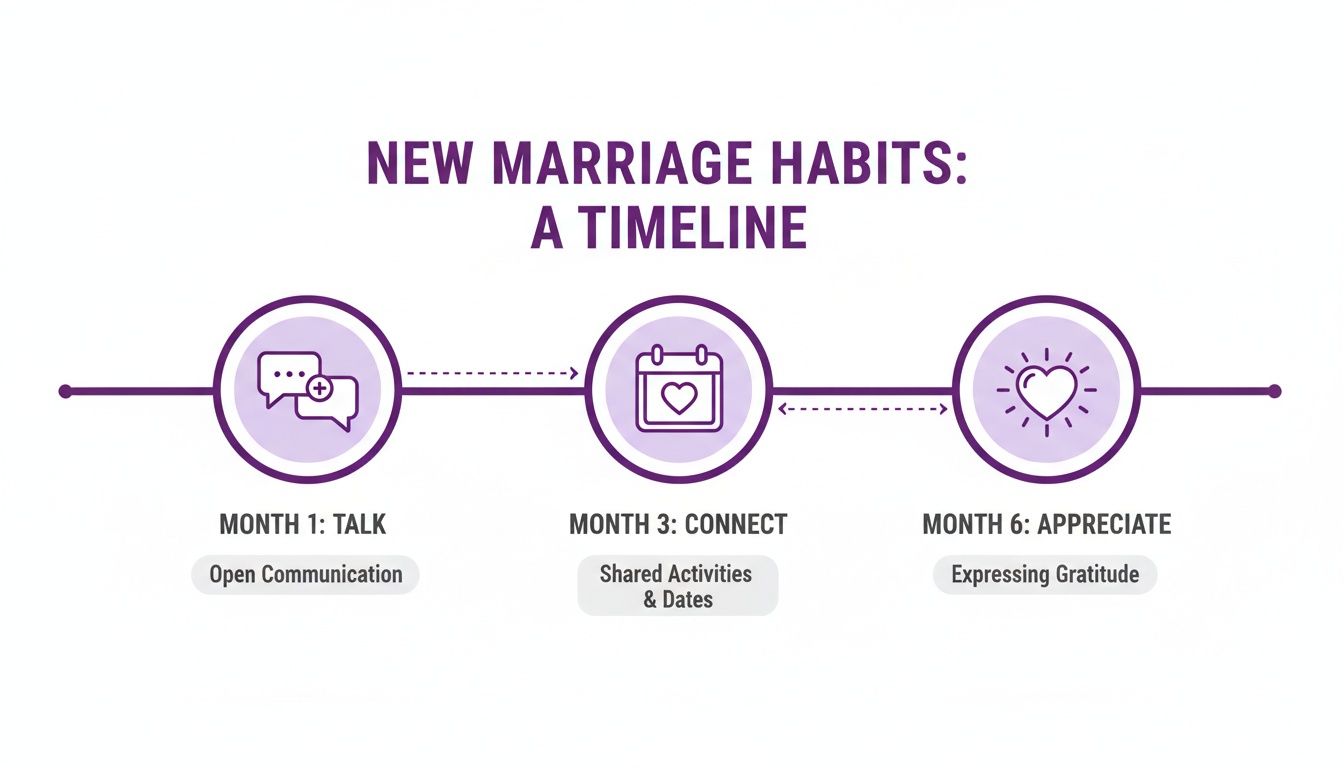
As you can see, progress is built on small, consistent actions—not grand, one-off gestures. Every milestone, no matter how small it seems, is a victory worth acknowledging. It’s the tangible proof that you’re not just hoping for a better future; you are actively building it, one changed behavior at a time.
When to Call in a Professional
Even with the best intentions and a solid plan, rebuilding trust on your own can feel like trying to perform surgery on yourself. The pain is just too intense, and the tools can feel clumsy in your own hands.
Bringing in a professional isn't admitting defeat. Far from it. It's a sign that you value your marriage enough to give it the best possible chance to heal in a structured, safe, and guided way.
So, how do you know when it's time to make that call?
Red Flags That You Need Outside Help
If you feel like you're spinning your wheels and getting nowhere, or worse, digging a deeper hole, it’s probably time. Look out for these tell-tale signs:
- You're Stuck on a Loop: It’s the same argument, day in and day out. Nothing ever gets resolved. You're just left exhausted and more disconnected than before.
- Every Spark Becomes an Inferno: You can’t seem to talk about anything without it escalating into a full-blown fight. The skills to de-escalate have vanished, and any mention of the betrayal just pours gasoline on the fire.
- The Emotional Toll is Unbearable: One or both of you are struggling with constant anxiety, a cloud of depression, or a sense of hopelessness that just won't lift. The betrayal’s aftermath is bleeding into every corner of your lives.
"When your attempts to connect only create more distance, that's your cue. A good therapist acts as a neutral guide, helping you turn chaotic, painful arguments into conversations that actually heal."
It's completely normal to wonder about the process and if it really helps. Getting a better sense of whether does couple counselling work can give you the confidence to move forward.
A Compassionate, Evidence-Based Resource
At reVIBE Mental Health, we create a space where you can finally breathe and do this difficult work without judgment. Our therapists are trained in proven, effective methods that get to the heart of the issue. We use talk therapy to rebuild shattered communication and, when needed, specialized treatments like EMDR to help process the very real trauma that betrayal leaves behind.
Our entire goal is to give you the skills to not just patch things up, but to build a marriage that’s stronger and more honest than before.
We know that taking that first step can feel monumental. That's why we make getting help as straightforward as possible. We have appointments available seven days a week and accept most major insurance plans. You can get a clear picture of what the process looks like by exploring our couples therapy services.
With five convenient locations across the Valley—in Chandler, Phoenix Deer Valley, Phoenix PV, Scottsdale, and Tempe—expert help is close by.
You don't have to walk this path alone. Give our team a call at (480) 674-9220 to get started.
Common Questions on the Road to Rebuilding Trust
Once you and your partner decide to start this difficult but rewarding work, a lot of practical questions will inevitably pop up. Let's tackle some of the most common ones I hear from couples navigating this journey.
How Long Does This Actually Take?
This is usually the first question on everyone's mind, and the honest answer is: there's no magic number. But you need to be realistic. Most couples find that it takes a significant amount of time—think somewhere in the range of 18 months to two years of consistent effort.
The goal isn't just to rush back to how things were. It's about building something entirely new and much stronger. Forget the calendar; progress is all about stacking up small, trustworthy actions, day after day.
Can Our Marriage Really Be Better Than Before?
It might seem impossible right now, but yes, a marriage can absolutely become stronger and more connected after a betrayal. I've seen it happen many times.
Think about it: the process of rebuilding forces you to have brutally honest conversations and confront issues you've likely been sweeping under the rug for years. Working through this together, with real intention, can forge a kind of emotional intimacy and deep understanding that simply wasn't there before. The result is often a relationship that feels more real and secure than ever.
The repair process can be transformative. When a couple has the courage to face the breach and commit to new ways of relating, they often build a partnership that is far more honest and connected than what they had before the crisis.
What if My Partner Won't Be Completely Honest?
This is a deal-breaker. If you're going to rebuild trust, you need a foundation of complete honesty. If your partner is still holding back, dodging questions, or you suspect they're not telling you everything, healing is going to be impossible.
This is a massive red flag and a clear sign that you need to bring in a professional. A good marriage counselor can create a safe, structured space to get these tough conversations on the table and figure out why your partner is resisting transparency.
The path to rebuilding trust is never easy, but you absolutely don't have to walk it alone. The compassionate, expert therapists at reVIBE Mental Health are here to guide you and your partner using proven methods for healing and reconnection. With five convenient locations and flexible scheduling, getting the support you need is simple.
Find a reVIBE Location Near You!
We currently have five locations for your convenience. (480) 674-9220
reVIBE Mental Health – Chandler
3377 S Price Rd, Suite 105, Chandler, AZ
reVIBE Mental Health – Phoenix Deer Valley
2222 W Pinnacle Peak Rd, Suite 220, Phoenix, AZ
reVIBE Mental Health – Phoenix PV
4646 E Greenway Road, Suite 100, Phoenix, AZ
reVIBE Mental Health – Scottsdale
8700 E Via de Ventura, Suite 280, Scottsdale, AZ
reVIBE Mental Health – Tempe
3920 S Rural Rd, Suite 112, Tempe, AZ