

Feeling overwhelmed by anxiety and looking for ways to manage it without turning to prescriptions? You’re definitely not alone. The path to reducing anxiety naturally is all about combining powerful, science-backed strategies—things like cognitive reframing, mindfulness, and some meaningful lifestyle adjustments. This guide will give you a practical roadmap to build resilience and find a lasting sense of calm.
Understanding Your Options for Natural Anxiety Relief
Navigating the world of mental wellness can feel like a lot, but learning how to reduce anxiety without medication is a goal that puts you back in the driver's seat. It’s about creating a personalized toolkit of strategies that work for both your mind and body. This isn't about just masking symptoms; it's about building sustainable habits for long-term mental health.
The main idea is to learn how to interrupt the anxiety cycle before it really takes hold. This could mean anything from shifting your thought patterns to tweaking your daily routine. For so many people I've worked with, the journey starts with the empowering realization that relief doesn't have to come from a pill bottle. Instead, it can be cultivated through consistent practice and a little more self-awareness.
This infographic really drives home how effective these non-medication approaches can be and highlights the huge global need for accessible mental health support.
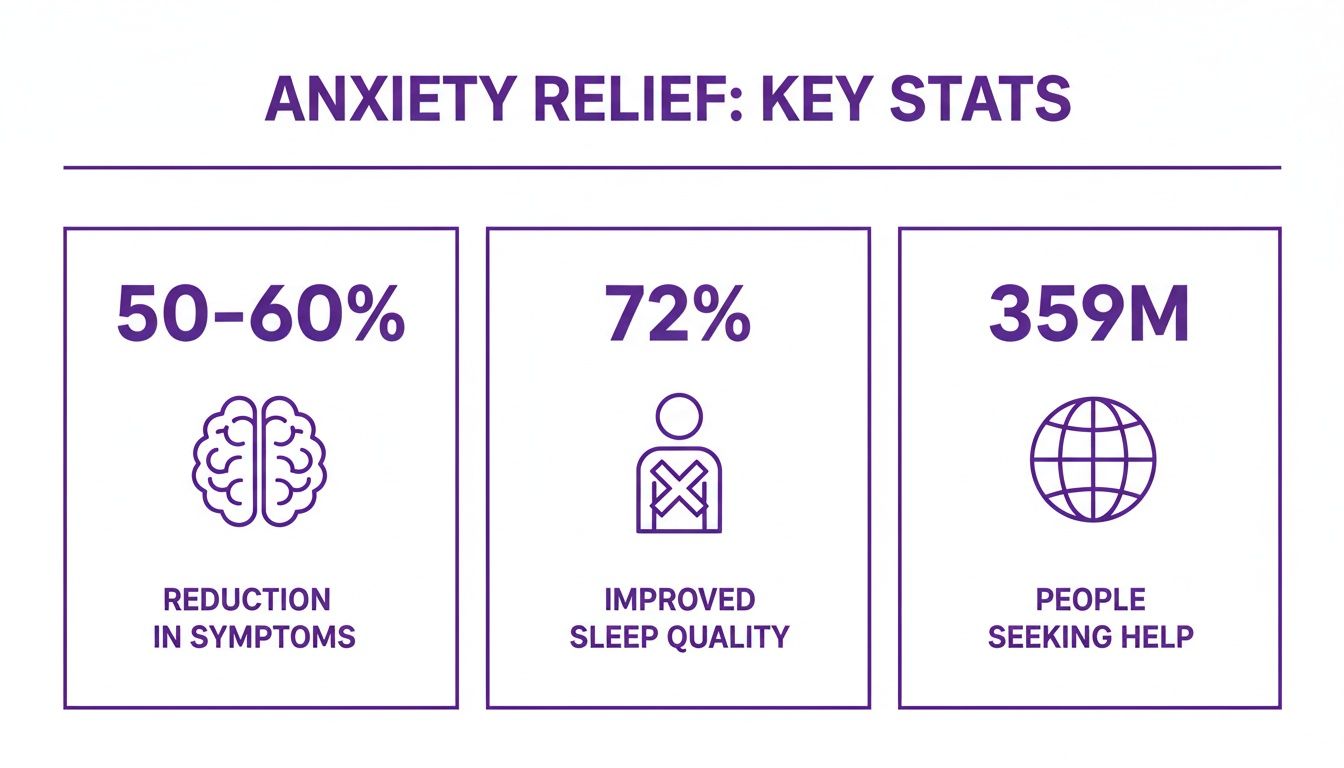
These numbers show just how many millions are dealing with anxiety, yet a massive number of people never get care. It really underscores the power of accessible strategies like therapy, which has been shown to reduce symptoms by 50-60%.
Building a Foundation for Calm
One of the most critical—and often overlooked—pieces of managing anxiety is its deep connection to our physical health, especially sleep. Anxious thoughts love to show up right when your head hits the pillow, and a night of poor sleep can crank up anxiety the next day. It's a vicious cycle.
For anyone looking for sleep solutions without pharmaceuticals, exploring effective alternatives to sleeping pills can open up a whole new world of helpful, non-habit-forming approaches.
Remember, managing anxiety isn’t about eliminating it entirely. It’s about learning how to respond to it differently. It’s about building a life where you feel equipped to handle challenges without being controlled by fear or worry.
Here at reVIBE Mental Health, our team is committed to providing expert, compassionate support for your journey. We have five convenient locations across the Phoenix area—including Chandler, Deer Valley, Phoenix PV, Scottsdale, and Tempe—to help you find a path to wellness that truly works for you.
Demystifying Anxiety and Its Physical Triggers
To get a real handle on anxiety, you have to understand what’s actually happening in your mind and body. The simplest way to think about anxiety is as your body's alarm system. It's a primal, powerful survival tool called the fight-or-flight response, hardwired into us to protect against immediate danger. When it kicks in, your system gets a flood of hormones like adrenaline and cortisol.
That hormonal surge is what creates all those familiar physical feelings: the racing heart, the quick and shallow breathing, the muscles that feel tight as a drum. It’s your body gearing up to either face a threat head-on or run for the hills. This was incredibly useful when our ancestors had to dodge a saber-toothed tiger, but today, that same alarm can get tripped by things that aren't life-threatening at all—a looming work deadline, an awkward conversation, or even just the thought of a crowded party.
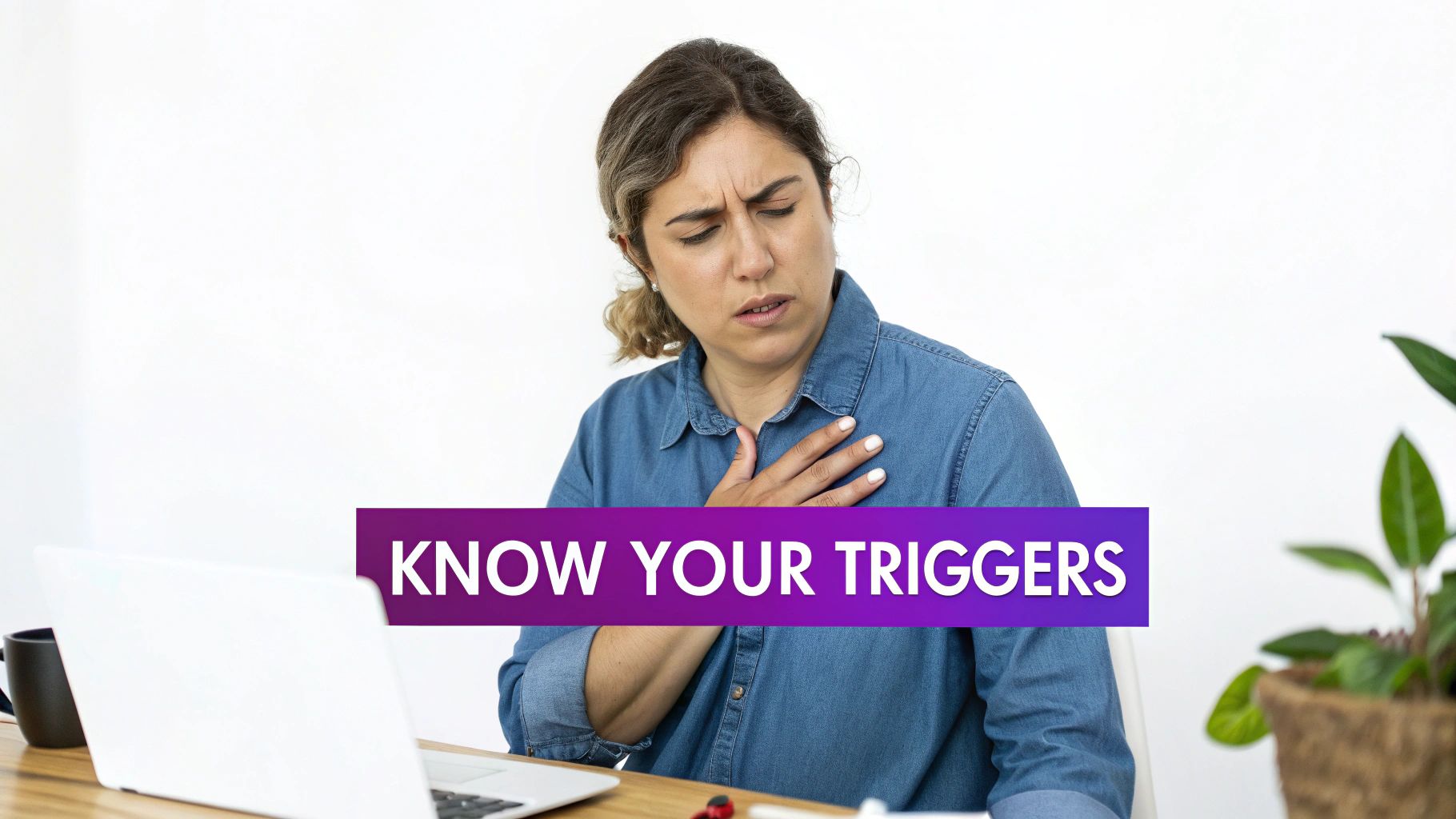
The trick is to remember that these physical sensations aren't dangerous in themselves. They're just your body's protection system being a little overeager. Grasping this connection is the first real step toward managing anxiety without medication, because it takes the mystery out of the experience and puts the power back in your hands.
The Autonomic Nervous System: The Engine Behind It All
The control center for all of this is your autonomic nervous system (ANS). It runs all the background processes without you having to think about them. It’s split into two main parts that are meant to work together like a seesaw:
- The Sympathetic Nervous System (SNS): This is your body’s “gas pedal.” When you perceive a threat, it slams down, activating the fight-or-flight response and putting you on high alert.
- The Parasympathetic Nervous System (PNS): This is the “brake pedal.” It’s in charge of the “rest and digest” state, calming everything down once the danger has passed.
For many people struggling with anxiety, it feels like the gas pedal is stuck to the floor. The sympathetic system stays dominant, keeping you in a constant state of readiness. This hypervigilance is exhausting and leads to that chronic feeling of being on edge.
This imbalance isn't a character flaw—it's a physiological state. The whole point of most non-medication strategies is to give you ways to consciously hit the brakes and activate your parasympathetic nervous system, bringing your body back into balance.
Understanding your anxiety is not about blaming yourself; it's about acknowledging a manageable biological response. By identifying your personal triggers and physical symptoms, you gain the power to intervene and regain a sense of control.
Connecting Your Triggers to Your Physical Responses
Learning to be a detective of your own anxiety is one of the most powerful things you can do. When you start mapping specific triggers to the physical sensations they cause, you can begin to see the pattern and interrupt the anxiety cycle before it really takes hold.
This isn't something you figure out overnight. It’s an ongoing practice of observing yourself without judgment. You might start to notice that your chest tightens up every time you check work emails late at night. Or maybe your stomach starts churning right before you have to make an important phone call. These patterns are your roadmap.
It’s worth remembering that anxiety is an incredibly common part of the human experience. A report from the World Health Organization noted that 359 million people worldwide were dealing with anxiety disorders in 2021. Yet, a staggering 72% of those who need help don't receive any. This is why accessible strategies that don't rely on medication are so critical. We also know that therapies like CBT are proven to reduce symptoms by 50-60%, showing there are effective paths to feeling better.
To start this process of self-discovery, you can use a simple framework to connect the dots between your triggers and your body's reactions. This table helps you connect common anxiety triggers to the physical sensations they produce, building crucial self-awareness.
Mapping Your Anxiety Triggers to Physical Responses
| Common Trigger Category | Example Scenarios | Typical Physical Sensations |
|---|---|---|
| Social Situations | Public speaking, meeting new people, attending large gatherings | Racing heart, blushing, sweating, trembling hands, shallow breathing |
| Work/School Pressure | Approaching deadlines, performance reviews, exams, conflict with a coworker | Muscle tension (shoulders/neck), headaches, stomach knots, fatigue |
| Health Concerns | Waiting for test results, noticing a new physical symptom, visiting a doctor | Dizziness, chest tightness, tingling in limbs, hyperventilating |
| Financial Stress | Paying bills, unexpected expenses, job insecurity | Upset stomach, difficulty sleeping, clenching jaw, loss of appetite |
| Environmental Factors | Loud noises, crowded spaces, cluttered environments, bright lights | Feeling on edge, jumpiness, increased heart rate, feeling overwhelmed |
| Anticipatory Anxiety | Thinking about a future event, worrying about "what ifs," upcoming travel | "Butterflies" in stomach, restlessness, inability to focus, dry mouth |
By paying attention to these connections, you're no longer a passive victim of your anxiety. Instead, you're an informed observer, equipped with the knowledge you need to start making changes.
Using Your Mind to Reshape Anxiety
Your thoughts have an incredible grip on how you feel. When anxiety creeps in, it can feel like your own mind has turned against you, churning out worst-case scenarios and catastrophic predictions on a loop.
But here’s the good news: you can learn to step in and change the channel. This is where Cognitive Behavioral Therapy (CBT) comes in. It’s a powerful, evidence-based approach that gives you a practical toolkit for reshaping the very thought patterns that feed your anxiety.
This isn’t about just slapping a "positive thinking" band-aid on a deeper issue. Instead, think of yourself as a detective investigating your own mind. You learn to spot unhelpful thinking habits, question them, and consciously replace them with more balanced, realistic perspectives. Over time, this literally starts to rewire your brain’s go-to response to stress.
From Automatic Negative Thoughts to Balanced Thinking
Anxious thoughts are often lightning-fast and automatic. A small mistake at work instantly becomes, "I'm definitely getting fired." A friend not texting back right away spirals into, "They're mad at me. I've ruined everything."
These Automatic Negative Thoughts (ANTs) feel incredibly real in the moment, but they rarely reflect reality. The first step is to simply start noticing them as they pop up, without judging yourself for having them.
Once you’ve caught an anxious thought, it’s time to put it on the stand. Be a gentle but firm questioner.
Let’s see how this works in practice:
- The Anxious Thought: "I completely bombed that presentation. Everyone must think I'm an idiot."
- The Cross-Examination: Ask yourself: "Is there any evidence that contradicts this? Did anyone say anything positive afterward? Am I being overly critical of myself? What's a more realistic way to view this situation?"
- The Balanced Reframe: "Okay, that presentation wasn't my absolute best, and my nerves got to me. One part was a bit rocky, but the section on Q3 data went really well. It's just one presentation, not a final verdict on my competence."
This process—catching, challenging, and reframing—is a core skill for pulling the plug on anxiety. It stops the downward spiral before it picks up speed and turns a moment of panic into a manageable experience.
Unmasking Common Thinking Traps
Anxiety loves to rely on a few predictable tricks of the mind called cognitive distortions. Just learning to name these patterns can rob them of their power, like turning on the lights in a dark room.
Here are a few of the most common culprits:
-
Catastrophizing: This is the "what if" game on steroids, where you instantly jump to the worst imaginable outcome. Your boss asks for a "quick chat," and your mind screams, "I'm being fired!"
- The Antidote: Play "what's most likely?" instead. Ask yourself: "Realistically, what is the most probable outcome? Even if the worst did happen, how would I handle it? What people or resources could I lean on?" This pulls you out of the land of fear and back into reality.
-
All-or-Nothing Thinking: Also known as black-and-white thinking. If your performance isn't perfect, you label the entire thing a total failure. There's no middle ground.
- The Antidote: Actively look for the gray areas. Acknowledge partial successes. Instead of thinking, "I failed," try reframing it as, "I did well on parts A and B, and I learned I need to work on part C."
-
Mind Reading: You assume you know exactly what others are thinking about you, and it’s almost always negative.
- The Antidote: Remind yourself that you are not a mind reader. Stick to the facts you actually know. Unless someone has explicitly told you what they think, your assumptions are just stories you’re telling yourself.
These cognitive tools aren't just mental tricks; they are proven methods for rewiring your brain's response to stress. Each time you challenge an anxious thought and replace it with a more balanced one, you are actively building new, healthier neural pathways.
The Power of Professional Guidance
While you can make incredible strides on your own, working with a trained therapist can make all the difference. Therapies like CBT create a structured, supportive space where you can hone these skills with an expert guide.
The world is facing a mental health crisis, with over a billion people experiencing conditions like anxiety, yet far too few receive treatment. This gap underscores just how vital non-medication strategies are. Evidence-based talk therapy has shown impressive success rates of 60-80% for reducing anxiety. You can explore more mental health statistics on Grow Therapy and see just how effective these approaches can be.
If you feel ready to build a more robust toolkit, exploring professional support could be a game-changer. Our guide to anxiety therapy at reVIBE explains how our team can partner with you to manage anxious thinking and get back in control. We are committed to providing expert, compassionate care across our five locations in Chandler, Phoenix, Scottsdale, and Tempe.
Building Resilience Through Lifestyle Adjustments
Beyond the powerful cognitive tools you can use to reframe anxious thoughts, some of the most effective strategies for managing anxiety are woven right into the fabric of your daily life. Building true resilience starts with a strong physical foundation. Think of your body as an ecosystem; when nutrition, movement, and sleep are in balance, your mind is far better equipped to handle whatever life throws at it.
This isn't about some radical, overnight transformation. It’s about making small, consistent adjustments that add up over time. By focusing on these core areas, you can directly influence your brain chemistry and nervous system, creating a state of calm from the inside out.

Fueling a Calm Mind with Nutrition
The old saying "you are what you eat" is especially true when it comes to mental health. The gut-brain axis is a real thing—a direct communication line between your digestive system and your brain. An unhealthy, inflamed gut can send stress signals straight to your head, while a nourished one promotes calm.
Forget about a complete diet overhaul. The best approach is to start by adding more anxiety-reducing foods, not just taking things away.
- Magnesium-Rich Foods: Often called nature's relaxant, magnesium helps regulate neurotransmitters that keep you calm. You can find it in leafy greens like spinach, plus nuts, seeds, and even dark chocolate.
- Omega-3 Fatty Acids: These healthy fats are essential for brain health and have been shown to reduce both inflammation and anxiety. Fatty fish like salmon are fantastic sources, along with flaxseeds and walnuts.
- Complex Carbohydrates: Foods like oatmeal, quinoa, and whole-grain bread help boost serotonin levels in the brain, which has a naturally calming effect. They also give you steady energy, preventing those awful blood sugar crashes that can easily trigger anxiety.
A simple first step is to add a handful of spinach to your morning smoothie or swap your usual afternoon snack for a small bag of almonds. These minor changes give your brain the raw materials it needs to build resilience.
The Power of Movement to Rebalance Your Brain
Exercise is one of the most potent tools we have for managing anxiety without medication. When you get your body moving, it releases endorphins—your brain's natural feel-good chemicals—and dials down levels of the stress hormone cortisol.
The trick is finding something you actually enjoy. That’s how it becomes a sustainable habit instead of another chore on your to-do list.
Different types of movement offer unique benefits:
- Aerobic Exercise: Anything that gets your heart rate up, like brisk walking, running, or cycling, is brilliant for burning off that restless, anxious energy and boosting your mood. Even just 20-30 minutes a day can make a world of difference.
- Mindful Movement: Practices like yoga and tai chi are a double whammy—they combine physical postures with deep breathing and meditation. This approach not only calms your body but also trains your mind to stay grounded in the here and now.
The need for these strategies is clear. Global anxiety rates have climbed sharply since 2019, yet just 1 in 4 people (27.6%) who need help actually receive treatment. This makes accessible, non-medication approaches absolutely vital. Research backs this up, too; meta-analyses show that regular exercise can cut anxiety symptoms by 26%, and practices like yoga can reduce them by a remarkable 43%. It's solid proof that how you move your body directly impacts how you feel. You can learn more about these powerful findings and how they tie into therapies like CBT.
Optimizing Your Sleep for Mental Restoration
Sleep is when your brain does its most important work. It’s busy processing emotions, consolidating memories, and literally cleaning out metabolic waste. When you skimp on sleep, your emotional resilience plummets, leaving you wide open to anxiety.
Improving your sleep hygiene—the habits and environment that set you up for a good night's rest—is non-negotiable.
- Create a Wind-Down Routine: About an hour before you want to sleep, dim the lights and put away the screens. The blue light from phones and tablets messes with melatonin, the hormone that tells your brain it's time for bed. Try reading a book, taking a warm bath, or listening to calming music instead.
- Stick to a Consistent Schedule: Going to bed and waking up at roughly the same time every day, even on weekends, is one of the best ways to regulate your body's internal clock.
- Optimize Your Bedroom: Keep your room cool, dark, and quiet. This helps signal to your body that this space is for rest, not for replaying your worries.
By thoughtfully adjusting what you eat, how you move, and how you sleep, you create a powerful, natural buffer against anxiety. Every healthy meal, every walk, and every restful night is a direct investment in your long-term well-being.
Grounding Techniques for Immediate Anxiety Relief
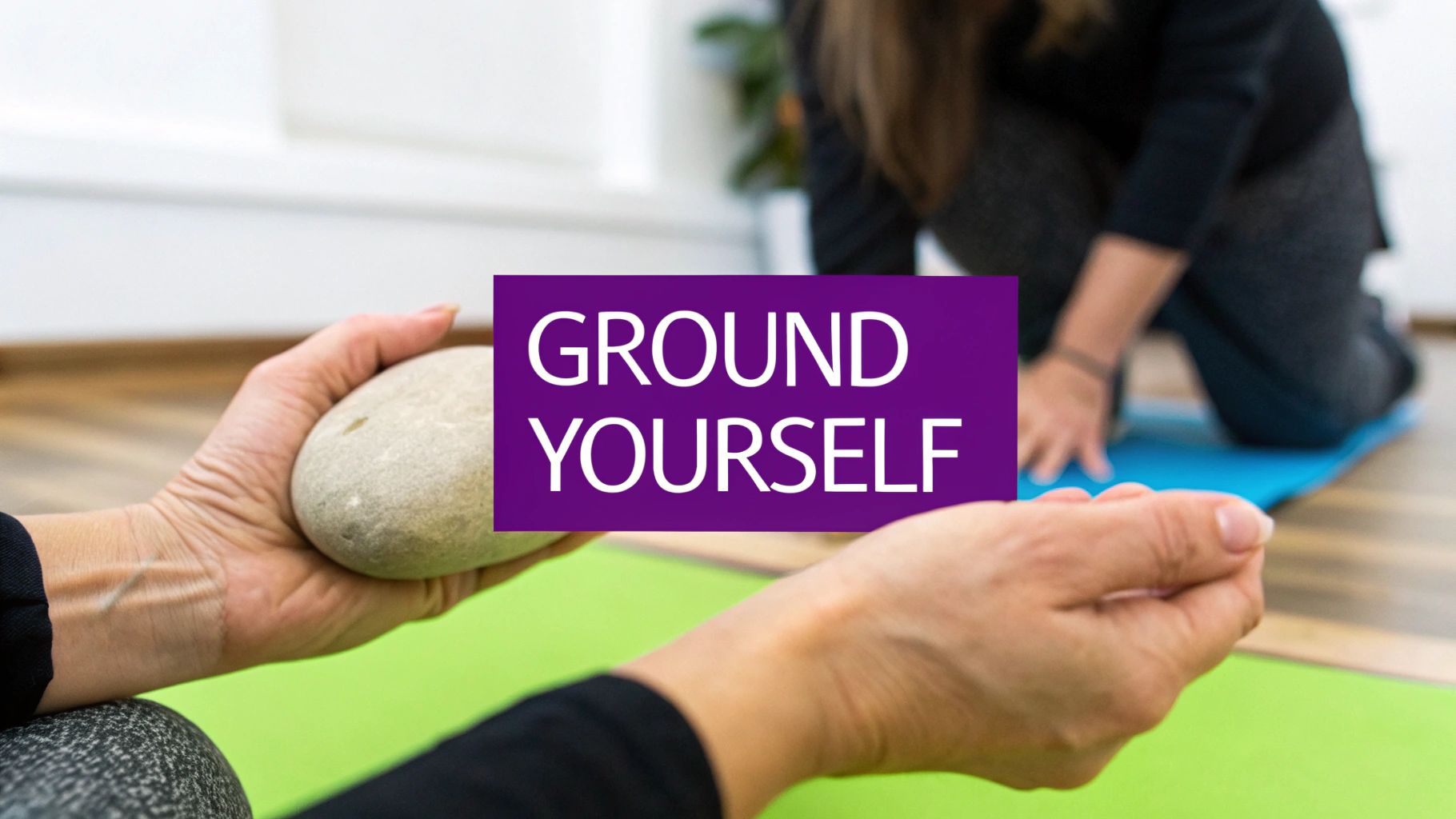
When that familiar wave of anxiety crashes over you, your thoughts can start to spiral. It feels like being pulled into a vortex of what-ifs about the future or what-if-I-hadn't-dones from the past. In these moments, you need something that works right now. That's where grounding techniques come in. They act as an anchor, pulling your attention out of the mental storm and back into the safety of the present moment.
Think of grounding as hitting a mental reset button. These exercises are deceptively simple but incredibly effective, using your physical senses to interrupt the anxiety cycle. Best of all, they're discreet and can be done anywhere—at your desk before a big presentation, in a chaotic grocery store, or even in the middle of a tense conversation.
Engaging Your Senses with the 5-4-3-2-1 Method
One of the most trusted grounding techniques in a therapist's toolkit is the 5-4-3-2-1 method. It's so powerful because it forces your brain to stop its anxious chatter and focus on the real, tangible environment around you. It’s a fantastic way to reconnect with the physical world when your mind is running away.
Here’s a breakdown of how it works:
- See 5 things. Really look around. Don't just list them; notice the little details. The grain of the wood on your desk, the way light hits a picture frame, a tiny crack in the ceiling.
- Feel 4 things. Tune into the physical sensations you’re experiencing. It could be the solid feeling of your feet on the floor, the texture of your jeans, the cool surface of a glass, or the weight of your phone in your hand.
- Hear 3 things. What sounds can you pick up? Maybe it’s the low hum of the refrigerator, the distant sound of traffic, or birds chirping outside your window. Isolate each one.
- Smell 2 things. This one can be a little tougher, but give it a shot. Can you smell the faint aroma of coffee in the air? The soap on your hands? The scent of rain from an open window?
- Taste 1 thing. Focus on the taste in your mouth. You could take a sip of water and really notice it, pop a mint, or just acknowledge the lingering taste from your last meal.
This exercise yanks your brain out of abstract worries and plants it firmly in concrete, sensory details, offering an immediate sense of relief.
Calming Your Nervous System with Box Breathing
When anxiety takes over, your breath often gets shallow and quick, sending panic signals to your body. You can reverse this process by consciously taking control of your breathing. Box breathing, also known as square breathing, is a powerful technique used by everyone from Navy SEALs to yoga instructors to instantly calm the nervous system.
The power of grounding lies in its simplicity. It’s a reminder that even when your mind feels lost in a storm of anxiety, your body is always anchored in the present moment. Learning to shift your focus to your physical senses is a skill that offers immediate refuge.
The concept is simple. Just visualize a square and trace it with your breath:
- Breathe In: Slowly inhale through your nose for a count of 4.
- Hold: Gently hold your breath for a count of 4.
- Breathe Out: Slowly exhale through your mouth for a count of 4.
- Hold: Hold your breath again for a count of 4.
Repeating this cycle for just a minute or two can make a huge difference. The steady, rhythmic pattern helps regulate your heart rate and activates the part of your nervous system responsible for rest and relaxation, effectively shutting down the fight-or-flight response.
Expanding Your Grounding Toolkit
Beyond these structured exercises, you can find grounding in all sorts of simple sensory experiences. The ritual of making a warm cup of calming herbal tea blends can be wonderfully grounding, engaging your sense of touch, smell, and taste.
Other people find that a quick sensory jolt does the trick—things like holding an ice cube, splashing cold water on your face, or firmly pressing your palms together. The key is to find what works for you and practice it, so it becomes a reliable and trusted tool you can turn to whenever you need it.
How Professional Support Can Take You to the Next Level
The self-help strategies we’ve covered are powerful tools for managing anxiety. They can truly make a difference. But sometimes, even the best personal toolkit isn't quite enough to handle what life throws at you.
Recognizing when it’s time to call in a professional isn't a sign of failure—it's a sign of strength and self-awareness.
If anxiety is constantly interfering with your job, putting a strain on your relationships, or making everyday tasks feel like climbing a mountain, it might be time for expert guidance. Those persistent feelings of being overwhelmed or the sense that you just can't get a handle on your worry are clear signals that a compassionate professional can help.
Finding the Right Guide for Your Journey
Deciding to see a therapist is a major investment in yourself. A good therapist provides a safe, confidential space where you can get to the bottom of what’s really driving your anxiety. They do more than just offer generic advice; they work with you to build personalized strategies for your specific challenges using proven techniques.
Here at reVIBE Mental Health, our entire team is focused on helping people in the Phoenix area learn how to reduce anxiety without medication. We believe in crafting a plan that respects your unique story and goals. It’s all built on trust and collaboration, so you feel understood and empowered from day one.
We have five convenient locations, including Scottsdale, Tempe, and Chandler, that are intentionally designed to feel more like a comfortable home than a sterile clinic.
Therapy isn’t about "fixing" something that's broken. It's about partnering with an expert who can provide you with a clearer map and better tools to navigate the terrain of your own mind.
Therapeutic Approaches That Give You Control
We specialize in evidence-based therapies that deliver lasting relief, not just a temporary fix. A cornerstone of what we do is talk therapy, particularly Cognitive Behavioral Therapy (CBT). It’s an incredibly practical approach that teaches you how to identify and challenge anxious thought patterns and, in turn, change how you react to stress.
For clients whose anxiety is deeply connected to past trauma, we also offer more specialized treatments. Learning about the benefits of EMDR therapy for anxiety can be a game-changer for many. This powerful method helps the brain finally process and heal from distressing memories that often fuel today's anxiety symptoms.
We Make It Easy toGet Started
We get it—taking that first step can feel like the hardest part. The team at reVIBE is committed to making the whole process as simple and stress-free as possible.
We accept most major insurance plans and are happy to help you with verification. That way, you can focus on what’s most important: getting better.
Our compassionate professionals are ready to partner with you. Give us a call today at (480) 674-9220 to schedule a consultation and start exploring a path to wellness that feels right for you.
Find a reVIBE Location Near You!
We currently have five locations for your convenience. (480) 674-9220
reVIBE Mental Health – Chandler
3377 S Price Rd, Suite 105, Chandler, AZ
reVIBE Mental Health – Phoenix Deer Valley
2222 W Pinnacle Peak Rd, Suite 220, Phoenix, AZ
reVIBE Mental Health – Phoenix PV
4646 E Greenway Road, Suite 100, Phoenix, AZ
reVIBE Mental Health – Scottsdale
8700 E Via de Ventura, Suite 280, Scottsdale, AZ
reVIBE Mental Health – Tempe
3920 S Rural Rd, Suite 112, Tempe, AZ
Ready to start the conversation? Contact reVIBE Mental Health today at (480) 674-9220 to learn more or schedule a consultation. https://revibementalhealth.com