You've probably been there already. You know you want help, but then you start searching and run into a wall of credentials: LMFT, PhD, PsyD, therapist, psychologist, counselor. It all starts to blur together fast.
Clients don't need more jargon. They need a clear answer to one question: who should I book with?
That's where the LMFT vs Psychologist decision matters. Both can help. Both are legitimate mental health professionals. But they are not interchangeable, and choosing the wrong fit can slow down care, especially if you need formal psychological testing rather than talk therapy alone.
Navigating Your First Step in Mental Healthcare
If you're anxious, depressed, overwhelmed, or stuck in a painful relationship pattern, it's easy to assume any licensed mental health provider will do the same job. That's the trap. The wrong match doesn't always mean bad care. It often means care that's merely aimed at the wrong target.
An LMFT is usually the better fit when the problem lives inside relationship patterns, family tension, communication breakdowns, parenting stress, or recurring conflict with a partner. A psychologist is often the better fit when you need deeper diagnostic clarity, more complex clinical evaluation, or formal testing for issues like ADHD, cognitive decline, school accommodations, or court-related questions.
Practical rule: If your biggest question is “How do we communicate better?” start by looking at an LMFT. If your biggest question is “What diagnosis is actually going on here?” start by looking at a psychologist.
That distinction gets missed all the time. People book with a therapist because they know they need support, but what they really need first is assessment. Then they spend weeks or months in treatment before learning they still need formal testing elsewhere.
This doesn't have to be confusing. You don't need to memorize every license type. You just need to understand the job each one is trained to do.
A good choice starts with your goal, not the letters after someone's name.
Defining the Roles of LMFT and Psychologist

The cleanest way to understand LMFT vs Psychologist is this: they look at distress through different lenses.
What an LMFT is trained to do
An LMFT, or Licensed Marriage and Family Therapist, is a mental health professional who holds a master's or doctoral degree in marriage and family therapy, is licensed by a state board, and completes 2,000 to 4,000 supervised clinical hours after graduation before independent licensure, with a primary focus on relational dynamics rather than individual psychopathology, as described in this overview of LMFT training and licensure.
That training shapes how LMFTs think. They don't just ask, “What symptoms are you having?” They also ask, “What happens in your relationships right before this gets worse?” They look at family systems, conflict cycles, emotional disconnection, parenting patterns, and the roles people get stuck in.
LMFTs often work well for:
- Couples in conflict who keep having the same fight
- Families under strain from grief, transitions, or parenting challenges
- Individuals with relationship patterns that keep repeating
- Teens or children whose struggles are closely tied to family dynamics
What a psychologist is trained to do
A psychologist usually holds a PhD or PsyD and is trained in the science of behavior, diagnosis, assessment, and treatment. Their work often centers more directly on the individual's psychological functioning, symptom patterns, and diagnostic picture.
Psychologists are especially important when the case is more clinically layered. They may provide therapy, but they also bring deeper preparation in assessment, clinical evaluation, and standardized testing. That's the key difference many people overlook.
If you're torn between the two, ask yourself what you need most right now: help changing a relationship system, or help clarifying a diagnosis.
Neither role is “better” in the abstract. One is better matched to your actual problem.
Comparing the Path to Licensure and Education
The difference in training is not cosmetic. It directly explains why these professionals practice differently.
An LMFT's route is more direct and focused on therapy. A psychologist's route is longer and more assessment-heavy. According to Pacific Oaks on LMFT vs psychologist training, an LMFT typically completes approximately 2 to 3 years for a master's degree, followed by 2,000 to 4,000 supervised clinical hours for licensure. Psychologists complete a doctoral degree that typically takes 4 to 7 years, plus a postdoctoral internship, bringing the total training duration to roughly 8 to 10 years or more.
LMFT vs. Psychologist Education and Training at a Glance
| Attribute | LMFT (Licensed Marriage and Family Therapist) | Psychologist (Ph.D. or Psy.D.) |
|---|---|---|
| Primary degree | Master's or doctoral degree in marriage and family therapy | Doctoral degree in psychology |
| Typical graduate training length | Approximately 2 to 3 years | Approximately 4 to 7 years for doctoral training |
| Supervised experience | 2,000 to 4,000 post-graduate clinical hours | Postdoctoral internship after doctoral training |
| Overall timeline | Shorter path to independent practice | Roughly 8 to 10 years or more |
| Core training emphasis | Relational therapy and systems work | Assessment, diagnosis, research, and clinical evaluation |
Why the longer path matters
Longer training doesn't automatically make a psychologist the better therapist for every person. That's not how this works. But it does explain why psychologists are qualified for tasks that go beyond standard psychotherapy.
Their education usually includes more intensive exposure to:
- Psychometric assessment
- Research methodology
- Clinical evaluation across complex disorders
- Standardized testing and interpretation
LMFT training, by contrast, is built to produce strong relational clinicians. It's targeted. It's practical. It prepares people to help couples, families, and individuals whose distress is closely tied to patterns in close relationships.
Don't confuse years of school with the right fit
Some readers assume the longer educational path means they should always pick a psychologist. I don't agree. If your main issue is repeated conflict with your spouse, family boundary problems, or co-parenting stress, an LMFT may be the sharper choice because their training is centered exactly there.
More schooling doesn't automatically equal better care. Better fit equals better care.
Use training as a clue to specialization, not as a status ranking.
Scope of Practice Diagnosis and Treatment Approaches
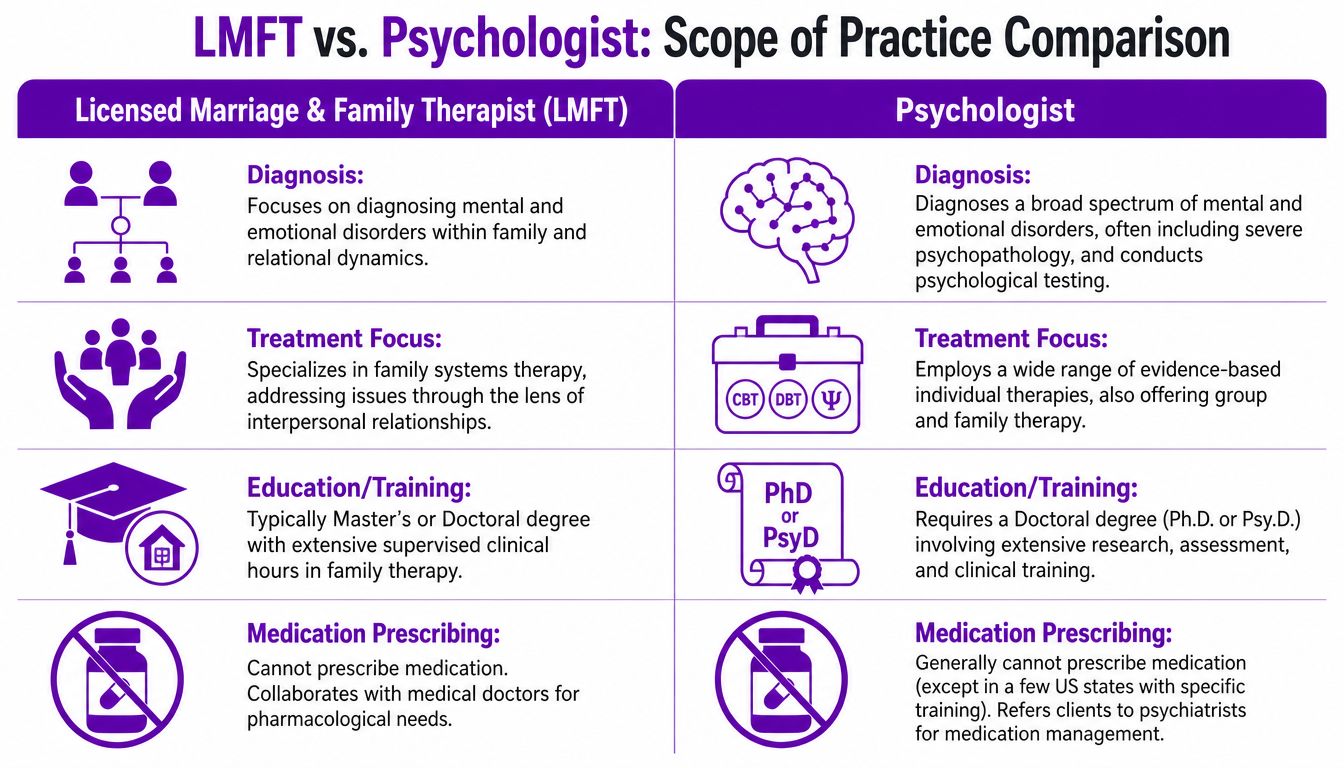
This is the section that matters most. The biggest practical difference in LMFT vs Psychologist is not personality, warmth, or whether one “cares more.” It's scope of practice.
The testing issue most articles miss
A psychologist holds a doctoral degree and has advanced training in psychometric assessment, research methodology, and clinical evaluation, making psychologists the only mental health professionals qualified to conduct in-depth psychological evaluations and provide formal diagnoses required by courts or schools, according to Thriveworks' explanation of psychologist qualifications.
That matters if you need:
- ADHD testing
- Cognitive evaluation
- Forensic assessment
- School or court documentation
- Formal psychological clarification when symptoms are complicated
Many people assume any therapist can “diagnose” in the same way. That's inaccurate. The critical underserved angle here is psychological testing. As explained in this discussion of when formal assessment points to a psychologist rather than an LMFT, people seeking help for complex diagnoses sometimes choose an LMFT when their need is for a psychologist for formal testing, which can delay the right care.
If you suspect ADHD, learning problems, cognitive decline, or a complicated diagnostic picture, don't guess. Start with assessment.
For a broader look at how diagnosis works in therapy, this article on whether a therapist diagnoses you is a useful next read.
Diagnosis and treatment are not the same thing
An LMFT can absolutely provide meaningful mental health treatment. Their strength is often in helping clients understand how symptoms interact with family systems, intimacy, communication, and emotional roles.
A psychologist, on the other hand, is usually the stronger fit when the case involves severe or complex mental illness, nuanced differential diagnosis, or the need for structured testing before treatment decisions are made.
Here's the practical breakdown:
| Area | LMFT | Psychologist |
|---|---|---|
| Relational therapy | Strong fit | Can provide it, but often not primary focus |
| Individual therapy | Yes | Yes |
| Formal psychological testing | Generally not part of role | Core area of qualification |
| Court or school diagnostic documentation | Limited | Often essential |
| Severe and complex clinical presentations | May refer out or co-manage | Often strong fit |
What about medication
Neither profession typically prescribes medication. Psychologists generally can't prescribe except in a few states with additional licensing, and LMFTs don't prescribe. In real life, both may coordinate with psychiatrists or other medical prescribers.
That's important because some people think “psychologist” means medication doctor. It doesn't. If medication may be part of your care, you may need a psychiatrist or another medical prescriber on your team.
The right question isn't “Who can talk to me?” It's “Who can evaluate what I'm dealing with, and who can treat it well?”
That question saves time.
Which Professional Is the Right Fit for You

Here's the direct answer. Choose based on the kind of help you need, not which title sounds more advanced.
Choose an LMFT when the real problem is relational
According to the American Association of Marital and Family Therapy, 78% of LMFTs primarily serve couples and families, compared with 22% of psychologists who report couples or family work as a primary focus, as cited in this AAMFT-related comparison reference. That tracks with what clients see in practice. LMFTs are built for relationship-centered work.
An LMFT is often the right first call if:
- You and your partner keep looping through the same conflict
- Your family communication is falling apart
- You're trying to rebuild trust after betrayal
- Your child's symptoms are tightly connected to family stress
- You want premarital counseling or co-parenting support
- You function fairly well alone, but close relationships keep becoming painful
If the pain makes the most sense in context, start with the clinician trained to work in context.
Choose a psychologist when clarity is the priority
A psychologist is often the better fit if your situation sounds more like this:
- You need a formal evaluation. This includes school accommodations, court matters, ADHD testing, or other structured assessments.
- Your symptoms are severe, unusual, or hard to sort out. You want more than support. You want diagnostic precision.
- You've tried therapy before but still feel unclear about what's driving the problem.
- You may be dealing with a condition that requires more extensive clinical evaluation.
If your main question is “Why am I like this?” therapy alone may not be enough at the start. Assessment may come first.
If you're still unsure
Start with the provider who matches your main goal today. That's the simplest rule.
- If your goal is repairing relationships, choose an LMFT.
- If your goal is testing, formal diagnosis, or more complex evaluation, choose a psychologist.
- If you need support between appointments or while you're organizing care, tools for automated mental health support can help with structure, check-ins, and symptom tracking, but they shouldn't replace a licensed clinician when assessment is needed.
Pick the clinician for the question you need answered first. You can always build a broader care team later.
That's often the smartest path.
Navigating Cost Insurance and Your First Appointment
Cost matters. Insurance matters. And the first appointment matters more than people realize.
Psychologists often charge more than LMFTs because their training path is longer and includes doctoral-level assessment expertise. I'm being intentional with that wording because fees vary widely by practice, insurance contracts, specialty, and region. Don't assume the highest rate means the best fit.
How to think about cost without getting stuck
Start with value, not just price.
If you need couples work and book a psychologist who doesn't focus on relational treatment, paying more won't help. If you need formal testing and book an LMFT for standard therapy, a lower fee may still cost you more in the long run because you'll need another provider later.
Use this filter:
- Best value for relationship work often points toward an LMFT
- Best value for diagnostic clarity often points toward a psychologist
- Best value overall is the provider who can address your actual need without unnecessary detours
What to ask your insurance company
Before the first session, verify the basics. This guide on therapy insurance coverage can help you understand the process.
Ask your insurer:
- Is this provider in network
- Do I need a referral or prior authorization
- Are mental health evaluations covered differently from therapy sessions
- What is my copay, coinsurance, or deductible responsibility
- Are telehealth sessions covered
- Is couples or family therapy covered under my plan
That last question matters. Some plans cover individual therapy more clearly than couples counseling.
What to ask in the consultation or first appointment
Don't waste your intake call with vague questions. Ask direct ones.
- What kinds of clients do you work with most often?
- Do you mainly treat individuals, couples, or families?
- Do you provide formal psychological testing, or only therapy?
- If I need assessment, can you do it or would you refer out?
- How do you approach treatment when trauma, anxiety, or depression is involved?
- If medication might help, how do you coordinate with a prescriber?
You're not being difficult by asking this. You're being smart.
A strong first appointment should leave you feeling clearer, not more confused.
Pay attention to that feeling. If the provider can explain their role plainly, answer your questions directly, and tell you when another specialist would be a better fit, that's a very good sign.
Find a reVIBE Location Near You
We currently have five locations for your convenience. Call reVIBE Mental Health at (480) 674-9220
reVIBE Mental Health – Chandler
3377 S Price Rd, Suite 105, Chandler, AZ
reVIBE Mental Health – Phoenix Deer Valley
2222 W Pinnacle Peak Rd, Suite 220, Phoenix, AZ
reVIBE Mental Health – Phoenix PV
4646 E Greenway Road, Suite 100, Phoenix, AZ
reVIBE Mental Health – Scottsdale
8700 E Via de Ventura, Suite 280, Scottsdale, AZ
reVIBE Mental Health – Tempe
3920 S Rural Rd, Suite 112, Tempe, AZ
If you're ready to stop guessing and get matched with the right level of care, reVIBE Mental Health can help you take the next step. Whether you need relationship-focused therapy, deeper diagnostic support, EMDR, or medication management, their team can help you find a provider that fits your goals and your life.