When you hear "medication management for depression," it’s easy to think it just means getting a prescription. But it’s so much more than that. It’s a dedicated, collaborative process between you and a psychiatric professional to find, adjust, and monitor the right medication for your specific situation.
This is about carefully tailoring a treatment plan to your unique symptoms and biology. The whole point is to make sure your medication is not only effective but also safe and supportive of your overall well-being.
Demystifying Medication Management for Depression

Think of medication management as having an expert navigator on your mental health journey. Depression isn't just about feeling sad; it’s deeply connected to your brain chemistry, impacting the neurotransmitters that control everything from your mood to your sleep and energy levels. Medication helps rebalance that chemistry, but since everyone’s brain is different, there's no magic pill that works for all.
This is exactly why the "management" piece is so vital. It means a skilled professional is right there with you, helping you find the best path forward. This isn't a top-down process; it’s a genuine partnership built on trust, open communication, and making decisions together.
The Core Pillars of Effective Management
Great medication management isn't a one-and-done appointment. It's a continuous cycle of care built on careful assessment, personalized prescribing, and consistent monitoring to get you the best possible results.
Here’s what that looks like in practice:
- Comprehensive Evaluation: It all starts with a thorough assessment. We need to understand your symptoms, your health history, and what you hope to achieve with treatment.
- Personalized Prescribing: Based on that initial deep dive, your provider will recommend a medication that seems like the best fit, clearly explaining the potential benefits and what to expect in terms of side effects.
- Ongoing Monitoring: Regular follow-ups are a must. These appointments are where we track your progress, address any side effects, and make small, precise adjustments to your dosage.
- Collaborative Partnership: Your feedback is the most crucial part of this entire process. You are the expert on you. Sharing how you’re feeling allows your provider to fine-tune the plan for success.
At its heart, medication management for depression is a dynamic and personalized approach to mental healthcare. It acknowledges that your needs can change over time and ensures your treatment adapts with you, providing a stable foundation for lasting recovery.
Why This Approach Is So Important
To put it simply, this structured approach removes the guesswork. Trying to find the right medication on your own can feel like wandering through a maze blindfolded. A dedicated professional, like a psychiatric mental health practitioner, brings the expertise needed to interpret your body's signals and make informed decisions.
This support is especially critical because antidepressants can take several weeks to start working, and sometimes the side effects show up before the benefits do. Having a guide during that initial period helps you stick with it, ensuring you don’t stop just before the medication has a real chance to help. This careful oversight makes the entire process safer, smoother, and ultimately, much more effective.
The First Steps in Your Treatment Journey
Taking that first step toward feeling better can feel like the biggest hurdle. It's completely normal to feel a bit apprehensive, but knowing what to expect can make all the difference. Your journey with us doesn't start with a prescription; it starts with a conversation. We begin with a detailed, compassionate psychiatric assessment designed to understand you, your life, and what you're going through.
This first appointment is far more than a simple symptom checklist. It's the beginning of a partnership. Our providers create a safe, judgment-free space for you to talk about what you've been experiencing—the emotional weight, the physical exhaustion, and how depression is getting in the way of your life. We're here to listen to your story.
The Initial Psychiatric Assessment
Think of this first meeting as building a detailed map of your mental health. To chart the best course forward, we first need to understand the terrain. This means we'll explore several key areas to get a complete picture of your unique situation.
This collaborative discussion typically covers:
- Your symptoms: We'll talk about when they started, how intense they are, and what seems to make them better or worse.
- Your health history: Understanding your overall health and any family history of mental health conditions gives us crucial context.
- Your life: Stressors at work or home, your support system, and daily habits all play a big role in your well-being.
- Your goals: Most importantly, we want to know what "feeling better" looks like to you. What do you want to get back to doing?
This deep dive is what allows for a truly personalized approach. It ensures that any medication we suggest is a good fit not just for your diagnosis, but for your life. Finding the right care team, which may include skilled and compassionate psychiatric nurse practitioners, is a vital part of this initial process.
From Assessment to a Personalized Plan
Once we have a clear picture of your situation, the conversation shifts toward solutions. If medication seems like a good option for you, this is where we start making decisions together. This isn't about us handing you a prescription; it's about exploring the possibilities as a team.
Your provider will explain which types of medication might be most effective for your specific symptoms. They’ll walk you through the potential benefits—like lifting your mood, sleeping better, or having more energy—and will be upfront about the common side effects of each option. Transparency is key.
The whole point of this first appointment is to take the mystery out of the process. It’s a dedicated time for you to be heard, to get your questions answered, and to start creating a treatment plan that feels right for you.
Ultimately, this first step is about building trust and creating a partnership. You are the most important person in the room. At reVIBE Mental Health, we believe this initial meeting sets the foundation for a successful recovery. It’s our promise that you won't be navigating this alone.
Picking the Right Medication for You
So, you and your provider have agreed that medication is a good next step. That's a huge decision, and now comes the part that can feel a little overwhelming: figuring out which antidepressant is the right one. The world of these medications can seem complicated from the outside, but they're not all a mystery. They simply work in slightly different ways to help rebalance your brain's chemistry.
The entire goal is to find a medication that lines up with your specific symptoms, your body, and even your genetic makeup. Good medication management for depression isn't about guesswork; it's about carefully matching the right key to the right lock. Your provider is your partner in finding that perfect fit.
How Antidepressants Actually Work
Let's break it down with an analogy. Think of your brain as having a complex communication network that uses chemical messengers called neurotransmitters to send signals. When it comes to mood, one of the all-star messengers is serotonin.
In depression, that serotonin signal can get a little weak. It's like a radio station with a faint signal—the message isn't coming through clearly. This can happen because the serotonin gets reabsorbed too quickly before its job is done, leaving you feeling down, anxious, or just plain exhausted.
Most of today's antidepressants, especially a group called SSRIs (Selective Serotonin Reuptake Inhibitors), don't add more serotonin to your brain. Instead, they act like a signal booster. They block the reabsorption process, allowing the serotonin you naturally have to stick around longer and do its job more effectively. This helps "turn up the volume" on its mood-stabilizing message, letting your brain’s communication system get back on track.
This flowchart gives you a peek into how a provider thinks through all the variables to land on a personalized recommendation for you.
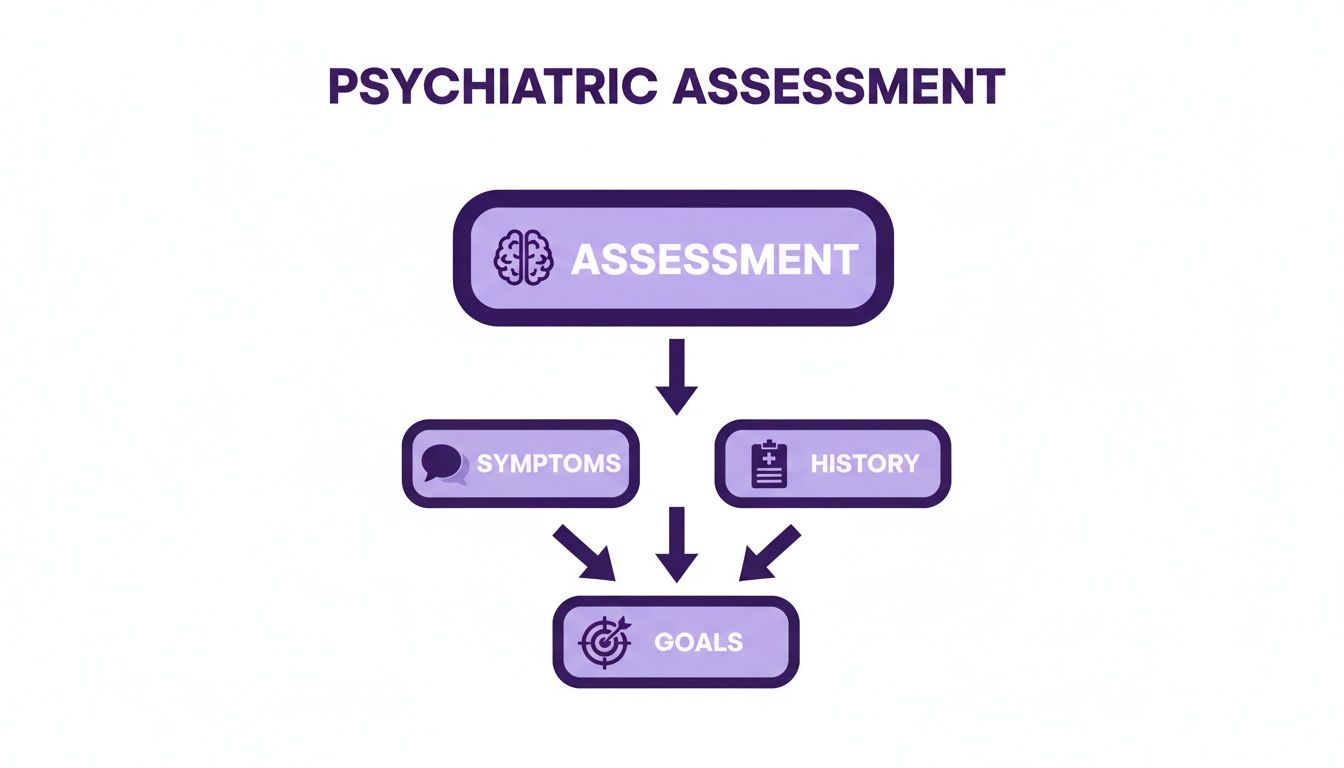
As you can see, it’s a process built on understanding your unique symptoms, personal history, and what you want to achieve.
The Most Common Types of Antidepressants
While there are many different medications out there, most people start their journey with one of two major classes. When you meet with a provider at a reVIBE Mental Health clinic, they'll walk you through why one might be a better starting point based on everything you discussed in your assessment.
Selective Serotonin Reuptake Inhibitors (SSRIs)
SSRIs are typically the first medication providers consider, and for good reason. They are proven to be effective for a wide range of people and generally have fewer side effects than older antidepressant classes.
Because they focus so specifically on serotonin, they offer a really targeted way to lift your mood.
- Common examples: Fluoxetine (Prozac), Sertraline (Zoloft), and Escitalopram (Lexapro).
- Best for: The classic symptoms of depression and most forms of anxiety.
Serotonin-Norepinephrine Reuptake Inhibitors (SNRIs)
SNRIs are a bit different because they work on two key neurotransmitters: serotonin and norepinephrine. Norepinephrine plays a big role in your energy levels and alertness.
This dual-action approach can be a game-changer if your depression comes with a heavy dose of fatigue or even physical pain.
- Common examples: Venlafaxine (Effexor XR) and Duloxetine (Cymbalta).
- Best for: Depression where low energy, lack of motivation, or chronic pain are major issues.
The choice between an SSRI and an SNRI isn't random. It’s a strategic decision based on the full picture of your health. Your provider considers your entire symptom profile to select the medication most likely to bring you relief.
Globally, depression affects about 5% of all adults, which has driven significant research and development. The antidepressant market is projected to hit USD 19.53 billion by 2025, with SSRIs leading the charge because of their excellent safety profile. SNRIs are a close second, often boosting response rates by up to 30% for people who don't see enough improvement with an SSRI alone. You can read more about antidepressant market trends if you're interested in the data.
Common Classes of Antidepressant Medications at a Glance
Feeling informed is a huge part of feeling empowered in your own treatment. This table is designed to be a quick reference, breaking down the main differences between the most prescribed types of antidepressants.
| Medication Class | How It Works (Simplified) | Common Examples | Often Prescribed For |
|---|---|---|---|
| SSRIs | Increases available serotonin ("the mood stabilizer"). | Prozac, Zoloft, Lexapro | General depression and anxiety symptoms. |
| SNRIs | Increases serotonin and norepinephrine ("the energy booster"). | Effexor XR, Cymbalta | Depression with fatigue or chronic pain. |
| Atypical Antidepressants | Works on different neurotransmitters, like dopamine. | Wellbutrin, Remeron | Depression with low energy, focus issues, or insomnia. |
| Tricyclic Antidepressants (TCAs) | An older class that works on multiple neurotransmitters. | Elavil, Tofranil | Severe depression or when other medications haven't worked. |
Keep in mind, this is just a starting point for the conversation with your provider. They will help you navigate these options to find what works best for your mind and body.
What to Expect: Treatment Timelines and Fine-Tuning Your Medication
Starting an antidepressant is a hopeful step, but it’s completely normal to wonder, "How long until I actually feel better?" It helps to think of it less like flipping a switch and more like tending to a garden. You've planted the seed, and now it needs a little time, patience, and care to really take root and grow.
One of the most important things to know is that this process is gradual. Most antidepressants need a few weeks—usually somewhere between two to four weeks—to build up in your system enough to start making a noticeable difference. During that initial window, it's pretty common for side effects to show up before the mood benefits do, which can feel frustrating.
This is exactly why staying in touch with your provider is so critical. They're your guide through this initial phase, helping you understand what you're feeling and reassuring you that it’s all part of the journey.
Why Follow-Up Appointments Are So Important
Your treatment plan doesn't just stop once you have a prescription in hand. In a way, that's just the beginning. Follow-up appointments are where the real work of medication management happens, allowing your provider to see how you're responding and make smart, careful adjustments.
Think of it like tuning a guitar. The first prescription gets you in the ballpark, but the follow-up visits are where we fine-tune the strings. Your provider listens to your feedback to get the pitch just right, making sure the medication works in harmony with your body and mind.
During these check-ins, we’ll talk about:
- What's working? Have you noticed any positive shifts, no matter how small? Maybe your energy is a little better, or you’re sleeping more soundly.
- Any side effects? We’ll discuss any side effects you're experiencing and how much they're impacting your daily life.
- Possible dose adjustments: Based on your experience, your provider might suggest tweaking the dosage—either up or down—to boost the benefits and ease any side effects.
This back-and-forth is a normal and necessary part of the process. It makes sure your treatment is dynamic and responsive to your unique needs, which is the key to getting the best possible results.
Patience and honest communication are your best allies here. The adjustment period is a journey, not a sprint. Trusting the process and staying connected with your provider are the keys to finding lasting relief.
Tracking Your Mood and Side Effects
To get the most out of your appointments, it helps to become a keen observer of your own experience. Keeping a simple daily journal can be a game-changer. You don't have to write a novel—just a few notes can reveal important patterns over time.
This simple habit empowers you to give your provider specific, concrete feedback. Instead of just saying, "I felt kind of off last week," you can say, "I noticed I had headaches on Tuesday and Wednesday, but my energy was way up over the weekend."
A Few Things to Jot Down in Your Journal:
- Mood Score: Use a simple 1-10 scale to track how you're feeling each day.
- Energy Level: Were you feeling sluggish, wired, or somewhere in the middle?
- Sleep: How was it? Did you toss and turn, or sleep right through?
- Side Effects: Note any physical or emotional changes you notice, like an upset stomach or feeling a bit more irritable than usual.
By tracking these things, you become an expert on your own treatment and a true partner in your care. Major depressive disorder (MDD) is a serious global health issue, and while medications are a primary treatment, they aren't one-size-fits-all. Even for people with treatment-resistant depression, SNRIs and SSRIs can still achieve a 30% response rate when dosing and management are handled carefully. To dig deeper, you can learn more about the evolution of antidepressant drugs and their market impact. Your personal tracking provides the real-world data needed to make that happen.
How Medication and Therapy Work Together

While medication is a powerful tool for managing the biological side of depression, it rarely works in isolation. In fact, combining medication with therapy is widely seen as the gold standard for treatment. This dual approach creates a powerful synergy, tackling both the immediate symptoms and the root causes for a more complete path to recovery.
Think of depression as being trapped in a deep, muddy ditch. The walls are slippery, and every time you try to climb out, you slide back down. Medication is like someone lowering a ladder into that ditch. It gives you the solid footing you need to start climbing.
But just getting out of the ditch isn't the whole story. That's where therapy shines. A good therapist helps you look around, understand how you fell in, and learn how to spot and avoid similar ditches in the future.
Creating the Headspace to Heal
One of the cruelest parts of depression is how it robs you of the very energy you need to fight it. The constant fatigue, sadness, and brain fog can make it feel impossible to do the deep, reflective work that therapy demands. This is where effective medication management for depression can be a game-changer.
By lifting the weight of the most disruptive symptoms, medication clears the way for you to truly engage in therapy. It can help you:
- Focus during your sessions: When you're not battling exhaustion, you can actually absorb what your therapist is saying and put their guidance into practice.
- Keep emotions in check: Medication can dial down the intensity, allowing you to talk through tough memories and feelings without becoming completely overwhelmed.
- Find the motivation to act: As your energy returns, you'll feel more capable of trying the new coping skills and strategies you discuss in your appointments.
In short, medication helps quiet the overwhelming static of depression so you can finally hear the valuable conversation happening in therapy.
Building Skills for Long-Term Resilience
Therapy, on the other hand, gives you the tools for lasting change that medication alone can't provide. While medication addresses the "what" (the neurochemical imbalance), therapy helps you explore the "why" and "how"—the thought patterns, behaviors, and experiences that fuel your depression.
The goal of combined treatment isn’t just to feel better right now. It's to build a foundation of resilience that will support you for years to come. Medication provides the stability to lay that foundation, and therapy teaches you how to build it.
Working with a skilled therapist, you can learn to identify and challenge negative thought loops, improve your relationships, and develop healthier ways to handle stress. This work is crucial for preventing relapses. For many people, a comprehensive depression treatment program that weaves medication and therapy together offers the strongest safety net.
The skills you gain in therapy are yours forever, long after you might stop taking medication. This two-pronged approach ensures you aren't just putting a bandage on your symptoms but are truly healing from the inside out.
Your Path to Feeling Better Starts Here at reVIBE
Taking that first step can feel like the hardest part. We get it. But you don’t have to do it alone. At reVIBE Mental Health, our entire focus is on making medication management for depression a clear, supportive, and accessible journey for you. We’re here to meet you right where you are, with compassion and understanding.
When you need support, you shouldn't have to wait. We offer appointments seven days a week, with options for both in-person visits and secure online sessions, so you can find a time that truly works for your life. Our mission is simple: remove the hurdles and create a welcoming, judgment-free space where you feel heard from the very first call.
Find a reVIBE Location Near You!
We currently have five locations for your convenience. (480) 674-9220
- reVIBE Mental Health – Chandler: 3377 S Price Rd, Suite 105, Chandler, AZ
- reVIBE Mental Health – Phoenix Deer Valley: 2222 W Pinnacle Peak Rd, Suite 220, Phoenix, AZ
- reVIBE Mental Health – Phoenix PV: 4646 E Greenway Road, Suite 100, Phoenix, AZ
- reVIBE Mental Health – Scottsdale: 8700 E Via de Ventura, Suite 280, Scottsdale, AZ
- reVIBE Mental Health – Tempe: 3920 S Rural Rd, Suite 112, Tempe, AZ
Making Care Both Accessible and Affordable
Worrying about insurance is the last thing you need when you're focusing on your health. We proudly accept most major insurance plans to ease that burden. Our team is always here to help you navigate the verification process, because we believe high-quality mental healthcare should be within everyone's reach.
Your well-being is our top priority. From the moment you contact us through every appointment, we're committed to building a partnership that helps you find your strength, regain your balance, and simply feel better.
As you move forward, it's also interesting to see how technology is creating new ways to access support. Innovations like chatbots for healthcare are beginning to change how people connect with and manage their own care plans, offering another layer of accessible interaction.
Common Questions About Depression Medication
Deciding to start medication for depression is a big step, and it's totally normal to have a lot of questions. We've put together answers to some of the most common concerns we hear from our clients, hoping to give you the clear, straightforward information you need to move forward with confidence.
Think of this as a conversation starter for you and your provider. Having the right information makes a world of difference.
How Long Will I Need This Medication?
This is probably the most common question we get, and the honest answer is: it's different for everyone. There’s no one-size-fits-all timeline.
For some people, medication acts as a short-term support, helping them get back on their feet during a tough patch, which might last 6-12 months. For others, especially those who've dealt with depression coming back over the years, a longer-term plan might be the best way to stay well.
The goal is always to use the lowest dose that works, for only as long as you need it. We’ll build a plan together and revisit it regularly. Any decision to stop the medication will be a joint one, involving a careful, gradual process to make sure you're comfortable.
Are Antidepressants Addictive?
This is a really important concern, and it’s one we take seriously. The short answer is no—antidepressants are not addictive in the same way substances like opioids or alcohol are. They don't create a "high," cravings, or a compulsive need to take more.
What can happen, though, is physical dependence. This just means your body gets used to the medication being there. That’s why stopping cold turkey can cause withdrawal-like symptoms, such as dizziness or feeling irritable. This is a normal physical response, not a sign of addiction, and it's why we always taper you off medication slowly and safely under our guidance.
It's not a failure if the first medication isn't the right fit. Think of it as gathering important data. Each experience, positive or negative, provides valuable clues that guide your provider toward the treatment that will ultimately work best for you.
What If the First Medication Doesn't Work?
First off, don't be discouraged. It's incredibly common for the first (or even second) medication not to be the right match. This isn’t a setback; it’s a standard part of finding what works for your unique brain chemistry.
If a medication isn’t helping or the side effects are too much, we have plenty of other paths to take. We might:
- Try a different medication in the same family (like another SSRI).
- Switch to a completely different class of medication.
- Add a second medication to complement the first one.
And for those with treatment-resistant depression, there’s more hope than ever. The global market for these specialized treatments is projected to grow from USD 2.0 billion to USD 4.8 billion by 2035, which just shows how much innovation is happening. You can discover more about the growing market for advanced depression treatments and the new options on the horizon.
Can I Just Use Therapy Instead?
Absolutely. For many people, particularly those with mild to moderate depression, therapy alone is an incredibly powerful and effective treatment. Our initial assessment is designed to figure out the best approach for your specific situation.
The decision to add medication is always a personal one, made in collaboration with your provider. Our job is to create a plan that you feel good about and that helps you meet your goals.
For more answers, feel free to check out our comprehensive FAQ page.
Your journey to feeling better is unique, and at reVIBE Mental Health, we are here to support you every step of the way with personalized, compassionate care. To learn more or to schedule your first appointment, please visit us at https://revibementalhealth.com.