
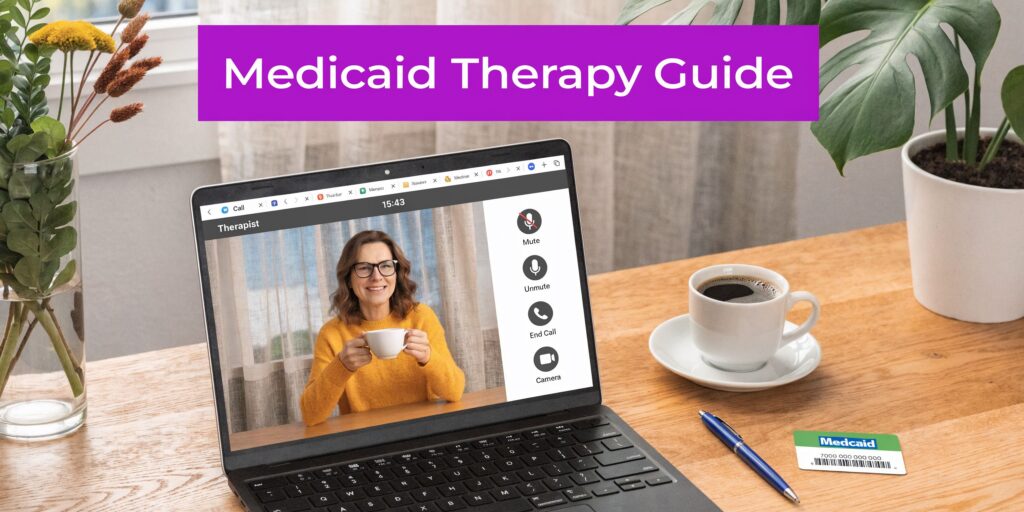
You finally decide to look for help. You open your phone, search for online therapist that accept medicaid, and get the same frustrating mix many people see: directory pages with little detail, profiles that may be outdated, and offices that say they accept Medicaid in general but not your specific plan.
That part matters more than one might realize.
A therapist can be licensed, skilled, even listed in a directory, but if they are not in network with your exact Medicaid plan, or if their office has not verified telehealth coverage correctly, you can lose time and end up with avoidable billing problems. When you are dealing with anxiety, depression, trauma, or burnout, that extra work can feel like too much.
The good news is that this process gets easier when you stop treating it like a random internet search and start treating it like a verification task. The right approach is not to call twenty places and hope one works. The right approach is to narrow your list, confirm your plan details, ask precise questions, and keep moving until you get a clear yes.
The Search for Affordable Mental Health Care
A common pattern shows up in intake calls. Someone has been meaning to start therapy for months. Then symptoms get worse, stress at home builds, or sleep falls apart, and they finally search for support. They find a few names, call two offices, leave one voicemail, get put on hold by insurance, and stop there.
That reaction makes sense. The system is not simple.
Why the search feels harder than it should
Many individuals are not only trying to find a therapist. They are trying to find a therapist who checks several boxes at once:
- Accepts Medicaid: Not cash pay only, not out of network reimbursement, but in-network participation.
- Offers online sessions: Because transportation, childcare, work schedules, illness, or distance make in-person visits hard.
- Is taking new clients: A profile can stay online long after a panel is full.
- Fits the clinical need: Trauma work, anxiety treatment, medication support, family issues, or teen therapy all require different experience.
When any one of those pieces is missing, the search resets.
What helps
The most effective approach is practical, not perfect. Start with your exact plan name. Check whether your Medicaid benefits are run directly by the state or through a managed care plan. Build a short list of therapists or practices. Then verify each one before scheduling.
That sounds basic, but it changes everything. Instead of asking, “Do you take Medicaid?” you ask, “Do you accept my exact plan for telehealth behavioral health visits, and are you accepting new online therapy patients right now?”
Tip: If a directory gives you a therapist name, treat that as a lead, not a final answer. The definitive answer comes from plan verification.
People feel defeated because they assume a dead end means there are no options. It means the search method needs to change. A more focused process can save energy, reduce confusion, and get you to a real appointment faster.
Understanding Your Medicaid Mental Health Benefits
Before you contact any therapist, get clear on what your plan is likely to cover and who administers it. Many searches go off track here.

Medicaid and your actual plan are not always the same thing
People say “I have Medicaid,” which is true, but not specific enough for scheduling. In many cases, your benefits are administered through a managed care organization, and that plan name is what the office needs.
If you live in Arizona, this distinction is especially important. You may think the state program name is all an office needs, but intake teams usually need the plan listed on your insurance card to confirm eligibility and network status. That is the name you should use when you call.
A few details to gather before you do anything else:
- The exact plan name on your card
- Your member ID
- Your date of birth
- Whether you want therapy, psychiatry, or both
- Whether you want online only or want both options
If you are looking for medication support as well as therapy, it helps to know that many clinics separate therapy scheduling from psychiatric scheduling. If that is part of your search, a page like https://revibementalhealth.com/psychiatric/ shows the type of service category you may need to ask for specifically.
Online therapy is now part of mainstream Medicaid behavioral health care
Telehealth is not a fringe option anymore. According to the U.S. Department of Health and Human Services, 6.0% of Medicaid providers delivered any behavioral health services via telehealth before the pandemic, and that stabilized at 61.4% by the end of 2021 in Medicaid behavioral health care (ASPE).
That shift matters for patients searching for an online therapist that accept medicaid. It means online care is no longer treated as a rare exception in many Medicaid systems. It is a standard way care is delivered.
Still, “common” does not mean “automatic.”
What your plan may cover
Mental health benefits under Medicaid are broader than people assume. Depending on your plan and clinical need, coverage may include:
- Talk therapy: Individual therapy is the most common starting point.
- Psychiatric evaluation: Useful if you need diagnosis clarification or medication review.
- Medication management: Follow-up appointments with a psychiatric professional.
- Trauma-focused care: If clinically appropriate and available in network.
- Telehealth visits: Often covered, but the details depend on your state rules and your specific plan.
The key issue is not whether Medicaid covers behavioral health in a broad sense. The key issue is whether your plan covers your service type, with your provider type, in your care setting, including telehealth.
What to look for in your benefits
If you have a member handbook, portal access, or a benefits summary, look for these terms:
| Term you may see | What it means for you |
|---|---|
| Behavioral health | General mental health and substance use services |
| Outpatient mental health | Standard therapy and psychiatry visits |
| Telehealth or telemedicine | Online or video visits |
| Prior authorization | Approval may be needed before some services |
| In network provider | The provider must participate with your plan |
Do not worry if the wording is confusing. Many benefits documents are written for billing departments, not patients. Your goal is not to decode every line. Your goal is to find out three things.
The three answers you need
- Does my plan cover online behavioral health visits?
- Do I need prior authorization for telehealth therapy or psychiatry?
- Which providers or group practices are in network for my plan?
Key takeaway: When people say Medicaid covers therapy, that is only the starting point. Real access depends on plan-specific verification.
Trade-offs to expect
Online care solves some problems and introduces a few others. It can reduce travel stress and make therapy possible for people balancing work, parenting, illness, or limited transportation. But some plans may handle online billing differently from in-person care, and some offices are more organized about verification than others.
That is why the best first step is not picking a therapist based on a nice profile photo. It is confirming that your plan, the provider, and the telehealth format all line up.
How to Find an Online Therapist Who Accepts Medicaid
Most searches fail because they start too broad. “Therapist near me” or “Medicaid counseling” produces too many weak leads. A better search narrows by payer, service format, and local follow-through.

Provider participation realities
The search is difficult partly because network participation is limited. Only about 43% of psychiatrists and 19% of nonphysician mental health providers accept any insurance, and Medicaid reimbursement is one reason participation stays low (PMC).
That does not mean you cannot find care. It means you should search strategically.
Use a three-lane search instead of one
Relying on a single directory is where people waste the most time. Use three lanes at the same time.
Official plan or state directory
Start with your Medicaid plan’s provider directory or member portal. This gives you the best chance of finding providers who are contracted with your plan.
Use filters for:
- Behavioral health
- Therapist, counselor, psychologist, or psychiatry
- Telehealth or virtual care
- Accepting new patients, if available
- Adult, child, teen, couples, or family, depending on your need
Directories are useful, but they are not self-verifying. Providers change panels. Availability changes. Use the directory to collect names, not to make assumptions.
Local group practices
This is a strong route, especially in Arizona. A group practice may have multiple clinicians, a scheduling team, and staff who verify benefits before the first visit. That gives you more than a therapist profile. It gives you an office that can confirm whether your exact plan works for online care.
Look for signs that a practice is set up to handle insurance well:
- Clear insurance language on the website
- Specific mention of online therapy
- Separate pages for therapy and psychiatry
- A phone number answered by intake or patient care staff
- Multiple clinicians or locations
If you are weighing online care against office visits, this comparison of https://revibementalhealth.com/online-therapy-vs-in-person/ reflects the kind of practical differences patients should think through before booking.
Large therapy platforms
National platforms can help when you want to browse many profiles. They work best as a screening tool, not your final authority.
Use them to answer these questions:
- Does the provider work with your age group?
- Do they list your concern, such as trauma, anxiety, depression, grief, or family conflict?
- Do they appear to have active scheduling availability?
- Does the platform verify insurance before booking?
If the platform says “accepts Medicaid,” confirm whether that means your exact plan, in your state, for telehealth.
Use better search terms
Generic searches create generic results. More precise language gets better leads.
Try combinations like:
- online therapist that accept medicaid in Arizona
- telehealth therapist Medicaid [your plan name]
- AHCCCS therapist online [city]
- Medicaid psychiatry telehealth Arizona
- trauma therapist Medicaid online Arizona
The added plan name or city helps reduce irrelevant results.
Build a short list, not a giant list
A list of five strong options beats a list of thirty uncertain ones. For each option, write down:
| Practice or provider | Accepts your plan | Online therapy listed | New patients | Notes |
|---|---|---|---|---|
| Option 1 | Need to verify | Yes | Need to ask | Good fit for anxiety |
| Option 2 | Need to verify | Yes | Need to ask | Offers psychiatry too |
| Option 3 | Need to verify | Yes | Need to ask | Trauma focus |
This keeps you from repeating the same calls and helps if you need a backup.
What tends to work best
The most successful searches share the same pattern:
- The patient knows their exact Medicaid plan.
- They contact offices that actively mention telehealth.
- They ask whether the office verifies benefits before scheduling.
- They stay flexible on provider name but firm on service need.
That last point matters. If your priority is “female therapist, evenings, online, trauma-informed, in network, available immediately,” the search may take longer. If your priority is “licensed therapist online who takes my Medicaid plan and treats anxiety,” access improves.
Tip: Ask the office, “Who on your team is available soonest for my plan and concern?” Flexibility can open doors faster than searching for one exact clinician.
What wastes time
Some search habits create unnecessary delays:
- Calling without your insurance card nearby
- Asking only “Do you take Medicaid?”
- Stopping after one denial
- Trusting directory labels without office confirmation
- Ignoring local practices because a national platform feels easier
An online therapist that accept medicaid is found through persistence plus precision, not luck.
Your Verification Checklist and Questions to Ask
Finding a likely match is only half the job. Verification is where you protect yourself from confusion, delays, and surprise costs.

The six-part verification checklist
Keep this simple and literal. Have your insurance card and a notes app open before you call.
Confirm active coverage
Make sure your Medicaid coverage is active for the current month and that you know the exact managed care plan name.Confirm provider type
Ask whether you are being matched with a licensed therapist, psychologist, psychiatric provider, or another professional. Plans may credential provider types differently.Confirm network status for your exact plan
Ask whether the therapist or practice is in network with the precise plan on your card, not Medicaid in general.Confirm telehealth eligibility
Ask whether online therapy visits are covered under your plan and whether the office bills them as telehealth behavioral health visits.Ask about prior authorization and referrals
Some plans require approval for certain services or visit types. The office should know whether they handle this or whether you need to call your plan.Ask about continuity and scheduling
A directory can list a provider today and tell you nothing about whether they plan to remain on your plan long term. That is worth asking directly.
A search result may tell you a therapist is available, but it does not tell you whether they are likely to stay in network. One guide on Medicaid therapist listings notes that directories do not provide data on provider turnover in Medicaid networks, which is why asking about ongoing plan participation is a smart step (Grow Therapy).
Phone script for the therapist’s office
You do not need to sound polished. You need to sound clear.
Try this:
“Hi, I’m looking for online therapy and I have Medicaid through [exact plan name]. I want to confirm whether your office is in network with my plan for telehealth behavioral health visits. Are you accepting new patients, and can you verify my benefits before scheduling?”
Then add the questions many people forget:
- Are online therapy visits covered under the way you bill my plan?
- Do I need prior authorization before the first appointment?
- Are there any limits I should know about before starting?
- Does your office handle insurance verification before I book?
- If I start with one therapist, how stable is your participation with my plan?
- What happens if a provider leaves the network or is no longer available?
Phone script for your Medicaid plan
Call the member services number on the back of your card and keep your question narrow.
Use this script:
“I’m looking for outpatient online therapy. Can you confirm whether my plan covers telehealth behavioral health visits, whether I need prior authorization, and whether [provider name or practice name] is in network?”
Then ask:
- Is this provider in network for my specific plan today?
- Do telehealth mental health visits process differently than in-person visits?
- Do I need a referral or authorization for the first visit?
- If the claim is denied, what denial reasons are most common for telehealth behavioral health visits?
Ask about the platform too
Patients focus on coverage and forget the visit itself. Ask what platform the office uses, whether it is secure, and whether they offer support if you have trouble logging in.
If you want a plain-language overview of ensuring HIPAA compliance for online therapy platforms, that resource is useful for understanding what secure online care should look like from the patient side.
What to write down after every call
Create a quick record with:
| Question | Answer |
|---|---|
| Date and time of call | |
| Name of person you spoke with | |
| Exact plan confirmed | |
| Telehealth covered | Yes, no, or unclear |
| Prior authorization needed | Yes, no, or unclear |
| New patients accepted | Yes, no, or waitlist |
| Earliest appointment | |
| Notes |
Key takeaway: “We take Medicaid” is not verification. “We verified your exact plan for online behavioral health and confirmed your next step” is verification.
This small paper trail helps if there is a billing error later. It also gives you confidence when offices give mixed answers.
Troubleshooting Coverage Denials and Common Problems
A denial does not always mean the service is not covered. It means the wrong step happened in the wrong order, or the claim was processed under the wrong assumptions.
Coverage denials happen because Medicaid rules are specific. Telehealth may be covered differently from in-person visits, and some plans require prior authorization while others do not (Charlie Health).
The most common reasons a denial happens
The office accepted the wrong insurance label
This happens when an office says it accepts Medicaid but does not accept your specific managed care plan. The fix is to call back and ask for network status under the exact plan name on your card.
Telehealth was covered, but billed incorrectly
Some plans process telehealth differently. If the office used the wrong billing pathway or failed to attach the correct authorization information, a claim can deny even when the service should have been covered.
Prior authorization was needed but not completed
This is common with specialized services or certain plan structures. If your denial notice mentions authorization, ask both the office and your plan who was responsible for obtaining it.
What to do first
Take a calm, administrative approach.
Read the denial notice carefully
Look for the reason code or the plain-language explanation.Call the provider’s billing office
Ask whether the denial was due to network status, telehealth billing, missing authorization, or eligibility.Call your plan
Confirm whether the service is covered in principle and what would need to change for approval.Document every call
Write down names, dates, and what each person tells you.
A useful script for denied claims
“I received a denial for an online behavioral health visit. Can you tell me the exact reason for the denial, whether this can be corrected and resubmitted, and whether any prior authorization or plan-specific telehealth requirement was missing?”
That wording keeps the conversation focused on action, not blame.
If you need an appeal
Ask your plan for the appeal process listed for members. Then ask the provider’s office whether they can supply supporting documentation.
Keep your appeal simple:
- State the service you sought
- State that you believed it was covered
- List what you were told during verification
- Request review based on medical need and correct plan processing
- Attach any notes or written confirmations you have
If your concern involves trauma treatment and you are trying to understand how specialty services fit with insurance, this page on https://revibementalhealth.com/is-emdr-covered-by-insurance/ is the kind of service-specific question patients often need to clarify before treatment begins.
Tip: When a claim denies, ask whether the issue is “not covered,” “not authorized,” or “billed incorrectly.” Those are three different problems, and each has a different fix.
If your preferred therapist is out of network
Do not assume the search is over. Ask your plan:
- Whether they have an in-network alternative with similar services
- Whether they can help locate a telehealth provider
- Whether any exception process exists if access is limited in your area
Even when the answer is no, that call points you toward a workable next option faster than restarting your search from zero.
Get Matched Today with reVIBE in Arizona
If you are in the Phoenix metro area, the easiest path is not doing all of this alone.
A good mental health intake process should reduce confusion, not add to it. That matters more with Medicaid, where delays come from paperwork, network questions, and plan-specific rules rather than from clinical need.

Why local support changes the experience
The administrative side of Medicaid is real. Provider-side Medicaid credentialing typically takes 30 to 60 days after a complete application is submitted, which is one reason organized practices matter for patients trying to access care quickly (BellMedEx).
For patients, that usually shows up as one simple question: can this office verify my insurance clearly and get me to the right provider without making me solve the system myself?
That is where a strong intake team makes a difference. Instead of asking you to guess which clinician fits your needs, confirm telehealth rules on your own, and sort out service lines by trial and error, a coordinated clinic can do that matching work for you.
What Arizona patients want most
In intake conversations, people want some combination of these:
- Online therapy that fits work or parenting schedules
- A therapist who understands anxiety, depression, trauma, grief, or burnout
- A practice that can also coordinate psychiatry if needed
- Straight answers about whether insurance is likely to work
- A real person to call when something is unclear
That is especially important for people who have already been bounced between directories, plan lists, and automated scheduling tools.
Why reVIBE is built for this process
reVIBE Mental Health is designed around the parts of access that usually break down. Patients are not left to piece together provider availability, insurance verification, and care coordination on their own. The practice offers therapy, EMDR, and psychiatry with medication management through an integrated team, along with in-person and secure online sessions.
For Arizona residents, that matters because the best experience usually comes from one place that can assess the whole picture. Not a profile site that sends you elsewhere for verification. Not a phone tree that cannot answer plan questions. An effective team.
The environment matters too. Many people avoid care because the first step already feels clinical, cold, or intimidating. reVIBE’s offices are built to feel welcoming and calm, and that same tone carries into virtual care.
Find a reVIBE location near you
Call (480) 674-9220.
reVIBE Mental Health – Chandler
3377 S Price Rd, Suite 105, Chandler, AZreVIBE Mental Health – Phoenix Deer Valley
2222 W Pinnacle Peak Rd, Suite 220, Phoenix, AZreVIBE Mental Health – Phoenix PV
4646 E Greenway Road, Suite 100, Phoenix, AZreVIBE Mental Health – Scottsdale
8700 E Via de Ventura, Suite 280, Scottsdale, AZreVIBE Mental Health – Tempe
3920 S Rural Rd, Suite 112, Tempe, AZ
If you have been searching for an online therapist that accept medicaid and want a clearer path, local help can remove a lot of the friction. The right office does more than offer appointments. It helps you get through the front door.
If you want support finding therapy or psychiatry in Arizona, contact reVIBE Mental Health. Their team can help verify insurance, explain your options, and match you with care that fits your needs and schedule.