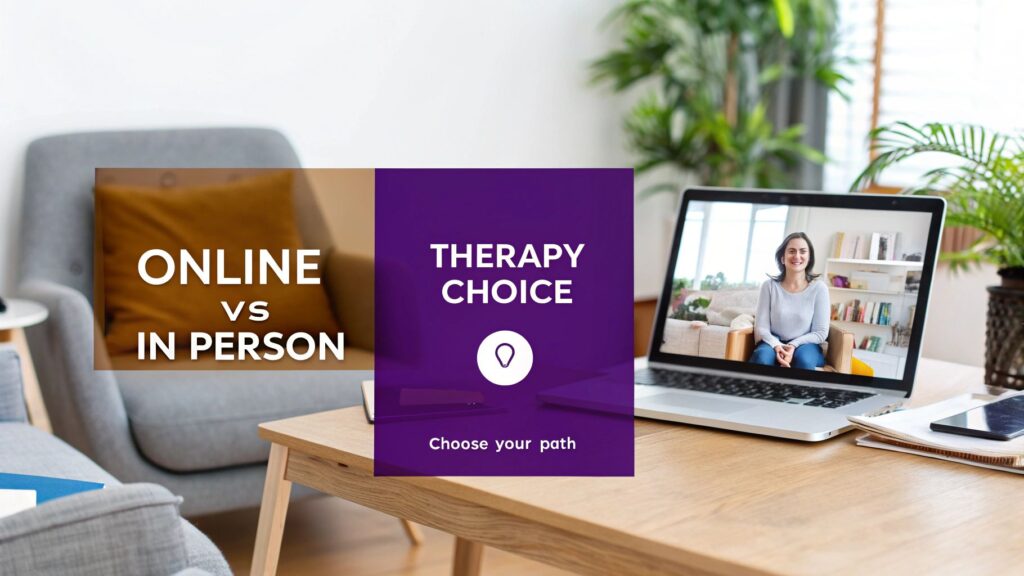
When you get right down to it, the "online therapy vs. in-person" debate really comes down to one thing: environment versus convenience. In-person therapy gives you a traditional, dedicated space that’s free from outside distractions, which can make it easier to pick up on subtle, non-verbal cues. On the other hand, online therapy offers a level of convenience and accessibility that was unheard of just a decade ago.
The right choice really depends on what you value more—a structured, face-to-face setting or the flexibility to get support from wherever you are.
Choosing Your Path to Mental Wellness
Figuring out whether to go with digital or in-person care is a huge first step on your path to feeling better. It's not about which option is universally "best," but about which one is best for you and your life at this moment.
This guide is designed to give you a clear, side-by-side look at both options. We'll walk through the factors that truly matter, from the quality of the therapeutic connection to the practical details, so you can make a choice that fits your needs.
Key Factors to Consider
Sometimes, the hardest part is just knowing when it's time to seek support. A good starting point can be recognizing the subtle signs of employee burnout and other stressors. Once you’ve decided to take that step, the next is to think about how therapy will actually fit into your day-to-day life.
To make it simple, here’s a quick breakdown of how online and in-person therapy stack up on the most important factors.
| Factor | Online Therapy (Teletherapy) | In-Person Therapy |
|---|---|---|
| Environment | Your chosen private space (home, office, car) | A dedicated, neutral clinical office |
| Accessibility | High; great for rural areas or mobility challenges | Limited by your proximity to the office |
| Communication | Relies on verbal tone and facial expressions | Captures full body language and environmental cues |
| Convenience | Zero travel time, often more scheduling flexibility | Requires commuting and adhering to fixed hours |
| Technology | Needs a reliable internet connection and a private device | No tech required on the client's end |
Making a Personalized Choice
At the end of the day, the best therapy is the therapy you'll actually stick with. At reVIBE Mental Health, we believe in meeting you where you are, which is why we offer both in-person appointments at our five Arizona locations and secure online therapy sessions.
The most effective therapy format is the one you can consistently attend and feel comfortable in. Both modalities are proven to be effective, so the decision should center on your personal preferences and practical needs.
Whether this is your first time looking into therapy or you're just considering a different approach, our team is here to help you figure it out. If you want to learn more about the experts who facilitate this work, you can explore the role of a psychiatric mental health practitioner and see how they can support you. We’re committed to helping you find the right fit.
Getting to Know the Two Therapy Formats
Choosing between online and in-person therapy isn't just about convenience; it's about understanding how the environment shapes your entire therapeutic experience. Where your session takes place—a therapist's quiet office or the comfort of your own home—fundamentally changes the dynamic and can influence how you connect, focus, and heal.
In-person therapy is the classic model we’re all familiar with. It’s built around a dedicated, neutral space that’s physically separate from the rest of your life. This separation is powerful. It sends a clear signal to your brain that this hour is set aside just for you—for healing and reflection, away from the constant interruptions of home and work.
For many people, the ritual of getting ready and traveling to an appointment helps create a mental transition. It builds a clear boundary, making it easier to step into a therapeutic mindset and, just as importantly, leave the emotional weight of the session in the office when you walk out the door.
What In-Person Therapy Feels Like
The real magic of in-person sessions is the depth of communication. A therapist can pick up on so much more than just words. They see the subtle, full-body non-verbal cues that are often lost on a screen—a restless foot, a shift in posture, or the way you hold your hands.
When a client is physically in the room, it creates a powerful sense of shared presence and emotional attunement. This is what we clinicians often call the ‘felt sense’ of connection, and it’s something that can be much harder to build through a video call.
This complete picture gives your therapist a richer, more nuanced understanding of what you're experiencing. For example, a therapist can more effectively help co-regulate a client's anxiety simply by being a calm, steady physical presence in the room—a dynamic that’s tough to replicate virtually.
What Online Therapy Feels Like
Online therapy, also called teletherapy, brings professional care to you through secure digital platforms. Its greatest strength is flexibility. You can have a session from any private space with an internet connection, which immediately tears down barriers like commute times and geographical limitations.
This accessibility has dramatically changed how people seek help. Globally, 55.5% of people actually prefer digital mental health options over traditional in-person care. The trend is even stronger among younger adults, with 72% of Gen Z and 68% of Millennials opting for teletherapy. You can see more teletherapy statistics that show just how much the field is changing.
With online therapy, your session takes place in your own environment, which has its pros and cons. Being in a familiar, comfortable space can help you relax and open up more quickly. It completely removes the intimidation factor that sometimes comes with visiting a clinical office.
The trade-off is that you're now responsible for creating a private, distraction-free zone for your session. The lines between therapy and the rest of your life can get a bit blurry when your appointment is in the same room where you work or unwind. One format offers a sanctuary you travel to; the other brings that sanctuary right to you. Each has its own distinct rhythm.
A Detailed Comparison Of Key Differences
When you're trying to decide between online therapy and in-person care, it usually comes down to a few core factors: the connection you build with your therapist, the subtleties of communication, overall convenience, and privacy. But instead of a simple pro/con list, let's dig into how these things actually play out in real life. This isn't about which one is "better" in general—it's about finding the better fit for you, right now.
This comparison gives you a quick visual rundown of the core differences between sitting in a therapist's office and connecting from your own space.
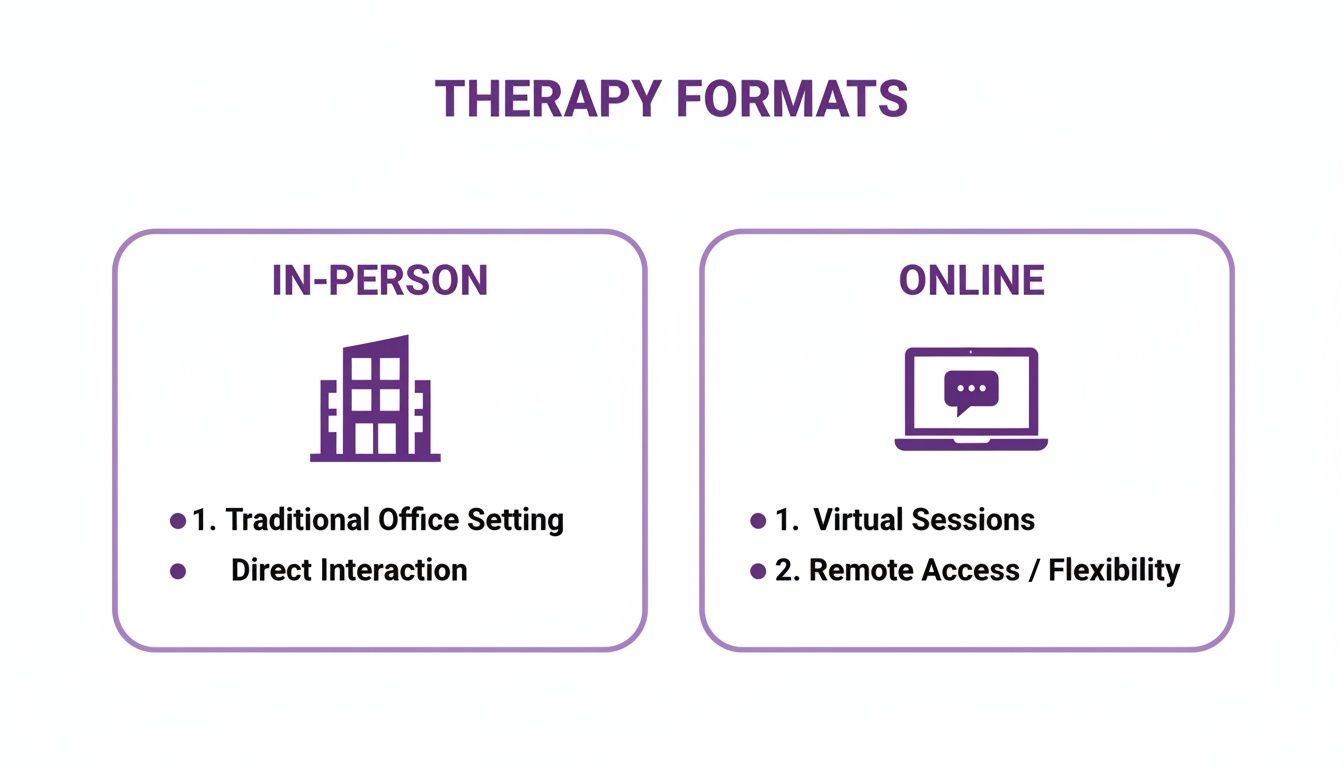
As you can see, the choice often boils down to a trade-off: the dedicated, structured environment of a professional office versus the unmatched ease of logging in from home.
The Therapeutic Alliance and Rapport
The single most important ingredient for successful therapy is the therapeutic alliance—that bond of trust and teamwork you build with your therapist. How that bond forms, however, can feel quite different depending on the setting.
In-person therapy offers a shared physical space. There’s a powerful sense of presence and connection that comes from simply being in the same room with someone. For many, especially when tackling tough emotions or trauma, this creates a tangible sense of safety that’s both reassuring and grounding.
On the other hand, online therapy builds rapport through focused, digital face-to-face time. While you lose the physical presence, some people actually find it easier to open up from the comfort of home. This can sometimes speed up the trust-building process because the safety of a familiar environment lowers their guard.
Research consistently shows that a strong therapeutic alliance is absolutely possible in both formats. The deciding factor is usually personal preference. Some of us feel more connected with direct human presence, while others thrive on the psychological comfort and control that a virtual setting provides.
In the end, the strength of your connection has far more to do with your therapist’s skill and your own comfort level than the medium itself.
Communication and Non-Verbal Cues
Therapy is so much more than just the words spoken. Non-verbal cues add a rich layer of information, helping a therapist tune into your complete emotional state.
In-Person Therapy Advantages
- Full Body Language: A therapist can see your entire posture—how you hold yourself, a tapping foot, or restless hands—cues that are usually out of frame on a video call.
- Environmental Cues: You can feel the energy in a room. A therapist can sense a shift in tension or a wave of emotion in a way that’s tough to replicate through a screen.
- Co-Regulation: During moments of intense anxiety or distress, a therapist’s calm physical presence can actually help soothe your nervous system. This is a powerful process called co-regulation.
Online Therapy Advantages
- Focused Facial Expressions: Video calls can zoom in on facial expressions, giving a therapist a close-up view of micro-expressions they might miss from across the room.
- Client's Environment: Getting a glimpse into your personal space can give your therapist valuable context about your life, habits, and daily stressors.
- Reduced Self-Consciousness: For some, the screen creates a buffer that reduces social anxiety, allowing for more direct and honest conversation without the pressure of being physically watched.
So while you might lose some non-verbal information online, you often gain a different kind of intimacy. The debate over online therapy vs in-person communication isn't about which is superior, but which style of communication you personally respond to best.
Accessibility and Overall Convenience
This is where online therapy really shines. By knocking down geographic and logistical hurdles, it has made mental health care accessible to a much broader group of people.
Here’s what convenience looks like with online therapy:
- No Commute: You get back the time and money you would have spent traveling.
- Scheduling Flexibility: It’s often much easier to find appointment times that fit around a busy work schedule, childcare, or other obligations.
- Location Independence: You can get support from anywhere with a private internet connection, which is a game-changer for people in rural areas or those with mobility challenges.
In-person therapy, while less flexible, offers a different kind of accessibility: a dedicated sanctuary. For many people, the ritual of traveling to an appointment helps create a mental shift, separating "therapy time" from the rest of the week. This protected space ensures you’re free from the distractions of home or work, letting you be fully present.
Below is a table that breaks down some of these key considerations side-by-side to help you weigh your options more clearly.
Comparison: Online Therapy vs. In-Person Therapy
| Factor | Online Therapy | In-Person Therapy |
|---|---|---|
| Connection | Built through focused digital interaction. Can feel less intimidating for some. | Fostered by shared physical space and presence. Can feel more grounding. |
| Communication | Emphasizes facial expressions. Context from home environment. | Captures full body language, energy in the room, and allows for co-regulation. |
| Convenience | High. No travel, flexible scheduling, accessible from anywhere with internet. | Lower. Requires travel and adheres to a more rigid schedule. |
| Accessibility | Ideal for rural areas, individuals with mobility issues, or busy schedules. | Provides a dedicated, neutral space away from home or work distractions. |
| Technology | Requires a stable internet connection and a private space. | No tech requirements, eliminating potential for glitches or connection issues. |
| Privacy | Dependent on secure platforms and a private location for sessions. | Controlled, confidential setting within the therapist's office. |
This table highlights that the "best" choice is truly contextual. What works wonders for one person might be a poor fit for another, depending entirely on their lifestyle, needs, and what makes them feel most comfortable.
Effectiveness and Clinical Outcomes
The big question in the online therapy vs in-person debate is, does one actually work better? Overwhelmingly, research says no for most common conditions. A massive review that included over 27,500 people found no significant difference in effectiveness between the two formats for the majority of mental health issues.
Online therapy has been shown to be especially effective for treating depression and anxiety. Some studies even suggest that the increased sense of control and comfort at home can lead to stronger client-therapist bonds and better consistency with treatment. You can read the full research about these therapy format findings for a deeper dive.
However, there are some nuances. Face-to-face therapy might have a slight edge when addressing broader, more complex mental health symptoms and in the initial stages of building that therapeutic bond. But the takeaway is clear: both methods are proven to work, which reinforces that the best choice is a deeply personal one.
When to Choose Online or In-Person Therapy
Deciding between online and in-person therapy can feel like a major hurdle right at the start. But here’s the thing: there isn’t a universally “better” option. The right choice is all about what fits your life, your personality, and what you’re hoping to achieve in therapy.
Think of it less as a right-or-wrong decision and more about matching the format to your current circumstances. Looking at some real-world scenarios can make it much clearer which path makes the most sense for you right now.
Situations Where Online Therapy Excels
Online therapy has really come into its own, providing a powerful and effective lifeline when the logistics of life get in the way of traditional care. It’s a way to get support that actually fits into the messy reality of a packed schedule or limited local options.
Teletherapy might be the perfect fit if any of these sound familiar:
- Your Schedule is Packed: Juggling a demanding job, family life, or an unpredictable work calendar? The flexibility of online therapy is a game-changer. Cutting out the commute makes it so much easier to squeeze in a session on your lunch break or between meetings.
- You Live in a Remote or Rural Area: If you're in a location with few mental health providers nearby, teletherapy completely removes geography from the equation. Suddenly, you have access to specialists you’d otherwise never be able to see.
- You're Dealing with Mobility Challenges: For anyone with a physical disability, chronic illness, or even just a lack of reliable transportation, online therapy ensures you get consistent care without the physical and mental toll of just getting to an office.
- You Experience Social Anxiety: The idea of walking into a new building and meeting a stranger face-to-face can be overwhelming. Starting therapy from the comfort of your own home can lower that initial barrier, making it easier to open up.
Online therapy is especially effective for working through common conditions like generalized anxiety, mild to moderate depression, and everyday life stressors. The simple fact that it’s easier to attend consistently is a huge factor in making real, steady progress.
Scenarios Where In-Person Therapy Is Often Recommended
While nothing beats the convenience of online therapy, some situations and conditions just do better with the structure and human connection of being in the same room. The traditional office setting provides a unique kind of focus and safety that's ideal for deeper or more intensive therapeutic work.
In-person therapy is often the go-to choice in these cases:
- Complex Trauma or PTSD: Hands-on modalities like Eye Movement Desensitization and Reprocessing (EMDR) are often most effective in person. A therapist's physical presence can create a powerful sense of safety and grounding that’s critical when processing traumatic memories.
- Severe Mental Health Conditions: For someone navigating severe depression, active suicidal thoughts, or other complex psychiatric disorders, in-person care allows for more immediate and comprehensive support. A therapist can better assess risk and provide a higher level of care.
- Family or Couples Counseling: When you have more than one person in the session, a therapist can pick up on subtle body language, group dynamics, and unspoken interactions that get lost on a screen. This is absolutely vital for untangling complex relationship issues.
- You Just Thrive on Direct Connection: It’s simple—some of us feel more comfortable and engaged when we are physically present with someone. If you value non-verbal cues and the energy of a shared space, in-person sessions will likely feel more impactful.
- You Need a True Sanctuary: If your home is chaotic, lacks privacy, or is full of distractions, a therapist’s office is a guaranteed quiet, confidential space. The simple act of going somewhere for therapy can help you mentally switch gears and fully focus on the work.
Data-Driven Insights on Patient Preferences
The whole online therapy vs in person conversation is also being shaped by how people are actually choosing to get care. The latest data reveals a massive shift, with preferences leaning heavily toward virtual options because of their convenience and proven results.
In 2023, a study of nearly 4.8 million adults in California seeking mental health care found that 47% chose teletherapy exclusively. That figure easily outpaced the 23% who opted for in-person sessions alone, showing that for a huge number of people, virtual care is now the first choice, not a backup.
What’s more, researchers have consistently found that for many conditions, teletherapy is just as effective as in-person care, with no significant differences in patient outcomes. However, that same data points to an access problem: while 81% of urban residents used teletherapy, only 62% in rural areas did, highlighting the ongoing need for better digital infrastructure. You can learn more about these therapy format findings and see how they reflect the new mental health landscape.
This trend confirms that your preference is valid, whether you’re drawn to the ease of digital sessions or the tangible connection of a physical office. At reVIBE Mental Health, we honor that choice by offering both. You can explore our different reVIBE Mental Health locations to find an office that feels right, or you can connect with one of our therapists through secure online sessions.
Flexible Care Options At reVIBE Mental Health
It’s one thing to understand the differences between online and in-person therapy, but it's another to find a provider who gives you the freedom to choose. Here at reVIBE Mental Health, we don't think you should ever have to sacrifice convenience for connection, or vice versa. That’s why we’ve built our practice around a hybrid model that fits your life, not the other way around.
We know that what you need today might not be what you need next month. You could start with online sessions because they fit perfectly into a hectic schedule, only to find yourself craving the grounded feeling of an in-person meeting later on. Or perhaps you begin at one of our welcoming offices but need to switch to virtual appointments after a move or a new job. Our entire approach is built for that kind of real-world fluidity.
A Hybrid Model for Modern Life
Life in the Phoenix metro area moves fast, and your mental healthcare should be able to keep up. Our hybrid model gives you the power to decide what’s best for your schedule, comfort, and therapeutic goals from one week to the next.
This flexibility is at the very core of our mission to provide compassionate and truly accessible care. By offering both secure online sessions and comfortable in-person appointments, we help remove the practical hurdles that can get in the way of prioritizing your mental health.
The best kind of therapy is the therapy you actually attend. Our hybrid approach ensures that logistics never become a reason to skip a session. Your well-being is always the priority, so our model adapts to you.
Comprehensive Services Where You Need Them
No matter how you choose to connect with us—online or in one of our offices—you always have access to our full spectrum of care. We believe in an integrated approach that addresses your mental health holistically, making sure you get the right support from the right professional.
Our offerings include:
- Talk Therapy: Work one-on-one with a dedicated therapist to build coping skills, process your experiences, and move toward your personal goals.
- EMDR Therapy: Our trained clinicians offer this highly effective, evidence-based therapy to help you process trauma and overcome its lasting impact.
- Psychiatry & Medication Management: When medication is part of your treatment plan, our licensed psychiatric professionals work alongside your therapist to provide expert evaluations and management.
You can explore our complete range of mental health services at reVIBE to see exactly how we can support you.
Find a reVIBE Location Near You!
We currently have five locations for your convenience. (480) 674-9220
reVIBE Mental Health – Chandler
3377 S Price Rd, Suite 105, Chandler, AZ
reVIBE Mental Health – Phoenix Deer Valley
2222 W Pinnacle Peak Rd, Suite 220, Phoenix, AZ
reVIBE Mental Health – Phoenix PV
4646 E Greenway Road, Suite 100, Phoenix, AZ
reVIBE Mental Health – Scottsdale
8700 E Via de Ventura, Suite 280, Scottsdale, AZ
reVIBE Mental Health – Tempe
3920 S Rural Rd, Suite 112, Tempe, AZ
Taking that first step is often the hardest part, so we make it simple. Our team is here to help match you with the right provider for your needs, verify your insurance, and get your first appointment scheduled. Your journey to feeling better should feel supported from the very first call.
Frequently Asked Questions
Even after weighing the pros and cons, you probably still have a few practical questions. It’s completely normal. Let’s tackle some of the most common ones that come up when you’re trying to decide between online therapy vs in person.
Is Online Therapy Effective for Serious Conditions?
This is a big one. People often wonder if teletherapy is "strong" enough for more severe mental health issues. The research is pretty clear: for many conditions, like moderate depression and anxiety disorders, online therapy is just as effective as meeting a therapist in their office. Consistent, easy-to-access support is a game-changer for managing these challenges.
But it's not a one-size-fits-all solution. For more complex conditions like severe PTSD or certain personality disorders, in-person therapy is usually the better route. The physical presence of a therapist helps build a deep sense of safety, which is crucial for the intensive work required to heal from significant trauma.
How Does Insurance Coverage Differ?
Good news here. Over the past few years, most major insurance carriers have started treating teletherapy just like any other medical appointment. This means your copay and benefits for an online session are often the exact same as they would be for an in-person visit.
It's always a smart move to double-check the specifics of your plan before you start. While coverage is much better now, some policies might have different reimbursement rates or require you to use certain providers for online care.
The team here at reVIBE Mental Health can actually help you with this part. We'll verify your benefits for you so you know exactly what to expect before your first session.
Can I Switch Between Online and In-Person Sessions?
Yes, you absolutely can—and this is precisely where a hybrid practice like ours really makes a difference. Life isn’t static, and your therapy shouldn't be either. You might start online because it fits your schedule, but later feel the need for the connection of an in-person meeting.
We built our model at reVIBE around this very idea. We make it simple to switch between online sessions and appointments at any of our five Phoenix-area locations. Whether it’s because your schedule changed, you’re craving a different kind of connection, or your therapeutic needs have shifted, your care stays seamless.
Ready to find the path that’s right for you? The team at reVIBE Mental Health is here to help you get matched with a provider and start your journey. Learn more and schedule your first appointment today.