
When someone mentions "psychiatric care," what comes to mind? For many, the term conjures up outdated and often intimidating stereotypes. It's time we put those old ideas to rest.
A psychiatric provider isn't a doctor for someone who is "broken." Think of them as a highly trained medical specialist who deeply understands the complex connections between your brain, your body, and your emotional life. This field is all about restoring balance and improving your quality of life.
What Is Psychiatric Care and Why It Matters
At its core, psychiatric care is a branch of medicine focused on diagnosing, treating, and preventing mental, emotional, and behavioral disorders. Just like you'd see a cardiologist for your heart, a psychiatric specialist treats the brain—the very organ that shapes our thoughts, feelings, and actions.
Their goal is to address the biological side of mental health. It’s about restoring chemical balance and providing the medical support needed for other therapeutic efforts, like talk therapy, to be truly effective.
A Partnership for Your Well-being
Here’s a helpful way to look at it: If a therapist is like a coach helping you build new coping skills and mental strategies, a psychiatric provider is the team's medical expert. They make sure your underlying biology—your brain chemistry and physical health—is in the best possible shape to support the work you're doing.
This medical oversight is critical because our mental health doesn't exist in a vacuum. A thorough psychiatric evaluation can uncover biological factors that might be contributing to your struggles, which leads to a much more complete and effective treatment plan.
This approach is a true partnership. It combines medical expertise with therapeutic support to treat the whole person, making sure both mind and body are working together toward wellness.
The Growing Need for Psychiatric Support
The need for accessible psychiatric services has never been greater. Mental health conditions are incredibly common, touching people from all walks of life.
For example, anxiety disorders are the most prevalent psychiatric issue worldwide, affecting 4.4% of the world's population. Depressive disorders aren't far behind, impacting another 4%. These numbers represent hundreds of millions of people, highlighting that seeking this kind of help is a normal and courageous step. You can discover more about the widespread impact of these conditions from recent mental health statistics.
Ultimately, psychiatric care is about providing relief, restoring function, and giving you the tools to manage your mental health. It’s a vital piece of the healthcare puzzle that validates your experience and offers a clear, evidence-based path toward feeling better and living a more fulfilling life.
What Exactly Does a Psychiatric Provider Do?
When you’re putting together your mental health support system, it helps to know who does what. While therapists and psychologists are incredible for exploring behaviors and providing talk therapy, a psychiatric provider brings a critical medical lens to your care. Their main job is to diagnose mental health conditions and treat them by addressing the underlying biology.
Think of it like building a house. Your therapist might be the architect, helping you design new ways of living and coping with stress. The psychiatric provider, on the other hand, is the structural engineer. They make sure the foundation—your brain chemistry and physical health—is solid enough to support the whole structure.
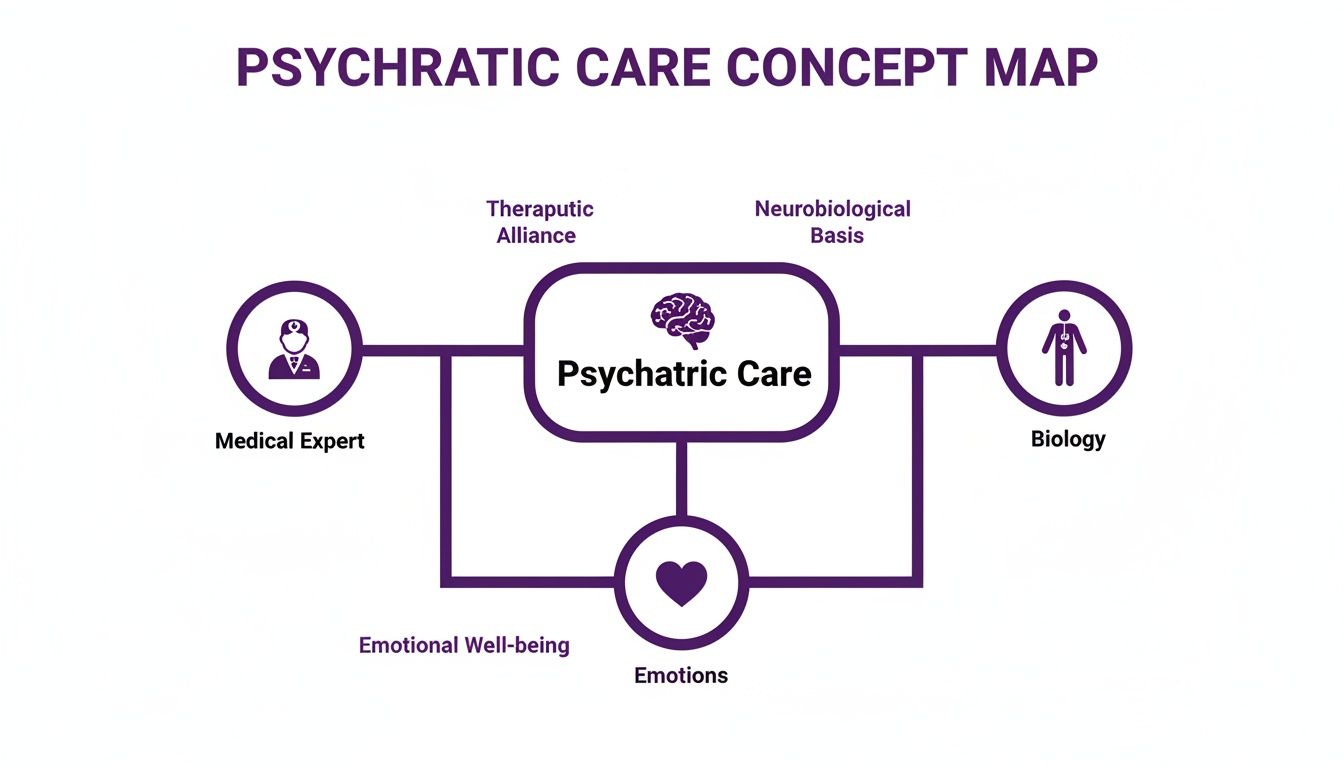
As you can see, their role isn't just about one thing. It’s about connecting the dots between your physical health, your emotional world, and deep medical knowledge to create one solid treatment strategy.
Rooted in Medical Science
What truly sets a psychiatric provider apart is their medical background. They are either medical doctors (MDs or DOs) or highly trained advanced-practice nurses who have specialized in psychiatry. This isn't just a few extra classes; we're talking about years of medical school followed by an intensive residency focused on the brain, neurochemistry, and the complex relationship between our physical and mental states.
This deep medical training gives them a unique skill set. They are qualified to:
- Pinpoint Complex Conditions: They can tell the difference between symptoms of a mental health condition and those that might be caused by a physical issue, like a thyroid problem or a vitamin B12 deficiency.
- Understand Brain Chemistry: They have an expert-level grasp of neurotransmitters—the brain's messengers like serotonin and dopamine—and how imbalances can fuel conditions like depression, anxiety, or ADHD.
- Prescribe and Manage Medication: As licensed medical professionals, they are the only ones on the mental health team who can prescribe medication to help rebalance brain chemistry and ease symptoms.
Your Mental Health Team at a Glance
Choosing the right professional can feel overwhelming. This quick comparison breaks down the key differences to help you decide who might be the best fit for your needs right now.
| Professional | Primary Role | Qualifications | Can Prescribe Medication? |
|---|---|---|---|
| Psychiatrist/PMHNP | Diagnoses conditions, manages medication, and oversees the medical aspects of treatment. | Medical Doctor (MD/DO) or Nurse Practitioner (PMHNP) with specialized psychiatric training. | Yes |
| Psychologist | Provides psychotherapy (talk therapy), psychological testing, and diagnoses behavioral disorders. | Doctoral Degree (PhD or PsyD) in psychology. | No (in most states) |
| Licensed Therapist | Offers psychotherapy (talk therapy) to help clients develop coping skills and process emotions. | Master's Degree (LCSW, LPC, LMFT) in a counseling-related field. | No |
Remember, it's not about one being "better" than another. They simply have different, often complementary, roles. Many people find the most success by working with both a therapist and a psychiatric provider.
Building a Complete Treatment Plan
A good psychiatric provider does more than just hand you a prescription. Their goal is to create and manage a holistic treatment plan that considers both the biological and psychological sides of what you're going through. They look at the whole you—your genetics, medical history, lifestyle, and current life pressures.
The ultimate aim is to create a plan that fits your life. This often means combining medication management to get your brain chemistry on the right track with therapy to build lasting coping skills.
This integrated approach is powerful. Medication can create the stability you need for therapy to be truly effective, while therapy gives you the tools to handle life's challenges long after you’ve found the right medication. They work together to build a strong foundation for lasting wellness.
If you'd like to dive deeper into who these providers are, you can learn more about the role of a psychiatric mental health practitioner. Understanding their unique skills can give you the confidence to take the next step and get the well-rounded support you deserve.
Common Conditions Addressed by Psychiatric Care
Psychiatric care isn't just for a full-blown crisis. Far from it. It’s for anyone whose mental or emotional state is getting in the way of their life—making it harder to work, connect with the people you love, or just feel like yourself.
Think of it as medical support for a wide range of very human challenges. Many of these conditions are way more common than people think, and they aren't signs of weakness. They’re recognized medical conditions with real, biological roots.
Mood Disorders That Affect Your Daily Life
We all have good days and bad days, but mood disorders are different. They’re marked by major shifts in your emotional state that can drain your energy, warp your perspective, and make even simple tasks feel like climbing a mountain.
- Major Depressive Disorder (MDD): This is so much more than just feeling sad. It’s a persistent low mood that hangs around for weeks or months, stealing your interest in things you used to love and filling your head with feelings of worthlessness. It’s like trying to navigate life with a lead blanket draped over you.
- Bipolar Disorder: This condition involves intense, dramatic swings between emotional highs and lows. Someone might cycle between periods of incredible energy and euphoria (mania or hypomania) and then plunge into deep depression. Psychiatric care is essential here to stabilize these shifts and manage the brain chemistry driving them.
- Dysthymia (Persistent Depressive Disorder): You can think of this as a chronic, low-grade depression that just doesn't let up, lasting for at least two years. The symptoms might not feel as severe as MDD, but their constant presence can take a serious toll on your quality of life.
It's also crucial to be aware of specific challenges, like spotting Postpartum Depression Warning Signs, which often need specialized psychiatric support.
Anxiety and Trauma-Related Disorders
A little anxiety is perfectly normal—it’s our built-in alarm system. But when that alarm is stuck in the "on" position, it can become completely overwhelming. Psychiatrists are experts at figuring out and treating the underlying brain chemistry that can leave your nervous system on constant high alert.
These conditions are incredibly disruptive. In fact, mental health disorders are now the leading cause of years lived with disability worldwide. Research on global mental health trends shows that between 1990 and 2021, mental disorder prevalence rates saw a sharp 4.74% annual uptick after 2019, highlighting the growing need for care.
Here are a few common anxiety-related conditions:
- Generalized Anxiety Disorder (GAD): This is when your brain gets stuck in a loop of excessive, uncontrollable worry about everyday things—work, money, health. It often brings along physical symptoms like muscle tension, fatigue, and trouble sleeping.
- Panic Disorder: This is defined by sudden, terrifying panic attacks. Your heart races, you can't catch your breath, you feel dizzy—it’s an overwhelming wave of fear. The fear of having another attack can become a major source of stress all by itself.
- Post-Traumatic Stress Disorder (PTSD): After living through or witnessing a traumatic event, some people develop PTSD. The experience keeps replaying through flashbacks, nightmares, and intrusive thoughts, making it incredibly difficult to feel safe in the world again.
Getting psychiatric help for these conditions isn’t about trying to erase your past. It’s about getting the medical support you need to process what happened, dial down the intensity of your symptoms, and take back control of your life.
Neurodevelopmental and Other Conditions
Psychiatric care also covers conditions that affect how the brain develops and functions, often impacting things like focus, behavior, and impulse control. While many of these are diagnosed in childhood, they absolutely stick around into adulthood and can create major hurdles at work and in relationships if they aren't managed.
- Attention-Deficit/Hyperactivity Disorder (ADHD): In adults, ADHD doesn't always look like the stereotypical bouncing-off-the-walls kid. It’s more likely to show up as chronic disorganization, an inability to focus, constant procrastination, and forgetfulness. The right medication and support can make a world of difference.
- Obsessive-Compulsive Disorder (OCD): This condition traps people in a cycle of unwanted, intrusive thoughts (obsessions) and repetitive behaviors (compulsions) they feel powerless to stop. A psychiatrist can help break that cycle by treating the intense anxiety at its core.
What Does Psychiatric Treatment Actually Look Like?
When it comes to mental health care, there's no magic bullet or one-size-fits-all fix. Effective psychiatric treatment is all about creating a plan that's as unique as you are. Think of it like a physical injury—a broken arm needs a different kind of care than a sprained ankle. Your mental well-being deserves that same level of personalized attention.
The real goal is to combine different therapeutic methods to build a strong foundation for your long-term wellness. It’s less about just managing symptoms and more about forming a partnership with your provider to find the right tools to help you feel like yourself again. Let's walk through some of the core treatments you're likely to encounter.

Medication Management: A Collaborative Process
One of the most common tools in psychiatry is medication management. The best way to think about it is as a method for rebalancing your brain's natural chemistry. When key neurotransmitters like serotonin or dopamine get out of sync, it can throw everything off, leading to symptoms of depression, anxiety, and other conditions.
Medications work to help correct these imbalances, giving you the stability needed for other therapies to be effective. This isn't about finding a "happy pill"—it's a careful, scientific process where your provider works alongside you to find the right medication at the right dose, aiming to relieve symptoms with minimal side effects.
This is a true team effort. It involves:
- Initial Evaluation: A thorough conversation about your symptoms, health history, and what you hope to achieve.
- Ongoing Monitoring: Regular appointments to track your progress, see how you're responding, and make adjustments as needed.
- Open Communication: Your feedback is crucial. You and your provider are partners in figuring out what works for you.
For those interested in exploring holistic ways to manage daily stress, certain stress relief supplements can offer additional support. However, it's essential to discuss any supplements with your provider first to ensure they are a safe addition to your treatment plan.
Psychotherapy: Building a Foundation for Coping
While medication can address the biological side of mental health, psychotherapy (or "talk therapy") tackles the psychological side. This is where you roll up your sleeves and learn the practical skills and gain the insights needed to navigate life's challenges.
Therapy offers a safe, confidential space to explore your thoughts, feelings, and behaviors. A therapist acts as a guide, helping you spot unhelpful patterns and develop healthier ways of coping. It’s like being given a map and compass to better understand your own inner world.
When you combine medication to stabilize brain chemistry with psychotherapy to build coping skills, you get the best of both worlds. This integrated approach is often the key to achieving the most powerful and lasting results.
EMDR: A Specialized Path for Healing Trauma
For people struggling with the lingering effects of trauma, a specialized therapy called Eye Movement Desensitization and Reprocessing (EMDR) can be life-changing. Trauma can cause distressing memories to get "stuck" in the brain, making them feel as raw and intense as the day they happened.
EMDR uses bilateral stimulation (like side-to-side eye movements) to help the brain reprocess these stuck memories. The purpose isn't to erase the memory, but to strip it of its emotional power. After successful EMDR, you can recall the event without it triggering the same intense fear, anxiety, or panic.
Essentially, it helps your brain file the memory away correctly, allowing it to feel like it belongs in the past. This powerful psychiatric tool can be a breakthrough for those with PTSD and other trauma-related conditions. We dive much deeper into this process in our guide to EMDR therapy for anxiety.
Knowing When It Is Time to Seek Psychiatric Help

One of the biggest questions people have is, "Is what I'm going through bad enough for a psychiatrist?" It's a valid concern, but it’s often tied to the old myth that you need to be at a breaking point to ask for help. The reality is much kinder.
There’s no distress-o-meter you have to hit before reaching out. It's simply about recognizing that you don't feel like yourself anymore and you want to find your way back. Instead of a rigid checklist, think of the following signs as gentle nudges—invitations to consider if professional support could help you feel better.
When Daily Life Starts to Feel Unmanageable
One of the most telling signs it’s time to get help is when your mental health starts getting in the way of your life. This usually doesn't happen overnight. It’s a slow creep that can turn simple, everyday tasks into monumental efforts.
Ask yourself if you’re seeing any of these patterns:
- Trouble at Work or School: Are you struggling to focus? Missing deadlines? That constant feeling of having zero motivation isn't a character flaw—it's often a symptom of mental and emotional exhaustion.
- Strained Relationships: Maybe you're pulling away from friends and family, or you notice you're more irritable and sensitive than usual. When your internal struggles start impacting your connections with people you love, it’s a big red flag.
- Neglecting Responsibilities: This can look like letting the mail pile up, struggling with basic chores, or finding it hard to even think about self-care. It’s not laziness; it’s a sign of being completely overwhelmed.
Significant Changes in Your Mood and Behavior
Beyond the day-to-day grind, it's crucial to notice lasting shifts inside your own head. Everyone has off days, of course. But a persistent change in your mood, thoughts, or even physical sensations is a strong signal that something deeper is going on that could benefit from a psychiatrist's insight.
The main takeaway is this: If you're struggling to cope or just feel like a stranger to yourself, that's reason enough. You don't have to wait for a crisis to ask for help.
Pay close attention to these key changes:
- Persistent Sadness or Emptiness: This is more than just feeling down. It's a heavy, lingering sense of hopelessness or apathy that just won’t lift, often lasting for weeks.
- Overwhelming Anxiety or Worry: Feeling constantly on edge, having panic attacks, or being stuck in a loop of uncontrollable worry are all signs your nervous system is stuck in overdrive.
- Major Shifts in Sleep or Appetite: Are you sleeping way too much, or barely at all? Have you lost your appetite or started eating compulsively? These physical symptoms are often directly connected to what’s happening mentally.
- Loss of Interest or Pleasure: One of the hallmark signs of depression is anhedonia—the inability to find joy in things you used to love, whether it's a hobby, seeing friends, or even listening to music.
If any of this feels familiar, please know that reaching out is an act of strength. It’s the first, most courageous step toward feeling like yourself again.
Find a reVIBE Location Near You!
Taking that first step is often the hardest part of the journey. If you’re feeling overwhelmed by the thought of finding help, you should know you’re in good company. The World Health Organization estimates that more than 1 billion people worldwide are living with a mental health condition—that’s about 1 in 7 of us.
Despite how common these struggles are, a shocking 71% of individuals with psychosis globally don't receive any mental health services at all. You can read more about these sobering global mental health statistics to see just how big the gap in care is.
Here in the Phoenix area, though, compassionate and high-quality care is much closer than you might think. The goal is to make finding a provider feel simple and supportive, not like another hurdle to overcome. At reVIBE Mental Health, we’ve designed our entire process to get you the help you deserve without the stress.
We currently have five locations for your convenience. (480) 674-9220
We believe finding the right psychiatric support should be easy. To make things even easier, we have five locations spread across the Phoenix metro area, ensuring that expert support is always nearby, no matter where you live or work in the Valley.
We’re committed to providing care that fits into your life, not the other way around. With appointments available seven days a week, including both in-person and secure telehealth options, you can connect with a professional in a way that feels right for you.
Explore all our welcoming spaces and find the one nearest you by checking out our full list of reVIBE Mental Health locations.
Our Locations Across the Valley
-
reVIBE Mental Health – Chandler
3377 S Price Rd, Suite 105, Chandler, AZ -
reVIBE Mental Health – Phoenix Deer Valley
2222 W Pinnacle Peak Rd, Suite 220, Phoenix, AZ -
reVIBE Mental Health – Phoenix PV
4646 E Greenway Road, Suite 100, Phoenix, AZ -
reVIBE Mental Health – Scottsdale
8700 E Via de Ventura, Suite 280, Scottsdale, AZ -
reVIBE Mental Health – Tempe
3920 S Rural Rd, Suite 112, Tempe, AZ
Navigating Insurance and Appointments
Worries about cost should never stand in the way of your mental health. We accept most major insurance plans, and our team is ready to help you figure out your coverage.
We'll work with you to verify your benefits so you understand everything upfront. From the moment you call, our mission is to provide a clear and supportive path to getting the care you need.
Answering Your Questions About Psychiatric Care
It’s completely normal to have a lot of questions when you're thinking about starting psychiatric care. Feeling a little nervous is normal, too. Getting clear, straightforward answers can help you feel more confident and ready to take that first step. Let's walk through some of the most common questions we hear from people just like you.
What’s a First Psychiatric Appointment Actually Like?
Think of your first appointment less like a test and more like a conversation. It's a dedicated time for you and your provider to get to know one another in a safe, completely non-judgmental space. The main goal is simply to gather information so we can start to understand your unique story.
We'll talk about the symptoms you're experiencing, touch on your personal and family health history, and discuss what you're hoping to get out of treatment. This initial meeting is the foundation for building a care plan that’s truly designed for you. The more open you can be, the better your provider can understand the full picture of what you're going through.
How Long Does Treatment Usually Last?
This is probably one of the most common questions we get, and the honest answer is: it’s different for everyone. How long you’ll need treatment really depends on a few things—the specific condition we're working on, how severe it is, and how your body and mind respond to the therapies we try.
Some people find that short-term support is all they need to navigate a particularly tough time in their life. For others, managing a more chronic condition might mean that psychiatric care becomes a longer-term part of their wellness routine. Our goal is always the same: to find what works best to help you feel stable and well. We'll constantly check in on your progress and adjust your plan as your needs change.
The most important thing to remember is that treatment is a collaborative journey. Your progress and goals will be regularly reviewed, ensuring your care plan remains relevant and effective for as long as you need it.
Will My Information Be Kept Private?
Absolutely. Your privacy isn't just a priority; it's protected by law. We adhere to strict legal and ethical standards, including the Health Insurance Portability and Accountability Act (HIPAA). Everything you share with your psychiatric provider is held in the strictest confidence.
This confidentiality is the bedrock of a trusting relationship, which is essential for any real progress. The only exceptions are very rare situations where there is an immediate risk of harm to yourself or someone else, which we are legally required to report.
What Does "Integrated Care" Mean?
Integrated care simply means your mental health team is working together. Your therapist and psychiatric provider collaborate directly on your care plan, ensuring that every angle of your well-being—both psychological and biological—is addressed in a coordinated way.
For instance, your therapist might share insights from your talk therapy sessions that help your psychiatric provider make a more informed decision about your medication. This kind of teamwork results in a much more complete and effective treatment plan. It gives you a unified support system that's entirely focused on helping you get better.
Ready to take the next step toward feeling better? The compassionate team at reVIBE Mental Health is here to guide you with expert psychiatric care that meets you where you are. Start your journey today.