
You've been up since 3 a.m. again, replaying a conversation from work and checking your pulse because your chest feels tight. A breathing app helped for a night. Cutting coffee helped for a week. The worry came back, and a search for a psychiatrist for anxiety is open on your phone while you wonder whether a therapist or your family doctor should come first.
That pause is reasonable. In 2024, 12% of U.S. adults, about 1 in 8, regularly reported feelings of worry, nervousness, or anxiety, according to the U.S. Centers for Disease Control and Prevention. The useful next step is matching the clinician to how much your days are shrinking, not collecting more labels.
Psychiatrists Compared With Other Anxiety Providers
Say it's Monday and you can make one call. A friend says to find a therapist. Your primary care office can see you this week. A listing shows a psychiatric nurse practitioner with an opening. Before you pick a name, look at what each role is built to do.
| Provider | Training | Can prescribe | Best suited for |
|---|---|---|---|
| Psychiatrist | Medical degree plus psychiatry residency | Yes | Diagnosis, medication and complex or co-occurring conditions |
| Psychiatric nurse practitioner | Graduate nursing degree with psychiatric specialty | Yes, under state rules | Medication management and ongoing monitoring |
| Psychologist | Doctoral degree (PhD or PsyD) | Usually no | Psychotherapy and psychological testing |
| Licensed therapist (LPC, LCSW, LMFT) | Master's degree plus supervised clinical hours | No | Talk therapy and skills building |
| Primary care physician | Medical degree | Yes | Initial screening and common first-line medications |
Hold the difference this way. The therapist teaches the skills, the psychiatrist adjusts the medical side of anxiety, and the primary care doctor is the gateway.
A psychiatrist is a physician who completed a psychiatry residency. That medical background is what the others usually don't bring to the same visit. They look for causes that copy anxiety, including thyroid disease, heavy caffeine or stimulant use, and side effects from medicines you already take. They sort overlapping conditions, then manage medication when symptoms are severe, haven't improved with therapy, or arrive with depression, bipolar-spectrum symptoms, or substance use.
A psychiatric nurse practitioner can also prescribe, within state rules, and often handles ongoing medication checks. A psychologist brings doctoral training in therapy and testing and usually doesn't prescribe. An LPC, LCSW, or LMFT provides master's-level talk therapy and skills. Your primary care physician can screen, start common first-line medicines, and refer when the picture gets complicated. Our guide to psychiatry versus psychology walks through what each kind of visit is built to do.
Practical rule: Start with a psychiatrist when medication is likely or symptoms are severe. Start with a therapist when talk therapy is the main need. Many people combine both.
Signs Your Anxiety Needs Psychiatric Care
A difficult week can make anxiety feel overwhelming. The clearest reason to seek care is a pattern that lasts and begins to limit work, relationships, sleep, or everyday choices.
The World Health Organization's anxiety disorders fact sheet estimates that 470 million people were living with an anxiety disorder in 2023, about 5.8% of the global population. Psychotherapy and medication can help, but deciding where to start depends on how symptoms affect you and what kind of support feels accessible.
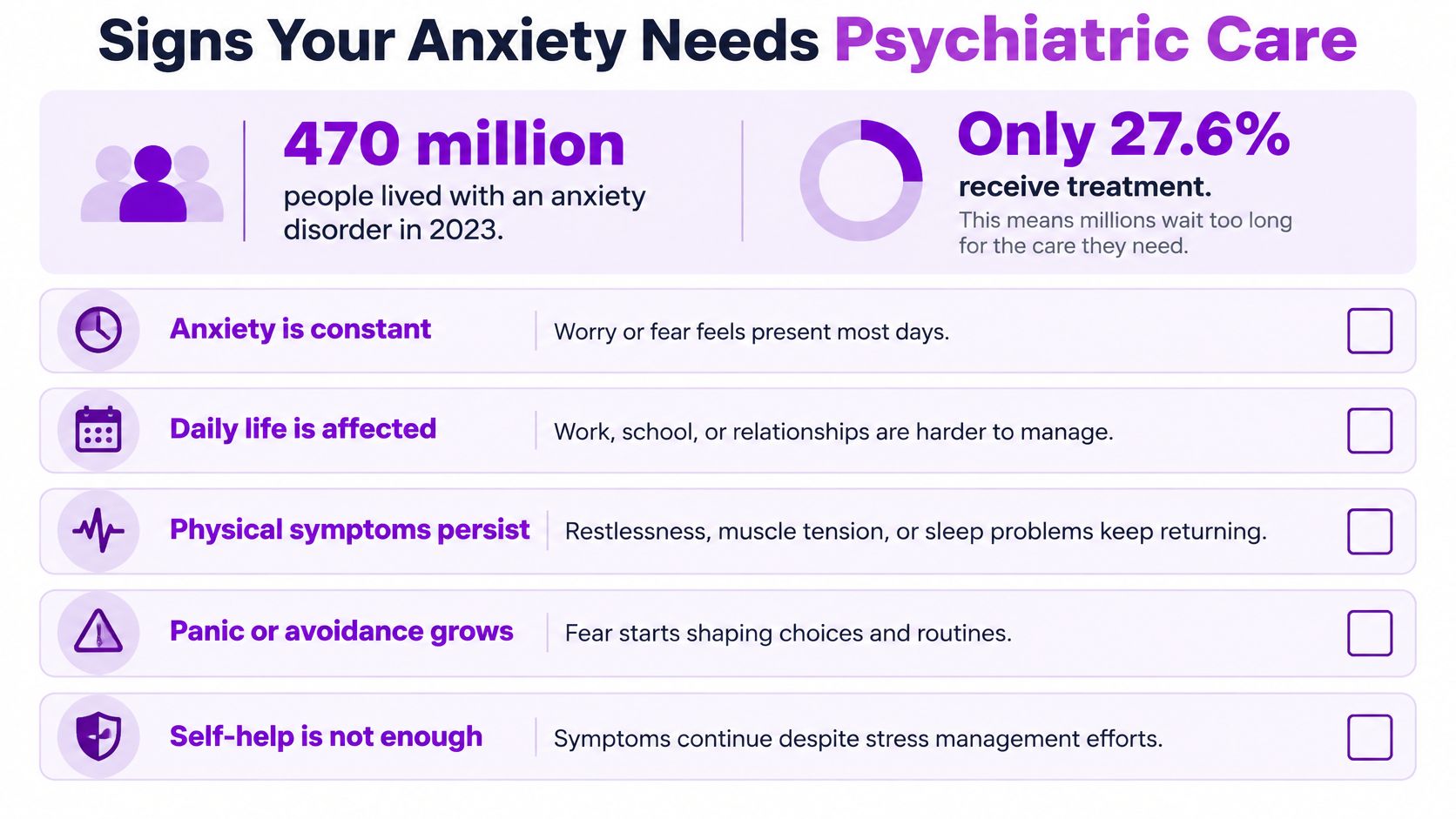
Look for recurring signs rather than relying on one difficult day:
- Hard-to-control worry: Fear or worry shows up most days and feels difficult to set aside.
- Panic attacks: A pounding heart, chest tightness, or fear of losing control comes in sudden surges.
- Avoidance: You start limiting work, school, driving, or social plans to avoid anxiety.
- Physical strain: Sleep problems, muscle tension, or stomach trouble persist and interfere with daily life.
- Rituals: Repetitive behaviors or mental rituals take up substantial time or disrupt routines.
- Low mood: Anxiety occurs alongside hopelessness or loss of interest.
- Substance use: You rely on alcohol or drugs to calm down.
- After trauma: Anxiety symptoms begin after a frightening event.
These signs do not determine a diagnosis on their own. They can help you decide whether to seek an evaluation. Cost, insurance, trust, and cultural fit also shape whether care is practical; a first step might be a therapist, a psychiatric provider, or another clinician you feel comfortable approaching.
Thoughts of self-harm or suicide, or being unable to eat, sleep, or stay safe, call for urgent help. In the U.S., call or text 988. Call 911 if there is an emergency.
How Psychiatrists Tell Anxiety Disorders Apart
Diagnosis is sorting, not a stamp. Say your heart races at your desk. Panic disorder, social anxiety, an overactive thyroid, and too much caffeine can all do that. Only an evaluation separates them.
Criteria were refined over decades. DSM-III-R, published in 1987, set a six-month duration requirement for generalized anxiety disorder, and DSM-5 later separated obsessive-compulsive and trauma-related disorders into related but distinct groups. The duration rules below are the standard psychiatrists use now.
| Disorder | Defining feature | Duration rule | Common first-line care |
|---|---|---|---|
| Generalized anxiety disorder | Excessive, hard-to-control worry about many things | At least 6 months | SSRI or SNRI plus CBT |
| Panic disorder | Recurrent unexpected panic attacks and fear of more attacks | Attacks plus at least 1 month of persistent concern | SSRI or SNRI plus CBT |
| Social anxiety disorder | Intense fear of judgment in social or performance situations | At least 6 months | SSRI or SNRI plus CBT |
| Specific phobia | Marked fear of a particular object or situation | No set minimum | Exposure-based CBT |
| Obsessive-compulsive disorder | Intrusive thoughts with repetitive rituals, often over an hour a day | Ongoing and time-consuming | Higher-dose SSRI plus exposure and response prevention |
| Posttraumatic stress disorder | Symptoms following a traumatic event | More than 1 month after trauma | Trauma-focused therapy, with SSRI or SNRI |
Before settling on one name, a psychiatrist screens for depression, substance use, bipolar-spectrum symptoms, and medical contributors. These problems often overlap, so "just anxiety" can be the wrong map. A racing heart before a meeting points toward social anxiety when the fear is judgment. The same sensation, arriving out of nowhere with dread of the next attack, points toward panic disorder. Our comparison of anxiety and panic disorder shows how those two get pulled apart.
Bring a two-week log so the visit starts with your pattern:
- Onset and triggers: When it starts and what was happening.
- How long it lasts: Minutes, hours, or most of the day.
- Sleep, caffeine, and alcohol: What you used that day.
Ask whether this is one condition or several overlapping ones.
Medication and Therapy Options Psychiatrists Combine
| Medication class | Examples | Typical onset | Role in anxiety care |
|---|---|---|---|
| SSRIs | Sertraline, escitalopram, fluoxetine | 4 to 6 weeks for full effect | First-line long-term treatment |
| SNRIs | Venlafaxine, duloxetine | 2 to 6 weeks | First-line alternative when SSRIs fail or are not tolerated |
| Buspirone | Buspirone | 2 to 4 weeks | Option for generalized anxiety without dependence risk |
| Propranolol | Propranolol | About 1 hour after a single dose | Short-term use for physical symptoms of performance anxiety |
| Benzodiazepines | Alprazolam, lorazepam, clonazepam | Within hours | Brief crisis use, usually 2 to 4 weeks, not long-term monotherapy |
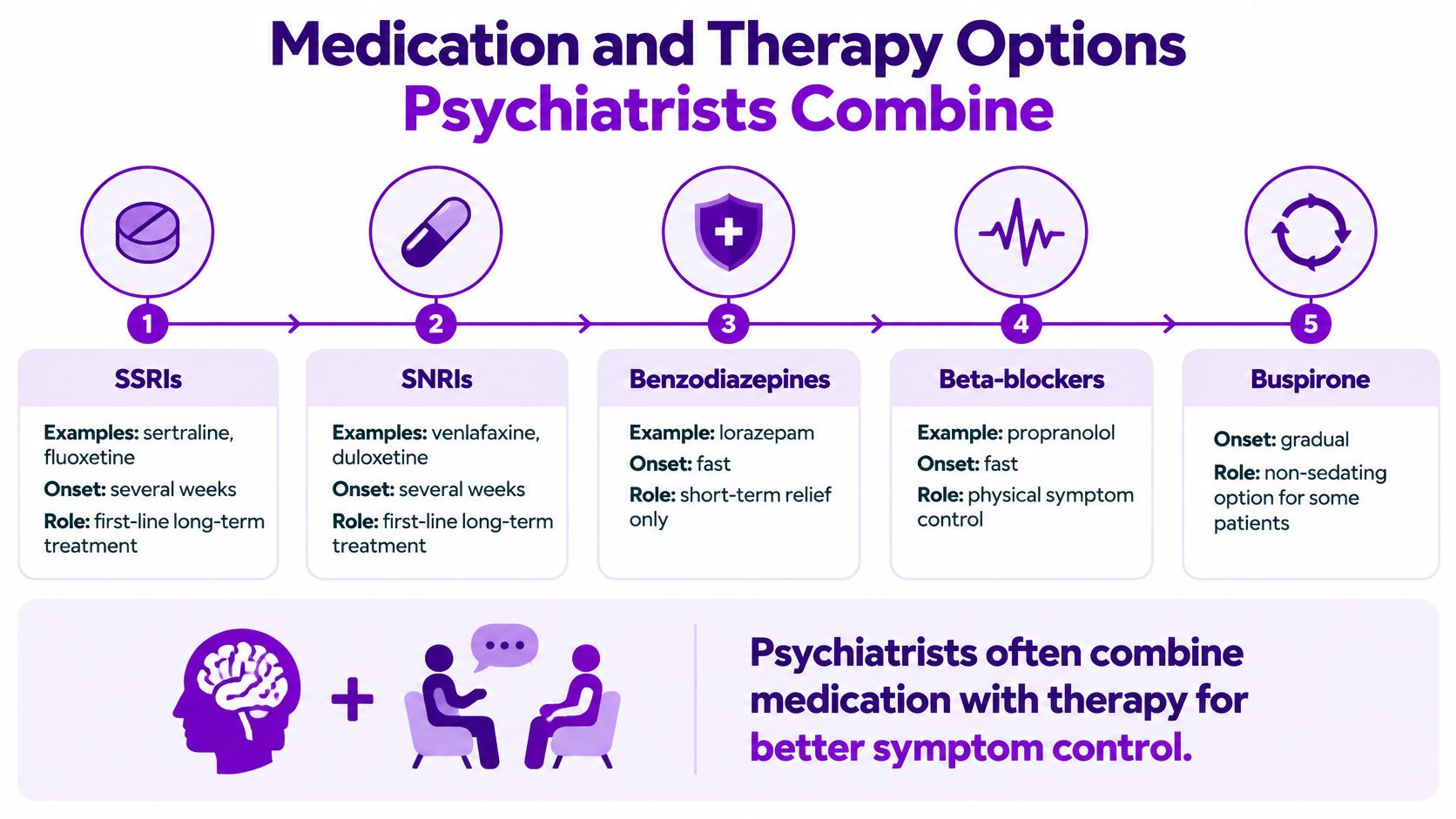
SSRIs and SNRIs are the long-term first choices because they treat the disorder, not only the next hour. Benzodiazepines work within hours and stay reserved for brief crisis use, usually 2 to 4 weeks, because dependence risk rises with ongoing daily use. Propranolol can blunt a pounding heart and shaky hands before a presentation. Buspirone is slower and doesn't carry that dependence risk, which makes it a fit for some people with generalized anxiety who want to stay clear-headed at work.
Shared choice, then a backup plan
For adults with generalized anxiety and marked impairment, or little gain from lower-intensity care, NICE guidance says the choice between high-intensity psychological treatment and medication should be shared. CBT or applied relaxation is typically delivered in 12 to 15 weekly sessions. If medication is preferred, an SSRI comes first, and sertraline is identified as a cost-effective starting option. When that SSRI doesn't help or isn't tolerated, the next step is another SSRI or an SNRI, not an immediate jump to higher-risk drugs. Complex, hard-to-treat anxiety is better managed by clinicians used to those cases.
Medication can lower the volume enough that exposure work in CBT feels possible. Therapy builds skills that stay after a prescription changes. Our page on therapy versus medication for anxiety lays out how people weigh that mix. The benefits and drawbacks of psychiatric treatment from Katy Teen & Family Counseling is a plain walk-through of relief versus risk before you decide.
Early nausea, restlessness, or sleep changes often ease within weeks. Stopping an SSRI or SNRI abruptly can bring withdrawal-type symptoms, so any taper belongs with your prescriber.
Ask three things before you leave with a plan. What is the expected onset? What happens if nothing has changed after six to eight weeks? How will the plan be adjusted if the first medicine fails?
How to Choose the Right Psychiatrist for You
A full directory isn't the same as a real appointment. A 2025 nationally distributed U.S. survey of 9,733 adults with moderate-to-severe depressive or anxiety symptoms found that 66.3% reported no current treatment. Black, Hispanic, Asian, multiracial, and foreign-born adults, as well as men, had higher odds of being untreated than comparison groups. Public insurance was also tied to lower access. Trust, cultural fit, immigration history, gender, and coverage decide who gets care, even in a metro area that looks well supplied.
Work the checks in this order.
Insurance first. Confirm the psychiatrist is in network, and ask the practice to verify coverage before the first visit. A public plan can shrink the list fast, so this filter comes before personality or office photos.
Format second. Secure online sessions help when a commute or a shift gets in the way. The clinician must be licensed in the state where you're physically sitting during the visit. We offer both in-person sessions and secure online care for therapy and medication support.
Experience third. Look for comfort with anxiety, OCD, PTSD, and depression that travels with them. A general listing isn't the same as someone who treats the pattern you logged.
Fit fourth. You want a clinician who explains a diagnosis in plain language, accommodates your language and culture, and includes you in medication decisions. A first visit can stay exploratory. It isn't a promise to start a pill, which matters if stigma is what's kept you away.
The model fifth. Ask whether alternatives to medication get a real discussion and whether the psychiatrist will coordinate with a therapist. We match clients with a therapist or psychiatric provider who specializes in their needs and fits their preferences.
In the Phoenix metro area, you can test those checks against one practice instead of guessing from a directory. Use a short call and ask whether your insurance is accepted, who you'd see, whether telehealth is offered in your state, how soon follow-up happens, and how questions are handled between visits.
What Happens at Your First Psychiatry Appointment
People often want relief by the end of the hour. A careful visit is built as a sequence, because the fastest calm isn't always the safest plan.
- Intake and history. You'll cover symptoms, family history, current medicines, and alcohol, cannabis, and caffeine.
- Safety screening. Expect direct questions about depression and suicidal thoughts. Answer them straight. They're there to protect you.
- Diagnostic interview. The clinician maps your pattern. A standard anxiety questionnaire sometimes supports that talk.
- Medical checks. Thyroid tests or other labs come up when a physical cause is plausible.
- A shared plan. Therapy, medication, or both. You can leave without a prescription.
- Follow-up. After a new medicine, the next visit is often four to six weeks later, so onset and side effects get judged on a real timeline.
What should be said before any prescription
Community Behavioral Health benzodiazepine guidance identifies SSRIs and SNRIs as better-supported first-line options and reserves benzodiazepines for second-line or short-term crisis use, often 2 to 4 weeks, rather than monotherapy. That same guidance notes that NHS practice favors continuing an SSRI after improvement to lower relapse risk. A responsible psychiatrist will also cover onset, common side effects, dependence risk, tapering, alcohol and substance interactions, pregnancy, and what happens if the first medicine fails.
Remote visits can produce anxiety outcomes comparable to in-person treatment, and they need extra steps. Confirm the state you're physically in, name a local emergency contact, and know the nearest emergency services before the session starts.
Bring four questions. Why this diagnosis? Why this medication? What does success look like? When should you call between visits?
Book an Anxiety Evaluation in the Phoenix Metro Area
If anxiety is making daily tasks harder, choose a first step that fits your needs and circumstances. Before booking, gather a list of current medications and note any alcohol or other substance use. That gives the provider useful context.
Then choose an appointment format. reVIBE offers therapy and psychiatric care in person or through secure online sessions. To find current locations or request an appointment, use the location finder at reVIBE Mental Health or contact the practice through its website. Ask about insurance coverage and out-of-pocket costs before you book; fees vary based on insurance, provider licensure, and private-pay options.
reVIBE serves Scottsdale, Tempe, Chandler, Deer Valley, Phoenix, Paradise Valley, and communities across Arizona. Its clinicians support people with anxiety and related concerns, including panic disorder, phobias, OCD, and PTSD. Therapy, psychiatric care, and medication management can be part of a personalized plan.
If thoughts of self-harm or suicide arise, call or text 988. Call 911 in an emergency.
reVIBE offers therapy and psychiatric care for anxiety, with in-person and secure online appointments. An evaluation can help clarify what support may fit your situation, while you remain part of decisions about your care. Visit reVIBE Mental Health to find a location and contact the practice about scheduling, insurance, and provider preferences.