
People with bipolar disorder may wait a decade or more for an accurate diagnosis and appropriate treatment, according to a 2025 review of bipolar disorder clinical guidance. That changes what it means to find a psychiatrist for bipolar disorder. You're not looking for someone to choose a medication alone. You're looking for a clinician who can clarify the pattern, identify the current phase, and keep checking whether treatment remains effective and safe.
When to See a Psychiatrist for Bipolar Disorder
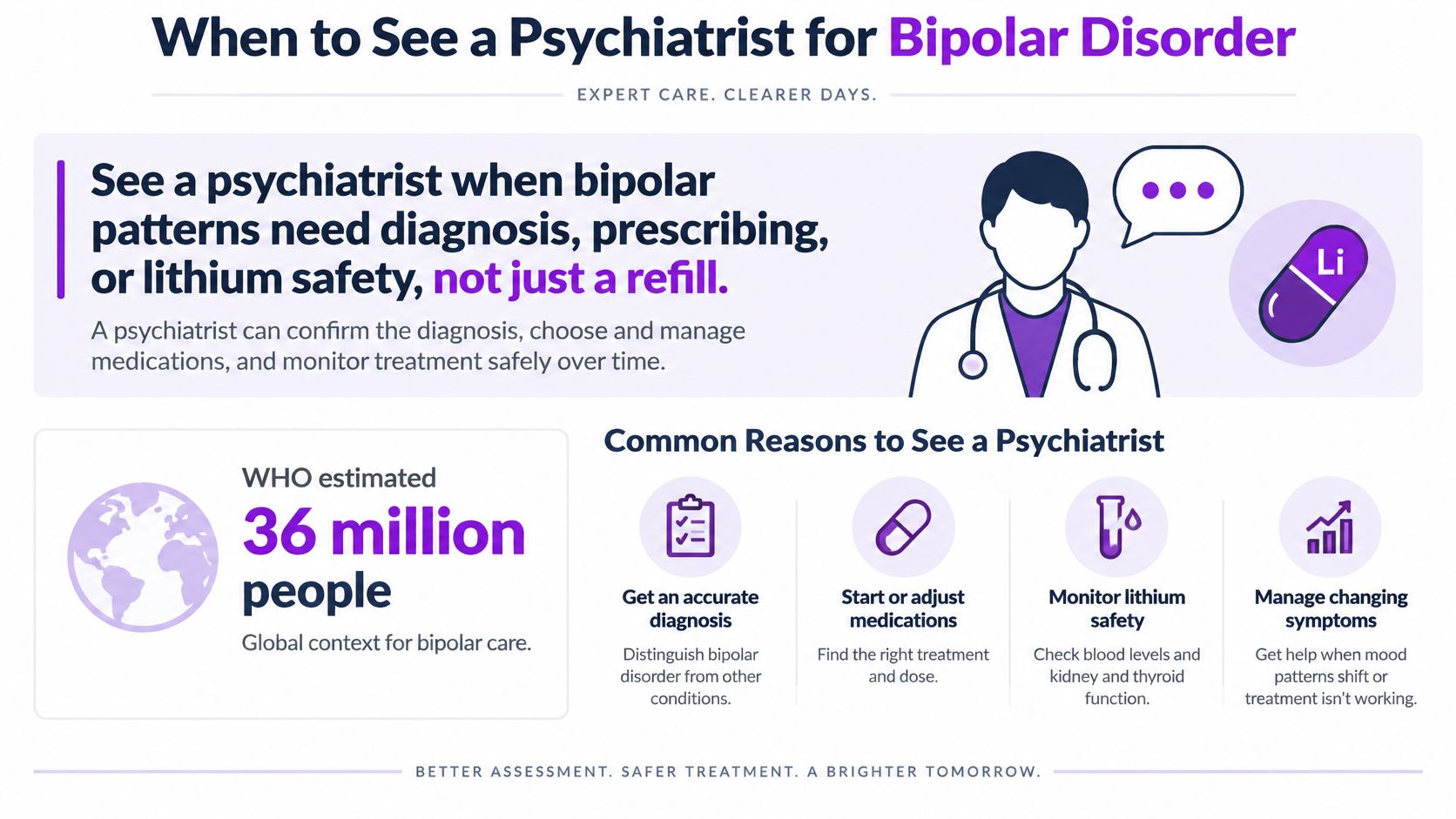
See a psychiatrist when bipolar patterns need diagnosis, prescribing, or lithium safety, not just a refill. An appointment is especially important when depression alternates with unusually high or irritable mood, reduced need for sleep, or decisions that feel out of character.
Say you seek help for depression but remember a period when you barely slept, started ambitious projects, and spent money you couldn't afford. Those details can change the assessment, even if you felt productive rather than unwell at the time.
When bipolar patterns need a psychiatrist first
| What you notice | What it may indicate | Who should lead | Urgency |
|---|---|---|---|
| Days of elevated or irritable mood with much less sleep | Possible mania or hypomania | Psychiatrist | Prompt; emergency if unsafe |
| Antidepressant followed by agitation, racing activity, or insomnia | Possible mood switch | Psychiatrist before continuing that drug alone | Prompt |
| Psychosis, paranoia, or lost contact with reality | Severe episode needing medical assessment | Psychiatrist or emergency care | Immediate if unsafe |
| Severe depression, hopelessness, or thoughts of suicide | Bipolar or unipolar depression with safety risk | Emergency or urgent psychiatric care | Immediate if danger is present |
| Impulsivity and restlessness only in distinct episodes | Bipolar spectrum versus ADHD | Psychiatrist for diagnostic clarification | Routine but do not self-label |
| Trauma symptoms overlapping mood swings | Trauma, bipolar disorder, or both | Psychiatrist plus trauma-informed therapy | Routine unless safety is at risk |
| Mood change after substances or a new medicine | Substance or medication effect | Psychiatrist with a full substance and medication history | Prompt |
| Known bipolar disorder with only occasional refills | Maintenance that still needs monitoring | Psychiatrist coordinating therapy | Scheduled longitudinal care |
Suspected mania, severe depression, psychosis, or danger to yourself or others warrants urgent assessment. If someone can't stay safe, emergency care replaces waiting for an office appointment. New agitation after an antidepressant needs prompt prescriber advice, not an independent medication change.
For global context, the World Health Organization bipolar disorder fact sheet estimates that 36 million people, about 0.4% of the world's population, including approximately 32 million adults, were living with bipolar disorder in 2023; the accompanying clinical summaries describe broader estimates of 0.5% to 2.4% and U.S. adult past-year prevalence of 2.8%. Different definitions and populations produce different estimates, but the practical task remains individual assessment.
Bring a history, not a self-diagnosis
A psychiatrist distinguishes acute mania, bipolar depression, mixed features, and maintenance. Mixed features means symptoms associated with opposite mood states occur together, such as depression alongside racing thoughts or increased activity. Maintenance focuses on staying well between episodes.
Screening questionnaires can support this work, but they can't establish the diagnosis. Depression, anxiety, ADHD, trauma, substance use, and medicine effects may overlap or coexist. If depression is your main concern, Insight Diagnostics Global's resource on when to seek specialist depression care offers additional context for considering a specialist assessment.
Prepare these materials:
- Mood timeline: Record highs, lows, episode duration, sleep changes, impulsivity, antidepressant reactions, substance use, and family history.
- Complete medication list: Include prescriptions, over-the-counter products, supplements, doses, and recent changes.
- A collateral note: With your consent, bring observations from a trusted relative about changes you may not have noticed.
Assessment Medication and Therapy Working Together
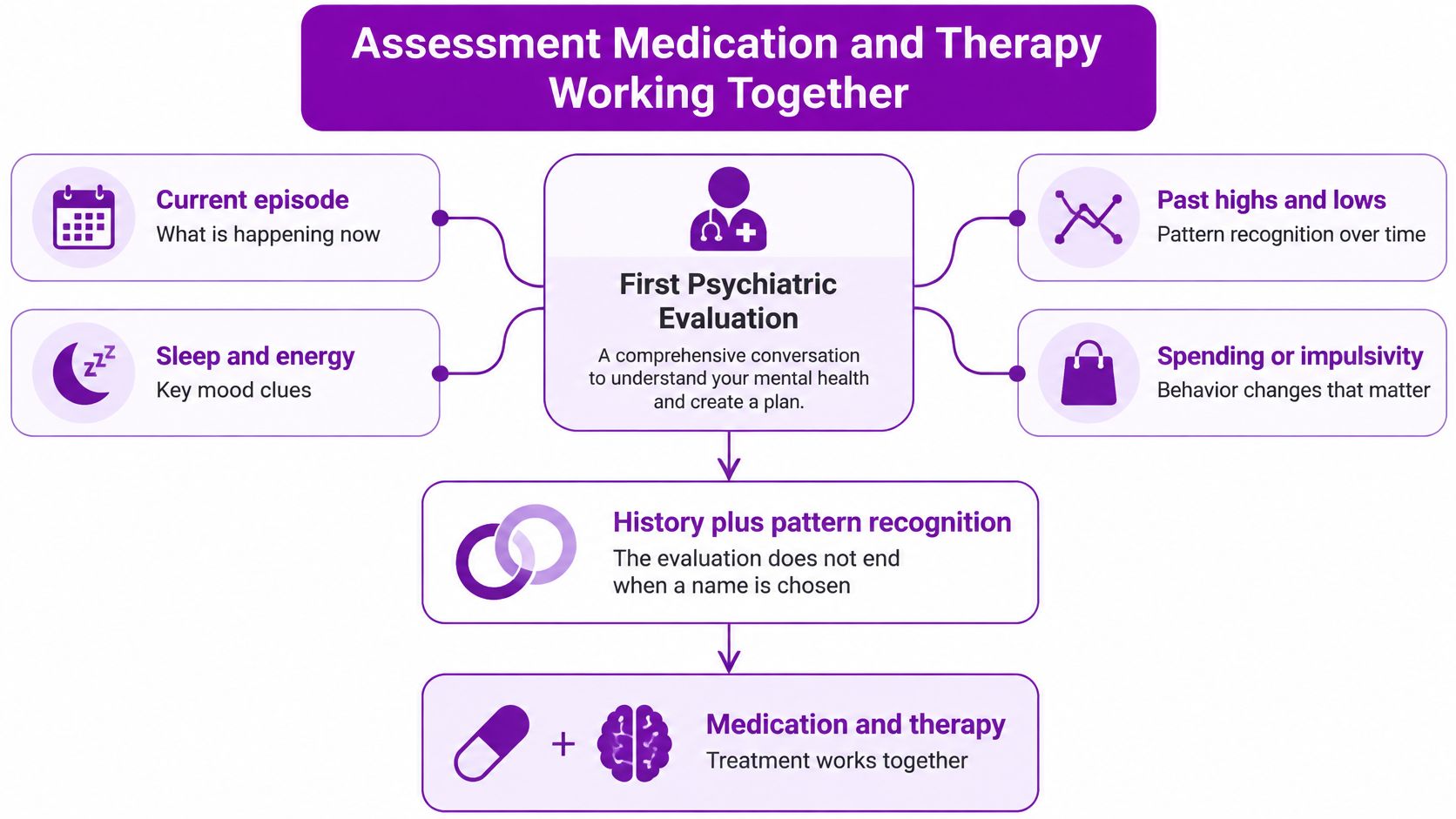
A first psychiatric evaluation combines history with pattern recognition. Naming a condition isn't the endpoint. The clinician needs to understand what's happening now, what happened before, and how those experiences affected your judgment, relationships, work, and safety.
Expect questions about sleep, energy, spending, sexual or other risky decisions, psychosis, and suicidal thoughts. Medical illness, pregnancy plans, and every medicine or supplement also matter because they can influence treatment choices. If you don't remember a period clearly, it's reasonable to say so rather than force a precise answer.
Medication should have a defined job
During acute mania, treatment addresses excessive activation, impaired judgment, and immediate safety. During bipolar depression, the goal is to treat depressive symptoms while considering vulnerability to mood switching. Mixed features require particular attention to agitation and risk, while maintenance aims to prevent recurrence without leaving side effects unaddressed.
A clinician may recommend a mood stabilizer such as lithium or a selected second-generation antipsychotic. Antidepressants require caution and generally shouldn't be used alone when bipolar disorder is likely. The explanation should connect the medication to your current phase, not just to the word depression.
For medication vocabulary before a visit, our explanation of Lamictal and lithium can help you prepare questions. It isn't a substitute for choosing treatment with your prescriber.
A relay team needs a shared plan
Think of the psychiatrist and therapist as a relay team. The psychiatrist carries responsibility for diagnostic clarification, prescribing, laboratory coordination, and medication safety. The therapist helps with skills, routines, relationships, and the aftermath of an episode.
The handoff matters. With permission to exchange information, both clinicians can work toward shared goals, such as protecting sleep, recognizing early warning signs, and rebuilding daily functioning.
A 2025 clinical-guideline review reports that only one in three people with bipolar disorder in the United Kingdom had been offered psychotherapy and four in five had received no psychoeducation. Those findings highlight why a medication-only visit can miss important parts of care.
- Therapy work: Practice coping skills, routines, and responses to early symptoms. Interactive Counselling's resource on counselling for people experiencing depression provides context for the supportive role of counselling, without replacing bipolar-specific psychiatric care.
- Medication reviews: Discuss missed doses, side effects, functioning, and emerging symptoms, not just whether this week feels better.
- Care coordination: Secure video can support appropriate appointments, and primary care may share stable follow-up under an agreed plan. Neither arrangement removes the need for psychiatric oversight of diagnostic uncertainty or complex treatment.
Leave knowing the working diagnosis, what the medicine is meant to do, who provides therapy, and when you'll be reviewed again.
How Treatment Plans and Follow-Up Unfold
Treatment follows the person's condition, not a fixed appointment calendar. Someone with escalating acute mania needs a different level of contact from someone doing well in maintenance. The schedule should reflect that difference.
The visit rhythm
- Assess the acute situation. Clarify the phase, sleep disruption, functioning, and safety. Decide whether outpatient care is sufficient or hospital assessment is needed.
- Review closely during changes. Starting or adjusting medication calls for closer contact while response and tolerability become clear.
- Extend intervals only after stability. Maintenance visits can become less frequent when mood, adherence, and required laboratory results are stable.
- Write a recurrence response plan. Identify personal warning signs, who to contact, and what should trigger urgent help.
Lithium demonstrates why feeling better isn't enough to establish medication safety. It has a narrow therapeutic index, meaning the effective and potentially harmful exposure ranges are close enough to require blood testing.
Lithium monitoring a psychiatrist should plan
The following monitoring framework includes CANMAT/ISBD targets alongside the stable-patient rhythm in the NICE bipolar disorder recommendations: a trough at approximately 12 hours, two consecutive therapeutic results after starting, ongoing checks at least every 3–6 months, and typical targets of 0.8–1.2 mEq/L during acute treatment and 0.6–1.0 mEq/L during maintenance, often lower for older adults.
| Check | When | Usual target or action |
|---|---|---|
| Serum lithium trough | About 12 hours after the last dose | Interpret against the current phase |
| Levels after starting | Two consecutive therapeutic results | Confirm the dose before stretching visits |
| Acute treatment level | During a manic or unstable phase | Often 0.8–1.2 mEq/L |
| Maintenance level | Once the episode has settled | Often 0.6–1.0 mEq/L; sometimes lower in older adults |
| Ongoing lithium levels | At least every 3–6 months; about every 6 months if stable | Sooner after dose changes, illness, or interacting drugs |
| Kidney and thyroid tests | On a schedule set by the psychiatrist | Watch organ effects, not mood alone |
| Toxicity symptoms | Every visit | Tremor, ataxia, paresthesia, cognitive change, stomach symptoms, functional decline |
| Sick-day rule | Vomiting, diarrhea, fever, dehydration, or a new medicine | Call; don't stop or double the dose alone |
NICE's stable-patient rhythm is generally about every six months, with closer checks when clinically indicated. Your clinician must individualize both the target and the schedule rather than treating the table as a prescription.
Dehydration, kidney problems, interacting medicines, and dose changes can raise lithium exposure even when the prescribed dose hasn't changed. The psychiatrist should review over-the-counter drugs and supplements, coordinate kidney and thyroid testing, and explain symptoms in everyday terms: ataxia means unsteady coordination or gait, while paresthesia means unusual tingling.
Medication safety: Significant vomiting, diarrhea, fever, dehydration, or a new medicine calls for clinical advice. Don't independently stop, double, or otherwise adjust lithium.
The non-laboratory half of follow-up matters too. Track mood, sleep, activity, adherence, and daily functioning; with consent, a family member can report reduced need for sleep, rising goal-directed activity, impulsivity, or emerging hopelessness.
The NICE assessment and management guideline recommends collaborative warning-sign planning and gradual withdrawal when discontinuation is appropriate. Appointment spacing should tighten during titration or rising relapse risk and loosen only during stable maintenance.
Questions to Ask Before the First Visit
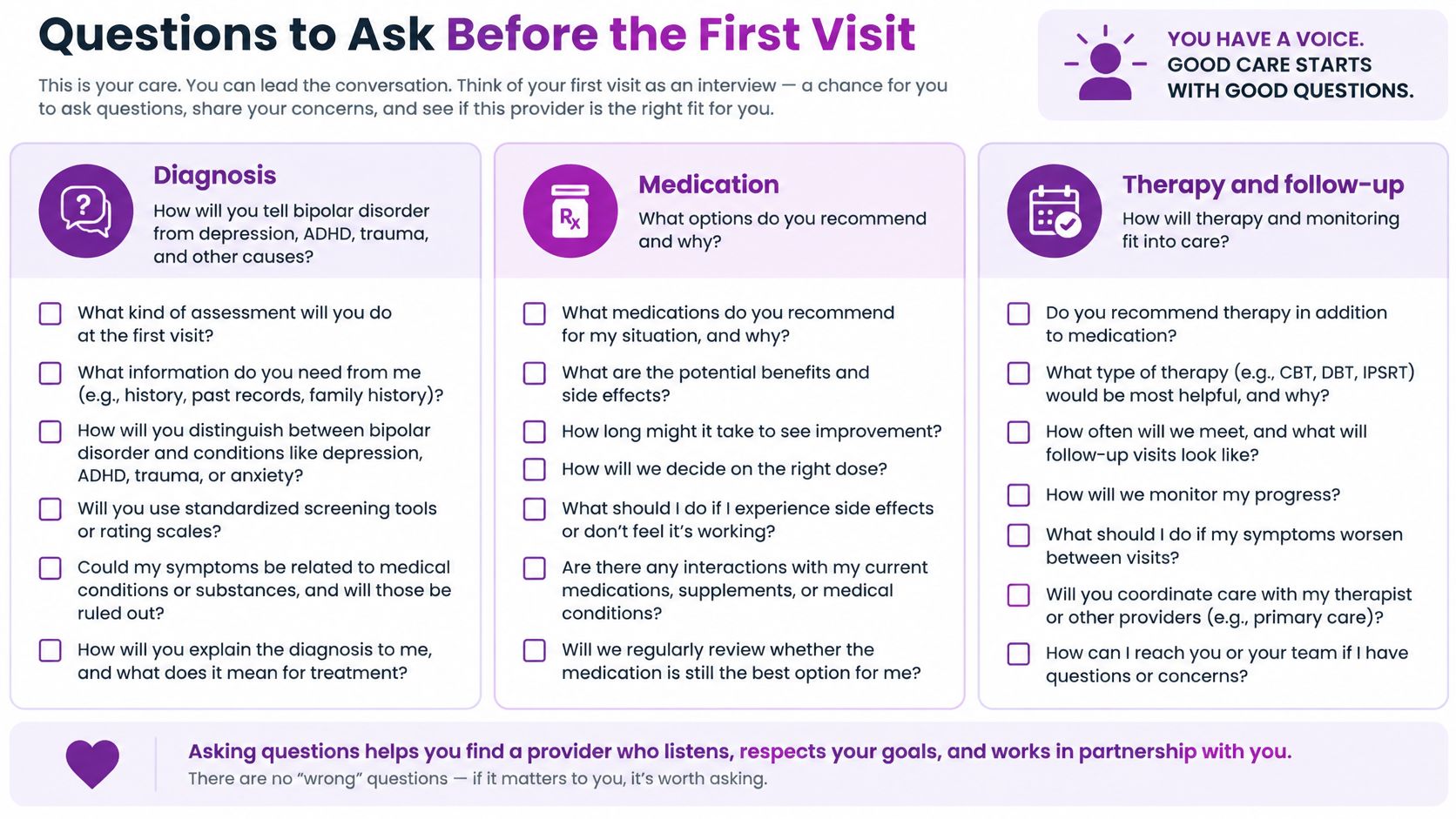
You're allowed to interview the clinician, too. A useful consultation makes the reasoning understandable and gives you a workable plan, even when the diagnosis remains provisional.
You might open by saying that you want help understanding your pattern of highs and lows, not only relief from today's symptoms. Bring written questions so fatigue, anxiety, or difficulty concentrating doesn't make you forget what matters.
Questions that test the clinical plan
- Diagnosis: How will you distinguish bipolar disorder from depression, ADHD, trauma, or a substance effect? What records or observations would help?
- Treatment fit: Which phase am I in, and why does this medicine fit? Why would you choose it rather than an antidepressant alone?
- Safety: Which side effects should prompt a call? If lithium is prescribed, who orders levels and kidney and thyroid tests, and what should I do if I can't keep fluids down?
- Follow-up: How will contact change while the dose is adjusted and after I'm stable?
A useful answer explains a process. For example, the clinician might describe gathering previous records, comparing symptoms across time, and revisiting the working diagnosis as more information becomes available. A refill-only answer skips those uncertainties and moves directly to renewing a prescription.
Questions that test the working relationship
Ask whether the clinician provides ongoing care for adults with bipolar disorder, not only an initial prescription. Clarify whether you're meeting a psychiatrist or another licensed psychiatric provider, how they coordinate with your therapist, and whether a family member can share observations with your permission.
Practical access belongs in the conversation as well. Can appropriate appointments take place in person or by secure video, and how do you reach the team between visits? Our guide to what happens during a psychiatric evaluation can help you prepare for the assessment itself.
Red flags include a promise of a permanent dose at the first visit, no interest in past mania, no laboratory plan for lithium, or advice to stop a mood stabilizer abruptly without a clinical rationale and supervised plan. An honest clinician can acknowledge uncertainty without leaving you unsupported.
Before leaving, write down the agreed medicine and its purpose, the next laboratory check if needed, the next appointment, and the contact route if sleep collapses. Ask for clarification if any part of that plan is unclear.
Insurance Telehealth and Scheduling Basics
Insurance coverage, appointment format, and follow-up availability are separate decisions. An office can be convenient and still be a poor practical fit if you can't access appropriate follow-up during a medication change. Resolve the administrative details before the first appointment so the visit can focus on care.
Insurance is more than a plan name
Psychiatric appointments and therapy may be billed differently depending on the service and clinician's license. Ask your insurer to verify the specific provider's network status, referral requirements, prior authorization, and expected patient responsibility. The visit type or billing code can help the insurer answer accurately.
Our mental health insurance coverage guide can help you organize that conversation. Don't assume that coverage for therapy automatically means the same coverage for psychiatric assessment or medication follow-up.
Keep a record of the verification conversation and request clarification about anything that sounds conditional. Insurance verification reduces uncertainty, but it isn't the same as a guarantee of payment.
Match the format to the appointment
Secure video may be appropriate for medication follow-up or therapy when the clinician offers it. Confirm whether the initial diagnostic assessment is available online, whether you need an in-person evaluation, and how any required laboratory work will be arranged.
Our therapists can explain whether telehealth is offered and discuss technical requirements during your inquiry. For a video appointment, arrange a private space where you can speak openly; if you can't stay safe, a routine video visit isn't an adequate substitute for urgent assessment.
Booking checkpoint: Ask about the next follow-up opening, not only the earliest intake appointment.
When scheduling, clarify appointment length, access after a troublesome side effect, and how to communicate between visits. Our policy requires 24-hour advance notice to cancel or reschedule. If you miss an intake, keep the history packet ready for the replacement appointment; if illness raises a medication-safety concern, use the clinical contact route rather than treating it only as a scheduling issue.
Before booking, confirm:
- Plan status: Coverage for the specific clinician and service.
- Clinician role: Who will assess and prescribe.
- Appointment format: In person or secure video.
- Follow-up access: Availability during medication adjustment.
- Cancellation window: The notice needed to change an appointment.
Find the Right Phoenix Psychiatrist Near You
A nearby office matters, but the right psychiatrist also needs to clarify the diagnosis, track symptoms over time, and adjust care as needed. Bipolar treatment is more than a refill visit: the goal is a plan that supports stability and makes changes visible before they become harder to manage.
reVIBE Mental Health offers psychiatric care and medication management alongside therapy, with licensed psychiatric professionals available in person or through secure online sessions. Personalized matching helps connect you with a provider based on your needs and preferences. Ask directly whether the clinician provides ongoing care for bipolar disorder.
Find a reVIBE Location Near You!
reVIBE serves Scottsdale, Tempe, Chandler, Phoenix, and Paradise Valley. Use the Phoenix-area location directory to find a nearby office and confirm current availability. Appointments are offered seven days a week, with both in-person and secure online care.
Choose based on the trip you can reliably make, not just the distance on a map. Consider your usual travel time, work, caregiving, and transportation needs. If you prefer video appointments, ask whether the assessment and follow-up you need are available online.
Make the first call clinically specific
Tell the scheduling team you're seeking assessment and medication management for possible or diagnosed bipolar disorder. If you're transferring care, mention your existing diagnosis, relevant records, and whether your medication supply needs timely review. Ask what the first appointment includes; an intake does not automatically mean a prescription will be renewed.
Before booking, ask:
- Ongoing bipolar care: Does the psychiatric provider offer continuing care for adults with bipolar disorder?
- Provider fit: Can the practice match you with a clinician whose experience fits your needs?
- Follow-up: How are follow-up appointments arranged after a medication change?
- Insurance and cost: What will your coverage and provider choice mean for the cost? Fees vary by insurance coverage, provider licensure, and private-pay options.
A location listing cannot confirm a specific clinician's experience or your insurance coverage. Ask about both directly. If there's immediate danger, contact emergency services rather than waiting for an appointment.
At reVIBE Mental Health, therapy, psychiatric care, and medication management are available in person and online. Contact the team to discuss provider matching and arrange an assessment focused on your symptoms and ongoing stability.