
If you can't sleep, is the right next step a stronger sleep aid, or a clinician who can work out why you're awake? A psychiatrist for insomnia can be helpful, but psychiatry isn't the default destination for every sleep problem. The best starting point depends on whether you're dealing with persistent insomnia alone, a mental-health condition, medication effects, or another sleep disorder.
Good care should leave you with more than a prescription. You should understand what may be disrupting your sleep, which treatment fits, and how your clinician will judge whether you're functioning better during the day.
Who Treats Insomnia and When to Choose a Psychiatrist
A psychiatrist is a strong first call when insomnia overlaps with depression, anxiety, trauma, bipolar symptoms, substance use, or medication side effects. Safety concerns also warrant prompt psychiatric assessment. If you're in immediate danger of harming yourself, seek emergency help rather than waiting for a routine appointment.
Sleep difficulties are common, but they don't all have the same cause. In 2020, 14.5% of U.S. adults had trouble falling asleep and 17.8% had trouble staying asleep on most days or every day during the previous month, according to the Centers for Disease Control and Prevention. Those are symptom measures, not proof that everyone affected needs psychiatric medication.
Which clinician fits which insomnia case
| Provider | Best for | Typical first step | Limit |
|---|---|---|---|
| Psychiatrist, MD or DO, or psychiatric mental health nurse practitioner, PMHNP | Insomnia with depression, anxiety, trauma, bipolar symptoms, or medication effects | Psychiatric evaluation and medication review | Weekly CBT-I sessions are often delivered by another clinician |
| Sleep medicine physician | Suspected sleep apnea, restless legs, or unusual nighttime behaviors | Sleep history and sleep study when indicated | Mood or trauma treatment may require separate care |
| CBT-I therapist | Chronic insomnia without major psychiatric overlap | Sleep diary and structured CBT-I sessions | A nonprescribing therapist can't adjust medication |
| Primary care clinician | Initial screening and uncomplicated insomnia | Basic sleep history, medication check, and referral | Complex overlapping conditions may need specialist care |
A PMHNP is a psychiatric nurse practitioner, not a physician psychiatrist. Either may provide psychiatric evaluation and medication management within their professional scope.
For otherwise uncomplicated chronic insomnia, cognitive behavioral therapy for insomnia, or CBT-I, usually makes more sense than starting with a prescriber. When worry or panic accompanies sleeplessness, understanding the connection between anxiety and sleep problems can help you describe the pattern.
Persistent snoring, witnessed pauses in breathing, restless legs, or unusual nighttime behaviors point toward sleep medicine. The VA/DoD insomnia provider summary supports a coordinated approach rather than treating every presentation with a sedative.
A useful starting question: Does my insomnia travel with a mental-health condition or medication change? If yes, consider psychiatry. If no, start with CBT-I and a primary care check, unless breathing or movement symptoms suggest sleep medicine.
What Happens at Your First Psychiatric Visit
Your first visit should be an assessment, not a test of whether you deserve medication. The clinician needs to distinguish trouble sleeping despite wanting sleep from problems such as a shifted sleep schedule, substance effects, or feeling unusually energized with little sleep.
The overall process moves from history to screening, treatment discussion, and follow-up.
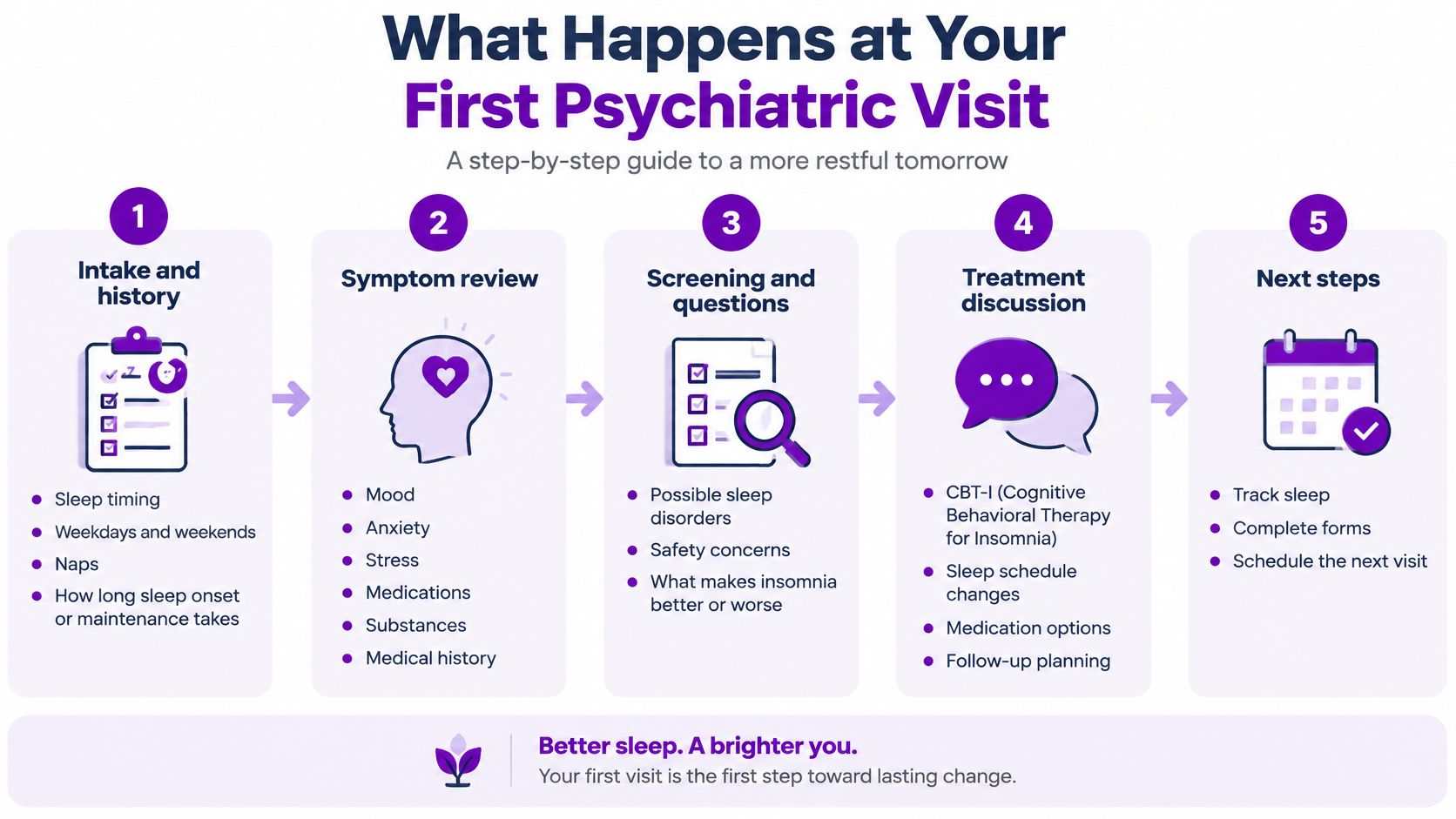
The assessment in practical steps
Intake and sleep history. Expect questions about bedtime, wake time, weekday versus weekend schedules, naps, and how long you spend awake before or during sleep. Your clinician will also ask when the problem began and what changed around that time.
Daytime effects. Describe fatigue, concentration problems, irritability, and difficulty completing everyday tasks. Mention drowsy driving or near misses directly, because these affect the immediate safety plan.
Substances and medications. The review includes caffeine, alcohol, cannabis, stimulants, prescription medicines, over-the-counter antihistamines, and supplements. Timing matters, so explain when you take each substance, not just its name.
Mental-health screening. Questions may address anxiety, trauma symptoms, depression, intense mood, impulsivity, and suicidal thoughts. These aren't distractions from your sleep complaint; they help determine whether insomnia is part of a broader condition.
Medical and sleep-disorder screening. Report snoring, witnessed breathing pauses, uncomfortable urges to move your legs, and unusual nighttime activity. Your clinician also needs relevant medical history, pregnancy or breastfeeding status, and other factors that affect medication safety.
A shared plan. The clinician should explain whether to begin CBT-I, review an existing medication, arrange sleep testing, or refer to another professional. You should leave knowing what to do next and when follow-up will happen.
The VA/DoD insomnia pocket guide supports reviewing sleep history, coexisting conditions, and contraindications before short-term medication. Sleep testing is targeted to suspected breathing or movement disorders, not automatically ordered for uncomplicated insomnia.
What the plan might look like
Say a patient reports sleeping five hours, drinking wine nightly, and having panic attacks at bedtime. The initial plan would examine alcohol use and panic symptoms before considering whether a sedative is appropriate, rather than increasing sedation.
The American Academy of Sleep Medicine pharmacologic guideline identifies CBT-I as the primary intervention for chronic insomnia. Psychiatric care can therefore involve treatment coordination and careful monitoring without adding a sleep medicine.
Bring a two-week sleep diary and a written list of every medicine and supplement. Reviewing what happens during a psychiatric evaluation can also help you organize questions before arriving.
Medication Versus CBT-I and Exiting Sleep Aids Safely
Sleep medication works like a bridge: it can carry you across a rough stretch while CBT-I builds the road underneath. The comparison that matters is which approach improves your sleep and daytime functioning with risks you can accept. CBT-I teaches skills you keep using after treatment ends, while medication generally helps only while you take it.
Treatment options compared on durability and risk
| Option | How it works | Durability after stopping | Main risks to review |
|---|---|---|---|
| CBT-I | Sleep restriction and stimulus control rebuild sleep cues and consolidate sleep | Effects tend to last after treatment ends | Temporary sleepiness during sleep restriction |
| Short-term sleep medication | Promotes sleep through drug-specific effects; some agents influence sleep timing | Relief often fades once stopped | Next-day impairment, dependence with some medicines, and interactions |
| Combined CBT-I and medication | Medication may provide interim relief while CBT-I builds skills | Retained behavioral gains, with medication withdrawal managed through a taper plan | Added side effects and monitoring needs |
| Untreated medical or mood cause | Sleep apnea, restless legs, or a mood disorder continues to disrupt sleep | Lasting improvement requires treatment of the underlying condition | Sedatives can obscure an untreated cause |
What CBT-I actually changes
CBT-I is more structured than advice to avoid screens or drink less coffee. Sleep restriction therapy temporarily aligns time in bed with estimated sleep time to build sleep pressure and reduce prolonged wakefulness in bed. A clinician adjusts the schedule using your diary, tightening or loosening it as your sleep consolidates.
Stimulus control helps you reconnect the bed with sleep instead of frustration, clock-watching, or worry. Its practical rules are:
- Go to bed when sleepy. Feeling exhausted or worried about tomorrow is not always the same as feeling ready to fall asleep.
- Leave bed when you can't sleep. Choose a quiet, low-stimulation activity instead of continuing to struggle under the covers.
- Return only when sleepy. Repeat as needed without treating wakefulness as a personal failure.
- Keep a consistent wake time and avoid daytime naps. This helps establish a more predictable sleep pattern.
The VA's stimulus-control guidance describes following these rules consistently for roughly two to four weeks before judging their effect. Treat that window as a trial period rather than a deadline, since some people need longer.
Sleep restriction needs professional adaptation when daytime sleepiness creates danger or when a condition such as bipolar disorder complicates the plan. Do not impose an aggressive sleep schedule on your own.
If work demands make a standard schedule difficult, The Sleep Consultant's resource on insomnia support for busy executives offers another way to explore structured CBT-I. Ask any prospective clinician about their insomnia-specific training and how they adapt treatment to your responsibilities.
When medication helps, and when to reconsider it
Medication may be reasonable when CBT-I is unavailable or insufficient, when a particular symptom such as repeated awakenings needs relief, or when a co-occurring psychiatric condition requires treatment. Within an integrated plan, the psychiatrist's job is to judge whether a medicine adds enough benefit to justify its risks, then set a defined purpose, monitoring plan, and strategy for eventual discontinuation.
The VA/DoD insomnia provider summary advises against routinely using antipsychotics, benzodiazepines, diphenhydramine, or trazodone specifically for chronic insomnia. A medicine prescribed for a different condition still needs its own review. The indication matters.
If you're still exhausted, describe the problem rather than assuming you need a stronger dose. In a 2025 Canadian insomnia public-perception study, medication users commonly reported daytime fatigue or drowsiness, dry mouth, low motivation, and memory problems, and only 30% rated their medication highly effective. Survey responses cannot predict your response. They do show why daytime effects belong in every medication review.
More sedation isn't automatically better sleep. A treatment that leaves you unable to drive safely or think clearly needs reassessment.
Tapering off a sleep aid safely
Rebound insomnia is a temporary worsening of sleep after stopping certain medicines. Relapse means the original insomnia has returned, potentially because its drivers remain untreated. The two can look identical in the first nights after a dose reduction, which is why continued tracking matters.
Some medicines require a gradual, clinician-directed taper because abrupt withdrawal can be unsafe. A taper lowers the dose in steps so your body adjusts, and follow-up visits give you space to work through fear about stopping while you practice CBT-I skills. Never stop, switch, or double a sleep medication on your own. Make sure the prescriber knows about every antihistamine and supplement you take, since those shape the plan too.
Questions to Ask Your Psychiatrist
A useful appointment produces answers you can act on. You don't need to know which medicine or therapy to request, but you should understand the reasoning behind the recommendation.
Use these prompts to make the discussion concrete.
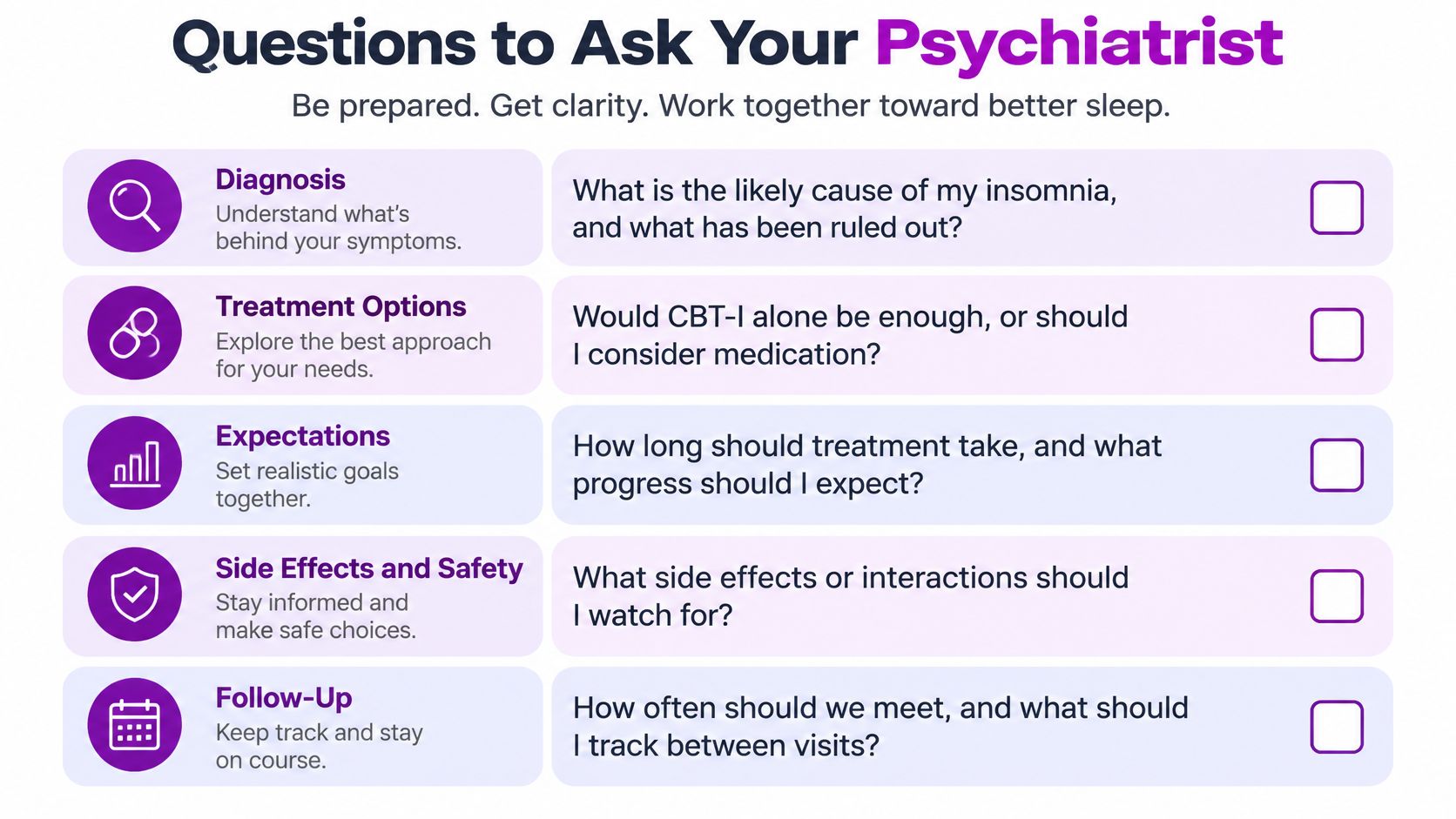
Questions that clarify the plan
Diagnosis. What's the likely cause of my insomnia, and what has been ruled out? A specific answer names the working diagnosis, remaining uncertainties, and any symptoms that require further assessment.
Treatment options. Would CBT-I alone be enough, and what would medication add? Look for a symptom-specific explanation, such as reducing prolonged nighttime awakenings, rather than a promise to make you sleep.
Medication safety. What side effects should I expect, how long would I take this, and what interacts with my medicines or supplements? If prescribed, your written plan should name the medicine, dose, timing, and adverse effects that warrant contact.
Stopping treatment. What's the taper plan? A useful answer explains whether tapering is necessary, when it will be reconsidered, and how the clinician will adjust reductions to your response.
Coordination. Do you work with a CBT-I therapist or sleep medicine physician, and who follows up on a sleep study? You need a named person or service responsible for referrals and results.
Progress. When will we review, and what will show success? Ask for a review date and practical measures, such as diary-recorded sleep, fewer prolonged awakenings, or better daytime function.
Safety. What should I do if I feel worse or have thoughts of harming myself? The answer should distinguish routine contact, urgent assessment, and emergency help.
Before leaving: Write down the answers and take a copy home. A clear plan should still make sense when you're tired the next morning.
Insurance, Telehealth and Coverage Checks
The right clinical pathway also needs a workable payment plan. Before booking, verify coverage for the specific service and clinician, not just whether a practice accepts your insurer.
Telehealth can work well for follow-ups and medication reviews when the clinician considers it appropriate. An initial evaluation may also require vitals, a physical assessment, or coordination with primary care if a medical cause is suspected. A video appointment doesn't replace those checks when they're needed.
Verify the appointment before committing
- Covered services. Confirm that your plan covers psychiatric evaluation and medication management. Ask separately about CBT-I and sleep-clinic services.
- Referral requirements. Find out whether you need a primary care referral or prior authorization before the visit.
- Network status. Verify the individual clinician and appointment location with your insurer.
- Your share of the bill. Ask about deductible, copay, or coinsurance, and request the expected cost of a follow-up separately from the initial evaluation.
- Telehealth terms. Confirm that your plan covers the proposed appointment format and that the clinician can see you where you'll physically be during the visit.
The patient guide to navigating insurance from Pain and Sleep Therapy Center is a supplementary resource for organizing coverage questions. Our guide to how to verify insurance coverage can help you prepare for that conversation.
If coverage isn't straightforward
Out-of-network care may require upfront payment followed by a claim for partial reimbursement, if your plan includes that benefit. Ask what documentation is available and what your insurer requires; reimbursement isn't guaranteed.
If coverage is denied, request the reason in writing and ask about appeal or clinical peer-review options. Check whether another appropriately licensed, in-network provider can deliver the same service.
A psychiatrist, therapist, and sleep clinic may bill under different benefit rules. Verify each part of a coordinated plan rather than assuming approval for one appointment covers them all.
Book Your Insomnia Evaluation in Arizona
reVIBE Mental Health serves Scottsdale, Tempe, Chandler, Phoenix, and Paradise Valley, Arizona, with appointments available seven days a week, in person or through secure online sessions. Visit the practice's website to find the location nearest you.
Prepare a short sleep summary
Before you reach out, write down the information that will help identify an appropriate starting point:
- Your sleep pattern. Note whether you struggle to fall asleep, stay asleep, or wake too early, along with weekday and weekend timing and naps.
- Related symptoms or changes. Include mood, anxiety, trauma symptoms, substance use, and any connection to a medication change.
- Possible sleep-disorder signs. Record snoring, witnessed breathing pauses, uncomfortable leg sensations, or unusual nighttime behavior.
reVIBE's listed specializations include anxiety, depression, PTSD, trauma, addiction, grief, insomnia, and OCD, among many others. The practice offers personalized matching to help you find a therapist or psychiatric care provider whose specialty and approach fit your needs and preferences, so the summary you prepare gives that matching process real information to work with.
Make the first call specific
Ask whether your first appointment should be a psychiatric evaluation or a therapy intake, and how CBT-I could be coordinated with medication review. That question matters because psychiatry is one selective step in a broader care pathway. Some people do best starting with a therapist trained in CBT-I, some need a medication review first, and many benefit from both working in parallel. Confirm coverage details before the visit, then book the earliest appointment that fits your schedule and clinical needs.
If you report breathing pauses or leg symptoms, a separate sleep-medicine evaluation may be appropriate. Breathing symptoms may lead to sleep testing, while restless legs is usually assessed through clinical history and targeted evaluation rather than an automatic sleep study.
Start your sleep diary today and keep it running while you wait. Even a straightforward record of bedtime, estimated sleep, awakenings, wake time, and daytime functioning gives your clinician a clearer starting point.
reVIBE Mental Health offers therapy, psychiatric evaluation, and medication management to help address insomnia alongside concerns such as anxiety, depression, and trauma. Visit reVIBE Mental Health to connect with the team and arrange an evaluation that identifies the right next step for your sleep.