
It's 10:40 p.m., and you're both still awake. One of you has barely slept all week, mood flat, patience gone. The other walks out mid-sentence, then comes back with a sharp remark about the silence or the dishes. Each of you is fairly sure the other person is the problem. A medication visit for one partner feels incomplete, and another kitchen argument hasn't touched the insomnia.
Psychiatry for couples treats relationship distress and psychiatric symptoms as things that can feed each other, but only when safety and each person's own needs allow joint care. Privacy and consent rules decide which format you can use: individual visits, conjoint sessions, or both at once. A virtual session follows the same clinical logic as an office visit. The camera changes logistics, not the standard for diagnosis, safety, or consent.
What Couples Psychiatry Covers Beyond Medication Visits
Take that late-night pattern. One partner has insomnia and low mood. The other withdraws, then criticizes. Each reads the other as the cause. A prescription might help sleep. It won't, by itself, change the loop of retreat and blame.
Think of a building inspector who doesn't only patch the leaking faucet. The inspector checks how the wiring, the plumbing, and the foundation affect one another. Psychiatry for couples works the same way. It coordinates three pieces of care rather than treating one symptom in isolation.
Individual psychiatry is a medical visit for one person. A psychiatrist evaluates symptoms, considers diagnosis, and manages medication when that's appropriate. The other partner isn't in the room unless you both agree, and even then the clinical relationship stays with the identified patient. A psychiatric medication management provider handles doses, side effects, sleep, and adherence for that person.
Conjoint therapy is joint psychotherapy. Both partners attend, and the work targets the pattern between you: criticism, withdrawal, reassurance-seeking, or conflict that keeps escalating. It is psychotherapy for the relationship, not a shared medication appointment.
Coordinated care runs both at once. One clinician, or a team, manages symptoms and medication while conjoint sessions work on the interaction. The two tracks stay distinct so relationship improvement isn't treated as proof that depression or anxiety has remitted.
Relationship distress and psychiatric symptoms often reinforce each other, so treating only the faucet can leave the rest of the house leaking.
A 2019 meta-analysis of 33 randomized studies and 2,730 participants compared structured couple therapy with control conditions. At the end of treatment, the overall effect on relationship satisfaction was moderate (g = 0.60). Behavioral couple therapy landed at g = 0.53, and emotionally focused couple therapy at g = 0.73. Six months later the overall effect was smaller (g = 0.44). At 12 months, behavioral couple therapy's effect was only g = 0.06. The authors also noted possible publication bias, so the evidence is strong but not final.
Couples work is an active treatment with measurable results. Those results shrink without follow-up, which is why a plan should include reassessment rather than a single block of sessions.
Which Format Fits Your Situation
The table below is a starting point, not a diagnosis. A clinician still has to meet you, ask about symptoms, and screen for safety. Read the rows from ordinary conflict toward higher risk. The last rows are the ones people skip, and they're the ones that decide whether a joint session is safe at all.
| Situation | Usually start with | Why | Check first |
|---|---|---|---|
| Relationship conflict, both partners stable, no safety concerns | Conjoint sessions, in person or telehealth | Symptoms are mild and the work targets interaction patterns | Both partners agree to joint sessions |
| One partner starts medication, the other objects | Individual medication visits; joint sessions only with consent | Adherence and consent issues | Written consent for any shared information |
| One partner with depression or anxiety, conflict maintaining it | Individual psychiatric evaluation, then conjoint therapy added | Symptoms need diagnosis; conflict keeps them going | Medication plan and private space to disclose |
| Both partners on interacting medications | Prescriber coordination before any joint medication discussion | Combined drug effects need one reconciled list | Current medication list from each prescriber |
| Partners living in different states | Clinician licensed where the patient is located | Telehealth licensing is state-based | Confirm location before booking |
| Coercive control, intimidation or intimate-partner violence | Individual safety planning; no joint sessions yet | Joint sessions may increase danger for one partner | Each partner screened privately first |
| Suicidal thoughts, mania, psychosis or severe substance use in either partner | Individual, higher-acuity care first | Joint sessions cannot replace individual risk assessment | Call or text 988 if the crisis is happening now, then a private individual evaluation |
Lower-risk rows
Mild-to-moderate conflict, with both partners stable and no safety concerns, usually starts with conjoint sessions, in person or by telehealth. The work is the pattern between you, and both of you have to agree to be in the room.
If one partner has depression or anxiety and the conflict keeps it going, start with an individual psychiatric evaluation. Add conjoint therapy after symptoms are assessed, a medication plan exists if one is needed, and each person has had private space to speak.
Higher-risk rows
Suicidal thoughts, mania, psychosis, or severe substance use in either partner call for individual, higher-acuity care first. A joint hour can't replace a private risk assessment. If someone is in immediate danger, call or text 988 before you book anything.
Coercive control, intimidation, or intimate-partner violence calls for individual safety planning. Don't start joint sessions until a clinician has screened each partner alone. A shared screen can become a place where one person is punished later for what they said.
Consent, medications, and state lines
When one partner wants medication and the other objects, keep medication visits individual. Add joint sessions only with consent, and get written consent before any clinical detail is shared.
If both of you take medications that might interact, the prescribers should reconcile one list before anyone discusses those drugs in a joint meeting.
If you live in different states, the clinician must be licensed where the patient is physically located during the visit. Confirm that city and state before you book.
A 2025 study of 150 heterosexual couples in residential couple therapy found that initial relationship distress predicted later improvement in individual psychiatric symptoms more strongly than individual symptoms predicted later relationship improvement. Stabilizing one partner doesn't automatically repair the relationship. Check the row that matches your actual risk first, not the row you wish applied.
Benefits and Limits of Virtual Couples Sessions
The first benefits couples notice are practical. No commute. A session fits in a gap between shifts. A familiar room can lower the guard that a clinic lobby raises.
The limits are just as concrete. A camera shows faces, yet it misses full posture, who is leaning away, and how far apart the two of you are sitting. Kids, roommates, and thin doors invite interruption. If a crisis starts, the clinician is not in the room, so they confirm where you are and who to call before they can help.
| Criterion | Virtual session | In-person session |
|---|---|---|
| Travel and time | Joins from home, no commute | Travel time added to every session |
| Scheduling around shifts | Easier to fit into short gaps | Limited to clinic hours and drive time |
| Privacy at home | Partners may share a space; interruptions likely | Separate arrival and a waiting room are possible |
| Reading body language | Camera view misses posture and distance | Clinician sees full posture and interaction |
| Crisis response | Clinician confirms location and an emergency contact first | Immediate in-room support |
What remote programs actually measured
A randomized trial of the web-based OurRelationship program found reliable gains in relationship satisfaction versus a waitlist. Between-group effects were medium: d = 0.46 with full support, d = 0.47 with contingent support, and d = 0.40 when the program was automated. A related open trial found similar within-group effects with four coach calls (d = 0.61) and one coach call (d = 0.52). Completion was not similar. 66% finished with four calls, and 36% finished with one.
Two cautions before you apply those numbers to your own situation. These trials studied self-guided web programs with scheduled coach calls, not live video sessions led by a clinician. And the completion gap is an association, not proof that the extra calls caused people to finish. Couples who received more support may have started out more motivated. A careful reading is that some form of human check-in tracks with staying in the work, which makes it fair to ask a clinician how they plan to keep both of you engaged between sessions.
A verdict by situation
Virtual care fits stable couples who have a private room, a reliable connection, and no active safety crisis. In person is the better default when crisis risk is present, when one partner cannot speak freely at home, or when the tension lives mostly in the posture, distance, and silence the camera will not catch.
The couple works as a treatment target only when both partners can speak safely and consent freely. Where either is in doubt, individual sessions come first and joint video waits. You can also mix formats: evaluation in the office, later check-ins on video, and a return to the office if risk rises. If one of you starts missing sessions, treat that as a question to raise with the clinician rather than a verdict on either of you. The reason matters more than the count.
Setting Up Technology and a Private Space
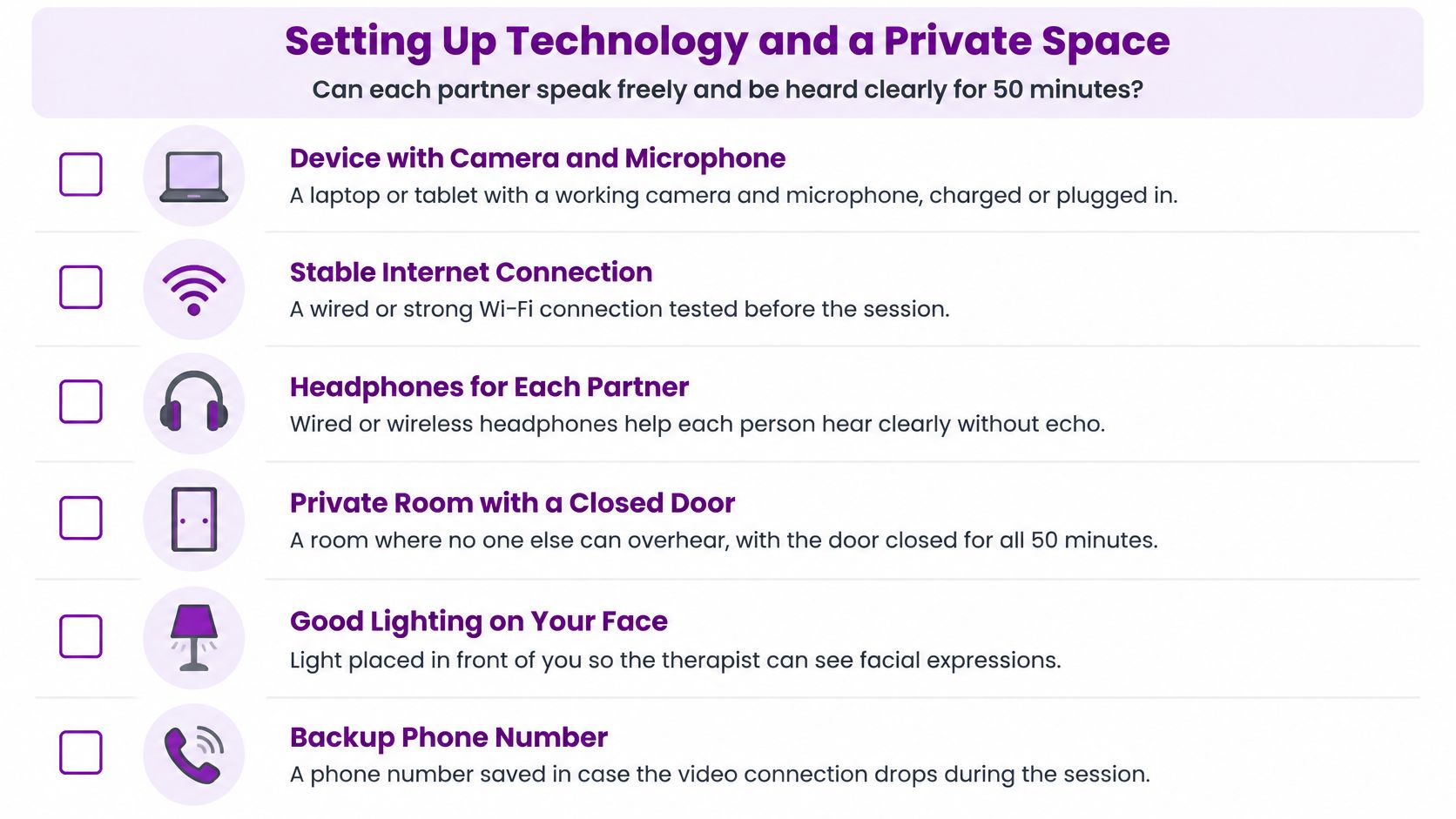
Ask one question before you book a video hour. Can each partner speak freely and be heard clearly for 50 minutes? If the answer is no, fix the setup before you fix the relationship.
Device and connection
Use a laptop or tablet with a working camera and microphone, charged or plugged in. Prefer a wired connection or home Wi-Fi you've already tested. Skip public Wi-Fi. A café network isn't private, and it drops. Run a short test call the day before so you're not debugging audio in the first ten minutes of care. Many clinics route you through a virtual waiting room before the clinician joins. Open that link early so a login problem doesn't eat the session.
The room
Close the door. Sit facing the camera, with light in front of you rather than a bright window behind. Headphones keep the clinician's voice off the room's speakers, which matters if someone else is home. If you share one device, each of you still needs your own login, and neither of you should be able to read the other's screen during individual time.
Logistics if the call drops
Join about 10 minutes early. Agree on a backup phone number before you start. Don't drive, and don't walk, during a session. A moving car isn't a private room, and it isn't safe. If video fails mid-session, stay where you are and switch to phone audio if the clinic offers it. Text the backup number only to say you've dropped, not to continue the clinical conversation in writing.
Confidentiality, Consent and Insurance Rules
More transparency between partners isn't always safer. A protected individual space is often what makes an honest assessment possible. Trauma history, missed doses, suicidal thoughts, and fear of a partner's reaction don't come out easily when that partner is sitting six feet away.
Carefully protected individual time can be what makes medication adherence, trauma disclosure, and a real suicide-risk check possible.
Ethics guidance on couple and family care treats conflicting goals, disclosure of private information, and risk management as recurring problems. The practical standard is plain language at the first meeting, the same limits written into consent forms, and a fresh review whenever care shifts between joint and individual sessions. A confidentiality in therapy policy should spell this out before anyone is asked to speak.
Three kinds of information
- Shared logistics: Appointment times, reminders, and which format you're using. Coordinating a calendar isn't the same as sharing a chart.
- Shared clinical content: What is said in a joint session. Both of you were there, so that material is part of the shared work.
- Private content: Individual disclosures, private messages to the clinician, and medication details. These stay with the person who shared them unless that person consents in writing, or safety requires otherwise.
Safety overrides ordinary privacy when someone discloses suicidal intent, abuse, or risk to a child. The clinician should tell you that limit up front, not after a crisis. Screening for intimate-partner violence happens privately, before anyone recommends conjoint care. A controlling partner who monitors visits, messages, or portal logins is a reason to keep care individual.
What insurance mail can reveal
Insurers often mail an explanation of benefits to the policyholder. That letter can show session dates to a partner on the same plan even when the clinical note stays private. Ask whether couples sessions are billed under individual or family psychotherapy codes, what each code costs you, and whether the clinician is in network before the first visit. If a mailed statement would create danger at home, say so during intake so the team can talk through billing options. None of this replaces a private safety screen.
How to Prepare for and Run Each Virtual Session
Room and device setup belongs on the technology checklist. Finish that first. Then each partner completes the sequence below before the first clinical hour. The point is an honest baseline the other person hasn't edited.
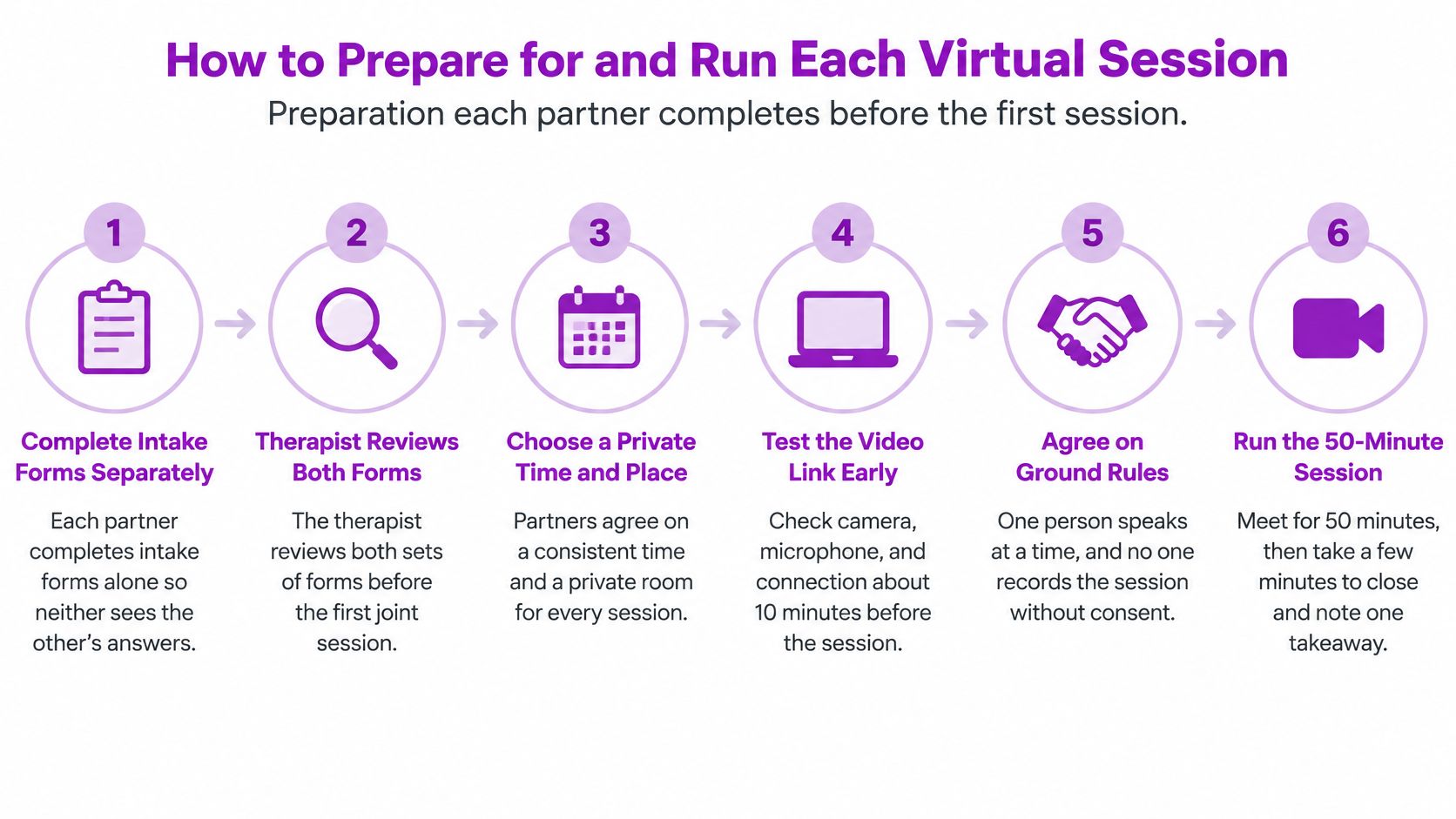
- Complete intake forms separately. Neither of you should see the other's answers. The clinician needs each person's version, not a negotiated one.
- List medications and keep a two-week log. Write the drug, the dose, and the prescriber. Note sleep, mood, and alcohol use so patterns are visible before the first visit.
- Write one goal for the couple. Not a list of complaints. One shared target gives the first session somewhere to land.
- Agree on what may be repeated. Use the three information categories from your consent conversation. Name, out loud, what stays private from individual sessions.
- Name a backup contact and your location. Say who to call in a crisis, and confirm the physical address where you'll be for that session.
- Hold 10 quiet minutes afterward. Don't walk straight into email, kids, or the same argument. A short pause keeps the session from spilling into the evening.
Habits once you're on camera
- One topic: Pick a single issue for the hour. A virtual session scatters fast if you open three fights at once.
- First person: Speak about your own experience. "I shut down when voices rise" lands differently from "You always attack me."
- Pause instead of performing a fight: If tempers spike, ask to pause. The clinician can't always read the room the way they could in an office.
- One homework item: Bring one concrete practice to the next session, such as a planned timeout or a written medication question, so the hour has a thread.
These habits matter more on video than in an office because posture and distance are partly invisible. A paused session is still treatment. An argument performed for the camera usually isn't.
Book a Virtual Couples Session at a Local reVIBE Clinic
Call (480) 674-9220 or request a time through the practice site, and ask whether virtual couples sessions are available at the location you choose. reVIBE Mental Health has five Phoenix-metro clinics, with in-person and secure online visits, so the format question is part of the first call rather than a surprise later.
- Name the visit type up front. Say this is a couples session, and say whether either partner is taking medication. Scheduling and clinician matching depend on that.
- Pick the format from your risk row. Ask for virtual or in-person care based on the starting-format table, not on whichever slot is soonest.
- Verify insurance before you arrive. Ask the team to confirm that your plan is accepted so a billed visit isn't the way you find out.
- Confirm the license and your location. The clinician needs to be licensed in the state where you'll physically be during the session.
- Ask how confidentiality and billing work. Request the plain-language limits and which codes apply to joint sessions, using the categories already covered above.
- Ask which intake each partner completes alone. Separate forms are the point. Don't fill them out together at the kitchen table.
| Location | Street address | City |
|---|---|---|
| reVIBE Mental Health – Chandler | 3377 S Price Rd, Suite 105 | Chandler, AZ |
| reVIBE Mental Health – Phoenix Deer Valley | 2222 W Pinnacle Peak Rd, Suite 220 | Phoenix, AZ |
| reVIBE Mental Health – Phoenix PV | 4646 E Greenway Road, Suite 100 | Phoenix, AZ |
| reVIBE Mental Health – Scottsdale | 8700 E Via de Ventura, Suite 280 | Scottsdale, AZ |
| reVIBE Mental Health – Tempe | 3920 S Rural Rd, Suite 112 | Tempe, AZ |
You don't need a perfect opening story. Call with the situation you're in now, confirm the format and the insurance, and book the first session this week.
reVIBE Mental Health offers therapy and psychiatry with medication management, including couples counseling in person and online across the Phoenix metro area. If relationship conflict and symptoms like anxiety or depression are feeding each other, a clinician can help you sort individual care, joint sessions, and consent before you start. Visit reVIBE Mental Health to request an appointment or call (480) 674-9220 and ask about a virtual couples session at the clinic nearest you.