
Somatic healing exercises are less about traditional fitness and more about a gentle, mindful conversation with your body. Think of them as practices designed to help you tune into your internal world, process stored stress, and finally release the trauma that gets held in your muscles and nervous system.
The entire focus is on your internal experience—how a movement or sensation feels, not what it looks like from the outside. This shift in focus is incredibly powerful for helping your nervous system move out of a constant state of high alert.
The Connection Between Body and Mind
Ever notice how your shoulders creep up to your ears during a stressful meeting? Or that pit in your stomach when you're feeling anxious? That’s not just in your head. Those are physical manifestations of your emotional state, proof that your body holds onto your experiences.
Somatic exercises are built on the fundamental truth that our bodies store the impact of our lives, especially deep stress and trauma, right in our tissues and nervous system.

At their core, these practices give your body a chance to complete its natural stress-response cycles. When you encounter a threat, your nervous system gears up for fight or flight. If you never get to use that surge of energy, it can get stuck, leading to issues like chronic tension, persistent anxiety, or a numb, disconnected feeling.
Somatic exercises offer a "bottom-up" approach to healing. Instead of trying to think your way out of distress, you learn to listen to your body's signals and use gentle movement to create a sense of safety from within.
Before diving into the exercises themselves, it helps to understand the core concepts that make this approach so effective. These principles are the "why" behind the movements.
Core Principles of Somatic Healing Exercises
| Principle | What It Means | Why It Helps |
|---|---|---|
| Mind-Body Connection | Recognizing that your thoughts, emotions, and physical sensations are deeply interconnected and influence one another. | It moves healing beyond just talking and into the physical realm where trauma is often stored. |
| Felt Sense | The practice of tuning into and noticing the subtle physical sensations inside your body without judgment. | It builds your capacity to listen to your body's wisdom and cues for safety or distress. |
| Pendulation | Gently and slowly shifting your attention between a sensation of distress and a sensation of calm or safety in your body. | This rhythmically expands your nervous system's capacity to handle difficult sensations without becoming overwhelmed. |
| Titration | Working with small, manageable "doses" of a difficult sensation or memory to avoid re-traumatization. | It allows your nervous system to process stored stress gradually, building resilience instead of flooding the system. |
| Resourcing | Identifying and connecting with sources of strength, safety, and calm—both internally and externally. | It creates a foundation of stability, reminding your body that it knows how to feel safe and regulated. |
These principles work together to create a safe container for healing, allowing you to approach difficult internal experiences with curiosity and compassion rather than fear.
Where Do Somatic Practices Come From?
This mind-body concept isn't some new-age fad; it has a rich history rooted in decades of research and practice. The modern lineage of somatic healing exercises goes back to pioneers in the early 20th century.
Innovators like F. Matthias Alexander, Moshe Feldenkrais, and Thomas Hanna developed techniques to essentially retrain the nervous system and reverse what Hanna called "Sensory Motor Amnesia"—that’s when we lose conscious control over muscles that have become chronically tight from stress or injury.
By the 1990s, this work was further crystallized by therapists like Peter Levine, whose Somatic Experiencing® method created targeted approaches for healing trauma that are now used by professionals all over the world.
Why This Approach Is So Effective
So, why does this work so well? Because these exercises speak the body's native language: sensation.
Instead of trying to logically analyze a traumatic event, you learn to track the physical sensations tied to it in a safe, controlled way. This process is what finally helps your nervous system understand that the threat is over and it’s okay to stand down.
These practices are often profoundly effective for addressing the deep-seated physical and emotional patterns left behind by difficult experiences. For a deeper dive into understanding the impact of trauma and PTSD, these resources can provide valuable context.
Somatic work also beautifully complements other therapeutic modalities. For instance, it can enhance treatments like EMDR by helping you stay grounded in your body while processing difficult memories.
Building a Foundation of Safety and Awareness
Before diving into the more dynamic somatic exercises, the first and most crucial piece of the puzzle is building a real sense of safety and awareness in your own body. Think of this as opening a compassionate dialogue with your nervous system. You're teaching it that right here, right now, you are safe. This foundational work is what makes it possible to feel secure enough to release stored tension later on.
The goal here is simple: gently guide your brain out of its high-alert state and into the present moment. Many of us, especially after experiencing prolonged stress or trauma, are walking around with a nervous system that's constantly scanning for threats. These initial, simple exercises are like a signal to that protective part of you that it can finally lower its guard.
Creating Your Safe Space
Your environment plays a huge role in how safe your body feels. You don't need a perfect yoga studio—just a quiet corner where you won’t be interrupted for a few minutes.
Here are a few small things you can do to set the stage:
- Minimize Interruptions: Let family or roommates know you need a few minutes, or find a time when you're likely to be alone.
- Adjust the Lighting: Harsh overhead lights can be activating. Try dimming them or opening a curtain to let in some soft, natural light.
- Notice the Temperature: If you feel a chill, grab a blanket. If it's stuffy, crack a window. Comfort is key.
Remember, the whole point is to create a container of safety. This small act of preparing your space is an exercise in itself—it sends a powerful message to your body that its comfort matters.
The Power of Grounding
If there's one fundamental practice to start with, it's grounding. It's the simple, profound act of connecting your body to the stable support of the earth beneath you. This physical connection sends a direct, undeniable message to your brain: "You are supported. You are stable. You are here."
The best part is, you can practice grounding anywhere, anytime. It’s incredibly useful when you feel that familiar wave of anxiety, overwhelm, or dissociation creeping in.
A Simple Grounding Practice for Your Chair
Let’s say you're in the middle of a stressful workday. You can do this right at your desk without anyone even noticing.
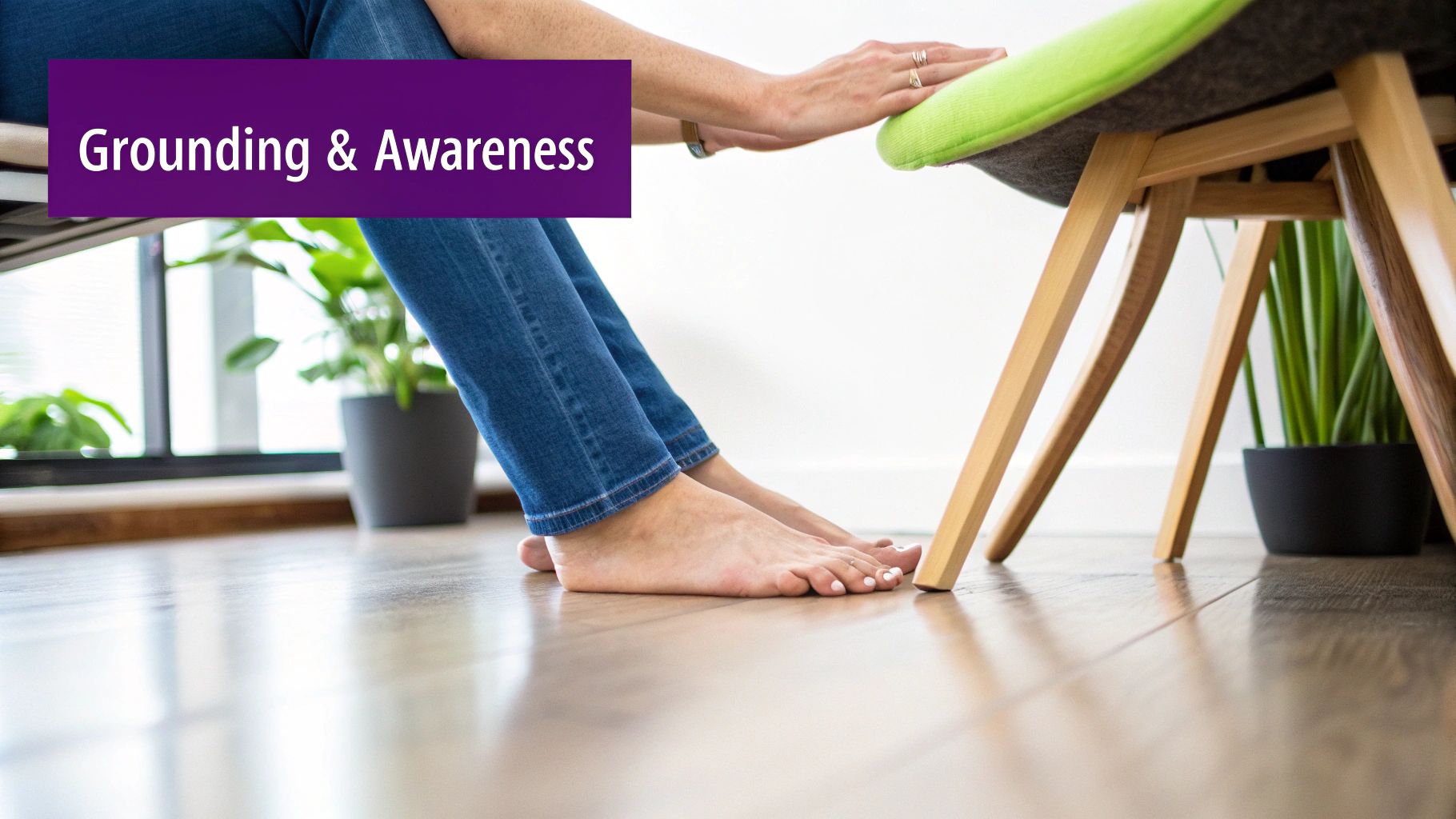
- Feel Your Feet: Start by just bringing your awareness to the soles of your feet. If you can, slip off your shoes and really feel the floor. Is it carpet? Cool tile? Wood? Just notice.
- Press Gently: Now, gently press your feet into the ground. Feel that solid, unwavering support coming up to meet you. Some people like to imagine little roots growing from their feet, anchoring them to the earth.
- Notice Your Seat: Shift your attention to where your body meets the chair. Feel the firm surface holding you up. See if you can let go just a little bit and allow your weight to be fully supported.
This isn’t about forcing relaxation. It’s about noticing the physical reality of the support that is already there for you.
Orienting to Your Surroundings
After trauma or chronic stress, it's common for the nervous system to get stuck in hypervigilance—that state of constantly scanning for danger. Orienting is a somatic exercise that directly works with this impulse. It involves consciously and slowly scanning your environment to register that you are safe in the present moment.
This practice helps your survival brain understand that whatever threat happened in the past is not happening now.
By intentionally looking around your space and noticing neutral or pleasant objects, you are actively telling your nervous system that there is no immediate danger. It’s like updating your internal alarm system with real-time data.
How to Practice Orienting
Find a comfortable spot to sit where you can see a good portion of the room.
- Let Your Eyes Lead: Very slowly, let your head and neck turn as you allow your eyes to just wander around the space. Don't force it. Simply follow what naturally catches your attention.
- Name What You See: In your mind, silently name what you see. "Blue lamp… green plant… wooden picture frame… sunlight on the wall." The key is to be factual and neutral, without judgment.
- Notice Colors and Shapes: Let your eyes rest on something that seems pleasant, or even just neutral. Notice its color, its shape, its texture.
- Check In with Your Body: After a minute or two, bring your awareness back inside. Has anything shifted? Do you feel a little calmer? Is your breath a bit deeper? There's no right or wrong answer—just notice.
These foundational practices—grounding and orienting—are your anchors. They are the tools you can return to anytime you feel overwhelmed, whether you're in the middle of another somatic practice or just going about your day. Building this base of safety isn't a step to be rushed; it’s the very ground upon which lasting healing is built.
Gentle Movements for Releasing Stored Tension
Once you've found your footing in the present moment, you can begin to gently explore movements that invite your body to let go of deeply held tension. Think of these less as "exercises" and more as conversations with your body. There’s no perfect form to master or goal to hit. The whole point is to allow your body to complete its natural stress responses and finally release what it’s been holding onto.
So many of us walk around carrying the physical residue of stress—a tense meeting at work, a close call in traffic, a difficult conversation. This tension is like a physical armor, the leftover energy from a fight-or-flight response that never got a chance to complete. The practices in this section are all about giving that stuck energy a safe exit ramp.

Unlocking Natural Release with Therapeutic Shaking
Ever notice how a dog will shake its whole body after being startled? That’s not just a cute quirk. It's an instinctual process called a neurogenic tremor, and it’s the body's brilliant way of discharging excess adrenaline and cortisol to reset the nervous system. As humans, we have this same innate ability, but we’re often taught to suppress it—to "keep it together."
Therapeutic shaking is a way to consciously tap back into this powerful, natural release valve. It’s incredibly effective for getting rid of that jittery, buzzy energy that can get trapped in your system after a stressful event. Best of all, it takes just a minute or two and requires zero equipment.
How to Practice Gentle Shaking:
- Find your stance. Stand with your feet about shoulder-width apart and soften your knees into a slight bend. Let your arms hang loose.
- Start a gentle bounce. Begin bouncing from your knees, letting that vibration move up through your whole body.
- Let it all go. Allow your arms, shoulders, and even your head to be loose and free. Let your hands and wrists jiggle. The key is to allow the movement, not force it.
- Don't forget to breathe. Taking a few deep, audible exhales can really help encourage the release.
- Pause and feel. After about 30–60 seconds, slowly let the bouncing subside. Stand still for a moment and just notice the sensations. You might feel a pleasant tingling, a sense of warmth, or a wave of calm wash over you.
This simple act is a direct signal to your survival brain. It says, "The threat is over. It's safe to stand down." This allows the body to finally let go of the stress hormones and return to a state of equilibrium.
Mindful Stretching and Pandiculation
Another incredibly powerful tool is something called pandiculation. It's the scientific term for that instinctual, full-body stretch-and-yawn you see cats and dogs do when they wake up. It involves consciously tensing a muscle, and then very, very slowly releasing it. This process actually resets the baseline tension level in your muscles far more effectively than just passive stretching.
This mindful action helps wake up the sensory-motor cortex of your brain, essentially reminding it that it’s in control of muscles that may have become chronically tight and forgotten.
A Simple Pandiculation Practice:
- Lie on your back and slowly, intentionally, reach your arms up over your head while pointing your toes. Imagine you're trying to make yourself as long as possible.
- Gently contract those muscles for just a few seconds—enough to feel the engagement without straining.
- Then, as slowly as you can, release the tension and let your limbs float back to a neutral, relaxed position. Pay close attention to the wave of release that follows.
These movements are less about achieving a perfect stretch and more about re-establishing that crucial mind-body connection. To really get to the bottom of that stored tension, it can be helpful to know where it comes from. For a deeper look, check out this great article on understanding the root causes of neck and shoulder tension.
Bringing These Movements into Your Daily Life
The real magic of these somatic practices is how accessible they are. You don't need to block out an hour on your calendar; you can use them in small, potent doses right when you need them.
- Real-World Scenario: You just got off a tense phone call. Your shoulders are up by your ears and your jaw is clenched tight. Instead of carrying that physical stress into your next task, find a private space (like a restroom or an empty office) and do a minute or two of gentle shaking. You’ll be amazed at how quickly it can discharge that nervous energy.
These aren't just feel-good exercises; a growing body of evidence shows that somatic-based interventions have measurable effects on trauma symptoms and chronic pain. Some studies on body-focused therapies have found symptom reductions ranging from 30% to over 50%.
Gentle movements like these are a vital piece of the healing puzzle. They offer a direct, body-based way to process stress that talk therapy alone might not be able to reach. When you're navigating your own healing journey, having a full toolkit is key. If you're exploring your options, learning more about professional trauma treatment can show you how practices like these can be integrated with expert therapeutic support for a truly comprehensive approach.
Weaving Somatic Exercises into Your Daily Life
Lasting change is built on consistency, not intensity. The real magic of somatic healing isn't found in long, complicated sessions. It comes from weaving small, mindful moments of body awareness into the rhythm of your day-to-day life.
This approach stops somatic healing from feeling like just another task on your to-do list and turns it into a reliable, ever-present resource. It’s about creating “micro-practices” that anchor you throughout the day, building your resilience one small moment at a time.
From Task to Habit: Making It Stick
The easiest way to integrate these exercises is to link them to activities you already do every day. This is sometimes called "habit stacking," and it makes consistency feel almost effortless. Instead of trying to carve out an extra 30 minutes you don't have, you simply find a spare 30 seconds.
Here are a few practical ideas to get you started:
- While your coffee brews: Stand with your feet flat on the floor. Gently press them down and really notice the solid ground beneath you. See if you can feel that sense of support traveling up through your legs.
- During your commute: When you're stopped at a red light, place one hand on your belly. Take a single slow, deep breath, feeling your stomach expand into your hand. Exhale just as slowly.
- Before answering the phone: Do a quick shoulder shrug. Breathe in and lift your shoulders all the way up to your ears, then let them drop completely with a sigh on the exhale.
These tiny interruptions to your automatic pilot are incredibly powerful. They create little pockets of regulation that can prevent stress from snowballing and becoming overwhelming by the end of the day.
A Powerful Partner to Therapy
Beyond managing daily stress, these "bottom-up" somatic practices are a fantastic complement to formal therapy. While talk therapy works from a cognitive, or "top-down," perspective by engaging your thoughts, somatic exercises work directly with the nervous system from the ground up.
Think about it: trying to discuss difficult memories when your body is already buzzing with anxiety can feel impossible. But by using a quick grounding exercise before a therapy session, you can walk in feeling more settled and present. This makes the deep cognitive and emotional work of therapy feel more accessible and far less overwhelming, creating a powerful synergy for healing.
Somatic Exercises for Busy Professionals
If you’re in a high-pressure role, incorporating somatic exercises can be a total game-changer for managing burnout and staying focused.
Picture this real-world scenario: You've just wrapped up a series of back-to-back, stressful meetings. Before jumping into your next big task, take just 60 seconds. Stand up, feel your feet on the floor, and gently shake out your arms and legs. This small act helps discharge built-up adrenaline and tension, allowing you to reset your nervous system and approach your work with a clearer mind.
The growing interest in these practices reflects a huge shift toward integrative, trauma-informed care. Since the 1970s, the number of somatic training programs has grown from just a handful to hundreds worldwide. This growth is matched by a major increase in people seeking out body-based mental health support as they recognize the undeniable link between how their body feels and how their mind works. You can explore a deeper dive into the history and expansion of somatics to understand its journey.
At reVIBE Mental Health, we see every day how integrating somatic awareness can deepen the therapeutic process. Our therapists across Chandler, Phoenix, Scottsdale, and Tempe are skilled in helping clients build this vital mind-body connection. Call us at (480) 674-9220 to learn how we can support you.
Knowing When to Seek Professional Guidance
While you can do so much on your own with these exercises, it’s just as important to know when to bring in a professional. Think of it this way: this journey into your body is deeply personal, but it doesn't have to be a solo mission. Reaching out for help isn't a sign of failure; it’s a sign of profound self-awareness and strength.
Sometimes, as you start to connect with your body, you might uncover emotions, memories, or sensations that feel too big to hold on your own. If you find yourself consistently feeling overwhelmed, intensely activated, or even numb and checked out during or after you practice, that could be your body signaling that it needs a bit more support.
The whole point of this work is to build a sense of safety within yourself, not to force your way through overwhelming discomfort. A trained therapist provides a safe, professional container where you can explore those deeper layers without the risk of re-traumatization.
Recognizing the Signs You Need More Support
So, how do you know if what you’re feeling is just part of the process or a sign that you need backup? It really comes down to intensity and how long it lasts. Feeling a wave of sadness is one thing; feeling completely destabilized for days afterward is a clear signal to reach out.
Keep an eye out for these specific indicators:
- Persistent Overwhelm: You consistently feel flooded by emotions like intense fear, grief, or rage that you just can't seem to manage alone.
- Increased Dissociation: Instead of feeling more present in your body, you feel more disconnected, numb, or like you're watching your life from a distance.
- Re-activation of Symptoms: Your anxiety, flashbacks, or chronic pain seem to be getting worse or more frequent since you started the exercises.
- Feeling Stuck: You’ve been practicing for a while but feel like you’ve hit a plateau, just cycling through the same old patterns of tension and stress.
It is essential to remember that this guide and these somatic healing exercises are for educational purposes. They are not, and should never be considered, a substitute for professional therapy or medical advice.
This little decision tree can be a great in-the-moment tool to check in with yourself when stress pops up, helping you choose a quick, regulating practice that fits the situation.
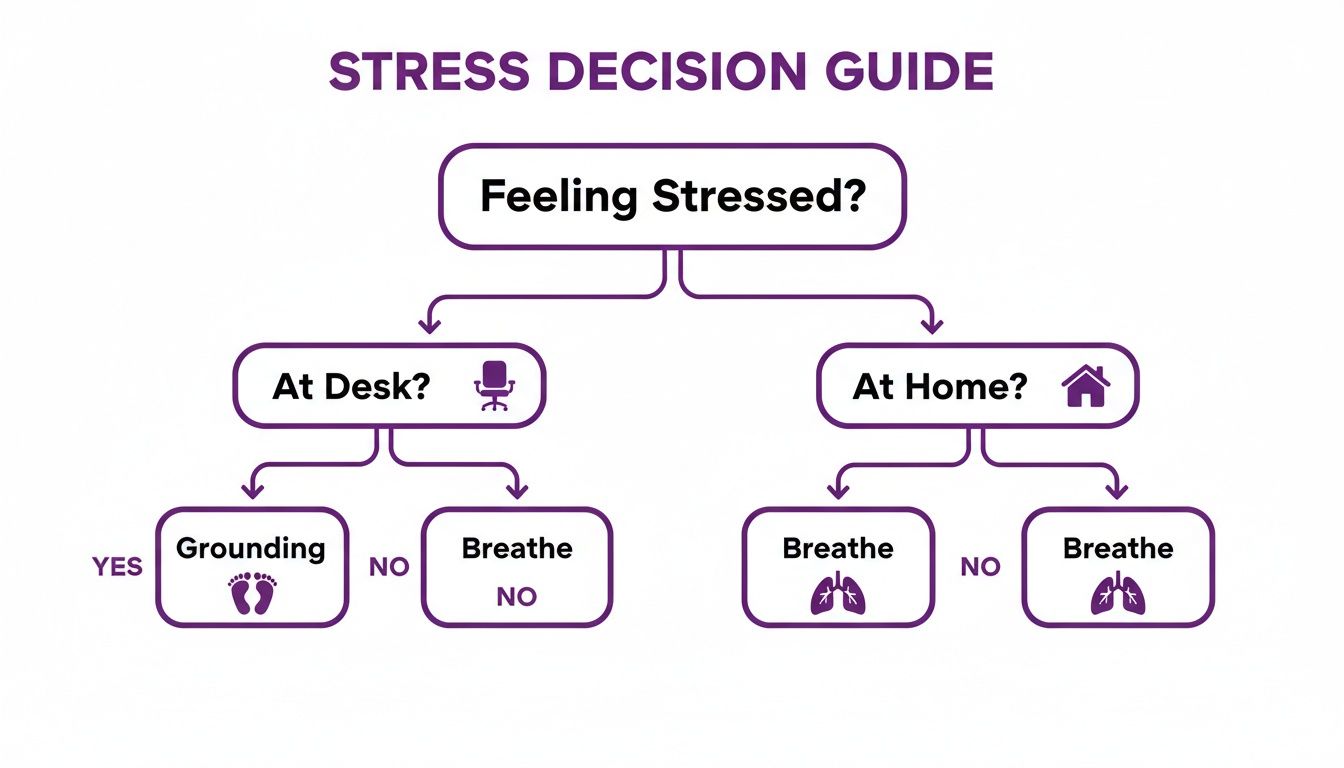
As the flowchart shows, simple, context-aware choices—like doing a quick grounding exercise at your desk or a breathing practice at home—can become your go-to tools for managing stress as it happens.
The Role of a Somatic Therapist
Working with a therapist isn't just about damage control for the tough moments; it’s about going deeper and making your healing more effective. A skilled somatic therapist has a map of the nervous system's terrain that you simply can't get from reading an article online.
Here’s what they can do:
- Co-regulate: A therapist’s calm, grounded presence can literally help your nervous system settle down, making it feel safe enough to process what’s coming up.
- Titrate the Experience: They are experts at helping you work with small, manageable "doses" of traumatic energy, so you don't get flooded or overwhelmed.
- Integrate Insights: They help you connect the dots between what your body is feeling and your life experiences, turning raw sensation into meaningful insight.
A great therapist acts as both an anchor and a guide. They hold a safe space for you while empowering you to navigate your own inner world. If you're looking for a provider to support you, consider finding a psychiatric mental health practitioner who understands these body-based, integrated approaches to healing.
For those in Arizona ready to take this courageous step, we make it easy to connect with a skilled professional.
Find a reVIBE Location Near You!
We currently have five locations for your convenience. (480) 674-9220
reVIBE Mental Health – Chandler
3377 S Price Rd, Suite 105, Chandler, AZ
reVIBE Mental Health – Phoenix Deer Valley
2222 W Pinnacle Peak Rd, Suite 220, Phoenix, AZ
reVIBE Mental Health – Phoenix PV
4646 E Greenway Road, Suite 100, Phoenix, AZ
reVIBE Mental Health – Scottsdale
8700 E Via de Ventura, Suite 280, Scottsdale, AZ
reVIBE Mental Health – Tempe
3920 S Rural Rd, Suite 112, Tempe, AZ
Making the choice to seek professional guidance is a powerful act of self-care. It’s a true investment in a safer, deeper, and more lasting healing journey.
A Few Common Questions About Somatic Exercises
Stepping into somatic work means learning a new language—your body's. It's totally normal to have questions and maybe even feel a little unsure as you begin. Let's walk through some of the most common ones I hear from people, so you can feel more confident and grounded in your practice.
The goal here isn't to have all the answers, but to demystify the process and help you feel empowered on your own path.
How Long Does This Actually Take to Work?
This is probably the most common question, and the honest answer is: there's no magic timeline. Every single nervous system is different. Some people feel a wave of calm after their very first grounding exercise. For others, the changes are quieter, unfolding slowly over weeks.
The key isn't intensity; it's consistency. Think of it less like a workout and more like building a new friendship with your body. A gentle, consistent practice of just 5-10 minutes a day will almost always create deeper, more lasting change than one long session once a month. The real goal is the process of reconnection, not racing to an imaginary finish line. Over time, you'll start to notice you feel more present, less emotionally reactive, and simply more at home in your own skin.
What if I Have Chronic Pain or Physical Limitations?
Yes, you can absolutely do this work. In fact, somatic exercises are often a lifeline for people with chronic pain precisely because they are so adaptable. The entire focus is on your internal awareness, not on pushing your body into a specific shape or hitting a performance goal.
Every single movement can be modified. You can make it smaller, slower, or even just imagine doing it in your mind's eye—the brain often responds in a similar way.
The golden rule is to never, ever push into pain. This is about listening to your body and respecting its boundaries. You're learning to work with it, not against it.
Of course, it's always a good idea to check in with your doctor before starting any new practice. Finding a somatic practitioner who has experience with your specific condition can also provide an extra layer of support and safety.
Is It Normal to Feel Emotional or Uncomfortable When I Do This?
It's not just normal—it's incredibly common. As you start paying attention to your body in this new way, you might notice feelings that have been tucked away for a long time, like a flicker of anxiety, a wave of sadness, or a spark of anger. This is actually a good sign. It means your body is finally getting the chance to process and release these stored-up emotions, which is a huge part of healing.
The most important thing to remember is to move at the speed of safety. If any feeling or sensation gets too big, gently pull back. You can always pause the exercise and come back to something simple, like feeling the solid ground beneath your feet. Remind yourself that you're safe right here, right now. This work is all about rebuilding trust with your body, not powering through discomfort.
How Is This Different from Yoga or Meditation?
That's a great question, as there's definitely some overlap. But the core focus is different in a really important way.
- Somatic Work vs. Yoga: While many yoga styles are about achieving a specific posture or form (the asana), somatic exercises flip that on its head. The priority is your internal, sensory experience. How a movement feels on the inside is infinitely more important than what it looks like on the outside.
- Somatic Work vs. Meditation: Many meditation practices guide you to observe your mind. Somatic work, on the other hand, uses the body as the front door to awareness. It’s a "bottom-up" approach, meaning we start with physical sensations to help calm the nervous system and process stored stress, rather than trying to think our way into feeling better.
At reVIBE Mental Health, our therapists know that mind and body are part of the same story. True healing happens when we listen to both. If you're curious about how somatic awareness can support your therapy journey, we're here to guide you. Our team offers expert, compassionate care in spaces designed to feel safe and welcoming.
Find your path to feeling better by visiting us at https://revibementalhealth.com or giving us a call at (480) 674-9220 to connect with a provider at one of our five convenient Arizona locations.