Spravato (esketamine) is not FDA-approved for any anxiety disorder; its approved uses are treatment-resistant depression and depressive symptoms in adults with major depressive disorder with acute suicidal ideation or behavior. Anxiety may improve alongside depression treatment, but that doesn't make Spravato an established treatment for a primary anxiety disorder.
The popular advice to try Spravato because it works differently skips the most important question: What condition are you treating? Someone with persistent worry but no depression needs a different evaluation from someone whose depression hasn't improved with antidepressants and who also experiences anxiety.
For adults considering Spravato for anxiety, that distinction affects treatment choices, insurance questions, and how a clinician measures success.
Spravato's Approved Uses Versus Anxiety Use
Spravato's FDA-approved uses are for depression, not primary anxiety disorders. The FDA prescribing information covers treatment-resistant depression in adults, either alone or with an oral antidepressant. It also covers depressive symptoms in adults with major depressive disorder and acute suicidal ideation or behavior, when used with an oral antidepressant.
That second approval concerns depressive symptoms during an urgent situation. It does not mean Spravato is proven to prevent suicide or replaces emergency assessment or hospitalization.
Spravato label status by condition
| Condition | FDA label status | What the evidence supports |
|---|---|---|
| Treatment-resistant depression in adults | Approved, alone or with an oral antidepressant | An approved treatment for depression that has not responded adequately to other treatment |
| Major depressive disorder with acute suicidal ideation or behavior | Approved for depressive symptoms, with an oral antidepressant | Treatment of depressive symptoms, not proven suicide prevention |
| Generalized anxiety disorder | Not approved | No established anxiety-specific esketamine indication |
| Panic disorder | Not approved | No established anxiety-specific esketamine indication |
| Social anxiety disorder | Not approved | Findings about ketamine do not establish that Spravato treats social anxiety |
| PTSD | Not approved | Findings about depression treatment do not establish a PTSD indication |
| Anxiety symptoms alongside treatment-resistant depression | Not a separate approved indication | Anxiety may improve alongside depression, but evidence for treating anxiety itself is limited |
Anxiety and depression can occur together, and some symptoms overlap. Trouble sleeping, poor concentration, avoidance, and distress alone do not show which diagnosis should guide care.
Published esketamine trials have mostly enrolled people with depression rather than people with primary anxiety disorders. That leaves limited evidence for using Spravato to treat an anxiety disorder itself. Anxiety that accompanies treatment-resistant depression is a different clinical question from anxiety as the main diagnosis.
Off-label use means prescribing a medication for a purpose beyond its FDA-approved indications. A clinician may consider it after an evaluation, but off-label prescribing is not an additional FDA approval and does not guarantee insurance coverage.
Diagnostic checkpoint: If anxiety is your main concern, ask which diagnosis the proposed treatment targets and how improvement in that diagnosis will be measured.
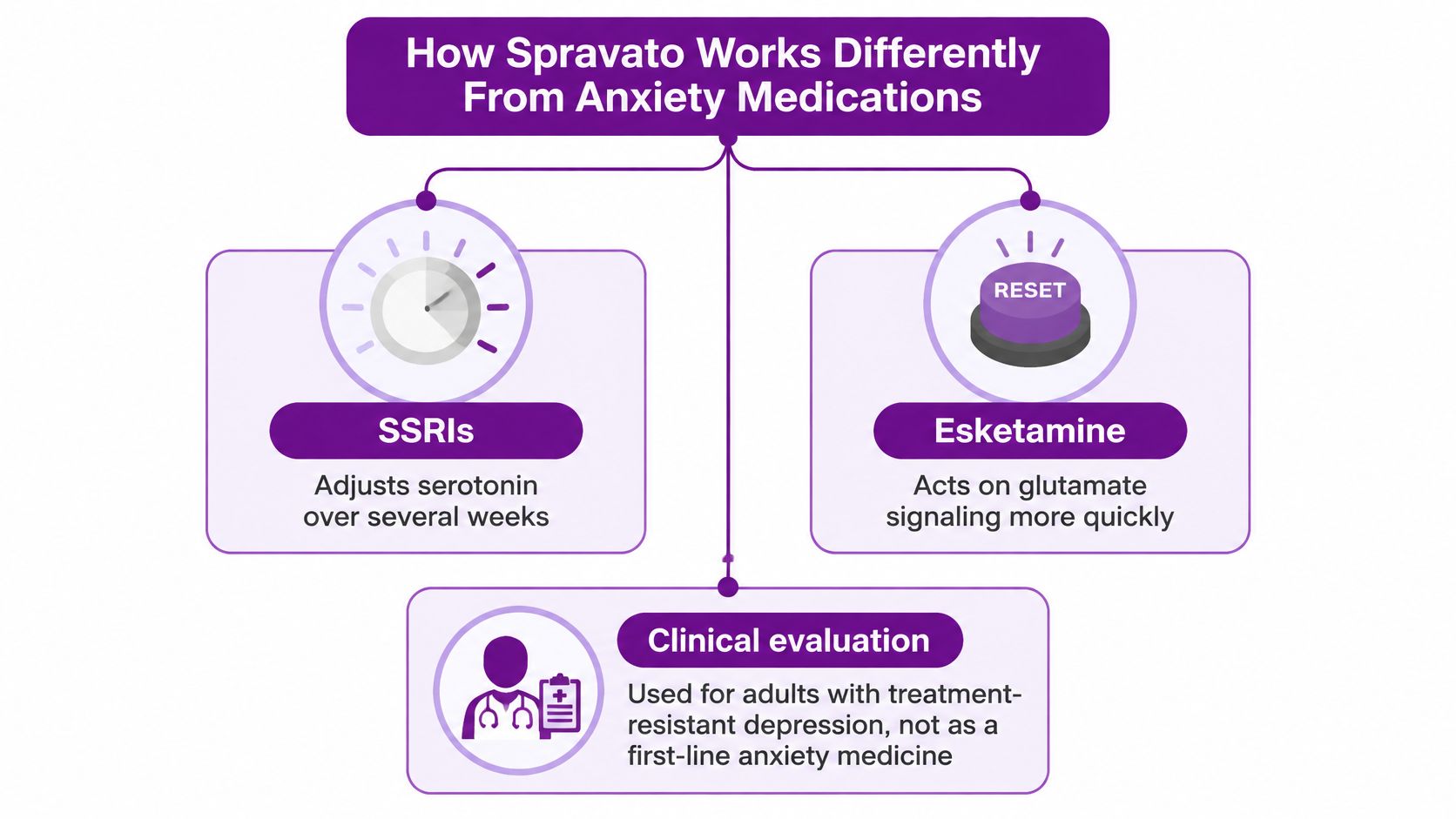
How Spravato Works Differently From Anxiety Medications
An SSRI can be compared loosely to a dimmer switch: it changes serotonin signaling, and improvement develops gradually. Esketamine acts through a different system, glutamate signaling, rather than providing a stronger version of the same medication.
The reset-button analogy sometimes used for esketamine is less reliable. It can help explain a different approach, but the brain doesn't reset, and treatment doesn't erase anxiety or permanently repair every symptom.
A different target, not an anxiety-specific mechanism
Esketamine is one molecular form of ketamine, delivered in Spravato as a nasal spray. It blocks NMDA receptors, which participate in glutamate signaling. Changes in communication between nerve cells are thought to contribute to its antidepressant effects, although its therapeutic mechanism isn't fully understood.
That explanation doesn't establish that Spravato directly treats panic attacks or chronic worry. A plausible biological pathway is a reason to investigate treatment, not proof that it works for every condition involving that pathway.
A faster-acting depression treatment is not the same as an anxiety-specific treatment.
Consider someone who avoids opening bills because depression has left them overwhelmed and hopeless. If depression improves, they may manage those tasks more easily and feel less anxious afterward. Another person may regain energy but still experience intense fear of social situations, requiring targeted anxiety treatment.
Questions that connect biology to your symptoms
For primary worry or panic, our explanation of generalized anxiety disorder treatment options can help frame the medication discussion. For complementary coping strategies, Vancouver Counselling Clinic's anxiety management guide offers a starting point for discussing nonmedication support.
Take these questions to your clinician:
- Treatment target: Are we trying to improve depression, anxiety, or both?
- Separate outcomes: How will we know whether worry or avoidance improves independently of mood?
- Remaining symptoms: If depression responds but anxiety persists, what treatment comes next?
The same treatment can also cause sedation or dissociation during dosing. Those experiences aren't evidence that the medication is working better, and they're among the reasons supervised treatment matters.
What the Studies Show About Anxiety Symptoms
The evidence is suggestive, but it doesn't establish Spravato as a primary anxiety treatment. Depression trials, ketamine trials, observational findings, and individual case reports answer different questions.
How to read the main findings
| Evidence type | What it can tell you | What it cannot establish |
|---|---|---|
| TRANSFORM-2 post hoc analysis | Whether depression treatment benefited participants who also had anxiety | Efficacy for a primary anxiety diagnosis |
| Ketamine systematic review and meta-analysis | Whether varied ketamine treatments show an anxiety signal | Equivalent results from intranasal Spravato |
| Real-world depression subgroup | Whether improvement occurs in routine care despite co-occurring anxiety | A direct anti-anxiety effect |
| Individual case report | Whether improvement occurred in a particular patient | Typical response or comparative effectiveness |
The depression-trial finding needs careful labeling. The TRANSFORM-2 post hoc analysis examined participants with treatment-resistant depression, including people with clinically significant anxiety. The frequently repeated between-group advantage was measured using MADRS, a depression scale, not an independent measure proving anxiety relief. Describing it as a definitive anxiety-score improvement confuses depression response with anxiety response.
Comorbid anxiety didn't clearly eliminate the antidepressant benefit. That's useful for someone with both diagnoses, but it doesn't establish that someone with anxiety alone should receive the same treatment.
The pooled ketamine result was mixed. A systematic review and meta-analysis combined six randomized trials involving 431 participants and found an overall standardized mean difference in anxiety symptoms of −0.42, with p = 0.052, which wasn't statistically significant. In that same review, a subgroup excluding electroconvulsive-therapy contexts showed a larger effect, −0.58 across five trials.
These are standardized effects, not points on a familiar patient questionnaire. The studies also involved different diagnoses, formulations, and settings, so the pooled finding can't be transferred directly to Spravato nasal spray.
Encouraging observations still need limits
Real-world subgroup findings describe improvements in depression and quality of life among patients with co-occurring anxiety. Without a design that isolates anxiety outcomes and controls other influences, those observations can't show whether esketamine directly reduced anxiety or whether patients felt less anxious as depression improved.
A published case-report record describes a 61-year-old woman whose anxiety decreased after four 56-mg intranasal esketamine doses over two weeks. That's an illustration of possible benefit, not a reliable prediction for another patient.
When evaluating a claim, ask:
- Who participated? People with primary anxiety, or people recruited for depression?
- What was the main outcome? Depression, anxiety, functioning, or something else?
- Was anxiety measured separately? A tool such as GAD-7, interpreted alongside a clinical assessment, helps avoid assuming that mood improvement means anxiety remission.
Who Qualifies and What the Evaluation Checks
A typical candidate is an adult with depression who has tried two or more antidepressants without adequate relief. Urgent, overwhelming depressive symptoms also warrant prompt assessment, but distress alone doesn't determine eligibility, and anxiety alone doesn't establish a qualifying depression diagnosis.
During our evaluation, we review your history, current medications, medical considerations, and safety factors. The purpose isn't just to decide whether Spravato is available. It's to decide whether it makes clinical sense for you.

What to expect in the assessment
Depression history and previous treatment. Bring medication names, doses, approximate dates, benefits, and side effects. A medication stopped because of intolerance tells a different story from an adequate trial that didn't improve symptoms.
Current medications and supplements. Include sleep medicines, prescribed sedatives, over-the-counter products, and supplements. The team needs to identify combinations that could increase sedation and give individualized instructions rather than having you stop medication yourself.
Blood pressure and cardiovascular history. Tell us about high readings, vascular conditions, and relevant medical treatment. Blood-pressure changes during dosing make this review part of safety planning, not routine paperwork.
Bipolar-spectrum illness and psychosis. Describe periods of unusually high energy, reduced need for sleep, impulsivity, hallucinations, or unusual beliefs. Those symptoms can change the diagnosis and treatment approach.
Substance-use history. Be candid about alcohol, cannabis, other drugs, and previous misuse. Accurate information helps clinicians assess sedation, misuse risk, and the support you may need.
Current suicide risk. Explain thoughts, intent, access to means, and any recent behavior. Immediate safety needs take priority over an outpatient treatment schedule.
Our guide to what happens during a psychiatric evaluation can help you prepare to discuss these concerns clearly.
Confirm benefits before committing
Insurance approval and clinical suitability are separate decisions. Ask your insurer which diagnosis and previous medication trials must be documented, whether prior authorization is required, and whether medication, administration, and observation are covered benefits.
Request your expected out-of-pocket cost per session before treatment begins. Make sure the diagnosis in your records accurately reflects the assessment, rather than assuming anxiety will be covered under a depression benefit.
Bring a medication list and a symptom log covering recent days. Record mood, worry, panic, sleep, avoidance, and daily functioning separately, with concrete examples such as missed work or difficulty leaving home.
How a Spravato Treatment Course Runs, Step by Step
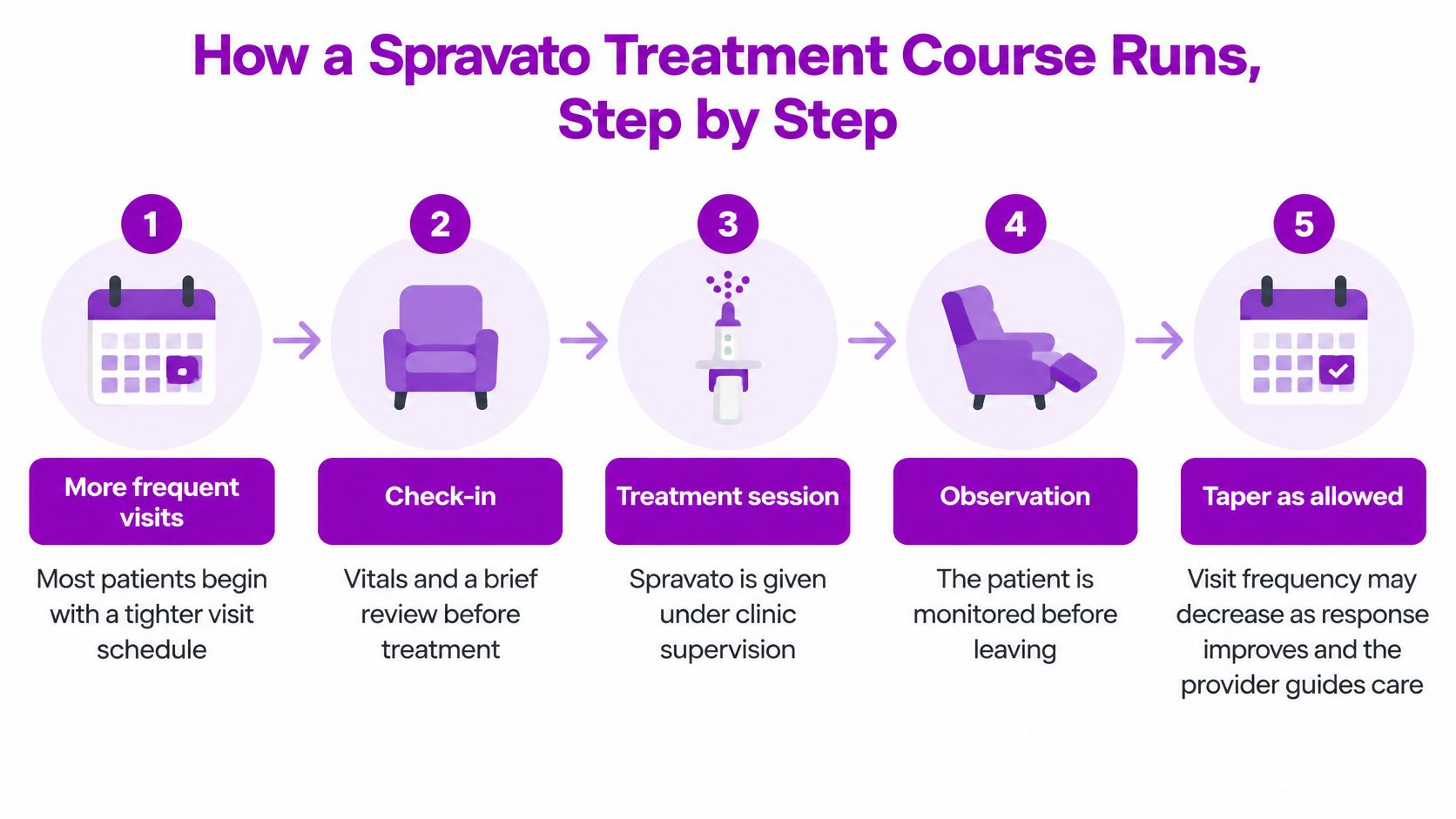
Most patients begin with more frequent visits, then reduce frequency as response and provider guidance allow. Less frequent treatment isn't automatic, and an early improvement doesn't by itself establish that maintenance is no longer needed.
Typical Spravato schedule by treatment phase
The following schedule describes treatment-resistant depression, not a validated course for primary anxiety. The prescriber sets the actual dose and schedule.
| Phase | Typical schedule | What happens at the visit |
|---|---|---|
| Induction, weeks 1–4 | Twice weekly, dose set by prescriber | Check-in, supervised dose, monitoring, and discharge check |
| Weeks 5–8 | Once weekly | Response review and symptom tracking |
| Maintenance after week 8 | Weekly or every two weeks, adjusted to response | Reassessment of maintenance frequency |
| Each session | One visit with at least two hours of monitoring | Vitals, symptom check, dose, observation, and clinical discharge |
These phase frequencies follow the prescribing-information approach for treatment-resistant depression; they shouldn't be assumed to apply to the separate acute-suicidality indication.
What happens during a visit
Check-in and baseline assessment. Our team checks vitals and symptoms before treatment. Tell staff about medication changes, illness, unusual anxiety, or a difficult reaction after the previous visit so the clinician can assess whether to proceed.
Supervised self-administration. You administer the nasal spray yourself under direct clinical supervision. Staff guide the process, rather than sending the medication home for independent dosing.
On-site observation. You remain under monitoring for at least two hours. Staff assess how you're responding, including sedation, dissociation, and blood-pressure changes; this isn't a waiting period.
Clinical discharge assessment. A clinician evaluates you before you leave. We discharge patients only when they're clinically stable, so reaching the minimum observation time doesn't guarantee immediate departure.
Safe transportation home. Arrange your ride before the appointment because you can't drive yourself after treatment. Build transportation into your ongoing schedule, rather than treating it as a detail to solve at checkout.
Response review and adjustment. Our team tracks symptoms and adjusts the plan using that information. Describe practical changes, such as returning to work or completing everyday tasks, as well as changes in questionnaire scores.
Set useful goals before treatment
A goal such as feel better is understandable but hard to evaluate. More specific goals might include getting out of bed consistently, resuming meal preparation, or participating in activities depression has interrupted.
For someone with co-occurring anxiety, the clinician should also identify anxiety-specific goals. Sleeping better doesn't necessarily mean that panic-related avoidance has improved, and lower depression scores don't automatically mean chronic worry has resolved.
Spravato isn't a pharmacy pickup for home use. It's available through a restricted safety program, called REMS, in a certified healthcare setting. Before beginning, establish which outcomes the team will measure and what would prompt reassessment rather than continuing the same schedule.
Side Effects, Anxiety Rebound and Continuity Planning
After dosing, a patient may feel detached, sleepy, mentally slowed, or anxious. Those sensations should be reported to staff rather than interpreted as something to endure.
A review of ketamine-related anxiety treatment describes the limitations of maintenance evidence and the possibility that anxiety can return after treatment stops. The drugs, routes, and patient groups differ, so it doesn't establish an anxiety-specific maintenance protocol for Spravato.
Side effects, what they can look like and what to do
| Effect | What it can look like | What to do |
|---|---|---|
| Dissociation | Feeling detached or unreal during or soon after dosing | Stay with staff until cleared; report anything that lingers |
| Sedation or impaired attention | Drowsiness or slowed thinking | Don't drive until the next day after restorative sleep |
| Blood-pressure elevation | Raised readings before or after dosing | Allow on-site monitoring; report chest pain or severe headache immediately |
| Agitation, fear, or panic | Anxiety before a session or panic after dosing | Record timing and discuss it before the next dose |
| Anxiety returning after stopping | Worry, tension, or avoidance re-emerging | Track anxiety and depression separately and arrange reassessment |
| Thoughts of self-harm | Hopelessness or urges to hurt yourself | Contact 988 immediately; use emergency services for immediate danger |
Anxiety-related reactions can include agitation, anticipatory anxiety, fear, nervousness, panic attacks, and tension. A short-lived dosing reaction and a sustained worsening of anxiety require different responses, so describe when symptoms started, how long they lasted, and whether they affected functioning.
Continuity matters: Before reducing or stopping treatment, agree on who to contact, what to track, and how quickly the team should reassess returning symptoms.
Make a plan for treatment days and changes
- Arrange transportation every time. Have a reliable ride home and a backup arrangement.
- Protect recovery time. Avoid driving and safety-sensitive activities until the following day after restorative sleep. Postpone major decisions while you're impaired.
- Track separate symptoms. Record worry, panic, avoidance, and mood independently. A paper log is enough if it's consistent and usable.
- Define reassessment triggers. Agree on how the clinician will review maintenance frequency, missed sessions, symptom return, or treatment that no longer seems helpful.
Anxiety returning after treatment ends doesn't automatically prove withdrawal, addiction, or permanent worsening. It calls for assessment of the underlying conditions, other medications, stressors, and the treatment plan.
Any thoughts of self-harm deserve immediate help. Call or text 988 for crisis support. If you have intent to act, cannot stay safe, or have a medical emergency such as chest pain, breathing difficulty, or severe neurological symptoms, contact emergency services immediately.
Frequently Asked Questions for Phoenix Adults
Does the FDA label change if I live in Arizona?
No. The same federal label applies in Phoenix as elsewhere in the country. A local clinic's availability doesn't create an anxiety indication.
Can Spravato treat panic disorder or generalized anxiety?
It isn't FDA-approved for either condition, and direct esketamine evidence for primary anxiety remains insufficient. Ask how SSRIs, SNRIs, or cognitive behavioral therapy fit your diagnosis before considering an off-label approach.
Is Spravato the same as ketamine infusion therapy?
No. Spravato is intranasal esketamine with specific approved depression indications, while ketamine infusion therapy uses a different formulation and route. Their findings, monitoring arrangements, and coverage shouldn't be treated as interchangeable.
Does Spravato replace my antidepressant?
Not necessarily. For treatment-resistant depression, the label permits use alone or with an oral antidepressant; the separate acute-suicidality indication requires an oral antidepressant. Don't discontinue your current medication without your prescriber's guidance.
Who should I call first in the Phoenix area?
Call our central line at (480) 674-9220. We can help you identify the appropriate location and explain which records to send before an evaluation.
Choosing an Anxiety Treatment and Booking an Evaluation
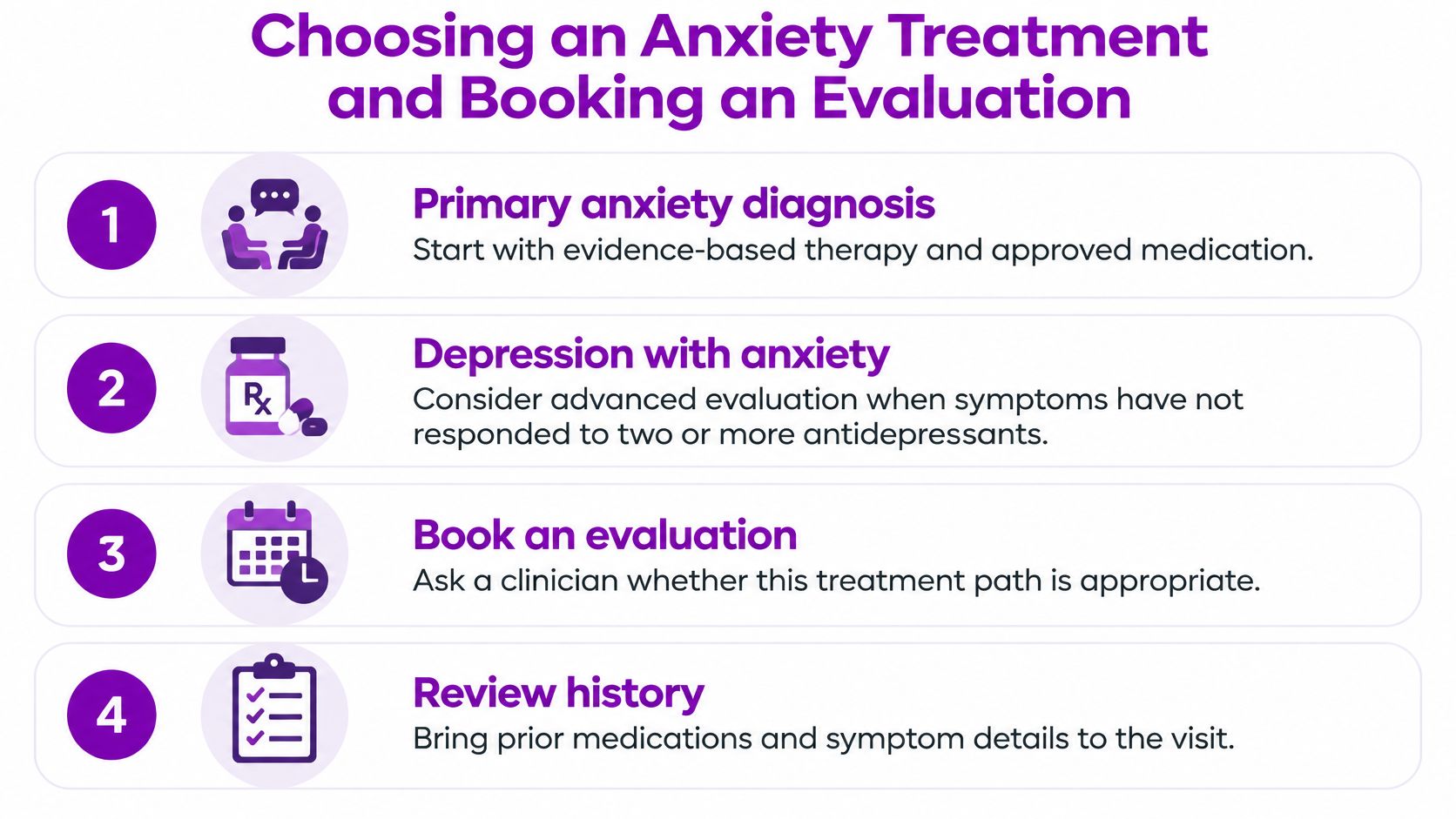
Anxiety alongside treatment-resistant depression raises a different treatment question from a primary anxiety disorder. The first step is identifying which condition best explains your symptoms. Treatment should follow that assessment, not the intensity of distress alone.
Anxiety treatment options compared
| Option | Evidence for anxiety | Where it happens | Best fit |
|---|---|---|---|
| SSRIs and SNRIs | Specific medications are FDA-approved for several anxiety disorders, including generalized anxiety and panic disorder | Oral medication prescribed by a psychiatrist or primary care clinician | Primary anxiety disorders as a first-line medication option |
| Cognitive behavioral therapy | Strong evidence for generalized anxiety, panic, and social anxiety | Regular therapy sessions | Primary anxiety disorders, alone or alongside medication |
| EMDR | Used for PTSD, anxiety, and phobias; evidence is strongest for PTSD | Therapy sessions | Anxiety linked to trauma, following assessment |
| Off-label ketamine-class treatment for anxiety | Mixed, limited evidence | Monitored clinical treatment | Difficult-to-treat symptoms considered individually |
| Spravato for treatment-resistant depression | Approved for depression; anxiety improvement may occur alongside treatment | Certified healthcare setting under REMS | Qualifying depression after inadequate antidepressant response |
Anxiety that accompanies depression may change as depression is treated, but that does not establish Spravato as a treatment for a primary anxiety disorder. If trauma memories or reminders contribute to anxiety, EMDR may be considered after assessment; it is not a substitute for every form of anxiety care.
At reVIBE, care options include therapy, EMDR, psychiatry and medication management, and supervised SPRAVATO treatment. The team evaluates whether SPRAVATO fits a person's history, current medications, medical considerations, and safety needs, then tracks symptoms and adjusts the plan based on response.
Bring questions that lead to a clear plan
- Diagnosis: Which condition best explains my symptoms, and what else needs assessment?
- Treatment choice: Why does this option fit better than the alternatives?
- Measurement: Which symptoms and daily activities will we track?
- Next steps: What happens if depression improves but anxiety doesn't?
- Coverage: What authorization, records, and costs should I confirm?
Review the Spravato insurance coverage information when organizing financial questions. A digital log may help you record changes over time. ThriveXDNA's overview of mood tracking tools for anxiety management compares options; check privacy settings and don't rely on an app instead of clinical or crisis care.
Find a reVIBE Location Near You!
reVIBE serves Scottsdale, Tempe, Chandler, Phoenix, and Paradise Valley. SPRAVATO and ketamine appointments are available in-office only, Monday through Friday, at the Scottsdale and Tempe locations.
For a SPRAVATO evaluation, bring your treatment history and a current medication list. Each session requires on-site monitoring, a clinical check before discharge, and a ride home because patients cannot drive afterward.
To request an evaluation, visit the reVIBE Mental Health website. Share your symptoms and treatment history so the team can discuss whether an assessment is appropriate.