

When we talk about the stages of grief, we're really talking about a framework that helps make sense of the emotional chaos that follows a loss. The most famous model breaks this journey down into five common responses: denial, anger, bargaining, depression, and acceptance.
A Gentle Introduction to the Kübler-Ross Model
Losing someone or something you love can feel like being tossed into a stormy, uncharted sea. The Kübler-Ross model, often called the five stages of grief, is the best-known map for navigating these waters.
It's crucial to think of this model less like a rigid, step-by-step staircase and more like a set of common weather patterns. You might experience a downpour of anger one day and a fog of denial the next. Sometimes, you might even feel two at once.
These stages give us a language for our pain, which helps normalize feelings that can otherwise make us feel incredibly alone. They're a lens for understanding our reactions, assuring us that what we're going through is a valid and human part of the grieving process.
The model was first introduced in Elisabeth Kübler-Ross's groundbreaking 1969 book, On Death and Dying. Her work was based on interviews with over 200 terminally ill patients, and it fundamentally changed how we talk about loss. It showed that there's often a progression from initial shock to eventual peace. If you're curious about the background, you can learn more about the history of the grief stages on Wikipedia.

The image above captures that feeling of solitary reflection that often comes with grief. The journey through these stages is deeply personal, and while this framework is helpful, your own path will be uniquely yours.
The Five Stages Explained
So, what exactly are the stages of grief? Let's break them down. Getting familiar with them can help you identify and name what you're feeling, which is the first step toward processing it.
For a quick overview, here's a simple breakdown of the Kübler-Ross model.
The Five Stages of Grief at a Glance
| Stage | Core Emotion | Common Experience or Thought |
|---|---|---|
| Denial | Shock & Disbelief | "This isn't really happening." |
| Anger | Frustration & Rage | "Why did this happen? It's not fair!" |
| Bargaining | Hope & Helplessness | "If only I had done something different…" |
| Depression | Sadness & Emptiness | "What's the point of anything now?" |
| Acceptance | Quiet & Peace | "I understand this is my new reality." |
This table provides a snapshot, but let's explore each stage a bit more deeply.
-
Denial: This is your mind's natural defense mechanism kicking in. It's a way of softening the immediate blow of the loss. You might find yourself in a state of shock, thinking, "This can't be real," as you struggle to absorb the new reality.
-
Anger: Once the protective shield of denial starts to fade, raw, intense emotions can rush to the surface. It's common for this to manifest as anger—at the person you lost, at doctors, at yourself, or even just at the universe for being unfair.
-
Bargaining: This stage is often filled with a desperate need to regain control. You might find your mind replaying "what if" and "if only" scenarios, trying to strike a deal with a higher power to reverse what has happened.
-
Depression: This isn't necessarily clinical depression, but rather the profound sadness and emptiness that sets in when you truly begin to process the loss. It's a natural and appropriate response to a significant absence in your life.
-
Acceptance: This final stage is often misunderstood. Acceptance doesn't mean you're "okay" or "over" the loss. It simply means you've acknowledged the reality of it and are beginning to learn how to live in a world that has permanently changed.
Moving Beyond a Linear Path to Grief
While the five stages of grief gave us a language for our pain, it’s critical to know they were never meant to be a strict roadmap. The reality of grieving is almost always messier and far more unpredictable than a neat five-step process. It’s a common misconception that you have to "graduate" from one stage to the next, but that’s just not how healing works.
Think of it less like a straight line and more like a tangled ball of yarn. You might pull on one thread and find yourself right back in a feeling you thought you’d already moved past. That's not a step backward; it's just part of the process.
One day, you might find a quiet moment of acceptance, only to be ambushed by a wave of anger the next morning. Your journey is yours alone. Giving yourself permission to feel these emotions as they come—without judgment—is one of the kindest things you can do for yourself.
The Science of a Non-Linear Journey
Modern grief experts and researchers have confirmed what so many of us have felt: feelings of loss don't follow a set schedule. For example, a major study pointed out that the stages aren't just non-linear, but they were originally based on observations of terminally ill patients, not people who were grieving a loss.
After analyzing 1,194 cases, the research revealed that acceptance was often the most dominant feeling right from the start, even while coexisting with intense yearning. This insight completely upends the old idea that you must finish one stage before starting another. You can dive into the full findings from the JAMA study to learn more.
This means that feeling moments of peace early on doesn’t mean your sadness isn't real. And feeling a surge of anger months down the road doesn't mean you're failing to heal. Grief isn't a race to the finish line; it’s a slow, often spiraling, process of integration.
The true goal isn't to graduate through stages but to learn how to carry your loss forward. Your healing journey is not about forgetting, but about discovering how to live with the reality of what has changed.
Embracing Your Unique Grief Experience
Putting pressure on yourself to grieve the "right" way only adds another layer of suffering to an already heavy burden. Instead of measuring your progress against a checklist, try to simply honor your feelings as they show up.
This non-linear experience can look different for everyone:
- Overlapping Emotions: It’s entirely possible to feel profound sadness and a sense of bargaining at the exact same time. You might find yourself wrestling with "what ifs" while also mourning the finality of your loss.
- Revisiting Stages: A song, a particular time of year, or an unexpected memory can pull you right back into a state of denial or anger you were sure you'd left behind.
- Unique Combinations: Your grief might not fit neatly into any of the five stages. Sometimes, it shows up as confusion, numbness, or even relief, depending on the relationship and the circumstances of the loss.
Ultimately, knowing the stages of grief is less about following a script and more about having a vocabulary for the powerful, unpredictable, and deeply personal emotions that will shape your path.
How Long Does Grief Actually Last?
If you've ever found yourself asking, "When will this pain finally end?"—you are not alone. It's one of the most common, and most human, questions we ask in the wake of a loss. We crave a finish line, some assurance that the hurt won't last forever. But grief doesn't follow a calendar. It's a deeply personal journey, and there’s no universal clock for healing.
The first step toward navigating your own grief is to release any pressure to "get over it" by a certain date. That pressure, whether from others or yourself, just adds another layer of stress when you're already carrying so much. Your healing process is unique to you, shaped by the relationship you lost, your support system, and your own life experiences.
Understanding Different Grief Timelines
When we look at how people move through loss, the paths are incredibly varied. For some, the sharpest edges of pain might start to soften within a few months. For others, that process takes much, much longer. The important thing to remember is that these different timelines are all normal.
Research gives us a clearer picture of just how diverse this experience is. One U.S. survey found that about 48% of people felt their most intense grief begin to ease within the first six months. That number climbed to 67% within a year. Other studies following bereaved individuals showed that between 26% and 45% actually experience fairly low, stable levels of grief from the very beginning.
What do all these numbers tell us? There is no single "right" way to grieve. If you want to dive deeper, you can discover more insights about grief statistics that reinforce this idea.
The image below does a great job of showing the difference between what we think grief should look like and what it actually feels like.
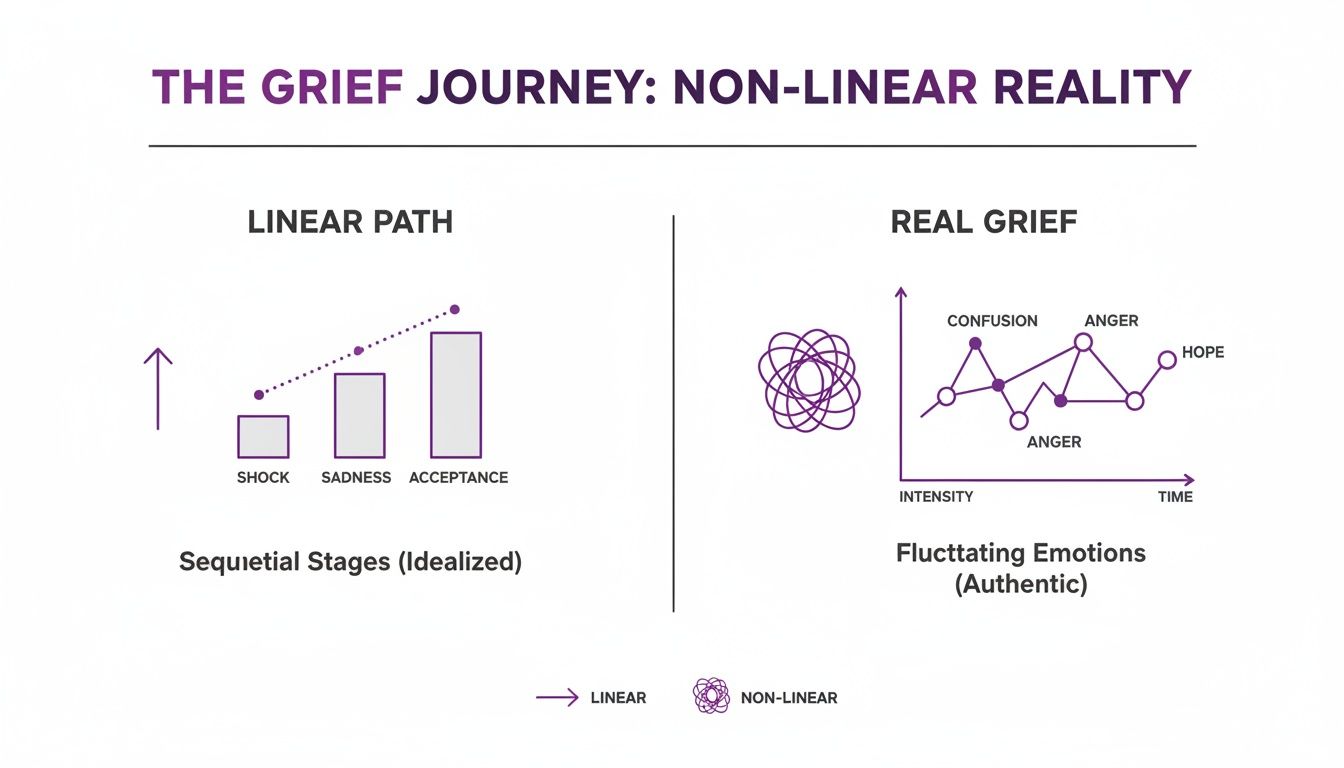
As you can see, healing isn’t a straight line. It's a messy, looping journey with good days, bad days, and a lot of unexpected turns along the way.
When Grief Becomes Prolonged
While most people find their grief softening over time, a small number of individuals get stuck in a state of intense, persistent mourning. This is often called prolonged grief disorder, a condition where the pain of loss remains completely debilitating long after the event.
Research indicates that 7% to 10% of bereaved individuals may experience this. For them, the feelings of loss are so constant and severe that they disrupt daily life.
It’s crucial to know what prolonged grief can look like. Some common signs include:
- An intense, persistent yearning for the person who died.
- Profound difficulty accepting the reality of the loss.
- A sense of emotional numbness or feeling that life has lost its meaning.
- Struggling to connect with friends, engage in hobbies, or manage responsibilities.
If your grief still feels this raw and overwhelming after a year or more, it’s a strong signal that getting professional support could make a world of difference. It's not a sign of weakness or a personal failure; it's an indication that the weight of your loss is too heavy to carry alone.
Practical Strategies for Navigating Your Grief
Knowing the stages of grief is one thing, but actually living through them is another beast entirely. When you're in the thick of a loss, all the theories in the world can feel a million miles away from the raw, immediate need for comfort. This is where practical, gentle coping strategies become your lifeline.
The goal isn't to "get over it" or speed up the process. It’s about making the journey a little more bearable, one day at a time. It’s about taking small, intentional steps that honor what you're feeling while slowly, carefully, rebuilding a sense of who you are now. Some days, just getting out of bed is a monumental win.

Cultivate Self-Compassion and Patience
First and foremost, you have to be kind to yourself. Grief is utterly exhausting, both emotionally and physically, and there is no instruction manual for doing it "right." You're going to have good days and you're going to have terrible days, and that's perfectly normal. Self-compassion is simply giving yourself permission to feel whatever comes up, without judging it.
Grief is not a problem to be solved; it is an experience to be carried. Practicing patience with your own heart is one of the most powerful forms of self-care you can offer yourself during this time.
Instead of trying to push your feelings away, just try to acknowledge them. It can be surprisingly helpful to name what you’re feeling—"Today, I feel angry," or "Right now, I just feel numb." It doesn't fix it, but it can lessen its hold on you. Your feelings are a valid response to a major loss.
Maintain Simple, Grounding Routines
When your internal world feels like it's been turned upside down, a little stability in your external world can be a powerful anchor. Simple, predictable routines can ground you in the here and now, even when your mind is lost in the storm of grief. This doesn't mean you need a rigid, complicated schedule; it's about focusing on small, consistent actions.
Here are a few simple anchors to consider for your day:
- Morning Ritual: Start your day with the same small act. Maybe it’s making a cup of tea and sitting by a window for five minutes, or just doing a few simple stretches.
- Consistent Mealtimes: Your appetite might be gone, but try to eat something small at regular times. Keeping your body fueled is crucial.
- Bedtime Routine: Grief often wreaks havoc on sleep. Winding down around the same time each night can help signal to your body that it's time to rest.
Find Meaningful Ways to Honor Memories
Creating a space to remember the one you lost can be a deeply comforting and healing practice. It helps transform grief from something that just happens to you into an active expression of ongoing love. There are countless beautiful ways to keep their memory close.
For some, it might be putting together a photo album or planting a garden in their honor. For those feeling the unique pain of losing a pet, finding thoughtful memorial gifts for pet loss can be a tender way to cherish their memory. If you're looking for more inspiration, we have a whole guide on other healthy https://revibementalhealth.com/ways-to-cope-with-grief/ that focus on remembrance and connection.
When to Seek Professional Support for Grief
Trying to navigate the pain of a major loss all on your own can feel impossible. While grief is a universal human experience, there are times when its weight becomes too much to bear alone. Reaching out for help isn't a sign that you’re failing at grieving—it's a sign of profound strength and self-awareness.
It's crucial to know the difference between the typical, gut-wrenching pain of grief and signs that you might need professional support. Intense sadness is part of the deal, but when that grief takes over your life for a prolonged period, it might be time for more structured guidance.

Recognizing When Grief Requires More Support
So, how do you know if what you're feeling has crossed a line from "normal" to something more complicated? There’s no perfect timeline, of course, but a few key signs can tell you it's time to talk to a professional.
Think about seeking help if you’re experiencing a few of these things:
- Prolonged, Intense Sadness: Months, or even a year later, the pain still feels as raw and overwhelming as it did in the beginning, with very few breaks from the intensity.
- Inability to Function: You're consistently finding it hard to manage the basics—getting to work, keeping the house in order, or even taking care of your own hygiene.
- Persistent Numbness: You feel completely detached and empty, like all the color has drained from your life and nothing matters anymore.
- Thoughts of Self-Harm: You’re thinking about hurting yourself or feel like you can't go on living without the person you lost.
- Social Withdrawal: You're pulling away from friends and family, actively isolating yourself from the people who care about you.
If this list hits a little too close to home, it’s a strong signal that grief counseling could offer the safe space and tools you need to heal. It’s more common than you might think—between 7% and 10% of bereaved adults will experience this kind of complicated grief.
What Therapy for Grief Looks Like
Therapy for grief isn't about "fixing" you; it's about giving you a safe, non-judgmental space to work through your loss and find healthy ways to cope. A good therapist will help you navigate your own unique grief journey without any pressure to feel a certain way by a certain time.
Approaches like talk therapy give you a place to unpack all the complicated feelings and memories in a supportive setting. For sudden or traumatic losses, specialized treatments like EMDR (Eye Movement Desensitization and Reprocessing) can be incredibly helpful in processing the shock. If you're thinking about taking this step, it can help to prepare for your first therapy session to ease any anxiety. Therapy simply makes the healing process feel more manageable, creating a path forward when you feel completely stuck.
Find Compassionate Grief Support in Arizona
Walking through grief can feel incredibly lonely, like you're navigating a dense fog all on your own. But you don’t have to do it alone. For those of us here in Arizona, compassionate, professional support is closer than you think. Making that first call for help is a huge act of courage and self-care—it’s like finding a safe harbor in the middle of an emotional storm.
At reVIBE Mental Health, our team is dedicated to creating a space where you can just be—a place free of judgment where you can explore every messy, complicated feeling and start to find your footing again. We get that grief is deeply personal, not some rigid formula you have to follow. Our entire approach is built around meeting you exactly where you are and offering guidance, not pressure.
Accessible Care Right in Your Community
We believe that when you’re ready for help, getting it should be simple. With several convenient offices across the Phoenix metro area, we’ve tried to remove the barrier of a long drive so you can focus on what really matters: your own healing.
Find a reVIBE Location Near You!
We currently have five locations for your convenience. (480) 674-9220
reVIBE Mental Health – Chandler
3377 S Price Rd, Suite 105, Chandler, AZ
reVIBE Mental Health – Phoenix Deer Valley
2222 W Pinnacle Peak Rd, Suite 220, Phoenix, AZ
reVIBE Mental Health – Phoenix PV
4646 E Greenway Road, Suite 100, Phoenix, AZ
reVIBE Mental Health – Scottsdale
8700 E Via de Ventura, Suite 280, Scottsdale, AZ
reVIBE Mental Health – Tempe
3920 S Rural Rd, Suite 112, Tempe, AZ
For adults in Phoenix grappling with loss, knowing about the different grief models can bring a sense of order to the chaos. It helps. But our therapists always emphasize that the journey is never a straight line. Whether you visit us in Scottsdale, Tempe, Chandler, or Paradise Valley, our goal is to help you move through your emotions without the pressure of hitting certain "stages."
With 7-day availability and a commitment to matching you with an insurance-friendly provider, we help you process your grief holistically so you can start to find your balance again. If you're curious, you can discover more about the history of the grief stages on your own time.
Taking that first step is often the hardest part of any healing journey. Our team is here to support you with the expert care you deserve, making the process feel less overwhelming from the very first call.
We're deeply committed to making mental healthcare accessible. reVIBE Mental Health offers both in-person and online sessions, we accept most major insurance plans, and we work with your schedule. Our team is ready to help you find a therapist who feels like the right fit for you.
You can learn more about our approach to grief treatment in Arizona and see how we can support you on your path.
Ready to talk? Call us today at (480) 674-9220.
Grief FAQ: Your Questions Answered
When you’re trying to make sense of loss, a lot of questions can bubble to the surface. Let's walk through some of the most common ones that come up as people navigate their healing process.
Is It Possible to Skip Some of the Stages of Grief?
Yes, absolutely. Think of the stages of grief less like a rigid checklist and more like a loose roadmap. It’s completely normal to find that some stages, like bargaining or even deep anger, just don't show up for you.
The way we understand grief today is much more fluid. We know that everyone’s path is different. The most important thing isn't to hit every "stage," but to give yourself the grace to feel whatever comes up, without judging yourself for not fitting into a specific model.
Can I Grieve a Loss That Isn't a Death?
Of course. Grief is our natural human response to any profound loss, and it’s definitely not limited to death. The pain from a divorce, the disorientation of losing a job, or even the quiet sorrow of a friendship ending can all trigger a very real grieving process.
These feelings are valid and deserve just as much attention and support as any other form of grief.
What Is the Difference Between Grief and Depression?
This is a crucial question because while grief and depression can look similar on the surface, they are fundamentally different. Grief is almost always directly tied to a specific loss. It tends to come in waves—you might have intensely sad days, but you can still experience moments of joy or fond remembrance.
Depression, on the other hand, is a much more constant and pervasive state. It casts a shadow over everything, draining your interest in activities you once loved and often bringing with it feelings of worthlessness. If your sadness feels like a heavy blanket you can't shake off and it’s disrupting your ability to function, it’s time to talk to a professional.
If any of this sounds familiar, please know you don't have to figure it all out by yourself. reVIBE Mental Health is here to provide compassionate, expert guidance through your personal grief journey. With convenient clinics in Chandler, Phoenix Deer Valley, Phoenix PV, Scottsdale, and Tempe, professional care is closer than you think.
Find a reVIBE Location Near You or give us a call at (480) 674-9220 to start the conversation. To learn more about how we can support you, please visit us at https://revibementalhealth.com.