
A therapeutic alliance is the collaborative relationship between therapist and client, built on agreed goals, agreed tasks, and an emotional bond. In adult face-to-face psychotherapy, its connection with outcomes is about r = .278, while youth psychotherapy shows a smaller but still significant association of r = .19 (research review).
You may be sitting in a first session wondering whether therapy is supposed to feel comfortable, challenging, awkward, or some combination of all three. Perhaps one therapist seemed easy to talk to, while another had similar qualifications but left you feeling misunderstood. That difference isn't imaginary, and it doesn't mean you need to find a therapist who agrees with everything you say.
The relationship has a more useful structure than "clicking." You and your therapist need a shared understanding of what you're working toward, a workable agreement about how you'll approach it, and enough trust and respect to discuss difficult experiences. Together, these elements form the therapeutic alliance, the working partnership that gives therapy a secure and purposeful foundation.
The Hidden Engine of Successful Therapy
A client named Maya begins therapy after months of anxiety and disrupted sleep. Her therapist has excellent training, but the first few sessions feel confusing. Maya talks about panic and exhaustion, while the therapist focuses on childhood experiences. Neither person has clearly agreed on the destination, and Maya leaves each appointment unsure what the treatment is meant to accomplish.
Later, Maya tells the therapist that she feels lost. The therapist listens, acknowledges the mismatch, and asks what improvement would look like in daily life. Maya says she wants to feel able to drive to work without fearing a panic attack. They agree to begin with anxiety education, practical coping skills, and gradual work on the thoughts and situations that maintain her fear. The therapist also checks whether this approach feels acceptable. That conversation changes the work because Maya now understands the plan and feels invited into it.
This is the difference between a therapist who is merely qualified and a therapeutic relationship that is actively organized around the client's needs. The alliance isn't just friendliness or a pleasant personality match. It involves collaboration, trust, shared direction, and the freedom to raise concerns when therapy doesn't feel right.
The alliance applies across concerns such as anxiety, depression, trauma, grief, and relationship difficulties. It also supports different clinical approaches, including cognitive-behavioral, humanistic, psychodynamic, and trauma-focused work. The technique matters, but the client needs to feel safe enough to use it and understand why it belongs in the treatment plan.
A practical test: You should be able to explain what you're working on, why a particular intervention is being used, and how to tell your therapist when something isn't helping.
Therapy is a process rather than a single conversation. Understanding how therapy usually progresses can make the relationship feel less mysterious, especially when early sessions involve assessment, uncertainty, or the gradual development of trust.
The Three Pillars of a Strong Therapeutic Alliance
Edward Bordin's 1979 paper is usually credited with shaping the modern, transtheoretical concept of the alliance. His framework moved the idea beyond psychoanalytic theory and made it useful across therapy types, including cognitive-behavioral, humanistic, and later online psychotherapy (historical and research overview).
A simple way to understand Bordin's model is to think of therapy as a road trip. You and your therapist are traveling together, but a successful journey requires more than getting into the same car.
Agreement on goals
Goals are the destination. They describe what you hope will change through therapy, such as reducing panic, processing grief, improving communication, or feeling less overwhelmed at work.
Your goal doesn't need to sound clinical. “I want to stop feeling like I'm failing everyone” may be more useful than a formal label. A therapist can help translate that concern into practical treatment aims, but you should recognize your priorities in the plan.
Problems arise when the destination belongs only to the therapist. If you want help managing present-day anxiety but feel pushed toward a topic you aren't ready to address, the alliance may weaken even if the therapist has a reasonable clinical explanation.
Agreement on tasks
Tasks are the route and the vehicle. They include the conversations, exercises, coping strategies, exposure work, cognitive restructuring, EMDR preparation, behavioral experiments, or other methods used to pursue your goals.
Agreement doesn't mean you must understand every technique immediately or that therapy will always feel easy. It means your therapist explains the purpose of the work and considers your response. You can ask, “How does this connect to what I want to change?” or “What should I expect if we try this?”
The emotional bond
The bond is the human connection that makes difficult work possible. It includes trust, mutual respect, empathy, and the sense that your therapist is paying attention to your experience rather than forcing you into a preset model.
A strong bond doesn't require constant comfort. You may feel challenged, embarrassed, angry, or uncertain. The important question is whether you can bring those reactions into the room without expecting dismissal or punishment. If one pillar becomes unstable, the whole journey can slow down, which is why therapists should welcome feedback about the relationship itself.
What the Research Says About Alliance and Outcomes
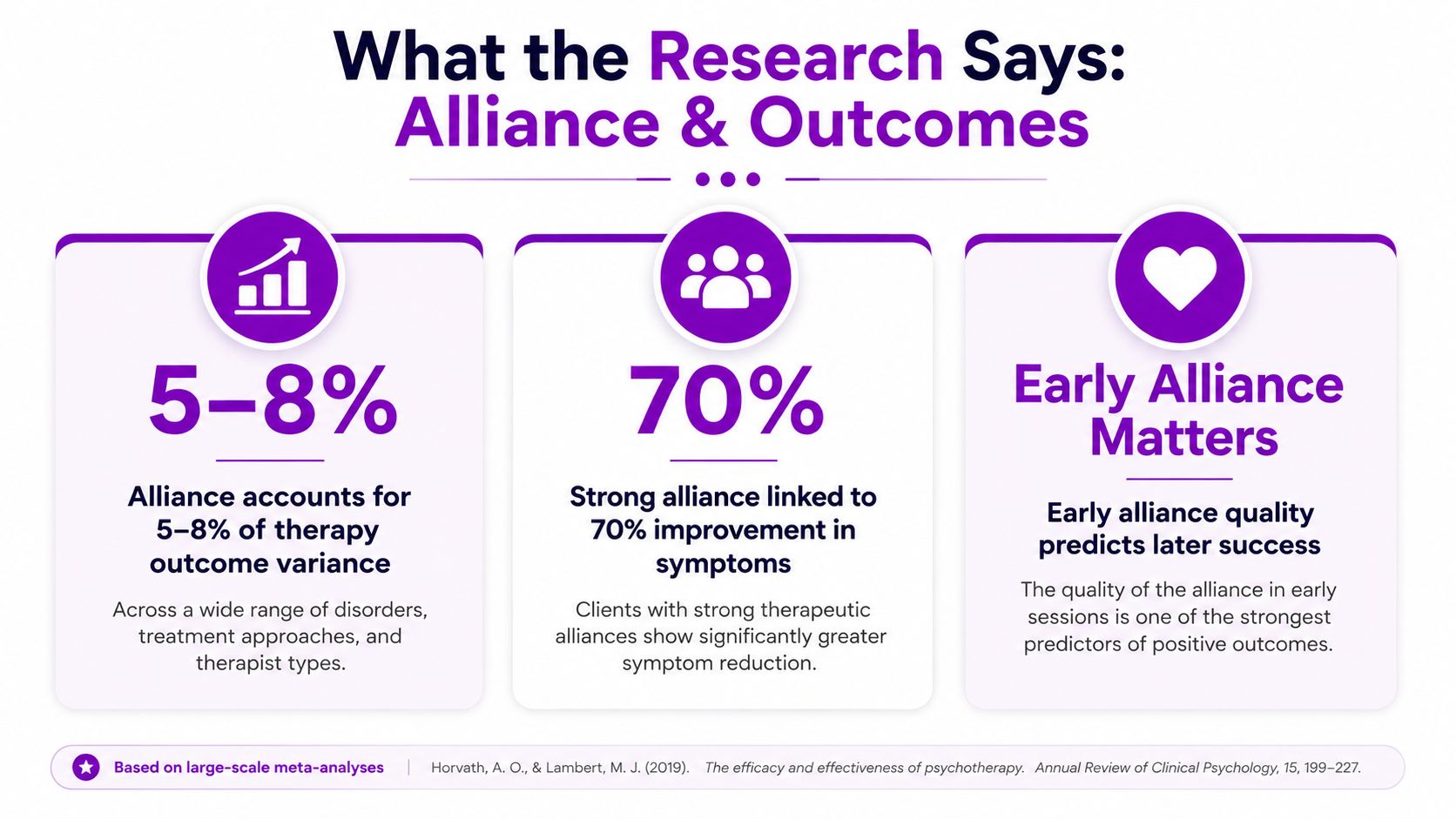
A client may leave therapy feeling understood, yet research examines more than that impression. The alliance is measured as a treatment factor, and studies consistently connect its strength with psychotherapy outcomes. A large meta-analysis combined 295 independent studies involving more than 30,000 patients, published from 1978 to 2017, and found an alliance-outcome relationship of about r = .28 (World Psychiatry review). In everyday terms, people who report stronger working relationships with their therapists also tend to report better results.
A separate 2018 meta-analysis of adult, face-to-face psychotherapy found an overall association of r = .278, with a 95% confidence interval from .256 to .299, corresponding to d = .579. Only 2% of the 295 effect sizes were negative, suggesting that a constructive alliance is generally helpful rather than linked to unpredictable outcomes (meta-analysis abstract).
Why correlation still matters
These findings do not mean that a strong alliance guarantees recovery or that the relationship alone causes every improvement. Outcomes also reflect a client's circumstances, symptoms, motivation, access to care, timing, treatment approach, and other factors that cannot be captured by one relationship score.
The consistent association across settings and treatment approaches is still meaningful. It supports the idea of the alliance as a common factor, one that contributes to therapy even when the specific techniques differ. The same World Psychiatry review notes earlier research involving 24 studies and 1,148 patients, which found an aggregate correlation of .26, described as approximately 7% of outcome variance.
Research with younger clients points in the same direction. A meta-analysis of 28 studies and 2,419 participants found a weighted effect of r = .19, equivalent to d = 0.39, as reported in the same PubMed-reviewed study.
The practical lesson is reassuring: you do not have to dismiss your experience as “just a vibe.” Feeling understood, included in decisions, and able to work toward shared goals is clinically relevant information. This applies whether sessions happen in an office or through teletherapy, because the alliance concerns how the work is experienced, not only where the conversation takes place.
Signs of a Strong Versus Weak Therapeutic Alliance
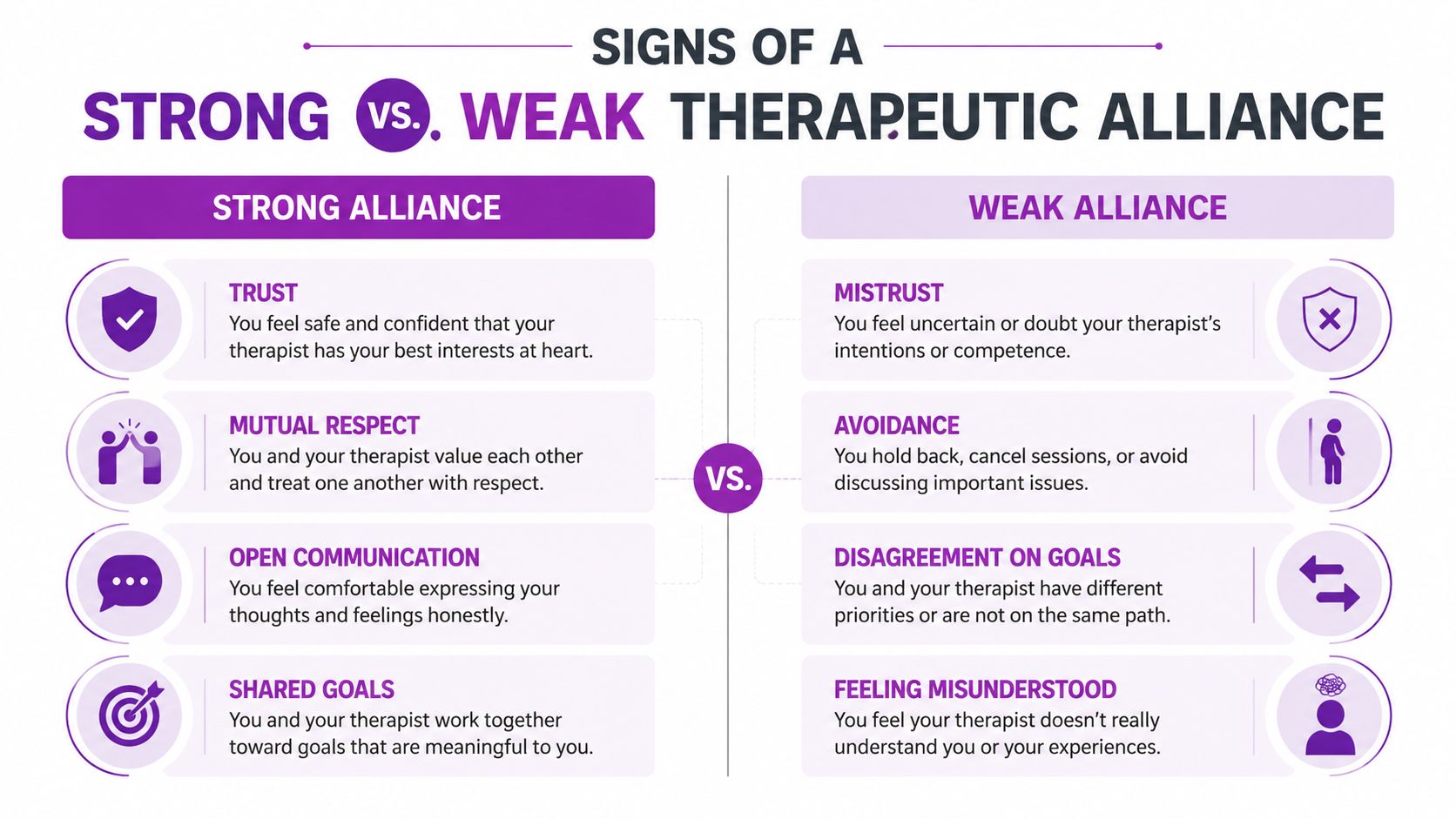
A strong alliance often feels like shared ownership of the work. You may not agree with every interpretation, but you understand the direction and can ask questions without feeling that you've disrupted the relationship.
| Strong alliance | Weak alliance |
|---|---|
| You feel heard without being judged. | You regularly feel misunderstood or dismissed. |
| You understand why an intervention is being suggested. | The process feels confusing or unexplained. |
| You and your therapist set an agenda together. | The therapist repeatedly pushes an agenda that doesn't fit your needs. |
| You can discuss difficult subjects at a manageable pace. | You dread sessions or feel unable to speak honestly. |
| Disagreements can be named and explored. | Tension is ignored, denied, or treated as your fault. |
These signs aren't a scorecard that determines whether therapy is working after one uncomfortable appointment. Vulnerable conversations can feel awkward, and effective therapy sometimes challenges familiar ways of thinking. A difficult session may still belong to a healthy alliance if you can understand what happened and return to the shared work.
When the relationship feels strained
A weak alliance doesn't automatically mean your therapist is unethical, unskilled, or uncaring. You may have different communication styles, expectations, cultural perspectives, or preferences about structure. The problem may be a poor fit rather than a bad provider.
Try naming the experience directly: “I'm not sure we're focusing on what matters most to me,” or “I felt confused about why we moved to that exercise.” A responsive therapist should take the concern seriously, clarify the reasoning, and work with you on an adjustment.
You don't have to choose between silent endurance and immediately leaving. When it feels safe, asking for a repair conversation can give both of you useful information.
If the therapist becomes defensive, repeatedly ignores your goals, violates boundaries, or makes you feel unsafe, seeking another provider is reasonable. Your instincts deserve attention, especially when the pattern continues rather than improving through honest discussion.
Building the Alliance in Teletherapy and Online Sessions
A screen changes the setting, not the basic ingredients of the alliance. You still need shared goals, agreement about the work, and a relationship that feels respectful and emotionally safe.
Video sessions can create friction. Delayed audio, an unstable connection, limited camera framing, or difficulty reading facial expressions may interrupt the rhythm of conversation. Your home environment can also affect privacy. On the other hand, some clients find it easier to speak from a familiar space or access care without travel.
A 2024 meta-analysis found a small but significant alliance-outcome association in teletherapy, with an average weighted effect size of 0.15. The relationship was weaker than typically reported in in-person treatment, but it was larger when alliance was measured later in therapy and when outcomes came from the patient's perspective (teletherapy meta-analysis).
Making virtual connection more intentional
You can support the working relationship by choosing a private location, using headphones when appropriate, and telling your therapist when technology interrupts your attention. Looking toward the camera at times can help communicate presence, although you shouldn't feel pressured to maintain constant eye contact.
Your therapist can strengthen the online bond by checking your understanding, naming emotional shifts, and leaving room for feedback instead of assuming silence means agreement. A short question such as “How is this format feeling for you today?” can identify problems before they become disengagement.
Online care can be a meaningful option when the therapist and client treat the medium as part of the work. If you're weighing virtual and in-person treatment, learn more about online therapy and consider which environment helps you feel most focused, private, and able to participate.

Practical Steps to Strengthen Your Therapeutic Relationship
You aren't responsible for creating the entire alliance. The therapist carries professional responsibility for safety, boundaries, responsiveness, and competent care. Still, your participation can make the partnership clearer and more useful.
Name what you want from therapy. You can bring a broad concern, a specific symptom, or uncertainty about where to begin. Tell the therapist what prompted you to seek help and what you hope might feel different.
Share expectations and fears. If you're worried about being judged, pressured, misunderstood, or asked to discuss trauma too quickly, say so when you can. This gives the therapist a chance to adapt rather than guess.
Ask about the method. When an exercise or question confuses you, ask what it is designed to address. Understanding the purpose can help you decide whether the task fits your goals.
Offer feedback early. You might say, “That strategy doesn't feel realistic this week,” or “I need more structure in our sessions.” Specific feedback is easier to respond to than a general feeling that therapy isn't working.
Repairing a rupture
Misunderstandings happen. A therapist may miss an important cue, you may withdraw after feeling exposed, or you may disagree about the pace. The alliance becomes stronger when both people can recognize the strain, take responsibility where appropriate, and agree on a way forward.
If your work includes trauma, you may also benefit from a practical trauma aware coaching guide that discusses how support can respect safety, choice, and a person's lived experience. Coaching isn't a substitute for mental health treatment, but the resource can help clarify what trauma-sensitive support should feel like.
Finding the Right Fit for Your Mental Health Journey
The right therapist isn't the person with the most impressive biography. Look for someone who listens carefully, explains the treatment process, respects your pace, and treats your goals as part of the clinical plan. This guide to choosing a therapist can help you think through fit, communication style, treatment preferences, and practical needs.
The alliance is measurable, connected with outcomes, and open to repair. At reVIBE Mental Health, an integrated team of therapists and licensed psychiatric professionals provides talk therapy, EMDR, psychiatry, and medication management through in-person and secure online sessions. The practice serves clients across Chandler, Phoenix Deer Valley, Phoenix PV, Scottsdale, and Tempe, with welcoming environments designed to feel more like home than a clinic.
Find a reVIBE Location Near You!
We currently have five locations for your convenience. (480) 674-9220
reVIBE Mental Health – Chandler
3377 S Price Rd, Suite 105, Chandler, AZ
reVIBE Mental Health – Phoenix Deer Valley
2222 W Pinnacle Peak Rd, Suite 220, Phoenix, AZ
reVIBE Mental Health – Phoenix PV
4646 E Greenway Road, Suite 100, Phoenix, AZ
reVIBE Mental Health – Scottsdale
8700 E Via de Ventura, Suite 280, Scottsdale, AZ
reVIBE Mental Health – Tempe
3920 S Rural Rd, Suite 112, Tempe, AZ
If you're looking for care that treats collaboration and trust as part of the treatment itself, visit reVIBE Mental Health to explore therapy, EMDR, psychiatry, medication management, and secure online appointments. Call (480) 674-9220 or contact the team to begin finding a provider whose approach fits your goals and circumstances.