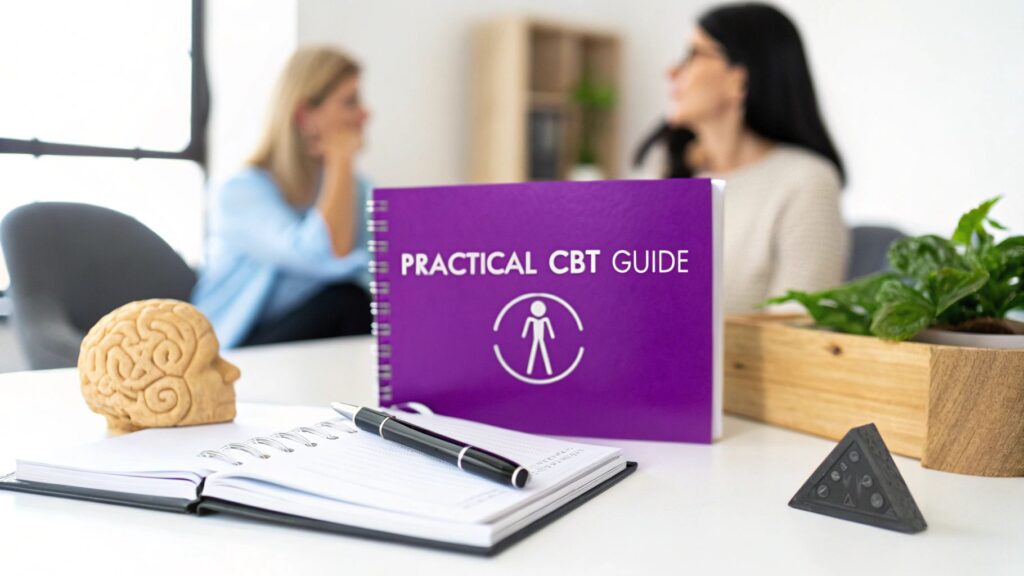
Ever heard of Cognitive Behavioral Therapy, or CBT? It’s a practical, evidence-based approach to therapy built on a simple yet powerful idea: your thoughts, feelings, and actions are deeply connected. By learning to spot and shift unhelpful thinking patterns, you can directly change how you feel and what you do, leading to real, lasting improvements in your life.
Demystifying Cognitive Behavioral Therapy
Think of it like this: a negative thought pops into your head. That thought triggers a difficult feeling, which then prompts you to act in a certain way. Often, that action just ends up confirming the original negative thought, and the cycle continues.
CBT provides the tools to interrupt that cycle.
Unlike some therapies that focus heavily on your past, CBT is very much about the here and now. It’s less about digging for the roots of a problem and more about giving you practical skills to handle the challenges you're facing today. The entire point is to move beyond just talking about issues and start developing concrete strategies to overcome them.
The 3 Core Components of CBT
At its heart, CBT is all about understanding the relationship between three key elements. Getting a handle on how they influence each other is the first real step toward taking back control.
- Thoughts (Cognitions): These are your beliefs, assumptions, and internal chatter about yourself and the world. CBT teaches you to catch those automatic thoughts that aren't serving you well.
- Feelings (Emotions): These are the emotions that bubble up as a direct result of your thoughts. If you think, "I'm going to mess this up," you'll almost certainly feel anxious or discouraged.
- Actions (Behaviors): This is what you do in response. That feeling of anxiety might lead you to avoid a social event, which means you never get the chance to prove that initial negative thought wrong.
To see this in action, let's break down how these pieces fit together.
The CBT Triangle At a Glance
| Component | What It Represents | Everyday Example |
|---|---|---|
| Thoughts | Your internal monologue, beliefs, and interpretations. | "I'm so awkward. No one at this party will want to talk to me." |
| Feelings | The emotions that arise directly from your thoughts. | Anxiety, self-consciousness, sadness. |
| Behaviors | The actions you take based on your thoughts and feelings. | Standing alone in a corner, avoiding eye contact, or leaving early. |
This simple example shows how a single thought can set off a chain reaction. CBT helps you intervene at any point in that triangle to create a better outcome.
It's a common misconception that CBT is about forcing yourself to "just think positive." It's not. The real work is in learning to look at your thoughts with a more balanced and realistic eye, almost like a detective examining the evidence.
This structured and collaborative process helps you become your own therapist over time. By learning to spot and challenge these patterns, you’re not just solving a problem for today—you're building resilience and skills that will serve you for years to come. Here at reVIBE Mental Health, our therapists are experts in guiding you through this process to help you find that lasting relief.
The Core Principles That Make CBT Effective
Cognitive Behavioral Therapy isn't like the old-school therapy you see in movies, where you lie on a couch and talk about your childhood for years on end. It’s built on a foundation of clear, practical principles designed to help you with what's happening right now. Instead of digging endlessly into the past to find the root of a problem, CBT gives you the tools to manage the challenges you're facing today.
This "here and now" focus is incredibly empowering. It's all about what you can control and change, making the entire process feel proactive and dynamic. The goal isn't just to talk about your struggles; it's to actively build new skills to overcome them. At its heart, CBT operates on a simple but powerful idea: our emotional difficulties are often fueled by learned patterns of unhelpful thinking and behavior.
A Collaborative and Structured Partnership
One of the first things you'll notice about CBT is that it's a team effort. Your therapist isn't a passive listener; they're more like a coach or a guide, working right alongside you. Together, you’ll set clear, measurable goals for what you want to achieve, which gives your sessions a real sense of direction and purpose.
This structure means you won't just be talking aimlessly. Each session is designed to work on specific skills and strategies that are directly tied to your goals. This collaborative approach is key because it puts you in the driver's seat of your own healing journey.
CBT is designed to be a temporary support system. The ultimate objective is to equip you with the knowledge and skills to become your own therapist, empowering you to handle future challenges with confidence long after your sessions have ended.
Skill-Building Over Symptom Management
At its core, CBT is all about building skills. It teaches you how to catch, question, and change the distressing thoughts and behaviors that are holding you back. Think of it like learning to play an instrument or a new sport—it takes guidance, patience, and most importantly, practice.
Let's take a common struggle like procrastination. Someone might be stuck on the thought, "If I can't do this perfectly, there's no point in starting." This all-or-nothing thinking creates a ton of pressure and anxiety, which naturally leads to avoiding the task altogether.
You can see the cycle pretty clearly:
- The Unhelpful Thought: "This has to be perfect."
- The Resulting Feeling: Overwhelming anxiety.
- The Consequent Behavior: Putting it off (procrastination).
CBT gives you a logical framework to break this loop. You learn to challenge that rigid, perfectionistic thought, find ways to calm the anxiety, and take small, manageable steps to just get started. Once you change your behavior, you start collecting proof that the original thought wasn't true, which builds a new, more positive cycle. This process shows how CBT transforms you from a passive recipient of your thoughts into an active participant in shaping your own emotional health.
Practical CBT Techniques You Can Use
CBT isn't just about talking; it’s about doing. It gives you a practical, hands-on toolkit to actively challenge the mental and behavioral habits that hold you back. Think of it as learning to become your own therapist—you gain the skills to observe your mind and make real changes in your life.
This focus on actionable strategies is exactly why CBT has become a cornerstone of modern mental healthcare. Its growth is a testament to the shift toward evidence-based, skill-building approaches. In fact, the global CBT market was valued at over USD 7.5 billion in 2025 and is expected to soar to USD 93.2 billion by 2034, showing just how vital this therapy has become. You can discover more insights about this growing market on Biospace.
So, what are these techniques? Let's break down some of the most common and effective ones.
Cognitive Restructuring: Changing Your Thoughts
This is a cornerstone of CBT. Cognitive restructuring teaches you to catch, challenge, and change those unhelpful, often automatic, thoughts that pop into your head. It’s not about forcing yourself to "think positive"—it’s about learning to be more realistic and balanced.
The most common tool for this is the thought record. It’s a simple but powerful way to slow down and get some distance from your thinking.
Here’s how it works:
- Step 1: Situation: Describe the event that triggered a strong emotion. What happened?
- Step 2: Automatic Thought: What was the very first thing that went through your mind?
- Step 3: Emotion: How did that thought make you feel? (e.g., anxious, sad, angry).
- Step 4: Evidence: This is the crucial part. List the evidence for and against your automatic thought. Be a detective.
- Step 5: New Thought: Based on your evidence, craft a more balanced, helpful thought.
Let's say you have a big presentation at work. Your automatic thought is, "I'm going to bomb this, and everyone will think I'm an idiot." Using a thought record, you’d find evidence against that thought ("I've prepared for weeks," "My boss said my last report was great") and create a new thought like, "I'm nervous, but I'm well-prepared. It’s okay to be imperfect."
Behavioral Experiments: Testing Your Beliefs
This is where you take your negative beliefs and treat them like scientific hypotheses. Instead of just accepting them as fact, you design small, real-world experiments to see if they hold up.
The idea is to become your own scientist. You gather real data about your assumptions instead of letting fear-based beliefs run the show.
For example, someone with social anxiety might believe, "If I try to talk to someone at a party, they'll find me boring and walk away." A behavioral experiment could be as simple as going to a friend's get-together with a single goal: ask one person a question about their weekend. The result—whether it's a short chat or a longer conversation—gives you actual evidence to work with, which is far more powerful than just thinking about it.
Other Powerful CBT Tools
Beyond these two, a CBT therapist has many other tools they can tailor to your specific needs. Each one is designed to help you change what you do in order to influence how you think and feel.
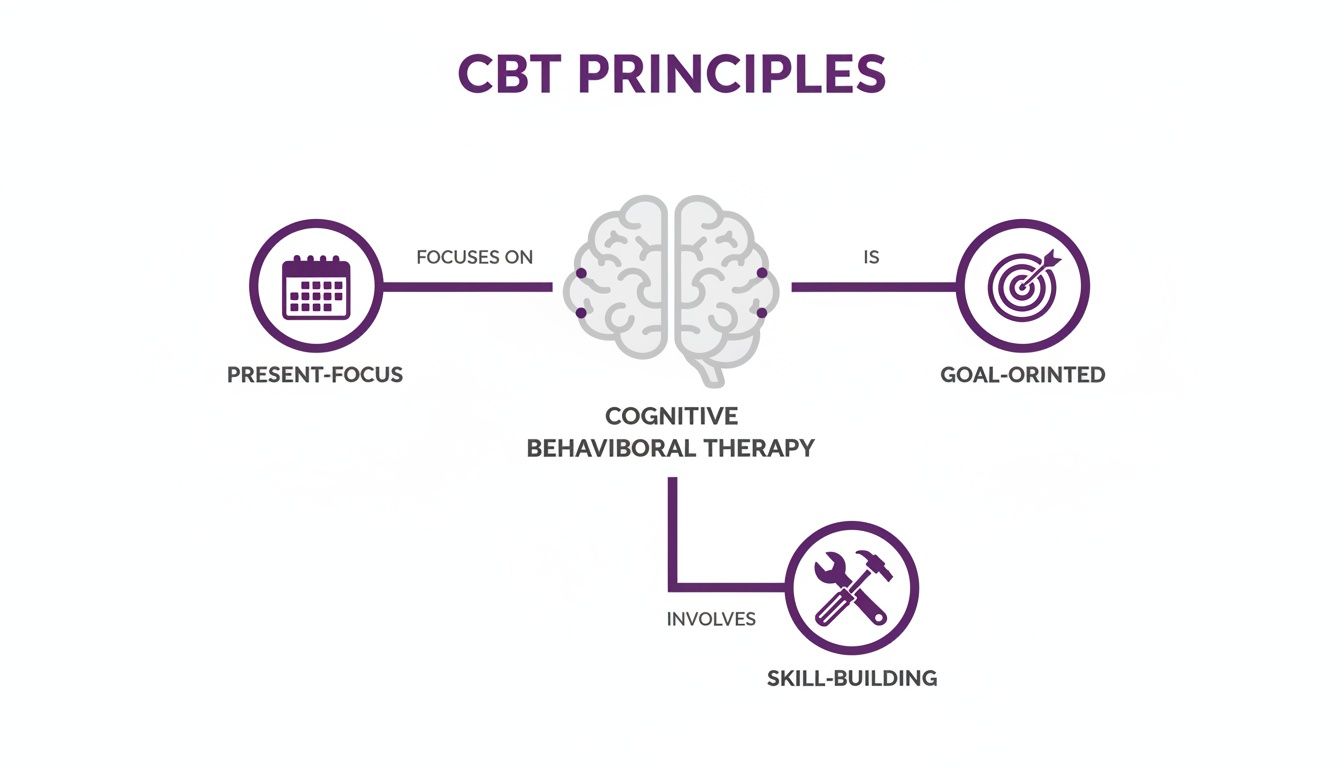
These techniques are all guided by a few core principles: CBT is focused on the present, it’s collaborative and goal-oriented, and it’s all about building skills you can use for the rest of your life.
Here are a couple more key techniques:
- Exposure Therapy: This is the gold standard for treating phobias and many anxiety disorders. It involves gradually and safely facing the things you fear in a controlled way. Over time, your brain learns that the feared outcome doesn't happen, and the fear response fades.
- Activity Scheduling: Especially helpful for depression, this technique combats the tendency to withdraw and isolate. You and your therapist will work together to intentionally plan enjoyable, rewarding, or meaningful activities into your week to boost your mood and energy.
What Mental Health Conditions Can CBT Help With?
Cognitive Behavioral Therapy isn't just a buzzword; it's one of the most thoroughly researched and validated forms of psychotherapy out there. Its power lies in its practical, hands-on approach. Think of it less like a one-size-fits-all prescription and more like a flexible toolkit that can be customized to tackle the specific thought and behavior patterns fueling different mental health struggles.
Whether you're dealing with anxiety, depression, or more complex issues, CBT offers a clear, structured path forward. It works by targeting the very cognitive and behavioral cycles that keep people feeling trapped, which is why it’s so trusted by therapists and clients looking for real, sustainable change.
Anxiety and Depressive Disorders
When it comes to treating anxiety and depression, CBT is widely considered the gold standard. These are two of the most common mental health challenges globally. According to the World Health Organization, anxiety affected over 301 million people in 2019, and depression wasn't far behind, impacting another 264 million. These staggering figures show just how critical it is to have effective, evidence-based treatments readily available. You can read the full analysis on mental health trends to get a better sense of the global scale.
For anxiety, CBT helps you pinpoint and dismantle the catastrophic thoughts that feed worry, panic, and fear. Using techniques like exposure therapy, a therapist guides you in safely and gradually confronting feared situations, which effectively rewires your brain's fear response. This is especially true for social anxiety, where structured guidance is key. If you want to learn more, this guide on cognitive behavioural therapy for social anxiety is an excellent resource.
With depression, the focus shifts to breaking the grip of negative thinking and the behavioral withdrawal that often comes with it. A core CBT technique here is behavioral activation. It's all about gently encouraging you to re-engage with activities that bring you a sense of reward or pleasure. By changing what you do first, your mood and thoughts naturally begin to lift.
OCD and Trauma-Related Conditions
The structured nature of CBT also makes it a powerhouse for treating conditions like Obsessive-Compulsive Disorder (OCD) and Post-Traumatic Stress Disorder (PTSD).
For OCD, a highly specialized form of CBT known as Exposure and Response Prevention (ERP) is the leading treatment. This involves facing obsessive thoughts head-on without engaging in the usual compulsive rituals. It's tough work, but it’s incredibly effective at breaking the powerful bond between the obsession and the compulsion.
When working with PTSD, a CBT therapist helps you process traumatic memories and challenge the distorted beliefs that often follow a traumatic event, like feelings of self-blame or the idea that the world is no longer safe. By restructuring these core thoughts and gradually reducing avoidance behaviors, you can reclaim your sense of control and safety.
What to Expect in Your First CBT Session
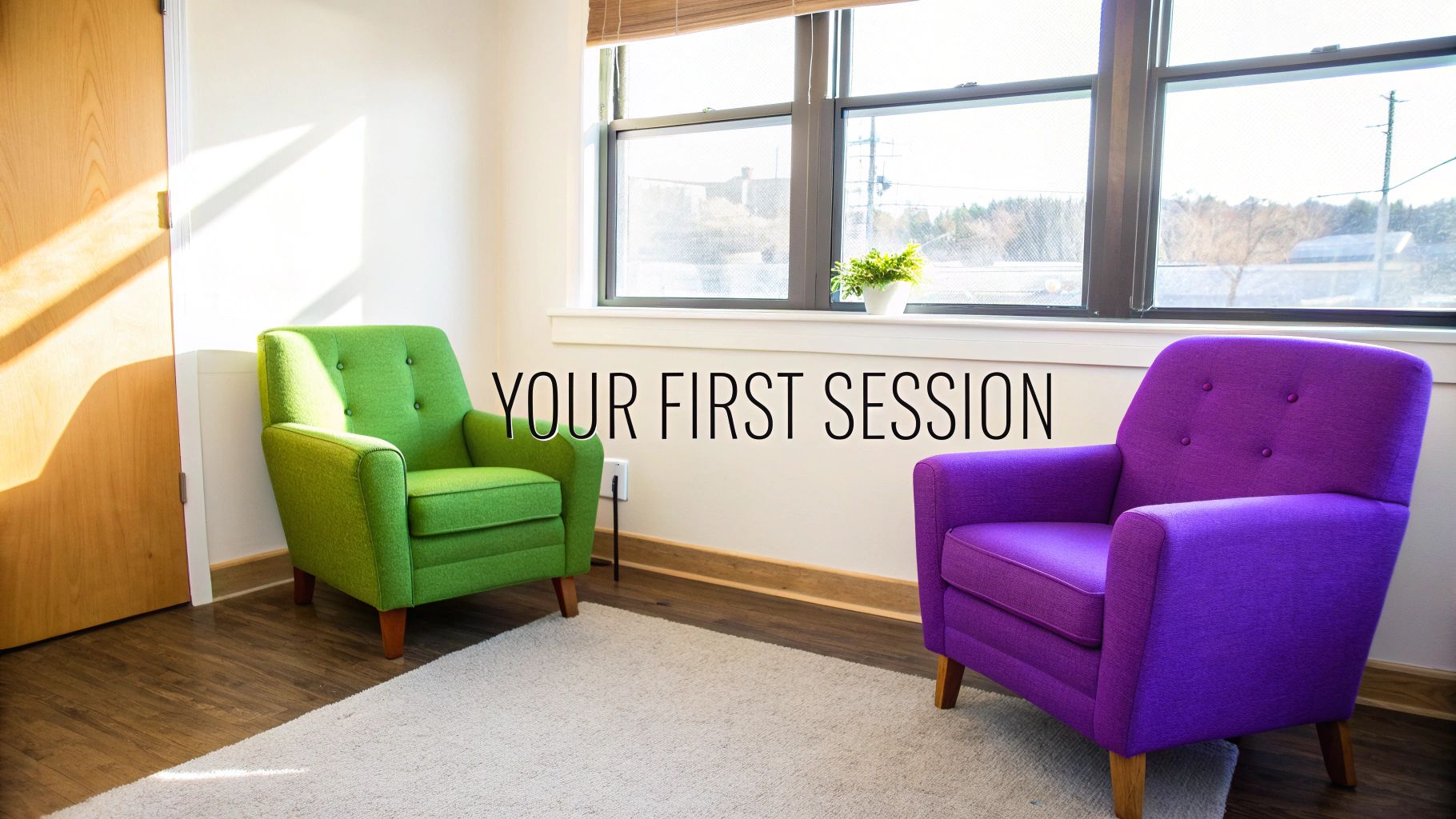
Walking into your first therapy appointment can be nerve-wracking. It’s totally normal to feel a mix of hope and apprehension. But when it comes to Cognitive Behavioral Therapy, that first session isn't about diving into the deep end; it's about building a solid foundation, getting to know each other, and making sure you feel comfortable.
Think of this initial meeting as a structured, non-judgmental conversation. The therapist’s main job is to listen and understand what brought you in. They’ll ask about the challenges you're facing, a bit about your background, and what you’d like to see change in your life.
Building the Therapeutic Partnership
Your first session is really a two-way interview. You're checking to see if the therapist is the right fit for you, and they're learning how they can best help you move forward. This sense of teamwork is at the very heart of CBT.
Together, you’ll start to sketch out some initial, meaningful goals. This isn't about fixing everything overnight. It's about agreeing on a clear direction. What does "better" actually look and feel like for you?
Your first session is a safe space to share your story. The focus is on creating a roadmap for therapy that feels clear, manageable, and tailored specifically to you.
Your therapist will also give you a primer on the CBT model itself—explaining the powerful link between our thoughts, feelings, and actions. This gives you the "why" behind the work you'll be doing together. They’ll outline what future sessions will look like and, of course, answer any questions you have. No question is too small.
Setting the Stage for Success
By the time you walk out of that first meeting, the goal is for you to have a clear idea of the next steps. You should leave feeling heard, hopeful, and like you have a real partner in this process.
That relationship you build with your therapist is one of the most powerful tools for change. At reVIBE Mental Health, our team is full of professionals who are not only experts in CBT but are also genuinely committed to creating a supportive, collaborative space. A psychiatric mental health practitioner can be a vital part of your care team, helping build a plan that truly fits your life. From day one, we want you to feel confident in the path ahead.
Find a CBT Therapist in Your Arizona Community
Deciding to start therapy is a big step, and finding the right person to guide you is probably the most crucial part of the journey. Now that you know what cognitive behavioral therapy is, you can look for a professional who specializes in this practical, evidence-based approach. The relationship you have with your therapist is the foundation for success, so it's essential to find someone you genuinely connect with in a comfortable setting.
At reVIBE Mental Health, our entire team is dedicated to providing expert CBT that helps you reach your personal goals. We’re passionate about making top-tier mental health care easy to access across the Phoenix metro area, so you can find support right in your own community.
Ready to talk? Just give our team a call at (480) 674-9220 to get the conversation started.
Your Path to Expert CBT in Arizona
The first step toward making real, lasting change is connecting with a qualified therapist who gets it. Our integrated team of specialists collaborates to build a plan that is truly yours—one that addresses your unique challenges and aspirations.
To see who might be the best fit for you, we invite you to explore our list of qualified therapists and read about their individual areas of expertise.
Taking the step to find a therapist is an investment in yourself. The right partnership can provide the tools and support needed to navigate challenges and build a more resilient future.
If you’re curious about how CBT can be adapted for specific conditions, you might find this guide on finding a CBT therapist for ADHD and Autism helpful.
We have five convenient locations to serve you throughout the valley:
- Chandler: 3377 S Price Rd, Suite 105, Chandler, AZ
- Phoenix Deer Valley: 2222 W Pinnacle Peak Rd, Suite 220, Phoenix, AZ
- Phoenix PV: 4646 E Greenway Road, Suite 100, Phoenix, AZ
- Scottsdale: 8700 E Via de Ventura, Suite 280, Scottsdale, AZ
- Tempe: 3920 S Rural Rd, Suite 112, Tempe, AZ
Common Questions About CBT
Thinking about therapy brings up a lot of questions. That’s completely normal. Getting clear answers about the nuts and bolts of Cognitive Behavioral Therapy can make the idea of starting feel a lot less intimidating and put you in the driver's seat. Let's walk through some of the things people often ask.
How Long Does CBT Treatment Last?
CBT isn't the kind of therapy that goes on forever. It’s designed to be focused and goal-oriented. While everyone's journey is different, a standard course of CBT typically falls somewhere between 5 and 20 sessions.
The whole point is to give you a set of practical tools that you can carry with you long after therapy ends. Think of it as learning to be your own therapist, so you feel equipped to handle challenges on your own down the road.
Is CBT Effective for Children and Teenagers?
Yes, absolutely. In fact, CBT is one of the most well-researched and effective therapies for kids and teens dealing with everything from anxiety and depression to behavioral challenges. A good therapist knows how to make the concepts click for younger minds.
They'll adapt the techniques to be more engaging by using things like:
- Games and creative activities to make big ideas easier to grasp.
- Stories and real-world examples that a young person can actually relate to.
- Hands-on exercises for practicing new ways to cope with tough feelings.
The skills they learn aren't just for now; they help build a foundation of resilience that can support them for the rest of their lives.
Does CBT Always Involve Medication?
CBT itself is a form of psychotherapy, or "talk therapy," so your therapist won't be prescribing medication. For many people, CBT works incredibly well all on its own.
That said, for some people, especially when symptoms are more severe, research has shown that combining CBT with medication can be a powerful one-two punch. This is always a conversation between you, your therapist, and a psychiatrist or medical doctor. It’s about building a complete support system that’s right for your specific needs.
What If I Feel Like CBT Is Not Working for Me?
It’s so important to remember that no single therapy works for everyone. If you get a few sessions in and feel like CBT just isn't clicking, or you’re not seeing the progress you'd hoped for, the best thing you can do is bring it up with your therapist.
An open, honest conversation is your best tool. Sometimes a simple adjustment is all it takes. Other times, a different approach might be a better fit. While CBT is fantastic for its structured approach, something like EMDR might be more effective for processing specific traumatic memories. You can learn more about how EMDR therapy can help with anxiety in our detailed guide. A good therapist will work with you to find the path that truly helps you move forward.
Find a reVIBE Location Near You!
We currently have five locations for your convenience. (480) 674-9220
reVIBE Mental Health – Chandler
3377 S Price Rd, Suite 105, Chandler, AZ
reVIBE Mental Health – Phoenix Deer Valley
2222 W Pinnacle Peak Rd, Suite 220, Phoenix, AZ
reVIBE Mental Health – Phoenix PV
4646 E Greenway Road, Suite 100, Phoenix, AZ
reVIBE Mental Health – Scottsdale
8700 E Via de Ventura, Suite 280, Scottsdale, AZ
reVIBE Mental Health – Tempe
3920 S Rural Rd, Suite 112, Tempe, AZ
At reVIBE Mental Health, our team is here to answer all your questions and help you find the right therapeutic path. We believe in creating a personalized plan that fits your life and goals. To learn more or schedule a consultation, visit us at https://revibementalhealth.com.