
You may be considering therapy while carrying a difficult question: will this person understand what happened to you, or will you have to defend every reaction, explain every fear, and surrender control of the conversation? A trauma-informed approach begins by taking that concern seriously. It changes the care environment so you can participate in healing without being pressured, blamed, or unexpectedly pushed beyond what feels manageable.
Introduction to Trauma-Informed Care
Trauma-informed care is a way of providing services that recognizes how traumatic experiences can affect a person's emotions, body, relationships, behavior, and ability to trust. Instead of viewing distress only as a problem to eliminate, the provider considers whether a person's responses may have developed as ways of surviving overwhelming circumstances.
That distinction matters in a therapy office, doctor's appointment, school, or workplace. A rushed intake, unexplained procedure, harsh tone, forced disclosure, or lack of privacy can make someone feel powerless again. Trauma-informed care replaces those avoidable surprises with clear communication, consent, collaboration, and meaningful choices.
Trauma exposure is widespread. A World Health Organization summary cited in recent health literature found that 70.4% of respondents across 24 countries reported lifetime trauma exposure, averaging 3.2 traumas per person. In the United States, a national sample found that nearly 90% of adults reported at least one traumatic event exposure (health literature summarizing global and U.S. trauma exposure). These findings help explain why trauma-informed care applies far beyond specialized trauma clinics.
Trauma-informed care doesn't require you to share every detail of your history. It requires services to operate in ways that respect the possibility of trauma and reduce unnecessary harm.
For people exploring flexible support, a resource on virtual trauma informed care in PA can also help clarify how safety, privacy, and collaboration may be maintained through online care.
Origins and Evolution of Trauma-Informed Care
Trauma-informed care developed from a growing recognition that adversity can shape health over time. Earlier service models often focused on identifying symptoms and correcting behavior. The emerging trauma-informed perspective added a key question: what experiences might help explain the person's current response, and how can the system avoid causing further distress?
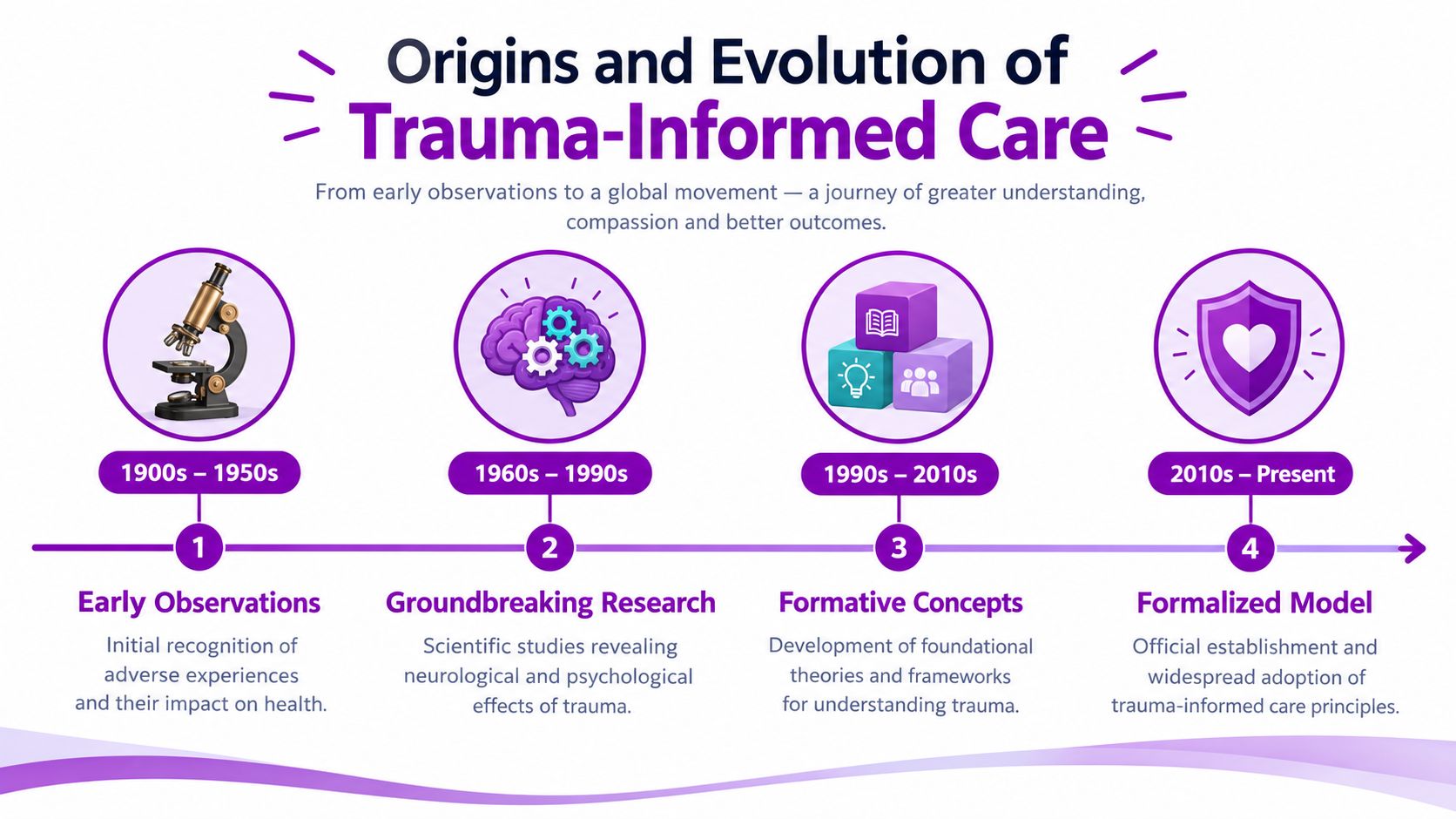
A major foundation was the Adverse Childhood Experiences, or ACE, Study, conducted by Kaiser Permanente and the CDC from 1995 to 1997. Researchers surveyed about 17,000 adult HMO members in San Diego. The study helped establish a dose-response relationship between childhood adversity and later health outcomes. Compared with people who reported no ACEs, people with four or more ACEs were twice as likely to have heart disease or cancer, four times as likely to develop emphysema or chronic bronchitis, and 12 times as likely to have attempted suicide (review of the ACE Study and trauma-informed care's development).
From research to system change
Trauma-informed care emerged as a formal practice response in the early 2000s, building on this evidence base. The model moved beyond treating trauma as an isolated diagnosis and began addressing the policies, environments, and relationships that influence whether people feel safe enough to accept help.
That shift also affected clinical education and organizational planning. A provider might still assess depression, anxiety, substance use, or post-traumatic stress, but the provider also considers how the intake process, language, physical setting, and treatment plan affect the client's sense of control. This is one reason trauma-informed care can complement specialized approaches such as the structural dissociation model, rather than replacing diagnosis or evidence-based treatment.
The historical lesson is practical: trauma-informed care isn't a softer communication style. It's a system-wide commitment to safety, control, agency, and avoiding retraumatization.
Core Principles of Trauma-Informed Care
SAMHSA defines trauma-informed care as an approach in which a program, organization, or system recognizes trauma's widespread impact, identifies signs and symptoms in clients, families, staff, and others, applies trauma knowledge to policies and practices, and actively resists retraumatization (SAMHSA's trauma-informed approaches).
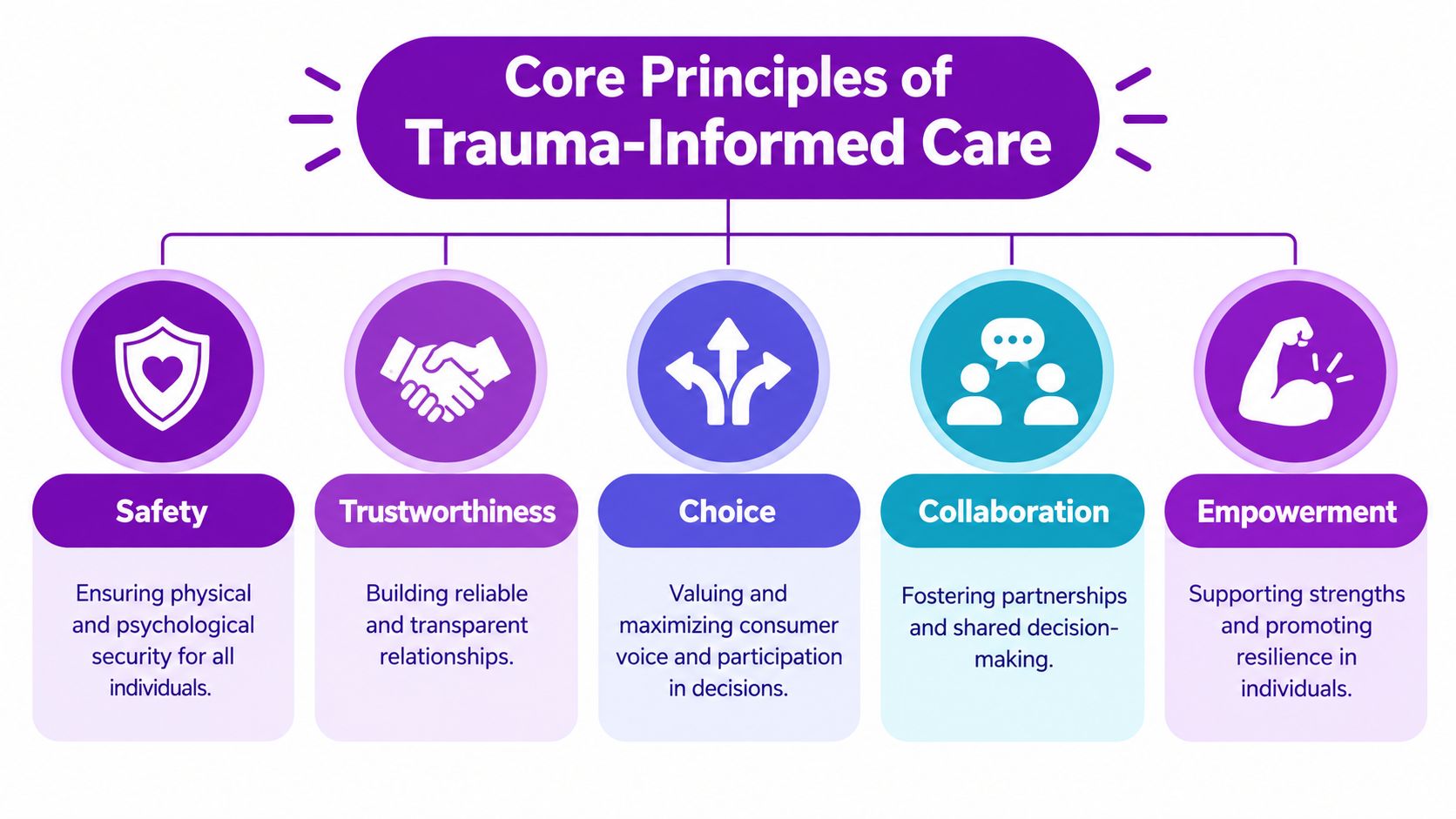
The framework includes six guiding principles: safety, peer support, trustworthiness and transparency, collaboration and mutuality, valuing voice and choice, and attention to cultural, historical, and gender issues. In therapy, these principles become visible through everyday interactions, from how a provider explains an intake to how a client can pause an exercise.
Safety
Safety includes the physical setting and the emotional experience of care. At a reVIBE Mental Health location in the Phoenix area, a therapist might explain the session plan, ask whether you prefer the door open or closed, offer seating options, and check before discussing sensitive material. Safety does not promise that difficult feelings will never arise. It means you receive information, support, and a clear way to pause.
Trustworthiness and transparency
Trust develops when providers explain decisions and follow through on what they say. A therapist can review confidentiality, fees, scheduling, treatment methods, and their limits before asking you to participate. Clear communication works like a window: you may not control every circumstance, but you can see what is happening and why.
Choice
Choice helps restore a sense of agency. You might choose which concern to address first, whether to answer a question, which coping tool to practice, or whether to continue an exercise. A real choice includes permission to decline without punishment or disappointment.
Collaboration
The therapist brings clinical training, while you bring knowledge of your own life. Trauma-informed collaboration treats both forms of knowledge as important. Goals and next steps become shared decisions rather than instructions delivered by one person to another.
Fostering agency and cultural responsiveness
Providers build on strengths, skills, voice, and recovery. They also consider cultural, historical, and gender-related experiences that can influence how safety, authority, and communication feel. For example, a question or clinical routine that seems neutral to a provider may carry a different meaning for a client because of past experiences or community context.
These principles make trauma-informed care an organizational framework, not merely a friendly attitude. They shape service delivery, decision-making, and the way power is shared across therapy settings.
A useful question: “What choices will I have if a therapy exercise becomes too intense?”
How Trauma-Informed Practices Look in Therapy
A trauma-informed therapy session may look ordinary from the outside. The difference often appears in the details: the therapist explains the plan, watches for signs of overwhelm, invites feedback, and treats your responses as information rather than resistance.

Consider an intake appointment. Instead of demanding a complete trauma narrative immediately, the therapist may ask what brings you in, what helps you feel comfortable, and what you hope will change. You can discuss relevant history at a pace that supports treatment. The therapist may also explain why certain questions matter and what will happen with the information.
EMDR and paced trauma work
In EMDR therapy, the therapist uses a structured process to help you work with distressing memories while maintaining attention to present-day safety and emotional regulation. A trauma-informed provider doesn't treat intensity as proof that the session is working. The provider monitors your response, uses preparation and grounding skills, and adjusts the pace when needed.
Other approaches, including cognitive behavioral therapy for trauma, somatic methods, mindfulness practices, internal family systems, and exposure-based treatment, can also be adapted around consent and readiness. A resource such as this guide to teen therapy options can help families compare approaches when a younger person needs support.
The room and the workflow matter
The environment can reinforce or undermine the therapeutic relationship. Comfortable lighting, accessible seating, privacy, predictable scheduling, and an easy way to request a break all communicate respect. These choices don't cure trauma, but they can reduce unnecessary stress and make it easier to stay engaged.
SAMHSA's behavioral-health guidance describes trauma-informed practices that include promoting trauma awareness, recognizing symptoms as adaptive responses, minimizing retraumatization, creating a safe environment, identifying recovery as a primary goal, supporting autonomy, building collaboration, and incorporating universal routine trauma screening (SAMHSA behavioral-health guidance). The guidance describes universal screening as a “steady reminder” to consider past traumatic experiences and their influence on engagement. In other words, trauma-informed care is a repeatable workflow, not a single question asked once.
People seeking adult support can review trauma-focused therapy for adults to understand how specialized care may fit within a broader, collaborative treatment plan.
Benefits of Trauma-Informed Care for Clients
Trauma-informed care can make treatment feel safer and more respectful, but a careful explanation must distinguish promising evidence from guarantees. The approach is not a universal treatment for every condition, and it doesn't replace trauma-specific therapies, medical care, crisis intervention, or practical support.
A 2026 meta-analysis of 13 randomized controlled trials found moderate-to-large effects for trauma-informed care programs, with an effect size of d = 1.03 for care recipients and d = 0.72 for providers (2026 meta-analysis of trauma-informed care programs). The review reported stronger effects in clinical settings and called for more tailoring in child-focused programs.
These findings suggest that trauma-informed programs may support meaningful improvements for clients and providers under particular conditions. The provider effect matters because staff understanding, confidence, and behavior influence the quality and consistency of the care environment.
What the evidence doesn't establish
A 2025 systematic review found that trauma-informed care definitions and components remain inconsistently operationalized, meaning researchers and organizations don't always implement or measure the model in the same way. The review also identified evidence on potential harms as an active area of study. That uncertainty doesn't make the approach meaningless. It means clients should ask what a provider specifically does, how outcomes are tracked, and what treatment is being offered for the concern at hand.
For example, a therapist may use trauma-informed communication while also providing EMDR for post-traumatic stress symptoms or medication management for a diagnosed condition. The trauma-informed framework explains how care is delivered. A clinical treatment model explains what intervention addresses the condition.
Somatic approaches may be useful for people who want to explore body-based awareness alongside talk therapy, and somatic healing exercises can introduce that topic in accessible language.
Finding Trauma-Informed Providers Near You
Start by asking prospective providers direct, practical questions. You don't need to disclose your trauma history during the first call. You can ask how the therapist handles consent, treatment pacing, screening, crisis concerns, confidentiality, and requests to pause or change an exercise.
A simple provider checklist
- Ask about training: Find out whether the provider has training in trauma-informed care and in the specific treatment being recommended.
- Clarify the process: Ask what happens during the first appointment and whether you can decide what personal information to discuss.
- Discuss treatment options: Learn whether the provider offers talk therapy, EMDR, psychiatry, medication management, or referrals when another service fits better.
- Check practical details: Verify insurance participation, expected costs, appointment availability, telehealth options, and cancellation policies.
- Notice your response: Pay attention to whether the provider answers clearly, respects boundaries, and makes room for your questions.
Online directories, insurance listings, primary care referrals, and recommendations from trusted people can all help you build a shortlist. You can also contact reVIBE Mental Health, which offers therapy, EMDR, psychiatry with medication management, and in-person or secure online sessions across the Phoenix area. The practice reports accepting most major insurance plans and providing verification guidance, so confirm current coverage and availability directly.
reVIBE Location Directory
| Location | Address | Phone |
|---|---|---|
| reVIBE Mental Health, Chandler | 3377 S Price Rd, Suite 105, Chandler, AZ | (480) 674-9220 |
| reVIBE Mental Health, Phoenix Deer Valley | 2222 W Pinnacle Peak Rd, Suite 220, Phoenix, AZ | (480) 674-9220 |
| reVIBE Mental Health, Phoenix PV | 4646 E Greenway Road, Suite 100, Phoenix, AZ | (480) 674-9220 |
| reVIBE Mental Health, Scottsdale | 8700 E Via de Ventura, Suite 280, Scottsdale, AZ | (480) 674-9220 |
| reVIBE Mental Health, Tempe | 3920 S Rural Rd, Suite 112, Tempe, AZ | (480) 674-9220 |
Embracing Trauma-Informed Care in Your Journey
Trauma-informed care asks providers to build safety before demanding vulnerability. It recognizes lived experience, protects choice, encourages collaboration, and connects respectful communication with appropriate clinical treatment. You can look for these qualities in the questions a therapist asks, the explanations they provide, and the control they give you during difficult work.
You're allowed to interview a provider, request a slower pace, ask for alternatives, and change direction when care no longer feels appropriate. Those actions aren't obstacles to healing. They're part of an informed, autonomous process.
reVIBE Mental Health offers therapy, EMDR, psychiatry with medication management, and secure online or in-person appointments for people seeking trauma-aware support in the Phoenix area. Visit reVIBE Mental Health to review care options, find a nearby location, and connect with a provider who can discuss your goals and preferences.