Trauma-informed therapy is a way of looking at mental health that starts with a simple, yet profound, shift in perspective. It recognizes that the difficult things we've been through can leave a lasting mark on our minds, bodies, and relationships.
Instead of asking the classic therapeutic question, "What's wrong with you?", this approach asks, "What happened to you?" This one change opens the door to a more compassionate, understanding, and effective path toward healing.
Understanding the Heart of Trauma-Informed Therapy
At its core, trauma-informed therapy isn’t one specific type of treatment. You can think of it as an "operating system" or a foundational framework that guides how a therapist interacts with you. It’s built on the understanding that traumatic experiences are surprisingly common, and many of the struggles that bring people to therapy—like anxiety, depression, or relationship issues—are often survival strategies developed in response to those events.
It’s an approach grounded in respect, recognizing that you are the ultimate expert on your own life.
Think about it like hiring a personal trainer. A typical trainer might just hand you a standard workout routine. A trauma-informed trainer, however, would first want to know about any old injuries, physical limits, or even bad experiences you've had at a gym before. They get that forcing you into a painful movement could not only re-injure you but also completely shatter your trust. They work with you, creating a plan that feels safe, honors your body’s history, and helps you get stronger without causing more harm.
That’s exactly how a trauma-informed therapist works. They make creating a space of deep physical and emotional safety their absolute top priority before even thinking about exploring difficult memories.
Core Shifts From Traditional To Trauma Informed Therapy
This table breaks down some of the fundamental differences in perspective and approach. It's not about one being "bad" and the other "good," but rather highlighting the critical evolution in understanding how to best support someone who has experienced trauma.
| Aspect | Traditional Therapy Approach | Trauma-Informed Therapy Approach |
|---|---|---|
| Core Question | "What's wrong with you? What is your diagnosis?" | "What happened to you? How did you survive?" |
| Focus | Diagnosing and treating symptoms. | Understanding the connection between past experiences and current struggles. |
| Client's Role | Patient receiving treatment. | Collaborative partner in the healing process. |
| Symptoms | Viewed as pathology or disorder. | Seen as adaptive survival strategies. |
| Safety | Assumed to be present in the therapy room. | Actively and intentionally created with the client. |
| Pacing | Often determined by the therapist's treatment plan. | Paced by the client's readiness and comfort level. |
This shift from a symptom-focused model to a person-centered one is what makes this approach so powerful. It validates your experience and fosters a genuine partnership.
A Foundational Shift in Perspective
This approach completely reframes how we see your reactions and feelings. Instead of labeling anxiety, emotional numbness, or hyper-vigilance as "symptoms" that need to be fixed, a trauma-informed therapist sees them for what they are: brilliant, protective responses that helped you survive a dangerous past.
The goal isn’t to erase these survival skills, but to honor them. From there, we can gently work together to build new, more flexible ways of navigating the world that feel less taxing and give you back a sense of control over your own healing journey.
This compassionate view is the secret sauce of the therapeutic relationship. It ensures you feel seen, heard, and deeply respected at every turn. Working through trauma in this way often helps people build stronger, more meaningful relationships, as it rebuilds the capacity to trust and connect. For those interested in strengthening their connections, learning how to build emotional intimacy can be a powerful next step.
The 5 Core Principles of Trauma-Informed Care
To really get what trauma-informed therapy is all about, we have to look past a simple definition and dig into its core commitments. These aren't just buzzwords; they're the active, guiding principles that shape a therapeutic space where real healing can happen. Think of it as a framework built on five essential pillars, each one working to give back the sense of control and safety that trauma so often strips away.
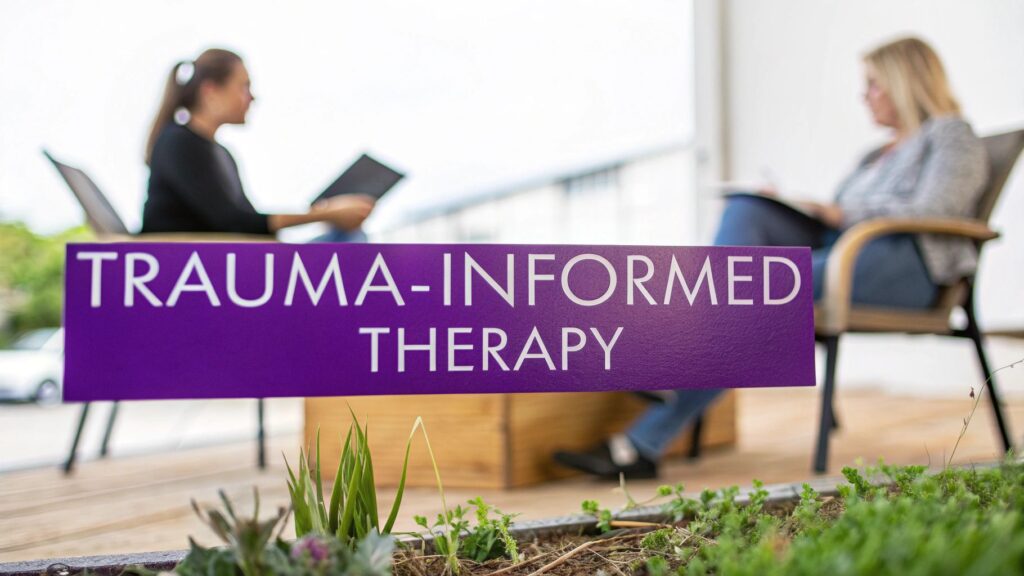
This image really captures the fundamental shift in thinking—moving away from the old model of just spotting deficits and toward a new approach that seeks to understand the whole person and their story.
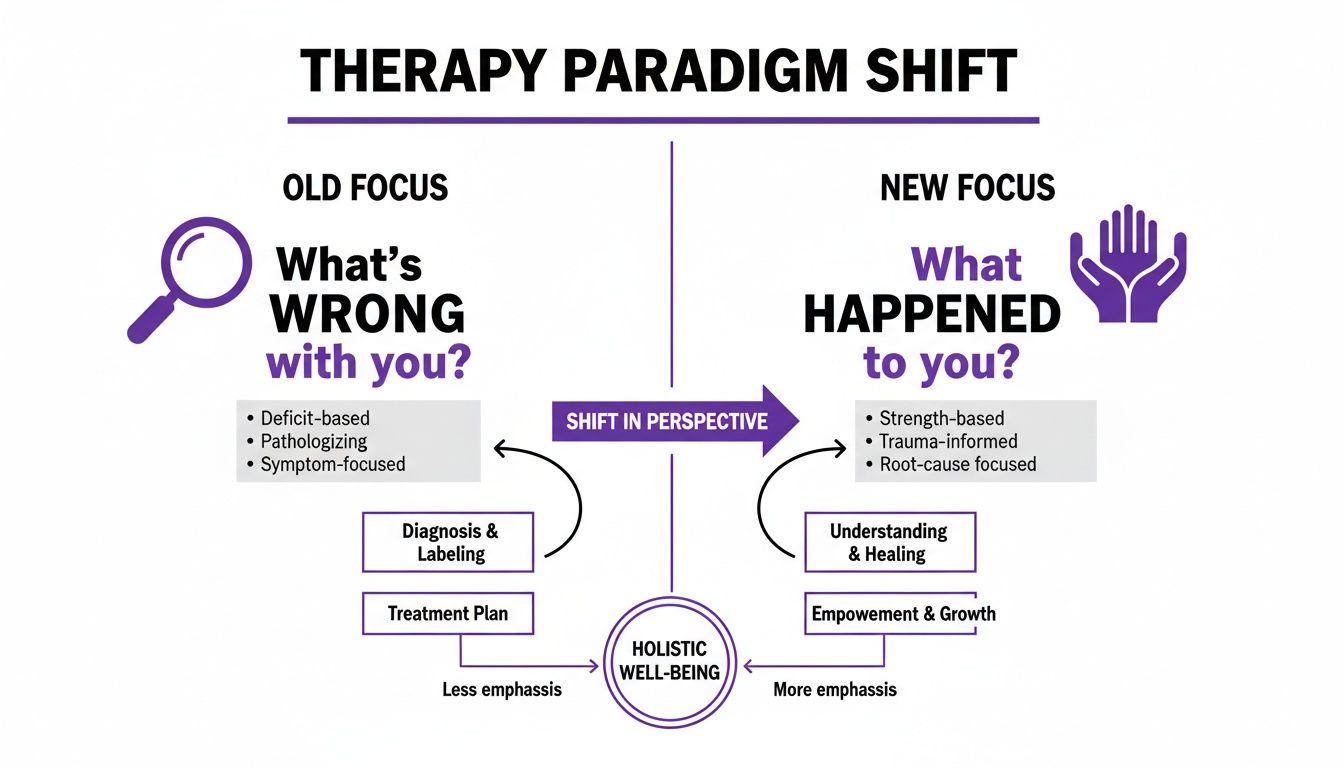
This one simple question—changing from "What's wrong with you?" to "What happened to you?"—opens the door to a much more compassionate and effective way of healing. Let's break down the principles that bring this idea to life.
1. Creating Genuine Safety
The first and most critical principle is Safety. Trauma, at its core, shatters a person's feeling of being safe in the world, in relationships, and even in their own skin. A trauma-informed therapist knows that healing can't even begin until that foundation of safety is carefully rebuilt.
And this goes way beyond just having a lock on the door. It means creating both physical and emotional security.
- Physical Safety: We're talking about a calm, predictable, and welcoming space. At reVIBE Mental Health, for example, we've designed our offices to feel less like a sterile clinic and more like a comfortable living room. The goal is to help your nervous system start to unwind the moment you walk in.
- Emotional Safety: This is all about making sure you feel respected, truly heard, and never pushed past your limits. Your therapist will constantly check in, honor your pace, and make it crystal clear that you are in control of the session. You will never be forced to talk about anything you're not ready to.
This deep commitment to safety creates a reliable container for the hard work ahead, allowing you to explore difficult emotions without the fear of feeling overwhelmed or re-traumatized.
2. Building Trust Through Transparency
Right on the heels of safety comes Trustworthiness and Transparency. So many trauma survivors have had their trust shattered, often by the very people or systems that were supposed to protect them. Learning to trust again is a delicate, and absolutely essential, part of the journey.
A trauma-informed therapist earns that trust by being clear, consistent, and completely upfront. In your first few sessions at reVIBE, your therapist will walk you through the entire therapy process, explain what you can expect, and clearly discuss the boundaries of confidentiality. There are no hidden agendas or unwelcome surprises.
By making the therapeutic relationship predictable and clear, the therapist helps to repair the expectation that relationships are unsafe or unreliable. Every interaction is an opportunity to demonstrate dependability.
This transparency demystifies therapy and puts you in the know, reinforcing that you're an equal partner in your own healing.
3. The Power of Collaboration and Mutuality
The third principle, Collaboration and Mutuality, directly counters the old-school, top-down model of therapy where the clinician is the all-knowing expert and the client passively receives treatment. In trauma-informed care, the relationship is a true partnership.
What this means is that you are seen as the expert on your own life. Your therapist brings clinical skills to the table, but your lived experience and insights are valued just as much.
In practice, this looks like:
- Shared Decision-Making: You and your therapist set goals and map out a treatment plan together.
- Leveling the Power Dynamic: The therapist openly acknowledges the power imbalance that can exist in therapy and works to minimize it.
- Valuing Your Input: Your feedback on what’s working (and what isn’t) is actively encouraged and used to guide the process.
For instance, your therapist might lay out a few different therapeutic options, talk through the pros and cons of each with you, and empower you to make an informed choice. This spirit of collaboration is vital for restoring a sense of agency.
4 & 5. Fostering Empowerment, Voice, and Choice
Finally, the intertwined principles of Empowerment, Voice, and Choice are woven into every single interaction. Trauma often leaves people feeling powerless, voiceless, and trapped. These principles are about actively reversing that.
Empowerment in therapy means we don't just focus on problems; we recognize and build on your inherent strengths and resilience. A trauma-informed therapist helps you see the incredible survival skills you've already developed.
Your voice isn't just heard—it's centered and honored. And most importantly, you always have a choice. You have the final say on the pace of therapy, the topics you discuss, and the methods you use. This constant affirmation of your agency sends a powerful, healing message: you are capable, your choices matter, and you are in the driver's seat of your own journey.
How This Approach Differs From Traditional Therapy
At first glance, trauma-informed care and traditional therapy seem to have the same goal: helping you heal and feel better. And they do! But the path they take to get there is fundamentally different. It's not a matter of one being "right" and the other "wrong," but rather the perspective they start from.
Traditional therapy often jumps right into diagnosing symptoms and teaching you skills to manage them. Think of it as addressing what's visible on the surface. Trauma-informed therapy, on the other hand, takes a step back. It starts with the understanding that your current struggles are deeply rooted in your past experiences.
This simple shift changes the entire therapeutic process.

Think about a gardener tending to a wilting plant. A more traditional approach might involve just trimming off the yellow leaves or pulling the weeds—tackling the obvious symptoms. It might help for a little while, but if the soil is nutrient-poor or the plant is in a spot with too much harsh sun, the problems will just keep popping up.
A trauma-informed gardener works differently. Before they even touch the leaves, they check the soil. They make sure the environment is right, the sunlight is appropriate, and the plant feels protected. They know that a healthy, safe environment is the foundation for any real growth. This is the heart of what is trauma informed therapy: it’s all about creating that safe, nurturing space and understanding your history before we even think about "fixing" the symptoms.
Symptom Management Versus Root Cause Understanding
One of the biggest distinctions is in how each approach sees your coping mechanisms—even the ones that aren't serving you anymore. Let's compare how a standard Cognitive Behavioral Therapy (CBT) session and a trauma-informed session might look.
- Standard CBT: Let's say you're struggling with avoidance—maybe you constantly cancel plans or can't bring yourself to go to certain places. A CBT therapist would likely work with you to identify and challenge the negative thoughts that fuel this behavior. The goal is to change the thought to change the action. For many, this is incredibly helpful.
- Trauma-Informed Approach: A trauma-informed therapist sees that same avoidance and gets curious. Instead of labeling it as a "problem" to be fixed, they recognize it as a brilliant survival strategy that probably kept you safe at some point in your life. They know that for someone who has experienced trauma, trying to directly confront those patterns can feel terrifying and might even re-trigger the nervous system.
The number one priority is to create a deep sense of safety—both emotionally and physically—in the therapy room. It's only from that place of security that you can begin to gently explore those ingrained patterns without feeling overwhelmed.
By shifting the question from "What's wrong with you?" to "What happened to you?", a trauma-informed therapist honors your resilience. They see your coping skills for what they are: adaptations, not defects.
A Partnership Versus An Expert Model
This naturally leads to a very different kind of relationship between you and your therapist. Some traditional therapy models can feel a bit top-down, with the therapist positioned as the expert who diagnoses and directs your treatment.
Trauma-informed care flips that script. It’s built on a foundation of collaboration and shared power.
You are always the expert on your own life. Your therapist brings their clinical training and tools, but you bring the irreplaceable wisdom of your own lived experience. This means you set the pace. You decide what feels right. You are always in the driver's seat. This partnership actively works to rebuild the sense of choice and personal power that trauma so often erodes, making the healing journey itself a deeply empowering experience.
Therapeutic Methods Used in Trauma Informed Care
A trauma-informed approach is the foundational mindset for healing, but what does the actual therapy look like in practice? Think of it as the operating system that runs several powerful, evidence-based programs designed to help you safely process difficult experiences. These aren't just random techniques; they are specialized tools applied within the guiding principles of safety, choice, and collaboration. This ensures you always feel in control of your own journey.
There are no one-size-fits-all solutions here. Your therapist will genuinely partner with you to figure out which method best fits your unique history, your nervous system's responses, and what you want to achieve.
Eye Movement Desensitization and Reprocessing (EMDR)
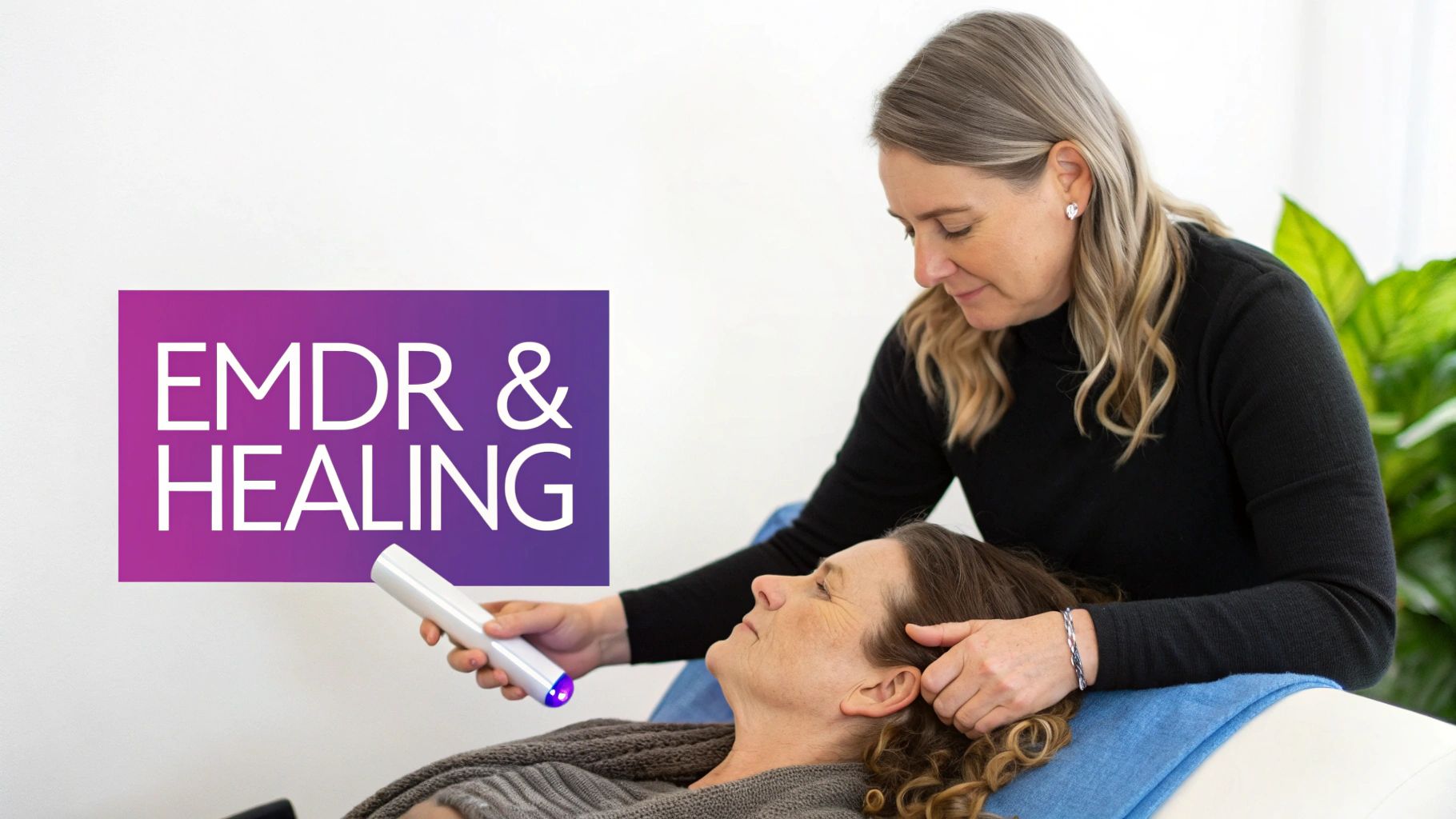
One of the most well-known and effective methods for processing trauma is Eye Movement Desensitization and Reprocessing (EMDR). In a nutshell, EMDR helps your brain’s own natural healing process get back on track by allowing it to reprocess traumatic memories that have become "stuck."
When a traumatic event occurs, the memory can get locked in the brain, complete with the original images, sounds, thoughts, and feelings. EMDR uses bilateral stimulation—like guided eye movements, tapping, or sounds—to activate both sides of the brain while you briefly focus on the memory. This process helps "unstick" the memory, allowing it to be stored properly in your long-term memory where it belongs.
The result? The memory is still there, but it loses its intense, painful emotional charge. You can recall the event without feeling like you're right back in it. A huge benefit for many people is that EMDR often doesn't require you to talk in exhaustive detail about the trauma, which can be a massive relief. To see how this can help with related symptoms, check out our guide on using EMDR therapy for anxiety.
Trauma-Focused Cognitive Behavioral Therapy (TF-CBT)
Another powerful tool in the toolbox is Trauma-Focused Cognitive Behavioral Therapy (TFCBT). This isn't your standard CBT. It’s an approach that integrates trauma-sensitive principles directly into cognitive and behavioral techniques.
TF-CBT helps you draw the lines between your past traumatic experiences and your current thoughts, feelings, and behaviors. It’s specifically adapted to work with trauma survivors by including key components like:
- Psychoeducation: Simply learning about common trauma responses can be incredibly validating.
- Relaxation Skills: You'll learn grounding techniques to manage distress when it bubbles up.
- Affective Modulation: This is all about building your capacity to regulate intense emotions.
- Cognitive Processing: You'll gently learn to identify and challenge unhelpful beliefs that grew out of the trauma.
This structured approach gives you practical, real-world skills, all while prioritizing a foundation of safety and trust.
Body-Based and Somatic Approaches
Here’s a critical piece of the puzzle: trauma doesn't just live in our minds. It's stored in the body, too. Somatic therapies, like Somatic Experiencing, are built on the understanding that our nervous system often holds onto the fight, flight, or freeze responses from a traumatic event, long after the danger has passed.
These therapies guide you in developing a greater awareness of your physical sensations. With a therapist's help, you gently notice these feelings—a tight chest, tense shoulders, a knot in your stomach—and allow your body to complete the self-protective responses that were cut short during the event.
This process allows the trapped survival energy to finally be released from the body. It helps calm the nervous system and restore a sense of balance and wholeness from the inside out. It's a slow, gentle process that honors the body's innate wisdom to heal.
These approaches are so effective because they work directly with the non-verbal parts of the brain where trauma is often held. And the data backs this up. Research shows that a clinician's use of trauma-informed practices explains 56.7% of the variance in the quality of the therapeutic relationship, directly highlighting how these principles improve real-world outcomes.
Finding a Trauma-Informed Therapist in Arizona
Knowing what trauma-informed therapy is all about is one thing, but finding a therapist who actually lives and breathes those principles is the crucial next step. For anyone in Arizona, the search is about more than just finding someone who uses certain techniques. It's about finding a therapeutic home that makes safety, trust, and empowerment its foundation from the very first phone call.
The goal is to connect with a team that gets it—a team that makes you feel seen, heard, and genuinely hopeful about what's ahead.
This search often starts with the space itself. At reVIBE Mental Health, we’ve put a lot of thought into creating environments that feel more like a comfortable living room than a sterile clinic. It’s a deliberate choice. When you walk in, we want your nervous system to get the message that it’s okay to relax, that you’ve entered a place of calm and security. That feeling is essential before any real therapeutic work can begin.
Your Integrated Care Team at reVIBE Mental Health
Healing from trauma isn’t a straight line. Your needs can shift, and your care should be able to adapt right along with you. That's why we built our practice around an integrated approach. Our therapists and licensed psychiatric professionals don’t just work in the same building; they work in close collaboration on your behalf.
This team model means you have a whole group of people looking at the full picture of your well-being.
- Therapists are experts in powerful methods like EMDR and other talk therapies, helping you process difficult experiences and build new, healthier ways of coping. You can meet our team of therapists to learn about their backgrounds and find someone who feels like a good fit for you.
- Psychiatric Professionals are part of your team for medication management, offering another layer of support if it’s needed. They work hand-in-hand with your therapist to make sure everyone is on the same page with your goals.
With this structure, you never have to worry about coordinating care between different offices or providers. You get one unified team that communicates constantly, partnering with you to ensure every part of your treatment is grounded in trauma-informed principles.
Making Expert Care Accessible Across the Valley
The last thing you need when seeking support is a long, stressful commute. We firmly believe that high-quality, compassionate care should be easy to get to, right in your own community. That’s why we’ve worked hard to establish a strong presence across the Phoenix metro area.
Finding care close to home removes a huge barrier to getting started. When therapy is convenient, it becomes a sustainable part of your life instead of another source of stress.
Find a reVIBE Location Near You!
We currently have five locations for your convenience. (480) 674-9220
reVIBE Mental Health – Chandler
3377 S Price Rd, Suite 105, Chandler, AZ
reVIBE Mental Health – Phoenix Deer Valley
2222 W Pinnacle Peak Rd, Suite 220, Phoenix, AZ
reVIBE Mental Health – Phoenix PV
4646 E Greenway Road, Suite 100, Phoenix, AZ
reVIBE Mental Health – Scottsdale
8700 E Via de Ventura, Suite 280, Scottsdale, AZ
reVIBE Mental Health – Tempe
3920 S Rural Rd, Suite 112, Tempe, AZ
Navigating Insurance and Getting Started
Let's be honest: worries about cost and insurance can feel like one of the biggest roadblocks to starting therapy. A truly trauma-informed practice gets this. The principle of trustworthiness has to extend to the practical side of things, too.
At reVIBE, we are in-network with most major insurance plans because we want to remove that barrier. Our dedicated team is here to help you make sense of your benefits. We'll handle the insurance verification so you know exactly what to expect before you even come in for your first session.
This commitment to clarity takes the guesswork out of the process, empowering you to make informed decisions for yourself. Your healing journey is too important to be derailed by administrative hurdles. Our goal is to make sure nothing stands in the way of you getting the compassionate, skilled support you deserve.
Your Questions About Trauma-Informed Therapy, Answered
Taking that first step toward healing is a big deal, and it's completely normal to have questions. You might feel a mix of curiosity, hope, and maybe even a little nervousness about what comes next. It's one thing to understand the definition of trauma-informed therapy, but it's another thing entirely to imagine how it will feel for you.
This section is all about answering the questions we hear most often. We want to give you clear, straightforward answers to demystify the process and help you feel more confident about starting this journey. Our goal is to make sure you have the clarity you need to move forward, knowing you're stepping into a space that puts your safety, comfort, and control first.
Do I Have to Talk About My Trauma in Detail?
This is probably the biggest fear people have, and the answer is a firm and reassuring no. A core part of trauma-informed care is that you are always in the driver's seat. You control what you share, how much you share, and when you share it. Your therapist's job isn't to push you to relive painful memories; it's to help you create a safe space to process their impact.
In fact, many of the most effective trauma therapies, like EMDR, don’t require you to narrate the event in detail at all. The focus is on helping your brain and body process the memory’s stuck emotional and physical energy, not on dissecting the story piece by piece. Your therapist will work with you to find an approach that feels safe, manageable, and completely respectful of your boundaries. You lead the way, always.
How Long Does Trauma-Informed Therapy Take?
Healing is a personal journey, not a race. Because every person is unique, the timeline for therapy looks different for everyone. It really depends on a few things, like the complexity of your experiences, what you hope to get out of therapy, and the specific approach you and your therapist decide is best.
Some methods, like Trauma-Focused Cognitive Behavioral Therapy (TF-CBT), are a bit more structured and might last around 12-20 sessions. Other approaches are more open-ended, flowing and adapting to your needs as they change over time. The most important thing is that we move at a pace that feels right for you—one that allows for deep, lasting healing instead of just a quick fix.
Your therapist at reVIBE will work with you to create a personalized plan and will check in regularly about your progress and how you're feeling about the timeline. This is your journey, and we're here to support you at your own pace.
This collaborative approach ensures the process itself feels empowering, never overwhelming.
How Do I Know if I Need This Type of Therapy?
You absolutely do not need an official diagnosis like Post-Traumatic Stress Disorder (PTSD) to benefit from this approach. Trauma-informed therapy is for anyone who feels like overwhelming past events are still casting a shadow on their life today.
Do any of these feel familiar?
- You're always on edge: A constant feeling of anxiety or hypervigilance, like you're easily startled or always waiting for the other shoe to drop.
- Relationships feel hard: You might struggle with trust and intimacy or just feel disconnected from the people you care about.
- You feel numb: A sense of being detached from your own emotions or the world around you.
- You just feel 'stuck': It feels like you’re being held back by the past, unable to move forward the way you want to.
If these points resonate, trauma-informed therapy can offer a safe harbor to understand why. It helps you see that your reactions are normal responses to abnormal situations and gives you the tools to forge new paths forward.
What Is the First Session at reVIBE Mental Health Like?
Your first session is all about one thing: building a foundation of safety and connection. It’s a chance for you to meet your therapist, get a feel for our space, and see if it feels like the right fit for you. We know how much courage it takes just to walk through that door, and we truly honor that.
Think of it as a collaborative conversation, not an interrogation. We’ll talk about what brought you to therapy and what your hopes are, but you will only ever be asked to share what feels comfortable. Your therapist will also explain how the process works, answer all of your questions, and go over confidentiality. When you work with a skilled therapist or psychiatric mental health practitioner, this first meeting sets the stage for a real, trusting partnership.
Our primary goal is for you to leave that first session feeling heard, respected, and genuinely hopeful about the road ahead. It’s the first step on a journey where you are seen, valued, and empowered.
Taking the next step is an act of profound self-care. At reVIBE Mental Health, we are committed to providing a safe, compassionate, and empowering environment where you can heal at your own pace. If you are ready to explore what trauma-informed therapy can do for you, we invite you to connect with our team.
Find a reVIBE Location Near You!
We currently have five locations for your convenience. (480) 674-9220
reVIBE Mental Health – Chandler
3377 S Price Rd, Suite 105, Chandler, AZ
reVIBE Mental Health – Phoenix Deer Valley
2222 W Pinnacle Peak Rd, Suite 220, Phoenix, AZ
reVIBE Mental Health – Phoenix PV
4646 E Greenway Road, Suite 100, Phoenix, AZ
reVIBE Mental Health – Scottsdale
8700 E Via de Ventura, Suite 280, Scottsdale, AZ
reVIBE Mental Health – Tempe
3920 S Rural Rd, Suite 112, Tempe, AZ
Learn more and begin your journey by visiting us at https://revibementalhealth.com.