
You're lying awake rehearsing tomorrow's meeting, or putting off a family call because you expect another argument. You know what's wrong. What you're less sure about is what would help and whether therapy means spending months explaining everything before anything changes.
Solution-focused brief therapy (SFBT) starts with a practical question: what would you like to be different in everyday life? It helps you describe that change, notice what already supports it, and choose a manageable next step. Its usefulness depends on more than asking encouraging questions, though. Good care also means judging whether the approach fits your needs and checking whether improvements last outside the therapy room.
What Solution-Focused Brief Therapy Is and Its Core Principles
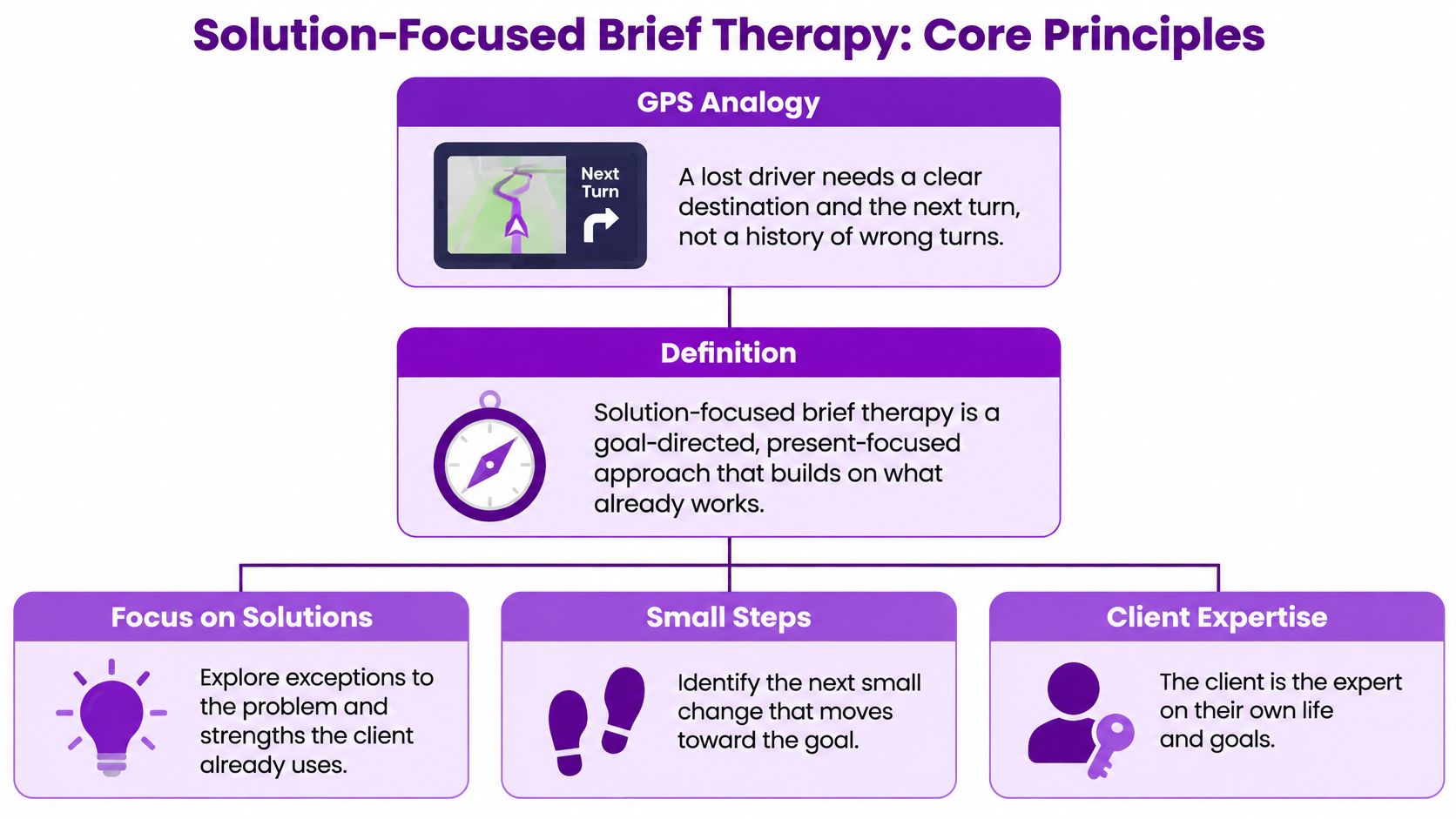
A driver who's lost doesn't always need a complete history of every wrong turn. They need a clear destination and the next turn. Solution-focused brief therapy uses a similar orientation, while recognizing that a therapist must still understand hazards before suggesting a route forward.
SFBT is a collaborative, goal-directed talk therapy associated with Steve de Shazer and Insoo Kim Berg at the Brief Family Therapy Center in Milwaukee. Rather than making a full explanation of the problem a prerequisite for change, therapist and client explore the life the client wants and the resources that might help them get there.
The principles in everyday language
- Describe the preferred future. Instead of stopping at insomnia, identify what a more restful night and a manageable morning would look like.
- Look for exceptions. If worry eased while you walked with a friend, explore what was different rather than dismissing that afternoon as luck.
- Recognize existing resources. Keeping an appointment during a difficult week may reveal planning, persistence, or support you haven't given yourself credit for.
- Start with a small change. Preparing a short meeting contribution may be more workable than trying to become a confident public speaker immediately.
- Follow the client's meaning. If you want to feel more present, the therapist asks what present means to you rather than choosing a definition for you.
This overlaps with a strength-based approach: the clinician notices abilities alongside difficulties. That doesn't mean assuming you can solve everything alone. Resources can include supportive people, accommodations, medical care, or practical changes to your surroundings.
What brief actually means
Brief describes the way of working, not a guaranteed session count. The intention is to keep treatment purposeful and avoid continuing without a clear reason. Your goals, symptoms, safety, and response to care still matter.
You don't have to understand every cause before making a useful change, but you shouldn't have to ignore important causes either.
A repeatable definition is this: SFBT helps you describe the change you want and build toward it using strengths and useful experiences you already have.
How Solution-Focused and Problem-Focused Therapy Differ
Solution-focused and problem-focused therapies differ in emphasis, not in whether they can help. One starts by exploring the desired change and available resources. The other puts more attention on understanding symptoms, maintaining patterns, and the mechanisms a treatment will address.
Problem-focused therapy isn't a single method. CBT, trauma-focused treatment, and insight-oriented approaches don't all handle history or homework alike, so the comparison below describes broad tendencies rather than rigid rules.
Solution-focused and problem-focused therapy compared
| Aspect | Solution-focused brief therapy | Problem-focused therapy |
|---|---|---|
| Main question | What should be different, and what is already working? | What caused the problem, and what keeps it going? |
| Time spent on the past | Limited, often used to identify resources and exceptions | History explored in depth when needed for the formulation |
| Session focus | Goals, exceptions, and small steps | Symptoms, patterns, and thought content |
| Typical length | Often a short course, adjusted through review | A planned protocol or ongoing course based on clinical needs |
| Therapist role | Guides the process while the client contributes expertise about their life | Guides assessment and method collaboratively |
| Between-session work | Small experiments building on what helps | Structured exercises, such as thought records |
| Best fit | Specific goals and a preference for present-focused work | Problems requiring a detailed formulation or targeted intervention |
What those differences feel like
Say you freeze before presentations. A solution-focused therapist might ask when speaking felt slightly easier, how you prepared then, and what a small improvement would look like at the next meeting. You might agree to rehearse an opening sentence and notice whether that helps you begin.
A CBT-oriented therapist might examine your prediction that a pause will make colleagues think you're incompetent. Together, you could test that prediction and practice a different response to anxious thoughts. Both approaches can involve action, collaboration, and present-day change.
Now consider someone whose fear of disagreement is connected with longstanding childhood conflict. They may want help understanding why ordinary disagreements feel threatening. A careful formulation could guide treatment more usefully than immediately assigning a communication experiment.
Choose by the work you need
The therapist's role isn't to be more or less directive. In either approach, you should understand why you're doing an exercise and have room to say it doesn't fit.
Choose according to how clearly you can define the goal and what needs understanding or treatment before you pursue it. Many clinicians combine methods, using a preferred-future conversation to clarify direction and another intervention to address the obstacle.
How a Solution-Focused Session Unfolds Step by Step
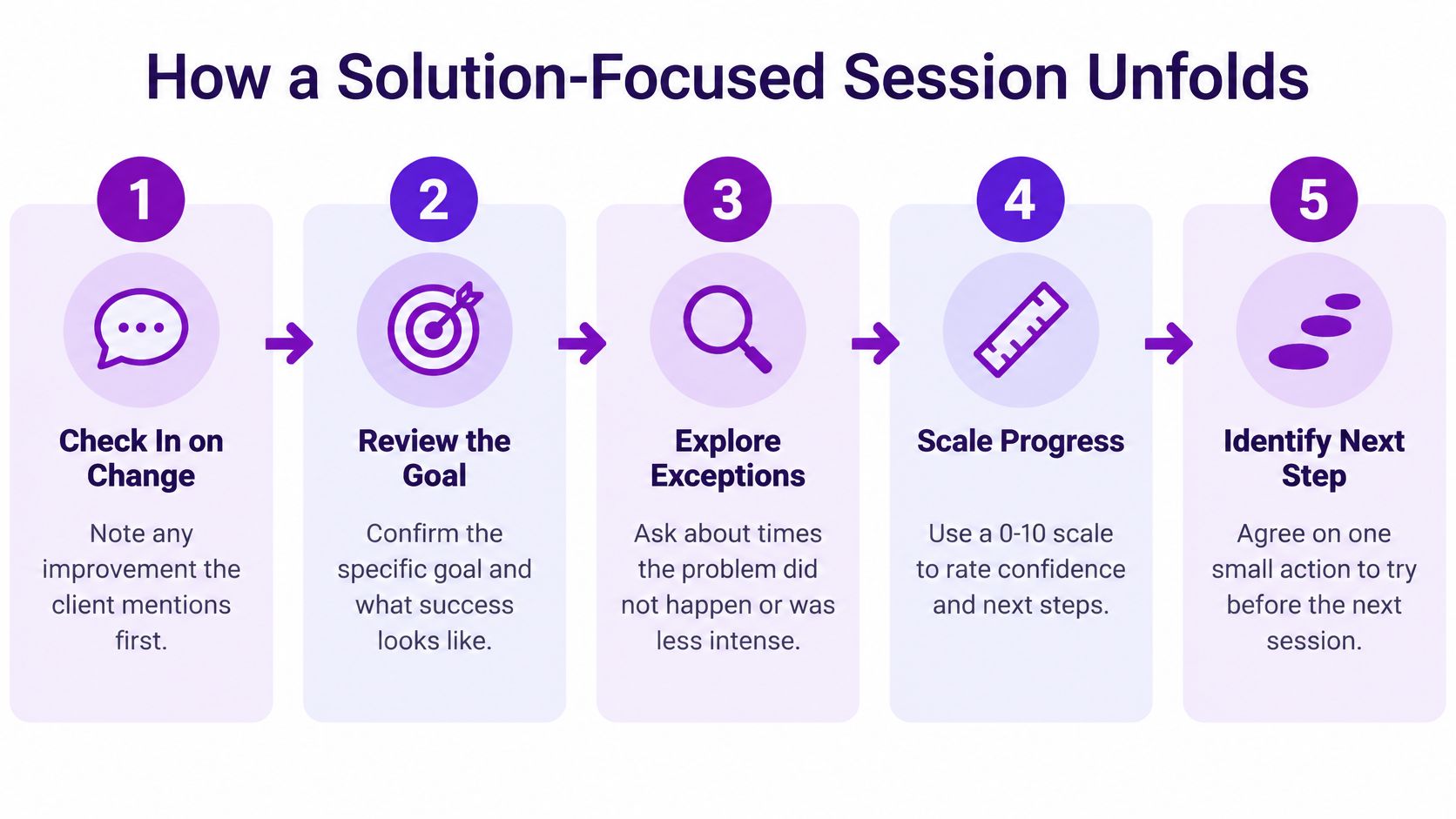
A solution-focused session is a conversation with a purpose, not a rapid-fire questionnaire. The therapist follows your answers, pauses when something matters, and helps translate broad hopes into changes you can recognize.
For a concrete example, consider an adult who stays silent in team meetings despite having useful ideas. The sequence below shows how the conversation might unfold. An initial appointment also needs assessment, relevant history, and discussion of confidentiality and safety.
From check-in to a workable direction
Check what has changed.
At a follow-up, the therapist invites you to describe anything that's improved, even slightly. You mention that you asked a colleague a question after a meeting. The therapist explores that moment without assuming the whole week went well.Confirm the goal in observable terms.
Feeling more confident is meaningful, but difficult to evaluate on its own. You refine it into contributing an idea during team meetings. The therapist checks that this is your priority, not what your manager expects.Explore what's already working.
You remember speaking more easily when you had written down your point beforehand. The therapist asks about the circumstances: who was present, what you prepared, and what helped you continue despite nerves. The aim is to identify something usable, not to claim anxiety has disappeared.Describe the preferred future in detail.
You picture opening your notes, offering an idea before the conversation moves on, and returning attention to the discussion afterward. The therapist may explore how you'd recognize progress and what another person might notice. This makes the destination more specific than wanting meetings to feel better.
Turn the conversation into an experiment
Review strengths and effort.
The therapist summarizes what you've described: preparation helps, smaller conversations feel more manageable, and you've already acted while uncomfortable. Useful feedback stays tied to your actual behavior. It shouldn't sound like generic praise or pressure to be positive.Agree on a manageable task.
You decide to prepare a brief contribution before the next meeting and observe what makes speaking easier or harder. If that feels too demanding, the task might be noticing when you feel ready to speak without requiring yourself to do it yet. The therapist checks your willingness rather than treating agreement as automatic.
An experiment is information, not a test of whether you're a good client. If it doesn't help, you and the therapist examine what happened and revise the plan.
Appointment length and spacing should be confirmed with the clinician rather than inferred from the word brief. Meetings may become less frequent when progress is holding, but a schedule should reflect clinical needs.
You leave with a clear goal, an observation or action to try, and an agreed review point. The therapist doesn't investigate causes merely out of habit, but does explore them when they're relevant to effective or safe care.
Techniques That Shape the Conversation
The tools in SFBT are ways to ask useful questions, not scripts a therapist should read regardless of your response. Each question has a different job: clarify the destination, identify resources, or make a next step easier to see.
You don't need to memorize their names. Recognizing their purpose can help you tell the therapist which kinds of questions help you think and which leave you stuck.
Core solution-focused techniques and what they reveal
| Technique | Sample question | What it reveals |
|---|---|---|
| Miracle question | If the problem were solved overnight, what would you notice first? | A concrete picture of the preferred future |
| Scaling question | On a 0 to 10 scale, where are you today, and what would one point higher look like? | Current progress and the next small step |
| Exception question | When in the past week was the problem even slightly less intense? | Conditions and actions that already help |
| Coping question | How have you kept things from getting worse this month? | Resilience and skills that may be overlooked |
| Compliment | You kept going through a hard week; what did that take? | Strengths the client can name for themselves |
| Observation task | Notice a moment this week when the problem happens less, and what you were doing. | Patterns to explore between sessions |
How the questions work together
In a hypothetical conversation, you rate your ability to manage work stress at 3. The therapist asks what keeps it from being lower, and you identify a colleague who helps you prioritize. That answer reveals support before the conversation turns to another change.
You then remember a week that felt closer to 5. Rather than asking why you can't always manage that well, the therapist explores what was different. You had clearer deadlines and took your lunch away from your desk, so you consider which part is feasible now.
The numbers aren't a diagnosis or an objective score. Their meaning comes from your explanation. A rating is useful when it leads to details about behavior, circumstances, or support.
When imagining change is difficult
The miracle question can clarify a goal when someone keeps describing only what they want to escape. But a person who feels overwhelmed may struggle to picture a better future. An exception or coping question may offer a more accessible starting point.
Practical rule: A helpful question creates room to think. It shouldn't require you to pretend you're hopeful.
Questions should come individually, with enough time for your answer to shape what follows. If you feel torn about changing, a conversation informed by motivational interviewing may help explore that ambivalence rather than treating it as resistance.
Notice whether the therapist helps you describe meaningful change without dismissing the problem story you need them to hear.
Who May Benefit and Where It Falls Short
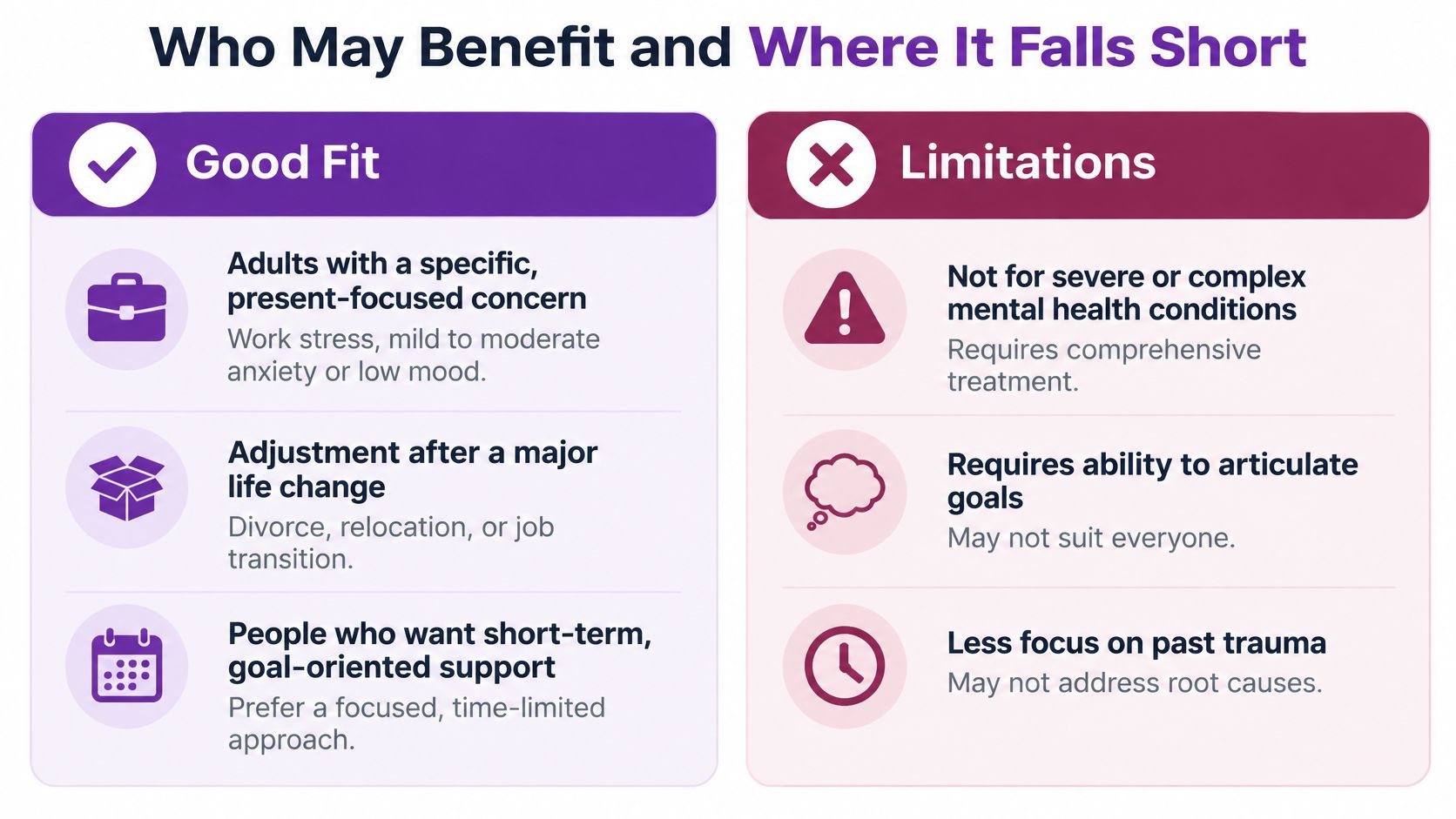
Wanting practical help is a reasonable preference, but it isn't enough to establish treatment fit. A clinician also needs to assess severity, functioning, safety, and whether a particular intervention is needed.
Potential good-fit profiles include:
- A specific work concern, such as difficulty setting boundaries or handling a stressful transition.
- Mild to moderate anxiety or low mood, when assessment supports a goal-focused approach.
- Adjustment after change, including relocation, divorce, or a job transition.
- A clearly stated relationship goal, such as responding differently during a recurring disagreement, provided safety and the wider relationship context are considered.
You don't have to arrive with a polished goal. A therapist can help you develop one. Being exhausted or unsure doesn't mean you lack motivation or are unsuitable for care.
What the evidence can and can't establish
A 2024 meta-analysis of SFBT found a large pooled effect across 34 studies and 156 effect sizes, d = 0.977, while noting small samples and possible treatment-fidelity problems; its discussion also describes earlier evidence as stronger for internalizing concerns such as anxiety and depression than for externalizing problems and family or relationship difficulties.
That headline effect isn't a personal probability of recovery. Questions about whether therapists delivered the model consistently and how well study conditions represent ordinary practice limit how confidently a result can be applied to an individual.
When a broader treatment plan matters
Concerns requiring more detailed assessment include:
- Complex trauma, especially when stabilization or trauma processing is needed.
- Suicidal thinking, which requires direct risk assessment and an appropriate safety response.
- Eating disorders, where medical, nutritional, and psychological needs may require coordinated care.
- Severe depression or recurrent symptoms across diagnoses, where psychiatric evaluation or more intensive support may be indicated.
- Relationship conflict needing couples-specific care, or circumstances involving coercion, abuse, or fear.
These aren't reasons to abandon every solution-focused conversation. They're reasons not to make it the whole treatment plan by default. A preferred-future question can support engagement while a clinician arranges trauma-focused therapy, medication evaluation, specialist referral, or higher-intensity care.
Goal-focused treatment shouldn't require avoiding painful experiences. Someone can work toward returning to daily routines while also processing trauma. Likewise, setting a manageable goal doesn't replace assessment of suicidal intent, medical instability, or an unsafe home.
If you're in immediate danger or think you may act on suicidal thoughts, contact emergency services or a crisis service rather than waiting for a routine appointment.
Solution-focused therapy is a strong starting point for goal-focused problems and a useful component in complex cases when assessment supports its role.
Measuring Progress and Keeping Gains After Therapy
Feeling hopeful after a session matters, but it isn't the same as functioning better afterward. Progress should show up in the parts of life you wanted to change: sleep, participation, relationships, responsibilities, or recovery after distress.
A review of solution-focused measures found that most instruments had been tested cross-sectionally rather than longitudinally, with only a small subset demonstrating sensitivity to pre- and post-treatment change. That makes it especially important not to treat a positive snapshot as proof of lasting improvement.
A practical monitoring routine
Record a baseline.
Through goal setting in therapy, describe observable targets. For a hypothetical sleep goal, you might track nights of disrupted sleep alongside how well you function the next day.Log a consistent progress rating.
Use the same personal scale at appointments and record what each rating means. A higher rating should connect with something concrete, not just a better mood that afternoon.Add symptom and functioning checks.
A clinician may use tools such as the PHQ-9 for depression or GAD-7 for anxiety. Review these alongside your daily functioning, because neither a questionnaire nor a personal rating captures everything.Agree on maintenance contact.
Before finishing, decide whether a follow-up appointment would help and when it should occur. Write down the routines, supports, and actions you intend to continue.Define when to return or change care.
Identify warning signs and a response. Depending on the concern, that might mean resuming sessions or considering psychiatry, EMDR, or family treatment after reassessment.
Before ending therapy: Know what you'll keep doing, what would concern you, and whom you'll contact.
There isn't a universal session count that proves treatment is complete. A reasonable stopping decision considers goal attainment, symptom burden, functioning, safety, and your ability to use supports independently.
Decide what better looks like and when you'll check it. If improvement fades, seek review rather than interpreting the setback as a personal failure.
Decide Whether Solution-Focused Support Fits Your Goals
Before a difficult family call, you want to stay in the conversation instead of shutting down. Write that goal in your own words. Solution-focused support works like a short route card: it marks the next turn, not the whole history of wrong roads. It tends to fit when you can name a preferred change and you are safe enough to practice it between visits. It is a weaker sole plan when trauma still needs direct work, depression feels urgent, or the goal is too foggy to describe.
Bring the written goal to an initial consultation. Ask how solution-focused methods would fit your symptoms, how you will know treatment is helping or needs to change, and how fees are structured. You can ask about sliding scale options during that first consultation. A licensed professional then shapes a plan around your goals, lifestyle, and preferences.

Fit also depends on the clinician. Personalized matching helps you find a therapist or psychiatric care provider whose specialties and style match the concern. Talk therapy may be enough. Some people also need medication management, or a later look at EMDR or family therapy if a forward-looking focus is not carrying the change. The gain is holding when that behavior shows up on an ordinary week after sessions end, and you already know whom to contact if it slips.
reVIBE Mental Health serves the Phoenix area across multiple locations, with in-person and online sessions. Contact and scheduling details are on its website.
This week, write the goal and choose the question you most need answered before you start.
reVIBE Mental Health offers therapy, psychiatric care, and medication management, with personalized matching to help you find a provider who fits your needs. Visit reVIBE Mental Health to discuss whether solution-focused support, another approach, or an integrated plan makes sense for your goal.