Psychiatrists take insurance less often than other doctors. Treat older national comparisons as a starting point, not a forecast for the clinician you call.
Three questions decide whether that insurance helps you. Is the psychiatrist in your network? Are they accepting new patients? After the plan processes the claim, what do you owe?
An insurance card works like a key that fits some locks and not others. Your plan can cover psychiatry while one psychiatrist is out of network or not taking patients. What you owe appears after the claim is processed.
Yes, Most Psychiatrists Take Insurance but Not Every One
In a national survey from 2009–2010, psychiatrists accepted private insurance at a rate of 55.3%, compared with 88.7% of physicians in other specialties. The national analysis of psychiatrist insurance participation published in Psychiatric Services used U.S. government survey data to compare acceptance by payer.
Psychiatrist vs. other physician acceptance by payer, 2009–2010
| Payer | Psychiatrists accepting | Other physicians accepting | Psychiatrist change since 2005–2006 |
|---|---|---|---|
| Private commercial insurance | 55.3% | 88.7% | Down 17.0% |
| Medicare | 54.8% | 86.1% | Down 19.5% |
| Medicaid | 43.1% | 73.0% | Not reported |
Acceptance was also lower for public coverage: 54.8% of psychiatrists accepted Medicare, compared with 86.1% of other physicians, and 43.1% accepted Medicaid, compared with 73.0%. Over the period covered by the analysis, psychiatrist acceptance fell 17.0% for private insurance and 19.5% for Medicare.
These figures describe the profession, not the odds of getting a particular appointment covered. Three separate questions matter: Is the clinician in your plan's network? Are they accepting new patients? After the insurer processes the claim, what will you owe? A “yes” to one does not answer the others.
When comparing prescribers, understanding what a psychiatrist does during medication care can help clarify which services you may need to ask about. The survey is a historical snapshot, so use it as context rather than a current directory.
Why Some Psychiatrists Stay Out of Networks
Coverage rules and network participation are two separate systems, and mixing them up is the most common reason people lose a week to phone calls. Federal law governs what a plan must cover. It doesn't obligate any particular psychiatrist to join that plan's network.
The federal guide to mental-health coverage protections from the U.S. Department of Health and Human Services lays out the sequence. The Mental Health Parity Act of 1996, the first federal parity law, barred large employer plans from setting annual or lifetime mental-health dollar limits tighter than medical limits, with implementation beginning in 1998. The Mental Health Parity and Addiction Equity Act, signed in 2008 and generally effective for many plans in 2010, extended the requirement to financial requirements and treatment limitations.
The Affordable Care Act in 2010 carried parity into individual policies and made mental-health and substance-use treatment an essential health benefit. Final federal rules extended those requirements to many individual and small-group plans from 2015.
Every one of those milestones addressed benefit design. None of them addressed the rate a psychiatrist is paid for a 20-minute medication check, which is where the decision to join a network gets made.
A practice weighing a contract looks at the contracted rate, the prior authorizations it will have to file, the documentation the plan demands and the claims it will have to chase. For a small psychiatric practice without a billing department, a modest rate plus heavy administration is a straightforward reason to stay out. The result is a plan that covers psychiatry on paper and offers a thin list of psychiatrists who will take it.
A card that covers psychiatric care gets you into the benefit. It doesn't get you a seat with a named clinician.
If you end up paying out of pocket, the paperwork matters. A clear explanation of what a superbill for therapy has to include covers the same details an out-of-network claim needs: dates of service, diagnosis codes, procedure codes and the provider's tax identification.
Verify Your Plan Before You Book
A claims analysis of 3.8 million commercially insured people found that median in-network reimbursement to psychiatrists was 13% lower than to nonpsychiatrist physicians for a lower-complexity established-patient service, and 20% lower for a higher-complexity service, as reported in the Psychiatric Services analysis of psychiatrist reimbursement. Lower contracted rates thin the panel. The same card can feel generous at a dermatologist's office and tight at a psychiatrist's.
That pay gap is why three answers get mixed together. "We take your insurance" is a practice policy. "This psychiatrist is in your network" is a contract between that clinician and your plan. "Your visit is covered" is a benefits decision only the insurer can make, and it is the one that sets the bill. A directory listing works like a storefront sign: it shows the shop exists. It does not say the specialist is on duty, or what the register will charge after the claim.
The steps below work for a first evaluation or a switch of prescribers mid-treatment.
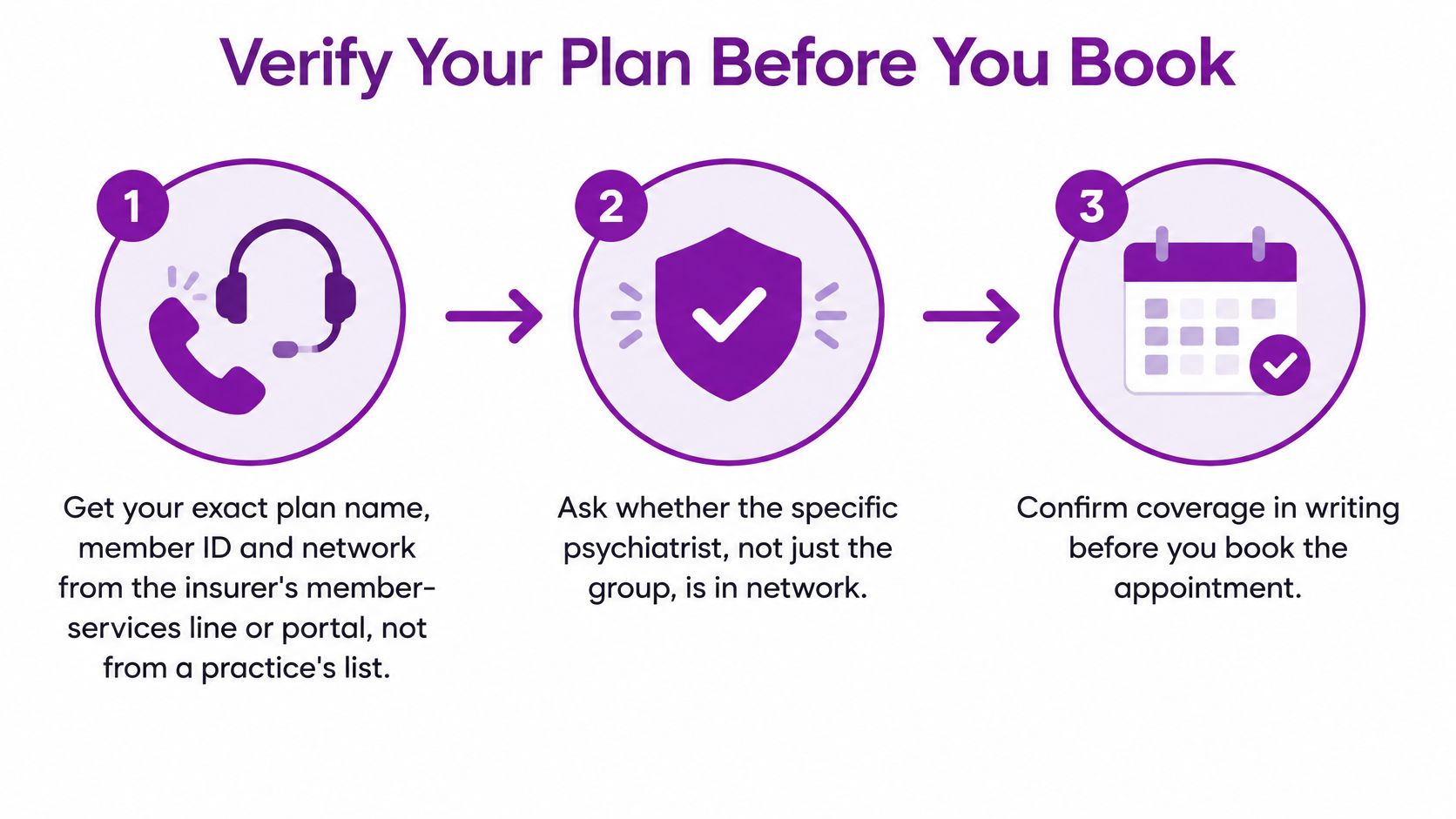
- Get your exact plan name, member ID and network from the insurer. Log into the member portal or call the number on your card. Plan names repeat across products, and a PPO and an HMO under the same brand network differently.
- Ask whether the specific psychiatrist is in network, not just the group. A group contract does not enroll every clinician at every office.
- Ask whether that clinician is accepting new patients today. Panel status changes weekly.
- Ask for the earliest opening for an initial medication evaluation and for the first follow-up. A six-week first visit and a two-week follow-up are different problems.
- Ask whether medication management is billed separately from therapy. Many people see a prescriber for 20 minutes and a therapist for 50, and the plan can apply different cost sharing to each.
- Request outpatient behavioral-health benefits in writing, including your deductible, copay or coinsurance, prior authorization rules and any visit limits.
- Write down the representative's name and the date of the call. If the claim later processes differently, that note is where an appeal starts.
Once you have chosen a clinician, ask the office for its National Provider Identifier and the procedure codes it will bill, then compare those against the insurer's allowed amount. A step-by-step walkthrough of how to verify insurance coverage before booking can keep the office side and the plan side of that conversation straight.
reVIBE Mental Health asks clients to call and verify insurance eligibility before scheduling, because the plan's answer decides the bill. If you are checking coverage for a teenager, expect extra layers: insurance coverage for teen day treatment usually runs through a different benefit category than a weekly outpatient visit, so ask the insurer to confirm the exact level of care before anyone books.
Listed in Your Plan Does Not Mean an Appointment Is Open
You find a psychiatrist in your plan's directory, six miles from home, with a profile that matches what you need. You call. The next new-patient appointment is in seven weeks.
That's a ghost network: a directory entry that exists on paper and produces no appointment. Research on commercial-insurance directories found that only some listed clinicians produced a specific appointment, and the mean wait among the bookings that succeeded was 20.5 days, rising to 22.5 days for psychiatry compared with 17.3 days for psychology, according to the published analysis of directory accuracy.
The phone call in that scenario is where many give up.

None of that makes the directory useless. It means the directory answers one question (is this clinician contracted) when you have three: contracted, open, and affordable. Ask the availability questions before you invest in a first visit, and treat a directory listing as a lead rather than a confirmed appointment.
What to do while you wait
- Ask about telepsychiatry. A video visit can sometimes be scheduled sooner than an in-person one, and it's worth confirming the plan covers it at the same level.
- Ask for interim support. A therapist, or your primary care clinician, can start symptom tracking and sleep work now rather than after the waitlist clears.
- Ask to be called. Offices get cancellations, and a receptionist who has your name will often fill a Thursday slot faster than the portal will.
Waiting hurts most when it interrupts medication continuity. Someone stable on an antidepressant for two years who suddenly has no prescriber is in a different position from someone scheduling a first evaluation.
If you're having thoughts of harming yourself, call or text 988 or go to an emergency department. Don't wait out a routine appointment.
What You Owe After Your Plan Says Covered
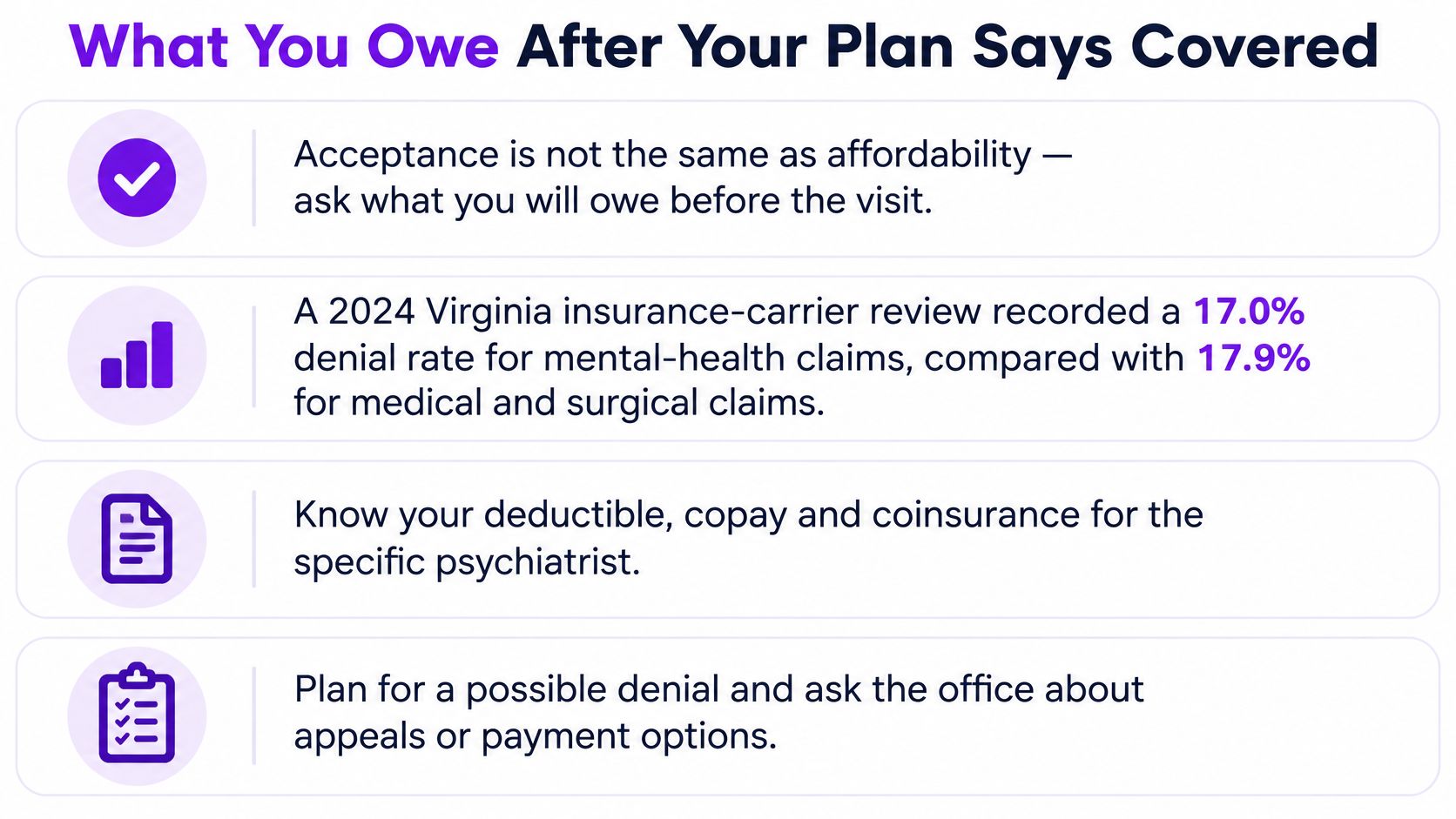
Covered doesn't mean free, and it doesn't mean the claim pays. A psychiatrist can be in network, submit the claim correctly, and still leave you with a balance that arrives six weeks after the visit.
A 2024 Virginia insurance-carrier review recorded a 17.0% denial rate for mental-health claims, against 17.9% for medical and surgical claims, with substance-use claims denied at 25.6%, per the 2024 Virginia insurance-carrier review. The structural problem sits underneath those figures: psychiatrist visits were reported as 8.9 times more likely to fall out of network than medical visits.
The terms that decide your bill
Deductible is what you pay for eligible care before the plan starts contributing. Copay is a flat amount per covered visit. Coinsurance is your percentage of the allowed amount, usually after the deductible, so a 30% coinsurance on a $200 allowed amount is $60 to you.
Prior authorization means the insurer must approve care based on documented medical necessity before it happens, and it can delay a first prescription or continued visits. Visit caps limit how many sessions a plan covers per year. Balance billing is a provider charging you the difference above the allowed amount, a risk that mostly shows up out of network.
Out-of-network care isn't automatically uncovered. Under parity rules, a plan that covers out-of-network medical services generally must offer comparable out-of-network mental-health coverage, though with its own deductible, higher coinsurance, balance billing exposure or claim-submission requirements, as the Arizona mental-health parity guidance describes. For Medicare, qualifying outpatient mental-health services run through Part B while prescriptions generally go through Part D.
Enforcement can shift too. In May 2025, federal agencies announced they would not enforce the 2024 Mental Health Parity final rule while reconsidering it, which means parity on paper doesn't guarantee predictable payment.
Ask before the first visit: how does this office handle a denied claim, and what happens if the insurer processes the visit out of network?
If you see an out-of-network clinician or pay cash, ask for an itemized receipt every time. A practical guide to using superbills for out-of-network reimbursement explains what the document has to contain and how a plan typically responds to it.
Confirm Coverage and Find a reVIBE Location
A card in your wallet is not the same thing as a covered visit on the calendar. Three answers have to line up before you book: the clinician is in network for your specific plan, that clinician is taking new patients, and you have a written sense of what you will owe after the claim is processed. Miss one of those and the slot you thought was settled can fall apart the week you were supposed to sit down.
Call the member-services number on your card first. Ask for your outpatient behavioral-health benefit in writing, and ask whether psychiatry and medication management are covered the same way as therapy. Write down the representative's name and the date. A verbal "you're covered" works like a weather forecast. It is useful until the claim arrives and nobody can find who said it.
Then call the practice with those notes in front of you. reVIBE Mental Health has five Arizona offices, in Scottsdale, Tempe, Chandler, Phoenix, and Paradise Valley, and offers appointments seven days a week, in person or online. Clients call (480) 674-9220 to confirm the nearest location, open times, and insurance eligibility before an appointment is scheduled.
Commonly accepted plans include Aetna, Banner Aetna, Banner University, Blue Cross Blue Shield, Cigna, Medicare, Mercy Care, UHC Commercial, and UHC Community Plan. If your plan is not on that list, use the same number and ask them to check it. A directory listing and an open appointment are different facts, so eligibility has to be confirmed before you are put on the schedule.
If the full fee is hard to manage, ask the therapist about a sliding scale during the initial consultation. reVIBE accepts most major credit cards, plus HSA and FSA accounts, so the amount due at the visit can come from a health account. If your coverage changes later, the website has a Client Portal and an Insurance Change Form so the file matches the card you will use.
The match matters as much as the network status. reVIBE pairs clients with a therapist or psychiatric provider based on the concern and the client's preferences, for talk therapy, psychiatry, or medication management. Bring your plan name, member ID, and whether you want a local office or an online visit. One call can sort network status, an open time, and a cost estimate you can plan around. Locations and insurance details are at reVIBE Mental Health.