
Does a depression that makes you oversleep and overeat really call for the same pill as a depression that makes you stop eating and wake before dawn? Patients often never hear a straight answer, because the appointment moves from questionnaire to prescription before anyone asks about sleep, appetite, or how heavy your legs feel.
That silence leaves a gap. The symptom pattern clinicians call atypical features is well described, and it shapes which medications get considered. Yet the drug list and the pattern rarely get explained in the same place. You end up with a page of drug names on one tab and a symptom checklist on another, with nothing connecting them.
Those two things belong together, because the pattern narrows the options and each option carries a different cost in weight, sleep, blood pressure, and appointments. What no article can do is pick the pill for you. Prescribing belongs to a licensed psychiatric clinician who has your history, your current medication list, and your blood pressure numbers in front of them.
Medication Options for Atypical Depression at a Glance
| Medication class | Examples | Typical role | Main trade-off |
|---|---|---|---|
| SSRIs | sertraline, escitalopram, fluoxetine | usual first-line choice | sexual side effects, nausea, early jitteriness |
| SNRIs | venlafaxine, duloxetine | alternative when SSRIs don't help | blood pressure rise, withdrawal symptoms if stopped abruptly |
| Bupropion | bupropion | second-generation option often weighed for fatigue or low energy | insomnia, anxiety, seizure risk at high doses |
| Mirtazapine | mirtazapine | considered when insomnia and poor appetite dominate | sedation, weight gain |
| Tricyclics | imipramine | older option used selectively | anticholinergic effects, heart rhythm risk in overdose |
| MAOIs | phenelzine, tranylcypromine | specialist-supervised later-line option | dietary tyramine restriction, drug interactions |
| Dextromethorphan-bupropion | Auvelity | FDA-approved in 2022 for adults with major depressive disorder | seizure and blood pressure monitoring |
| Esketamine nasal spray | Spravato | FDA-approved in January 2025 as monotherapy for adults with major depressive disorder who had an inadequate response to at least two oral antidepressants | in-clinic dosing, dissociation, sedation, blood pressure |
| Atypical antipsychotic add-on | aripiprazole, quetiapine, olanzapine, brexpiprazole | augmentation when depression needs more treatment | weight, glucose and lipid changes, sedation |
How to Read the Table
The order isn't a ranking. Rows near the top sit there because they get used most often, not because they work best for every person. Anyone who tells you there's a single correct drug for atypical depression medication has skipped the part where your history, your other prescriptions, and your blood pressure decide the fit.
The two first-line families, SSRIs and SNRIs, dominate because decades of use have mapped their risks clearly. Everything below them is either a variation on that theme (bupropion and mirtazapine, both second-generation drugs chosen for a specific symptom profile) or a step into closer supervision: older tricyclics and MAOIs, newer agents like Auvelity and esketamine, and antipsychotic augmentation.
None of those rows is a default for every patient. Your own treatment history carries more weight than the symptom label. So does whether anyone in your family has bipolar disorder, whether you've had a seizure, and whether you can tolerate months of a side effect that bothers you daily.
If you want the symptom list in plain language before your appointment, Total Mental Wellness's overview of atypical depression lays out the pattern clearly, which makes the conversation with a prescriber much faster.
Three Questions Worth Bringing to an Appointment
Ask these out loud: what exactly have I already tried, at what dose, and for how many weeks? Which side effects would disrupt my work or my sleep the most? What monitoring does this plan require, and who is responsible for it?
Vague answers to those three questions are a signal. A prescriber who can name the prior drug, the dose, and the duration is working from data rather than impressions.
What Atypical Features Mean for Medication Choice
Could the pattern of your symptoms shape which medication is worth discussing? A prescriber looks at how depression affects your mood, sleep, appetite, energy, and relationships, then weighs those details alongside your medical and treatment history.

Atypical features can include mood that lifts in response to positive events, sleeping more than usual, increased appetite or weight, a heavy feeling in the arms or legs, and heightened sensitivity to rejection. This pattern helps describe what to assess. It does not, by itself, identify the right drug. A plain-language list of atypical depression symptoms can help you recall which experiences to raise with a clinician.
Two Words That Cause Confusion
Atypical antipsychotics are a medication class, not another name for atypical depression. The word “atypical” refers to different things in these two terms: one describes a depression symptom pattern, while the other identifies a type of medication.
Treatment resistance is separate, too. It describes depression that has not improved adequately with previous treatment. A person can have atypical features, treatment resistance, both, or neither. Each points to a different part of the prescribing conversation.
A clinician also checks for conditions that may change the approach. Bipolar-spectrum illness matters because antidepressant treatment in someone with unrecognized bipolar depression can destabilize mood. Trauma, sleep disorders, substance use, other medications, and thyroid problems may also be relevant.
A review in the journal Medicine reported improved depressive outcomes versus placebo when atypical antipsychotics were added to treatment across 56 studies with 11,448 participants. The same review found quetiapine, olanzapine, aripiprazole, and brexpiprazole were each significantly less well tolerated than placebo. That finding captures a practical trade-off: potential symptom benefit must be weighed against the burden of side effects (review in the journal Medicine).
A symptom label describes a pattern. A clinician uses it as one part of a broader assessment, not as a prescription.
The lived trade-offs help make that assessment concrete. Is fatigue, insomnia, or rejection sensitivity disrupting life most right now? How would possible weight gain or sexual side effects affect daily routines? Would a plan requiring a clinic visit and monitoring be manageable? Those questions sit alongside what you have already tried, including the dose and duration. A licensed prescriber can use your answers and health history to discuss options suited to your needs.
Why SSRIs and Bupropion Usually Come First
Why might a clinician start with an SSRI or bupropion rather than a medication associated with atypical symptoms? The first choice weighs evidence against everyday burdens, including effects on sleep, weight, energy, and sexual function. It also leaves room to adjust if the first option does not help.
Second-generation antidepressants, including bupropion and mirtazapine, are recommended as first-line medication options for adult depression. Choosing among them is a shared decision that considers previous response, coexisting medical or psychiatric conditions, cost, and potential adverse effects, as described in the American Academy of Family Physicians' depression review. The atypical symptom pattern can inform the discussion, but it does not dictate one specific drug.
The Typical Sequence
You and your prescriber choose a first medication, then allow enough time at a therapeutic dose to assess its effects. That usually means several weeks. If symptoms persist, the plan may continue, change, or switch medications. A trial that ends before the dose and duration are adequate may not show whether the treatment could help.
Symptoms can guide the choice. For example, heavy fatigue and low motivation may make bupropion, which tends to be activating, worth discussing. Severe insomnia alongside poor appetite may bring mirtazapine into consideration. Its potential to cause sedation and weight gain is part of that trade-off, not a footnote.
The rule of thumb: assess a first-line drug after reaching a therapeutic dose and allowing enough time, rather than judging it by how you feel after ten days.
Mirtazapine is one of several antidepressants with evidence for acute response. Medication tends to work best when combined with psychotherapy, rather than treated as the whole intervention.
A Checklist for Judging a First-Line Plan
- Prior response documented: Can your prescriber name what you took before, at what dose, and for how long?
- Expected early effects named: Which side effects might occur early, and which may fade?
- Follow-up scheduled: Is there a date to review progress, rather than an open-ended refill?
- A failure plan in place: What happens if symptoms do not improve after an adequate trial, and who will decide?
These questions make the plan easier to evaluate. If any answer is unclear, ask your prescriber before you leave.
Older Options for Stubborn Symptoms
For atypical symptoms that persist, older antidepressants may enter the discussion. The evidence behind monoamine oxidase inhibitors (MAOIs) needs context: older studies suggested an advantage over tricyclic antidepressants, but that does not mean MAOIs are automatically the best choice.
A systematic review of four randomized trials found MAOIs superior to imipramine, a tricyclic, with response rates of 71% (83/116) versus 46% (55/120) and an effect size of 0.27 (95% CI, 0.16 to 0.42), as summarized in this review of atypical depression treatment evidence. That evidence helps explain why phenelzine and tranylcypromine still come up when atypical symptoms remain difficult to treat.
The Qualification That Matters
Later comparisons found no significant efficacy advantage for MAOIs over SSRIs. The older advantage was against tricyclics, not a clear reason to skip newer first-line options. Atypical symptoms describe a pattern of depression; treatment resistance describes insufficient improvement after treatment. Neither term means the same thing as atypical antipsychotics, which are a separate medication category.
The trade-offs matter because medication choice affects daily life, not only symptom scores. MAOIs can require dietary changes and careful coordination with other medicines. Tricyclics carry their own burdens, including anticholinergic effects and concern about heart rhythm in overdose.
- Tyramine reactions: Aged cheese, cured meats, fermented products, and some tap beers can trigger a hypertensive reaction with MAOIs. Dietary guidance is part of using these medications safely.
- Drug interactions: Many medicines and supplements can interact, including over-the-counter cold products and stimulants.
- Washout intervals: Switching to or from serotonergic drugs requires a gap. Skipping it risks serotonin toxicity.
- Tricyclic concerns: Dry mouth, constipation, and urinary hesitancy can occur. Cardiac rhythm risk in overdose is serious.
Before considering an MAOI or tricyclic, review your full medication and supplement list with a licensed clinician, including products bought without a prescription. Ask what dietary guidance applies to you and how blood pressure and interactions will be monitored between visits. These practical demands belong in the decision alongside the expected benefit.
Newer Options Like Auvelity and Esketamine
Could a newer medication change the balance between symptom relief and treatment burden? Auvelity and esketamine offer options with different mechanisms and practical requirements, but neither is chosen based on atypical symptoms alone.
The FDA approved Auvelity on August 18, 2022, as an extended-release combination of dextromethorphan hydrobromide and bupropion hydrochloride for adults with major depressive disorder, according to American Psychiatric Association Publishing's approval coverage. Dextromethorphan acts through mechanisms distinct from conventional monoaminergic antidepressants, while bupropion affects norepinephrine and dopamine availability.
What the Auvelity Trials Showed
In six-week trials, Auvelity outperformed placebo and bupropion alone on depression symptoms. These results give context for its potential benefit, but trial averages cannot predict an individual response. A medication that reduces symptoms may still bring side effects or monitoring needs that affect daily life.
The practical trade-offs matter alongside symptom change. Blood pressure, mood, sleep, and side effects can shape which option fits a person's circumstances and what follow-up is needed.
Esketamine and Who Actually Qualifies
Esketamine nasal spray, sold as SPRAVATO, is approved for adults with treatment-resistant depression, used alone or with an oral antidepressant. It is also approved for depressive symptoms in adults with major depressive disorder who have acute suicidal ideation or behavior, with or without an oral antidepressant. See the FDA's esketamine prescribing information.
A good candidate has tried two or more antidepressants without adequate relief. Atypical symptoms, such as sleeping or eating more during depression, do not by themselves establish treatment resistance. The key distinction is the response to prior treatment, not the symptom pattern. A clinician also reviews medical history, current medications, and safety factors when deciding whether SPRAVATO is appropriate.
SPRAVATO is not a nasal spray picked up at a pharmacy for home use. It is available through a restricted safety program and must be administered in a certified healthcare setting. At each session, the patient self-administers the medication under direct clinical supervision, then remains under observation and is evaluated before leaving.
For people considering this option, reVIBE's SPRAVATO treatment information describes its supervised care. Medication choice and prescribing decisions belong with a licensed clinician, who can weigh expected benefits against the demands of treatment and the patient's needs.
Side Effects, Monitoring and Age-Based Safety Checks
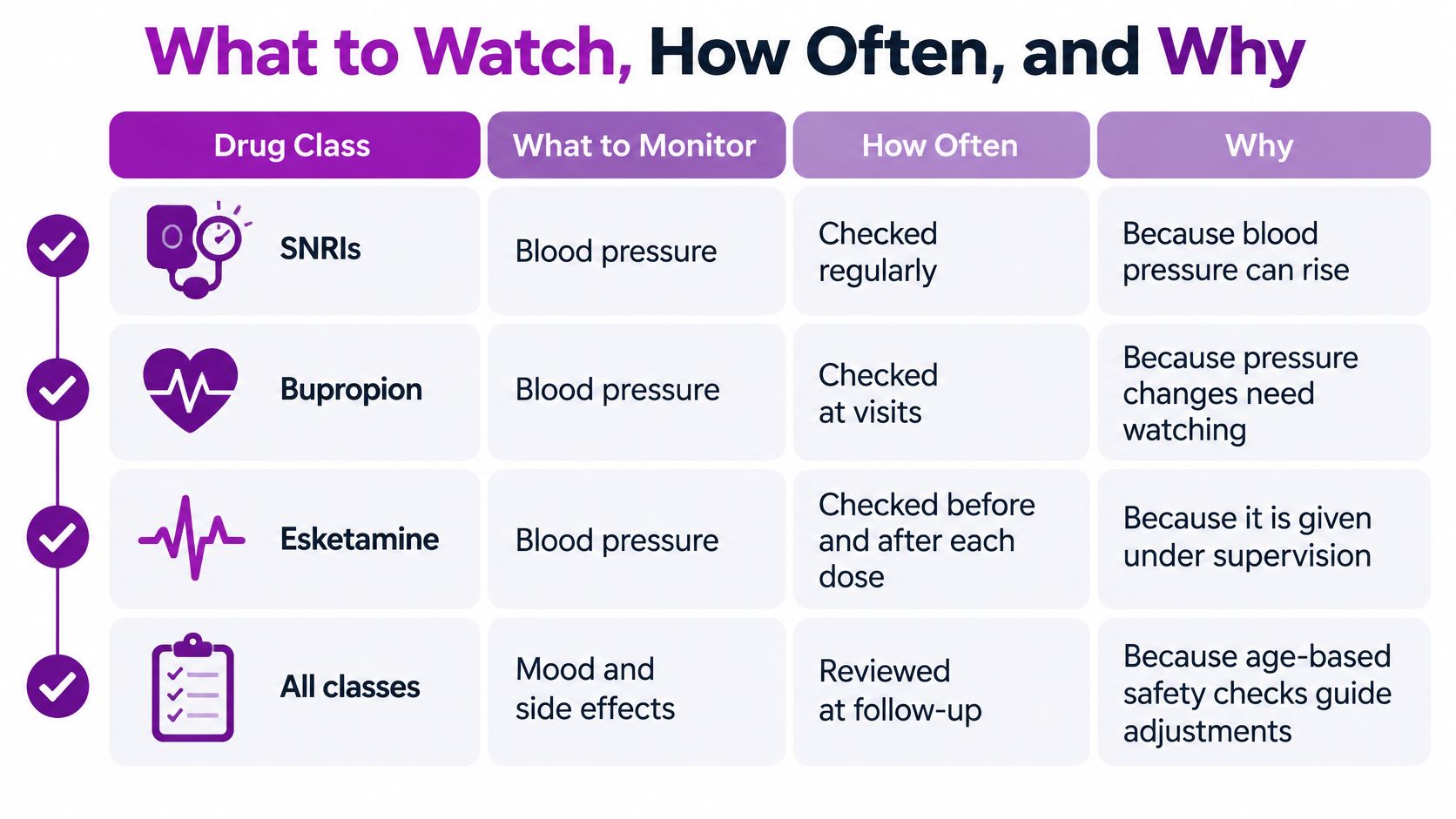
Medication monitoring works like a dashboard: the checks depend on the medicine and the risks that matter for the person taking it. Blood pressure, sleep, weight, and other effects can influence whether a treatment remains a good fit, even when mood symptoms improve.
| Medication class | What to monitor | When it's typically checked | Reason |
|---|---|---|---|
| SSRIs and SNRIs | suicidal thoughts, sodium, blood pressure (SNRIs), sexual side effects | early weeks and after each dose change | labeled age-based warning and common adverse effects |
| Bupropion | seizure symptoms, blood pressure, sleep and anxiety | early treatment and dose changes | seizure risk and stimulant-like effects |
| Mirtazapine | weight, sedation, daytime alertness | each visit and after dose changes | metabolic and sedation effects |
| MAOIs | blood pressure, dietary tyramine, drug interactions | each visit and before any new medicine | hypertensive reactions and interaction risk |
| Tricyclics | heart rhythm, anticholinergic effects | baseline and as clinically indicated | cardiac risk and overdose danger |
| Auvelity | blood pressure, seizure history, bipolar-spectrum symptoms | before starting and at follow-ups | labeled safety considerations |
| Esketamine nasal spray | blood pressure, dissociation, sedation | after each dose, before leaving the clinic | required post-dose observation |
| Atypical antipsychotic add-on | weight, waist, fasting glucose, lipids, sleepiness | baseline and periodically | metabolic burden of adjunct treatment |
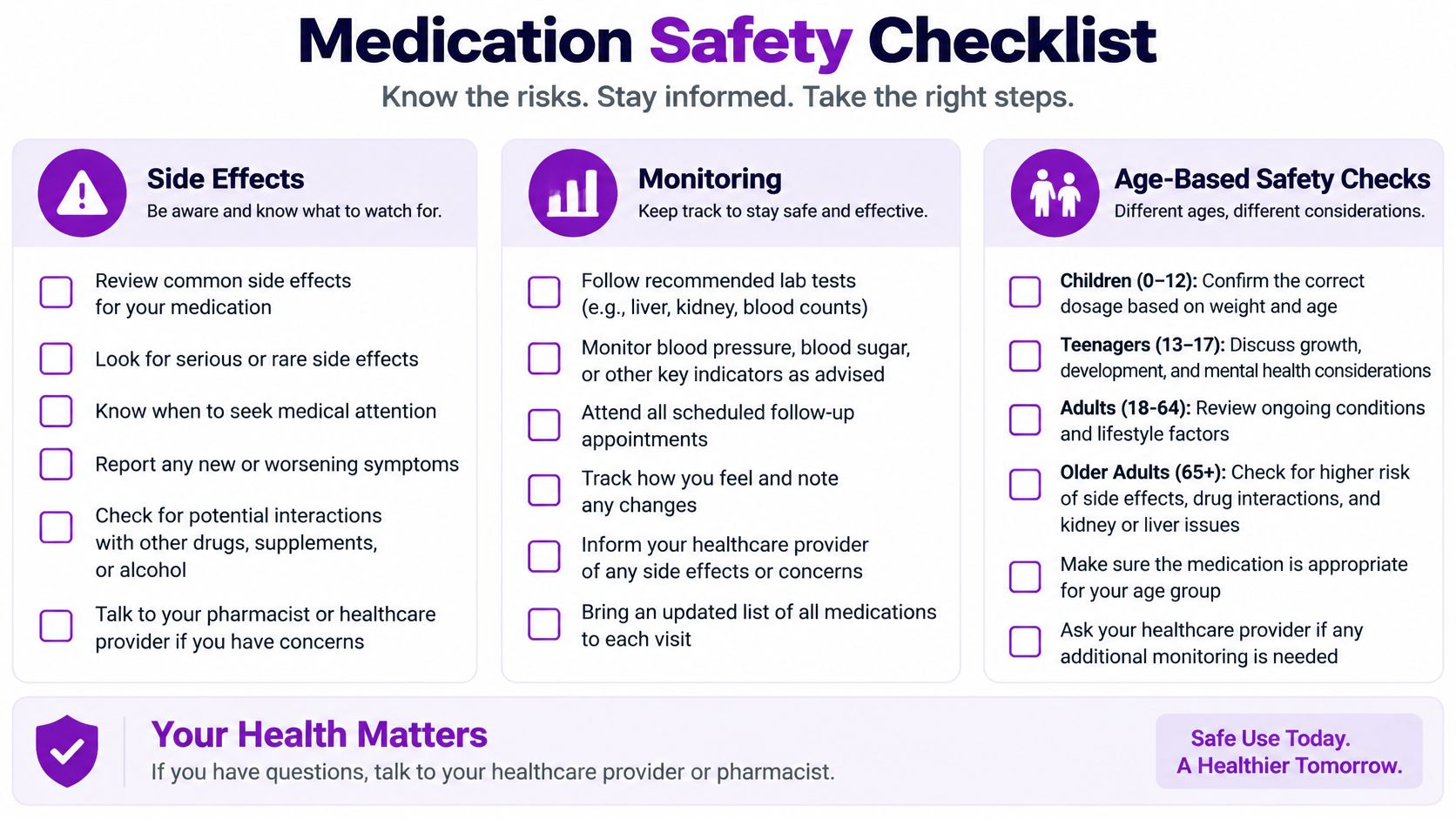
The reason for each check differs. Blood pressure may need attention with SNRIs, bupropion, and esketamine. MAOIs call for review of food choices and potential medication interactions. With an atypical antipsychotic add-on, tracking weight and metabolic measures helps make its physical effects visible. For Auvelity, the prescribing information flags seizure risk, blood pressure, bipolar-spectrum symptoms, and other medications as considerations before prescribing.
What the Age Warning Actually Says
FDA labeling warns about suicidal thoughts and behavior associated with antidepressants in children, adolescents, and young adults. The warning is especially relevant during the first weeks of treatment and after a dose change, when closer observation may be appropriate. The labeling does not report the same increase for adults over 24, and it reports a reduction compared with placebo among adults 65 and older (FDA antidepressant labeling).
These age-related warnings concern thoughts and behavior, not a claim about completed suicide rates. The New York State Office of Mental Health advisory discusses the warning and the need to monitor for changes in mood or behavior. Age is one part of the safety picture; timing also matters, particularly early in treatment and after a dose adjustment.
A side effect can be temporary, persistent, or a sign that the plan needs review. Describing when it began, how it affects sleep or daily routines, and whether it changed after a dose adjustment can help a prescriber assess it. This guide to antidepressant side effects explained offers more context, while medication management for depression explains how ongoing review can support safe prescribing.
Symptoms That Need a Same-Day Call
Esketamine requires monitoring after each dose and an evaluation before the patient leaves the clinic. For any medication, seek prompt help for a serious or sudden change. Call the prescriber the same day, or seek emergency care, for:
- New or worsening suicidal thoughts, or a plan forming where there wasn't one.
- Agitation or an unusual behavior change that people close to you notice before you do.
- Severe headache with high blood pressure, especially while taking an MAOI or an SNRI.
- Chest pain, confusion, or a racing heartbeat after a dose or a new medication.
Talk With a Psychiatric Professional Before Changing Medication
The decision in front of you is whether to start, change, or stop a medication, and who gets to make that call with you. It shouldn't be a solo decision. Abrupt changes to SNRIs, MAOIs, or esketamine-based treatment can trigger withdrawal symptoms, dangerous interactions, or a relapse that takes weeks to reverse.
Bring evidence to the appointment rather than memory. A symptom diary covering mood, sleep, appetite, and energy across two to four weeks is far more useful than a general impression, because patterns show up in writing that vanish in conversation.
What to Bring
- A full medication list, including supplements, sleep aids, and anything bought without a prescription.
- Past treatments with doses and durations, so an "SSRI didn't work" gets tested against whether the dose was adequate and the trial long enough.
- Family history, particularly any bipolar disorder, since it changes which drugs are safe to try.
- Medical conditions that matter here, including blood pressure problems, seizure history, diabetes, and thyroid disease.
A psychiatric professional can confirm the diagnosis, rule out bipolar-spectrum illness, and choose among the options based on prior response and safety. Therapy belongs alongside medication rather than after it, and for anyone moving through perimenopause, hormonal shifts can complicate both mood and sleep, so Lila's guide to menopause and mood swings is worth reading before you attribute everything to depression.
Our psychiatry and medication management services run in person at our Arizona offices or through secure online sessions, and our team can match you to a provider who fits your needs and your insurance. Three actions make the next step concrete: book an evaluation, bring the written list, and call emergency services immediately if thoughts of self-harm appear.
Find a reVIBE Location Near You
reVIBE Mental Health serves people in Scottsdale, Tempe, Chandler, Phoenix, and Paradise Valley, Arizona. To find the location nearest you and confirm contact details, visit the reVIBE Mental Health website.
The practice offers in-person and secure online therapy and medication support. Its therapists and licensed psychiatric professionals provide care for concerns including depression, anxiety, trauma, grief, and relationship issues. If you are seeking psychiatric care, the team can help match you with a provider suited to your needs, preferences, and insurance.
Ask about appointment options and whether in-person or online care fits your situation. A psychiatric provider can review your medication needs and discuss appropriate next steps; prescribing decisions should be made with a licensed clinician.