
What happens when an eating-disorder treatment asks parents to supervise meals, but nobody asks whether they can leave work to do it? Family-based treatment can give caregivers a meaningful role in recovery, but a workable plan needs more than commitment. It needs clear responsibilities, medical oversight, and an honest assessment of the family's time, money, and support.
For families considering family-based treatment for eating disorders, the central question isn't whether parents should help. It's how caregivers can provide effective support without being blamed for the illness or expected to manage risks that require professional care.
Who Does What in Family-Based Treatment
Family-based treatment (FBT) is an outpatient approach for adolescents with anorexia nervosa in which caregivers actively support nutritional rehabilitation while treating the illness as separate from the young person.
Responsibilities by phase in family-based treatment
| Phase | Parents take responsibility for | Adolescent's role | Clinician's role |
|---|---|---|---|
| Phase 1: Restoring nutrition | Planning, supervising and completing meals; interrupting restrictive or compensatory behaviors | Eating with support and following the meal plan | Setting weight goals, monitoring medical risk and coaching parents |
| Phase 2: Returning control | Handing back meal choices gradually as weight recovers | Taking on more independent eating while stable | Reviewing readiness and adjusting the pace |
| Phase 3: Development and ending | Supporting normal adolescent development and relapse prevention | Building autonomy, school and social life | Planning the end of treatment and the follow-up schedule |
Reading the responsibilities in practice
The opening phase places the heaviest practical load on caregivers. Parents organize food, sit through difficult meals, and follow the team's plan when restriction or compensatory behaviors interfere. Their task isn't to win an argument about food or persuade their child to stop feeling afraid. It's to provide steady support while the clinician helps them respond effectively.
As recovery progresses, parents hand back responsibility rather than withdrawing supervision all at once. An adolescent might begin by selecting a snack within the agreed plan, then take on more eating decisions as the team confirms readiness. The final phase makes room for a life that isn't organized around the eating disorder.
The clinician coaches the family rather than trying to fix it. Medical responsibilities must also have a named owner, who may be a separate physician or other qualified medical professional. A therapist's involvement doesn't automatically mean that medical monitoring is covered.
Families sometimes confuse the roles of therapist, physician, and psychiatric provider. Refresh Psychiatry & Therapy's explanation of what pediatric psychiatrists actually do can help clarify where psychiatric evaluation and medication support fit alongside family work.
Confirm the format before committing
The adolescent model discussed here was studied in young people aged 12 to 18; the randomized trial published in 2010 provided 24 outpatient treatment hours over 12 months for adolescents with anorexia nervosa. Families seeking care outside that age range should confirm how the model fits the patient's developmental stage.
Treatment schedules also differ by diagnosis. The NICE eating-disorders guideline describes bulimia-focused family therapy for young people as typically 18 to 20 sessions over six months, with a nonblaming relationship involving both the young person and family.
Before starting, settle these practical questions:
- Breakfast coverage: Who will supervise when the usual caregiver leaves early?
- Weight checks: Who measures weight, interprets changes, and communicates results?
- Meal refusal: What exactly should the caregiver do, and when should they contact the team?
- Scheduling: How long are sessions, who attends, and how will appointments fit around school and work?
How Parents and Clinicians Work Together Day to Day
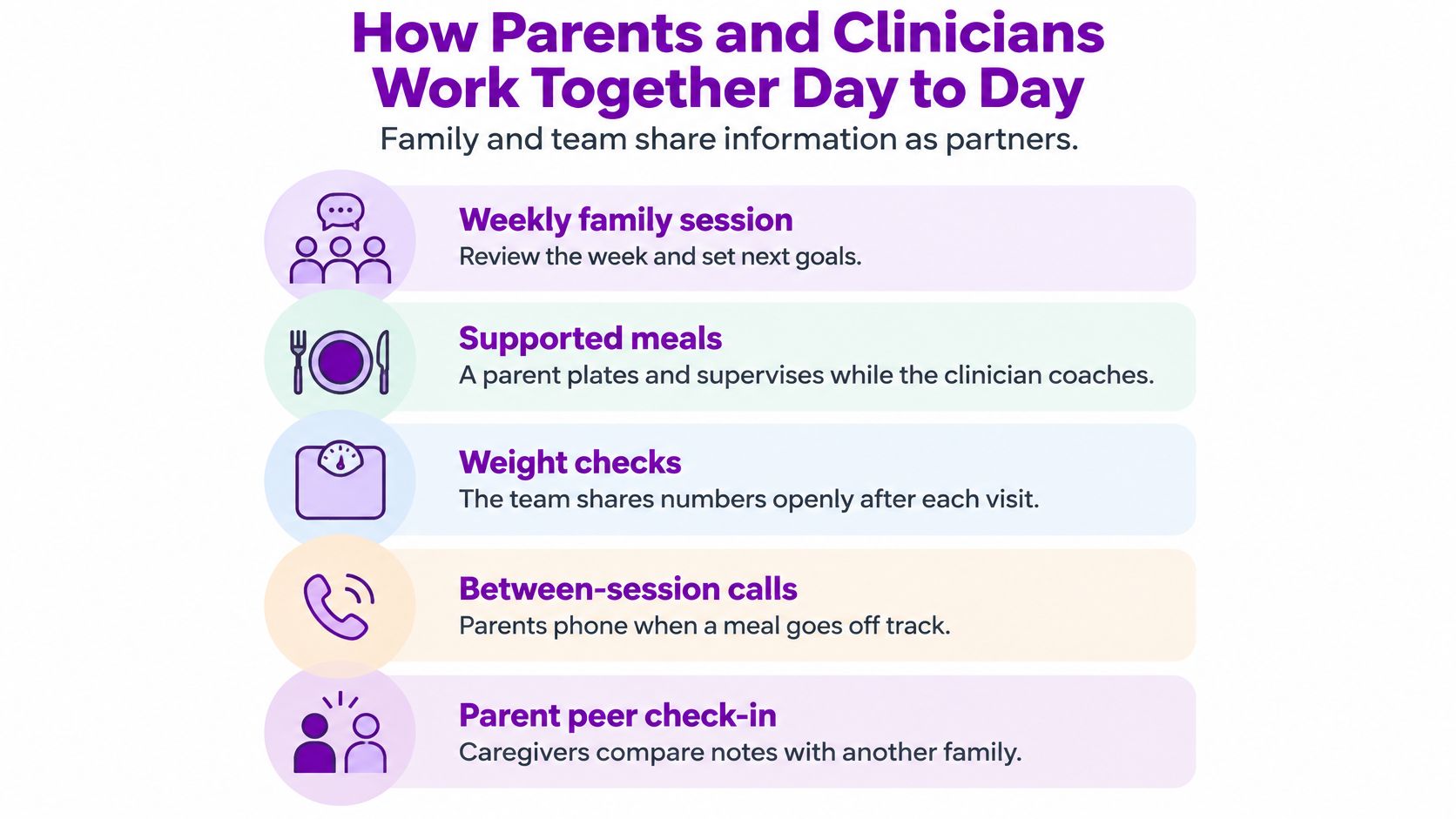
Families and clinicians work best as partners who share information, not as an expert issuing orders to a passive household. At reVIBE, our family therapy process often includes collaboration with parents and caregivers.
A workable week might include a regular family session and agreed brief check-ins between appointments. Say a parent supervises breakfast, records what was eaten and any difficulty completing it, then sends the agreed update before the next session. The clinician can use those observations to adjust support instead of relying on a general impression that meals went badly.
Make communication concrete
Agree on how weight checks and medical observations will be shared, including what the adolescent will hear and how results will be explained. Report dizziness, new meal refusals, or sudden mood changes rather than waiting for the next routine appointment. Confirm which between-session contacts are available; calls and peer support aren't automatic features of every program.
Use consistent, respectful language about the illness without dismissing the young person's account of distress. Parents should also decide who contacts the team when caregivers disagree, so the adolescent doesn't receive competing instructions.
For preparation, Guiding Growth's resource on talking to specialists with Guiding Growth can help families organize concerns. Our eating-disorder meal-support guide offers another starting point for discussing practical support.
Keep a copyable household checklist:
- Meal coverage: Name a supervisor for each meal.
- Reporting: Set a schedule and communication channel.
- Refusal response: Write down the agreed next action.
- Backup: Choose a caregiver who understands the plan.
Signs Each Phase Is Ready to End
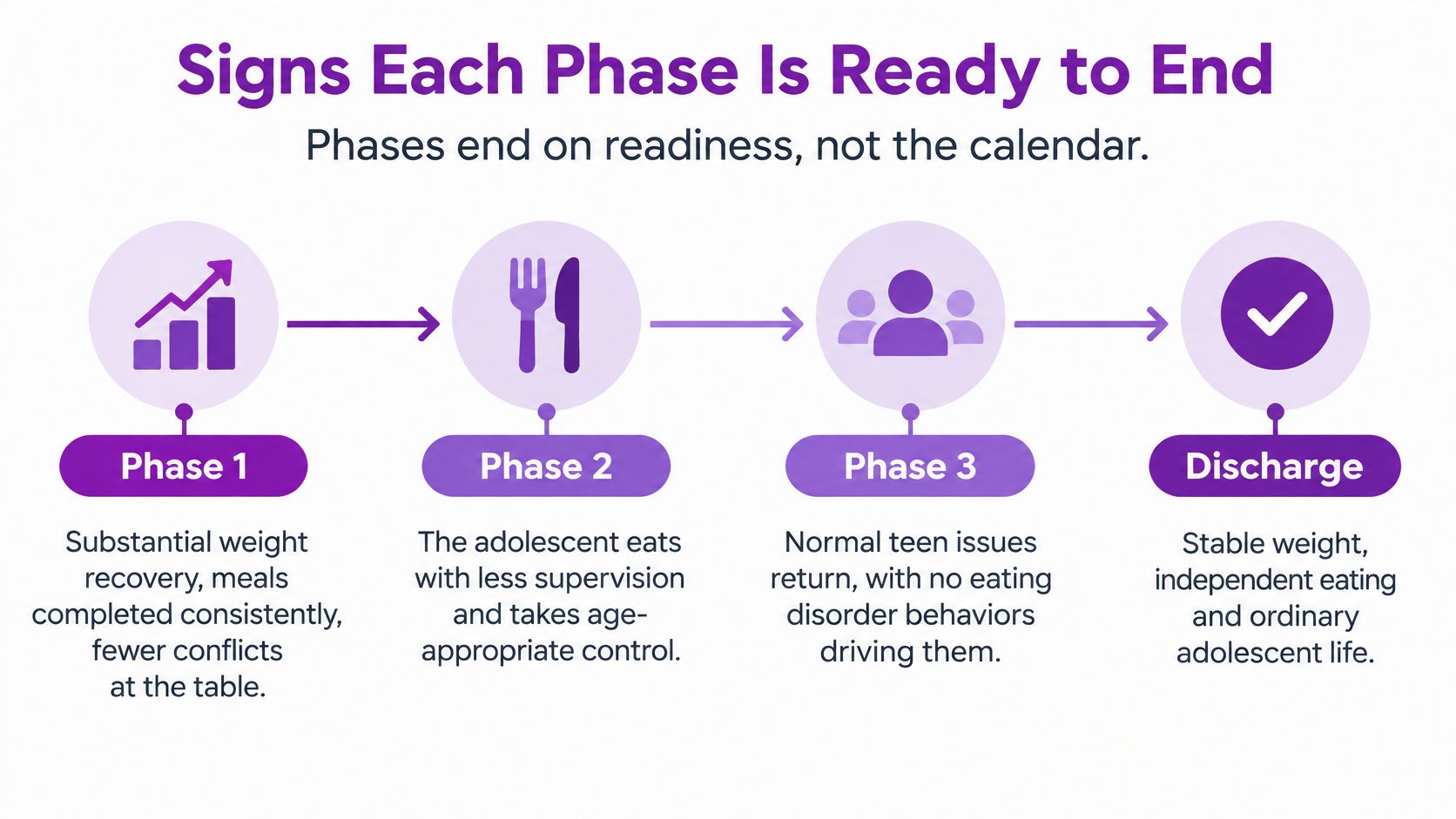
Phases end on readiness, not on the calendar. Finishing a run of appointments doesn't establish that an adolescent can safely manage eating independently. The team needs observable evidence that the next step is manageable.
The American Academy of Pediatrics clinical report describes three phases: caregiver-led weight restoration and interruption of eating-disorder behaviors, gradual return of eating control after substantial recovery, and attention to adolescent development and treatment termination. Parents are resources for recovery, not the presumed cause of illness.
Look beyond a single weight reading
Before reducing caregiver control, the team looks for substantial weight recovery, consistent meal completion, and fewer avoidance or compensatory behaviors. A calmer dinner matters, but it doesn't establish readiness if the adolescent is still skipping food elsewhere.
A clinical review available through the American Academy of Child and Adolescent Psychiatry identifies at least 95% of expected body weight for age and height as a commonly used full-remission weight threshold and approximately 4 to 5 pounds gained during the first month as a favorable early indicator. Neither figure should become a home-prescribed target or the sole basis for a phase change.
The team must interpret weight alongside growth history, medical status, eating behaviors, and psychological symptoms. A research threshold isn't a substitute for an individualized recovery assessment.
Readiness principle: Less supervision should follow demonstrated stability, not pressure to make treatment look finished.
Test independence gradually
During the return of control, the adolescent practices eating with less direct supervision while parents remain available. For example, the young person might portion a familiar lunch with coaching before managing a more demanding situation such as eating away from home.
Setbacks are common, and a transition can move backward when symptoms return. Increasing support again isn't punishment or proof that anyone failed. It's a response to what the adolescent currently needs.
Later work focuses on school, friendships, identity, and independence. Before treatment ends, the family should have a written relapse-prevention plan naming warning signs, who responds, and how follow-up will happen.
Review these questions before changing phases:
- Nutrition: Is the adolescent consistently completing the agreed eating plan?
- Behaviors: Have restriction, avoidance, and compensatory behaviors reduced sufficiently?
- Independence: Can the proposed responsibility be managed without losing stability?
- Communication: Can the adolescent describe difficulty and request help?
- Response plan: Does everyone know when to restore support or contact the team?
Where the Model Came From and What the Evidence Shows
Family-based treatment grew from family-therapy work at London's Maudsley Hospital in the late 1970s and early 1980s, giving rise to the name Maudsley Method, according to a historical review of adolescent family treatment. Its important departure was to mobilize families as resources rather than treating them as the cause of anorexia nervosa.
Historical success needs careful interpretation
The historical review also describes Salvador Minuchin and colleagues' work at Philadelphia's Child Guidance Clinic, where approximately 86% of patients were reported to have a successful outcome. Later Maudsley work found good outcomes at five-year follow-up in about 90% of younger adolescents with shorter illness duration assigned to family treatment, compared with 36% assigned to individual therapy.
Those results helped establish the importance of family involvement, but they aren't universal cure rates. Historical investigators used different definitions of a good outcome, including weight restoration or return of menstruation. Families shouldn't compare those measures directly with modern full-remission criteria.
The clinical contribution was broader than a promising percentage. Caregivers gained a structured role in supporting nutrition, interrupting harmful behaviors, and helping young people regain independence.

What the modern comparison found
A randomized clinical trial of 121 adolescents with anorexia nervosa compared FBT with adolescent-focused individual therapy over 24 outpatient treatment hours across 12 months, with the following full-remission results.
Full remission for FBT and individual therapy over time
| Time point | FBT remission | Individual therapy remission | Statistical note |
|---|---|---|---|
| End of treatment | 42% | 23% | Not significant (p = .055) |
| 6 months | 40% | 18% | p = .029; NNT = 5 |
| 12 months | 49% | 23% | p = .024; NNT = 4 |
At the end of treatment, the numerical difference favored FBT, but it didn't meet the conventional threshold for statistical significance. That distinction matters: a higher percentage alone doesn't establish a reliable difference between treatments.
During follow-up, the advantage was statistically significant. NNT, or number needed to treat, describes how many patients would need FBT rather than the comparison therapy for an additional patient to achieve remission. In this trial, an NNT of five means about five adolescents would need FBT rather than individual therapy for an additional adolescent to reach full remission.
The strongest practical message is that recovery support shouldn't disappear when formal sessions stop.
The follow-up pattern supports attention to sustained recovery rather than judging treatment only by the final therapy appointment. Families need a plan for recognizing renewed restriction, responding to setbacks, and reconnecting with clinicians.
These findings also have limits. They concern adolescents with anorexia nervosa, not every eating disorder or every developmental stage. They don't establish that FBT will work for every household, that individual therapy has no value, or that caregiver effort alone determines the outcome.
For a family choosing treatment, evidence should inform the recommendation without becoming a promise. The useful clinical conversation connects the model's demonstrated benefits with the adolescent's medical needs, the family's capacity, and a clear response if progress stalls.
When Treatment Needs Medical Care or a Different Plan
Waiting until treatment ends to decide whether it's working is the wrong benchmark. Clinicians should review nutritional and behavioral progress within the first one to two months; an evidence review of family therapies found significantly faster weight gain with standard FBT than systemic family therapy during the first 8 weeks in a randomized trial (F = 8.8, p = .003).
That finding supports close attention to early response, not a rigid deadline for recovery. When nutrition isn't improving, the team should investigate promptly rather than telling caregivers to try harder.
Medical instability changes the priority
Bradycardia, electrolyte abnormalities, severe malnutrition, dehydration, and other acute risks require medical assessment and stabilization before or alongside family treatment. Bradycardia means an abnormally slow heart rate. Electrolyte disturbances can't be reliably identified by watching how energetic someone seems.
Family treatment is not a substitute for medical care. A young person may be participating in therapy and still need urgent medical evaluation. Parents shouldn't be expected to determine safety from appearance, a bathroom scale, or whether the adolescent says they feel fine.
Ask the medical team for written instructions identifying urgent symptoms, the appropriate contact route, and where to seek emergency assessment. If the adolescent collapses, has chest pain, becomes confused, or appears acutely unsafe, seek emergency care rather than waiting for a therapy callback.
Safety rule: A household plan can organize care, but it can't replace medical stabilization.
Reassess the plan, not the family's character
If weight gain or behavioral interruption is inadequate, review medical status, caregiver implementation barriers, family conflict, and co-occurring conditions. Clarify whether the obstacle is insufficient supervision, intolerable distress, a medical complication, or a schedule nobody can realistically sustain.
NICE recommends anorexia-focused family therapy for young people with anorexia nervosa, using single-family sessions or a combination of single- and multi-family work. That doesn't mean every family-oriented intervention is interchangeable or that identical delivery fits every diagnosis.
A higher level of care may be necessary when outpatient support can't maintain safety or provide enough structure. When discussing an intensive outpatient program for eating disorders, establish whether the adolescent is medically appropriate for that setting and who remains responsible for medical monitoring.
Contact the team the same day for:
- New physical symptoms: Dizziness, near-fainting, unusual weakness, or difficulty maintaining hydration.
- Escalating behaviors: New meal refusals, increased purging, or rapidly worsening restriction.
- Loss of supervision: A caregiver can no longer carry out essential meal support.
- Psychiatric changes: Marked mood deterioration, self-harm concerns, or statements suggesting the young person cannot stay safe.
Adapting Family Treatment to Real Schedules and Budgets
A family that can't carry out the proposed schedule isn't necessarily unwilling to participate. Caregiver capacity is a clinical variable, not a test of love or motivation. A plan requiring unavailable time, transportation, food, or language access needs revision.
Interviews with Medicaid-insured families identified barriers involving job security, family leave, other dependents, food insecurity, caregiver resources, and culturally or linguistically appropriate services. These are practical constraints that clinicians need to assess directly.

Match each barrier with a concrete response
Consider a single parent working rotating shifts. Telling that parent to supervise every meal doesn't create coverage. A more useful discussion identifies a trusted relative or friend, confirms the adolescent's safety with that person, and provides coaching so both caregivers follow the same plan.
Adapt delivery while preserving nutritional support, behavioral interruption, medical oversight, and a route back toward autonomy:
- Unpredictable work hours: Discuss flexible appointments, shorter sessions where clinically appropriate, and a written meal-coverage schedule.
- Transportation difficulties: Explore telehealth check-ins and coordinated medical visits, while preserving required in-person assessments.
- Food insecurity: Request food-support referrals and a nutrition plan using foods the household can reliably obtain.
- Language barriers: Arrange a qualified interpreter rather than relying on the adolescent or a sibling to translate clinical decisions.
- Other dependents: Plan sibling care for appointments and identify who handles household tasks during supervised meals.
- Caregiver uncertainty: Request practical coaching, including rehearsal of what to say and do when a meal becomes difficult.
For technology planning, HearSmart's resource to compare virtual doctor visit apps can help families identify usability questions. Confirm the treating team's actual platform, privacy arrangements, and clinical suitability rather than choosing an app independently.
Address cost and cultural fit early
Discuss insurance authorization before establishing a schedule the family assumes will be covered. Ask who handles verification, what documentation is needed, and what happens if authorization changes. Our family-therapy cost guide can help organize the financial conversation without assuming a particular charge or benefit.
For work accommodations, identify the attendance and supervision demands that need documentation. For sibling care, distinguish between occasional help from relatives and an expectation that another child will become responsible for treatment.
A review of family-treatment adaptations highlights uncertainty about cultural and developmental fit, including misconceptions that boys cannot develop eating disorders. Families may need interpreters, extended or chosen supporters, sensory accommodations, or different explanations of caregiver authority; evidence about which adaptations best preserve outcomes remains limited.
Flexibility shouldn't mean removing essential support. If no safe coverage can be arranged, clinicians need to consider a different delivery plan or level of care rather than labeling the family resistant.
Bring these questions to the team:
- Coverage: Which responsibilities require a trained adult, and who can safely share them?
- Feasibility: What can change about scheduling or delivery without compromising care?
- Contingency: What will we do if our available resources still aren't enough?
Next Steps and Questions to Settle Before Starting
What should you bring to the first consultation? A short list of decisions you want the team to make with you. Ask the clinician to explain the family-based model in plain terms and to sketch the first two weeks: who attends which session, who weighs the patient if weight monitoring is part of care, and who receives those results. Bring the responsibilities table, readiness checklist, and adaptation questions so the conversation produces a starting plan.
At reVIBE, personalized matching helps clients find a therapist or psychiatric care provider whose specialization and preferences fit their needs. When you discuss eating-disorder care, confirm the specific clinician's training, the model being offered, and how outside medical or nutritional professionals will participate.
Leave with a usable starting plan
Before committing, settle the following:
- Treatment model: Which family-based approach will be used, and what does caregiver participation look like in a normal week?
- Medical oversight: Who schedules weight checks, assesses medical risk, and shares results with the therapy team?
- Meal coverage: Who takes over when the primary caregiver is unavailable, and what backup is realistic?
- Session format: Which appointments require the family together, and which can happen online?
- Authorization: Who handles insurance verification, and who tells the family when coverage changes?
- Capacity plan: What will the team adjust if work, money, or caregiving limits reduce what the family can sustain?
That last question treats caregiver capacity as a clinical variable. A plan that assumes unlimited availability is not stronger; it is more likely to collapse. Ask the team to state what is required, what can be shared, and what triggers a different level of support.
reVIBE serves families across Scottsdale, Tempe, Chandler, Phoenix, and Paradise Valley, Arizona, with in-person and telehealth options. Online availability does not establish that every eating-disorder assessment can happen remotely, so confirm the medical arrangements for the individual patient. Visit the reVIBE Mental Health website for contact details.
You do not need a perfectly organized household before seeking help. You need a candid conversation about safety, responsibilities, and what your family can sustain, followed by a plan that names who will do what.
reVIBE Mental Health offers family therapy, eating-disorder support, and coordinated psychiatric care with in-person and secure online options. Visit reVIBE Mental Health to discuss caregiver involvement, provider matching, and the next steps toward a treatment plan that fits your family's needs.