

A typical national self-pay family therapy session costs $120–$300, while insured Phoenix-metro visits often land at a $20–$75 copay once the deductible is met. The amount your family pays depends less on the posted fee than on how the session is coded, where the therapist sits in your network, how much of your deductible remains, and how the treatment is structured.
That distinction matters. A practice may quote a cash rate, an insurer may assign a negotiated allowed amount, and your final responsibility may be a copay, coinsurance, deductible payment, or the entire bill. Families who ask only, “What's your session fee?” often get the least useful answer.
I've walked Phoenix-area families through enough billing questions to know that the family therapy cost on a website is only the starting point. A longer session in Scottsdale, billed out of network before a deductible is met, can create a very different bill from a shorter in-network visit in Tempe. The right way to budget is to examine the four variables together, not compare sticker prices in isolation.
What Family Therapy Cost Looks Like in 2026
For planning purposes, start with the national cash range of $120–$300 per family session without insurance. Some private-practice reports place family therapy as high as $400 per hour, while commonly cited individual therapy self-pay averages sit around $100–$200 per session. The difference reflects the additional participants, coordination, preparation, and time involved in family work. Therapy Explained's family therapy cost guide provides the broader comparison.
Phoenix-metro families using insurance may pay a much smaller amount after benefits apply. An insured visit can involve a copay of roughly $20–$75, but that figure usually assumes the service is covered and the deductible has been satisfied. Before then, the family may owe the plan's allowed amount or another contract-defined share.
The posted cash rate, the negotiated insurance rate, and your out-of-pocket amount aren't interchangeable:
- Posted cash rate: The practice's price when you pay without insurance.
- Allowed amount: The maximum amount the insurer recognizes for a covered service under its contract.
- Patient responsibility: What remains after the plan applies the deductible, copay, coinsurance, and network rules.
A 2024 private-practice dataset reported an average therapy fee of $139 per session, up from $123 in 2019, while a separate market summary estimated the national average increased from about $130 in 2020 to $165 in 2026, roughly 27 percent. SimplePractice's fee analysis shows why a 2026 title needs current context. A modest 3–5 percent inflation projection from recent fee levels is a budgeting assumption, not a universal Phoenix price, because provider supply, credentials, location, and appointment length vary.
Family therapy cost ranges at a glance
| Payment Type | National Range | Typical Phoenix-Metro |
|---|---|---|
| Self-pay family session | $120–$300 | Ask each practice for its current quote |
| Higher-end private practice | Up to $400 per hour | More likely with extended sessions or specialized care |
| Insured visit after deductible | Copay roughly $20–$75 | Depends on plan, network, and billing |
| Individual therapy comparison | About $100–$200 | Useful only as a baseline, not a family-session quote |
Before booking, compare the rate and the benefit structure together. A practical starting point is reVIBE's therapy session cost guidance, then confirm the exact family-service quote and insurance treatment directly with the office.
What Family Therapy Actually Is and Why It Costs More
Family therapy is clinician-led treatment involving multiple family members, either in person or through secure telehealth. The clinician isn't just moderating a household conversation. They're assessing interaction patterns, communication breakdowns, emotional responses, and sometimes the family's role in treating one member's diagnosed condition.
That makes it different from individual therapy and couples therapy. Individual therapy centers on one patient and one clinician, usually through one person's symptoms, goals, and diagnosis. Couples therapy is dyadic, meaning the clinician works with two partners, generally around the relationship. Family therapy may include parents, children, siblings, or other caregivers, and the clinician must track how each person affects the treatment process.

Why the clinical work is more complex
The fee usually reflects more than the number of people on screen. A family appointment can require:
- More scheduling coordination: Several calendars must align, and the clinician may need to clarify who must attend.
- Longer blocks: Family work may be scheduled for 75–90 minutes, especially when conflict is active or several perspectives must be heard.
- Additional preparation: The therapist may review multiple histories, parent reports, school concerns, or prior treatment notes.
- More complex clinical tracking: The clinician must monitor several emotional states and relationships at the same time.
That complexity also affects insurance. Family psychotherapy may be billed with CPT 90847 when the identified patient is present, while CPT 90846 is generally used for family psychotherapy without the patient present. Payers can deny a family session without the identified patient when the coding and medical-necessity requirements don't support that service.
The result is a service that can't be priced as a simple “add another person” appointment. The therapist is managing a larger clinical system, not just a larger waiting room.
Practical rule: Ask whether the appointment is being treated as clinical family therapy, relationship counseling, or a family meeting. Those descriptions can lead to different billing outcomes.
The Four Factors That Drive Your Final Bill
Four variables usually determine whether a family session feels manageable or unexpectedly expensive: session length, provider credentials, format, and Phoenix-metro location. They interact. A short virtual visit with a less experienced clinician can cost far less than an extended in-person appointment with a highly credentialed specialist.
Session length changes the monthly math
A 45-minute check-in may fall around $90–$150 cash, while a 90-minute intensive can reach $250–$400. Those figures are planning ranges from the provided market data, not a promise from every Phoenix office. The important point is that one extended appointment can change the month's total more than a modest difference in the standard rate.
Ask whether the provider bills in a standard block, offers a longer family format, or requires extended appointments for the first visit. A family attending weekly may need to budget for the occasional longer session rather than multiplying the basic fee by four.
Credentials affect the rate
Training and licensure also influence pricing:
| Cost Driver | Low-End Estimate | High-End Estimate |
|---|---|---|
| Session length | $90 for a shorter check-in | $400 for a 90-minute intensive |
| LCSW | $120 | $200 |
| LMFT | $130 | $220 |
| Psychologist or psychiatrist | $200 | $350 |
| In-person office format | Online baseline | Often $30–$50 higher |
These ranges come from the supplied market guidance. They should help you compare quotes, not encourage you to choose a credential by price alone. A clinician's fit with the family's needs can matter more than saving a small amount per visit.
Format and location add another layer
In-person care carries office overhead that telehealth may not. A Scottsdale office can also produce a different rate from a practice in another part of the metro area. The supplied Phoenix planning data places Gilbert and Queen Creek clinicians roughly 15–20 percent below central Phoenix rates, while Paradise Valley and north Scottsdale may sit about 25 percent above. Those location comparisons should be treated as directional market estimates, not guaranteed averages.
Two families can receive clinically similar care and pay very different amounts because one chooses a 90-minute in-person appointment with a senior clinician, while the other uses a shorter telehealth visit with a different provider. Savings come from choosing the right combination, not from chasing the lowest advertised number.
How Insurance Actually Handles Family Sessions
The most common mistake is assuming that having insurance means family therapy will be covered. Usually, coverage depends on whether one family member is the identified patient, whether the session is medically necessary for that person's diagnosed condition, and whether the clinician and service are in network.
Without that diagnosis-based structure, the same family session may become self-pay. A therapist shouldn't add a diagnosis just to make a claim payable. Ask how the practice expects to code your appointment before anyone schedules recurring care.
CPT codes are not interchangeable
CPT 90847 generally describes family psychotherapy with the identified patient present. CPT 90846 generally applies when the identified patient isn't present. The insurer may apply different rules to each code, and some plans may deny a service if the people attending don't match the medical-necessity documentation.
Deductibles create another trap. Many plans reset the deductible at the beginning of the plan year. If the family starts treatment early in the year, the first sessions may be applied to the deductible before the lower copay begins. Network tier matters too. A plan may treat one therapist as preferred and another as a higher-cost or out-of-network provider.
A covered family session isn't automatically a low-cost family session. The diagnosis, code, network status, and deductible determine what the claim does after it leaves the office.
A billing example, with one important caution
Consider the supplied example of a Phoenix family with a Blue Cross PPO. The public session fee is $180, and the family has a $1,500 deductible that's half met. The plan's allowed amount is $95, and the remaining responsibility is described through a 30/70 split. The family shouldn't assume it owes 30 percent of the $180. The insurer generally adjudicates the claim against the allowed amount, while the deductible and coinsurance rules determine how much the patient owes.
The exact patient amount depends on the plan's claims processing, so the practice and insurer must confirm it. If you're organizing household medical bills or comparing ways to handle out-of-pocket care, a resource on how to pay for medical costs can help you think through the broader budgeting question.
| Plan Type | Session Fee | Allowed Amount | Patient Owes Today |
|---|---|---|---|
| HMO after covered cost-sharing applies | $180 | Plan-specific | Copay or plan-defined share |
| PPO with deductible and 30/70 coinsurance | $180 | $95 in the example | Depends on deductible status and claim processing |
| HDHP before deductible | $180 | Plan-specific | Often the applicable allowed amount until deductible rules change |
For a plain-language overview of benefit verification, see how insurance coverage for therapy works. Call the number on your insurance card too. The insurer, not the practice website, has the final word on your specific plan.
A Realistic Monthly Cost Scenario for Phoenix Families
Consider the Alvarez family in Gilbert, two parents and a 14-year-old, attending weekly family sessions for four weeks. This is a budgeting illustration, not a claim about an actual client or a universal insurance result.
Their cash-pay baseline is $640 for the month, based on four sessions at $160 each. One appointment is extended to 90 minutes, and two visits are held by telehealth. Depending on the clinician's policy, the longer visit may raise the total, while telehealth may or may not reduce it. The family must ask for the exact rate before booking rather than assume every format carries the same price.
Their insured path is approximately $310 once the deductible clears. That amount reflects the scenario provided, not a guaranteed copay calculation. If the deductible hasn't cleared, the family could pay substantially more at the beginning of treatment, even though the same plan later produces a smaller recurring responsibility.
An HSA-funded high-deductible plan changes the timing again. The Alvarez family may pay the full sticker amount until reaching a $3,000 deductible, with eligible expenses funded through the HSA rather than a predictable copay. The family may prefer that arrangement for tax or budgeting reasons, but it doesn't make the provider's rate disappear.
What changes the Phoenix calculation
The family also has to account for access. A behavioral-health network gap in Sun City may force longer travel or an out-of-network choice. East Valley and West Valley practices can have different fee structures, appointment availability, and telehealth policies. A lower rate isn't a saving if missed work, school pickups, or transportation make attendance unreliable.
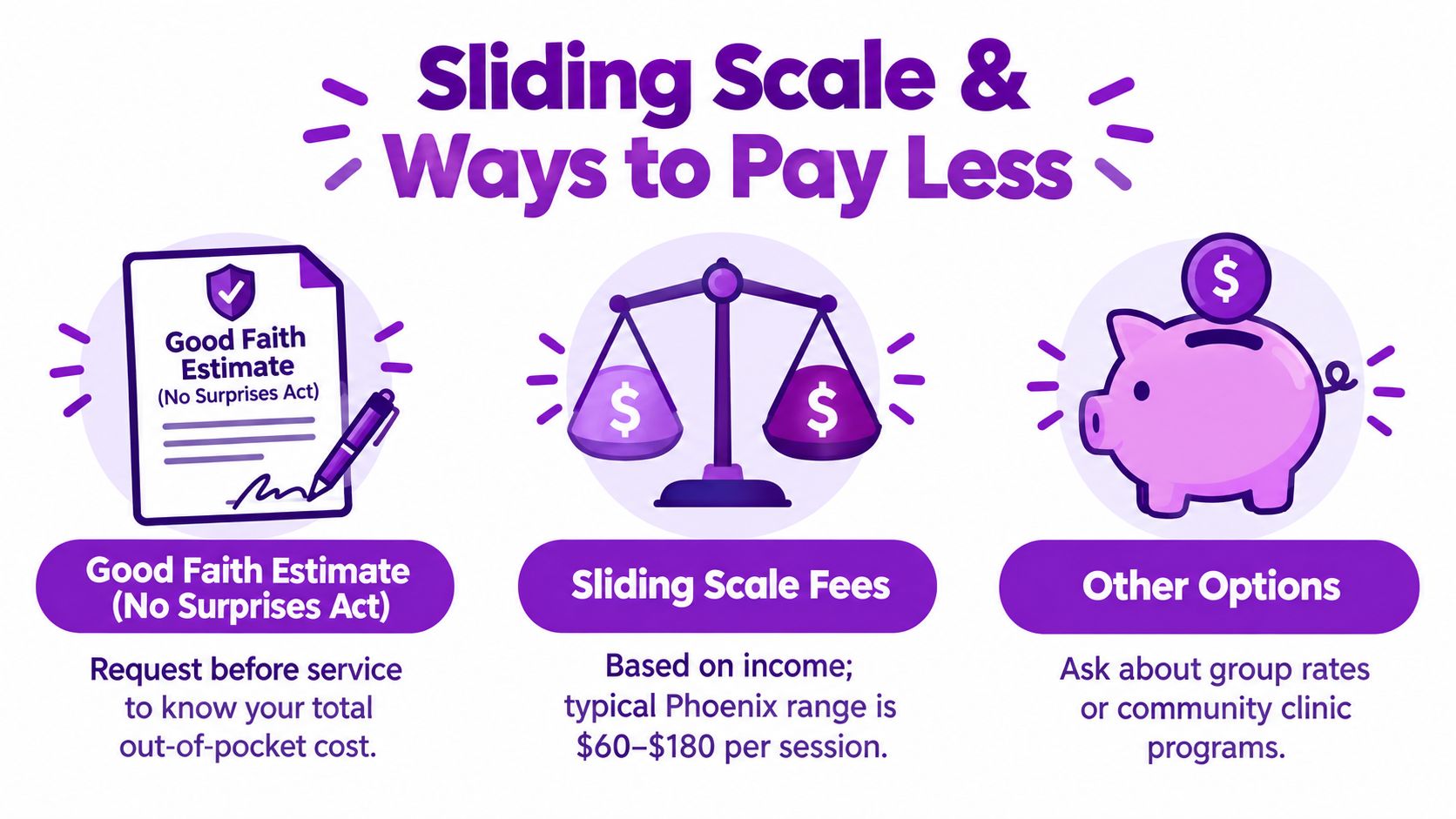
Before the first appointment, request a written estimate of expected charges if you're uninsured or paying privately. Then ask whether extended sessions, telehealth, missed appointments, and family members joining from different locations are billed differently. Families looking for nearby options can start with family counseling near you and still verify the specific cost structure directly.
Sliding Scale, Fee Schedules, and Other Ways to Pay Less
Sliding scale care can be a genuine affordability option, but it isn't an automatic discount. Practices may base the fee on household income and request documentation, such as a recent federal tax return or equivalent proof. One provider's published tiers place psychotherapy fees as low as $45–$70 per hour, with documentation required for eligibility. The provider's sliding-fee policy shows the kind of verification a family may encounter.
Other published schedules separate family and couples therapy from individual care. One fee schedule lists family or couples therapy at $125, while a resident family or couples session can be $90 under a sliding-scale self-pay structure. That published counseling fee schedule illustrates how clinician level, training stage, and session type affect the quote.
Ask for the full price before treatment
A Good Faith Estimate helps uninsured or self-pay families understand expected charges before services begin. Request it in writing and ask whether it includes the expected frequency of visits, longer sessions, administrative fees, and any separate assessment charges.
You can also ask about:
- Income-based pricing: Confirm the qualifying income method, required documents, and whether the reduced rate applies to every family session.
- Same-day payment discounts: Some practices may offer a fee-schedule reduction when payment is made at the visit.
- Bundled scheduling: Ask whether paying for a group of sessions changes the rate, and read the cancellation terms before agreeing.
- HSA or FSA cards: Confirm that your plan and the service qualify before using account funds.
A family considering major household financial decisions should keep therapy costs separate from legal and asset-planning questions. For example, a guide to 401k and divorce in Texas addresses a different problem, but it reinforces a useful budgeting principle: understand the financial consequences before moving money.
Use network status as a practical shortcut
An in-network practice can reduce phone calls because the office may verify benefits and explain the expected patient responsibility. reVIBE Mental Health lists in-network agreements with Aetna, BCBS, Cigna, and United, and offers care across its Chandler, Phoenix, Scottsdale, and Tempe locations, along with secure online appointments. Treat that as a starting point for verification, not a guarantee that every plan or every family-service code is covered.
Smart Questions to Ask Before You Book
Don't accept a single sentence such as “family sessions are $200.” Ask for the billing path. A good intake call should tell you what service is being provided, which code is expected, whether the clinician is in network, and what happens before your deductible is met.
Use this script:
- “Which CPT code will you bill for today?” Ask whether the appointment is expected to use 90846, 90847, or another code, and whether the identified patient must attend.
- “Is family therapy covered when it supports one member's diagnosed condition?” This separates medically necessary treatment from relationship support that the plan may exclude.
- “Am I on a tier-one or tier-two plan for your office?” Network labels vary, so ask the insurer to confirm the provider's exact status.
- “How much of my deductible remains?” A copay quote may not apply until the deductible is satisfied.
- “Will my deductible be met before we schedule a 90-minute session?” Ask for the estimated allowed amount and your likely responsibility for the longer block.
- “Do telehealth and in-person visits process the same way?” The format may affect the rate, coding, or network treatment.
- “Can you provide a Good Faith Estimate?” Get recurring charges in writing if you're paying privately.
When family therapy costs more after insurance
Family therapy can cost more than individual therapy even when the public family-session rate appears reasonable. Longer appointments, a deductible that hasn't cleared, non-covered relational work, and higher coinsurance can reverse the expected savings. The final comparison should use the amount your family owes after adjudication, not the therapist's advertised cash rate.
Location affects practicality too. Ask reVIBE which office best fits your schedule, whether the Tempe, Gilbert, Mesa, or Scottsdale option has suitable parking, after-school appointment times, and weekend availability. Those details aren't merely conveniences. A slightly different location can reduce missed appointments, travel burden, and the temptation to stop treatment because the logistics don't work.
reVIBE Mental Health offers family counseling, individual therapy, psychiatry, medication management, in-person care, and secure online appointments with insurance verification support. Visit reVIBE Mental Health or call (480) 674-9220 to ask about the office, billing code, network status, and session format that fit your family.
Find a reVIBE Location Near You!
We currently have five locations for your convenience. (480) 674-9220
reVIBE Mental Health – Chandler
3377 S Price Rd, Suite 105, Chandler, AZ
reVIBE Mental Health – Phoenix Deer Valley
2222 W Pinnacle Peak Rd, Suite 220, Phoenix, AZ
reVIBE Mental Health – Phoenix PV
4646 E Greenway Road, Suite 100, Phoenix, AZ
reVIBE Mental Health – Scottsdale
8700 E Via de Ventura, Suite 280, Scottsdale, AZ
reVIBE Mental Health – Tempe
3920 S Rural Rd, Suite 112, Tempe, AZ