

Ever find yourself struggling to put a feeling into words? Sometimes, the most profound experiences—a deep-seated memory, a complex emotion, or a recurring dream—just can't be neatly packaged into a sentence.
Sand tray therapy is a unique, hands-on approach that gives you a different way to communicate. It allows you to build your inner world in a small sandbox using a collection of miniature figures. It’s far more than just play; it's a powerful way to give shape to the thoughts and feelings that words can't reach.
What Is Sand Tray Therapy and How Does It Work

Think of the sand tray as a 3D journal for your psyche. Instead of trying to explain what's going on inside, you show it. This creative process allows you to bypass the logical, analytical part of your brain that often censors or gets in the way.
You simply select miniature figures—people, animals, mythical creatures, buildings, natural elements—and place them in the sand. This act of creating taps directly into the emotional and sensory parts of the brain, making it an incredibly effective tool for adults, teens, and children alike.
The Foundation of Healing: A Free and Protected Space
One of the most important principles in sand tray therapy is the idea of a "free and protected space." This isn't just about the room; it's about the emotional safety the therapist creates. Their job isn't to interpret your creation or tell you what it means. Instead, they act as a quiet, compassionate witness.
This non-judgmental presence is crucial. It builds a deep sense of trust and gives you the freedom to explore whatever you need to, at your own pace. The tray becomes a safe container for difficult emotions, making them feel less overwhelming and more manageable.
The sand tray becomes a mirror of your inner world. It’s not about creating a beautiful diorama; it’s about letting your right brain speak through symbolism and story, activating sensory awareness, emotion, and nonverbal memory.
Why It Is More Than Just Playing with Sand
The physical act of touching and molding the sand is inherently therapeutic. It’s a grounding experience that can soothe an anxious nervous system. The concept of What Is Sensory Play explains why engaging our senses is so powerful for emotional regulation. This hands-on process helps us process experiences that might feel too intense for traditional talk therapy.
To give you a clearer picture, here's a quick breakdown of what makes sand tray therapy work.
Sand Tray Therapy At a Glance
| Component | Description | Primary Goal |
|---|---|---|
| The Tray | A rectangular box, often with a blue interior to symbolize water and sky. | To provide a safe, contained boundary for the client's inner world. |
| The Sand | Can be used wet or dry, allowing for different textures and creative expressions. | To offer a tactile, grounding medium for sensory engagement and emotional regulation. |
| The Miniatures | A diverse collection of small objects representing all aspects of life. | To provide a rich symbolic "vocabulary" for non-verbal expression of feelings and experiences. |
In the end, this unique method gives a voice to the unspoken parts of ourselves. By building a world in the sand, you become your own storyteller, uncovering insights and illuminating a path toward resolution and healing.
The Therapeutic Roots of Sand Tray Therapy
Sand tray therapy might feel like a newer, creative approach to healing, but its story actually begins nearly a century ago. It wasn't born from a fleeting trend; it grew from profound, time-tested ideas about how we express what's deep inside and, ultimately, how we heal. Knowing its history helps us appreciate just how credible and powerful this method truly is.
The journey started in early 20th-century London, not in a modern therapist's office, but with a forward-thinking physician. She noticed a simple but critical problem: words often fail us, especially children struggling with things they can't quite name. This single observation sparked an incredible innovation.
The World Technique: A New Form of Expression
The origins of sand tray therapy trace back to 1929 with a British pediatrician named Margaret Lowenfeld. At her Clinic for Nervous and Difficult Children, she developed what she called the "World Technique."
Lowenfeld gave children trays of sand and a huge collection of miniature figures, letting them build scenes or "worlds" that reflected their inner feelings and experiences. She quickly realized this wasn't just play—it was a tangible language for things they couldn't put into words.
This technique became more than just a way for therapists to observe. It was a bridge. By creating these worlds in the sand, children could bring their internal reality out into the open, working through conflicts, fears, and joys in a safe, controlled space. It gave therapists an unprecedented window into a child's mind.
The Integration of Jungian Psychology
The method took its next great leap in the late 1950s. A Swiss Jungian analyst named Dora Maria Kalff, who had studied directly with Lowenfeld, took the "World Technique" and infused it with the deep psychological principles of Carl Jung. This evolution is what we now know as Sandplay Therapy.
Kalff worked from a core belief: in a safe and protected space, the human psyche naturally knows how to heal itself. She viewed the sand tray as a sacred container where the unconscious mind could finally speak, not with words, but with symbols.
"The client has the opportunity to set up a world corresponding to his or her inner state. In this manner, through free, creative play, unconscious processes are made visible in a three-dimensional form." – Dora Kalff
This changed everything. The focus shifted from just observing a child's play to honoring a profound therapeutic journey. The scenes in the sand weren't just stories anymore; they were seen as symbolic maps of a person's inner landscape, rich with both personal and universal meaning. This is why symbolic play is so central to its effectiveness—it lets people safely externalize their inner worlds to work through them.
By weaving in these Jungian concepts, Kalff helped establish sand tray as a deeply respected modality used around the globe. Its principles are now a cornerstone in many therapeutic settings, especially those focused on trauma-informed care. You can learn more about this compassionate approach by reading our guide on what is trauma-informed therapy.
When you trace these roots, it's clear that sand tray therapy stands on a solid foundation of psychological wisdom, offering a creative and genuinely effective path to healing.
What to Expect in Your Sand Tray Therapy Session
Walking into any therapy session for the first time can be a little nerve-wracking, especially when you're not sure what's going to happen. But a sand tray therapy session is designed from the ground up to feel safe, gentle, and entirely led by you. Forget about tests or getting things "right"—there are no wrong answers here. There is only your unique journey.
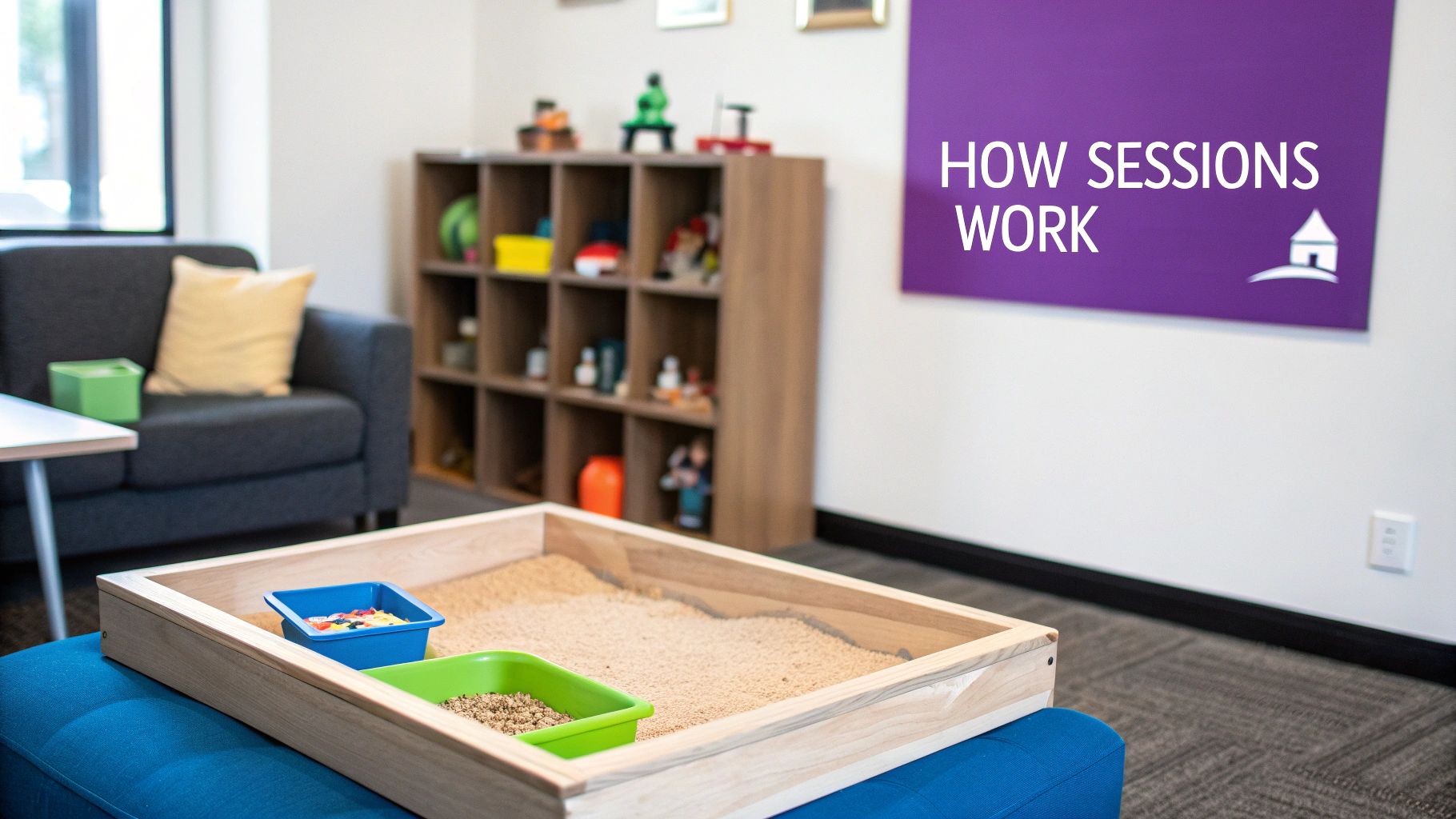
When you step into the room, two things will probably catch your eye. First, the sand tray itself—a rectangular box, usually with a blue interior, filled with fine, soft sand. The second is an incredible collection of miniature objects and figures displayed on nearby shelves, just waiting for you to explore.
Think of this collection as a rich, symbolic vocabulary. You'll find everything imaginable: people, animals, mythical creatures, buildings, cars, and natural objects like stones, shells, and trees. This huge variety ensures you have all the tools you need to express whatever is on your mind, even if you don't have the words for it yet.
A Gentle Invitation to Create
The session doesn't start with a difficult question. Instead, your therapist offers a simple, open invitation, something like, "Using the sand and any of the miniatures you'd like, create a world in the tray that feels right to you today."
That's your cue to begin. There's no rush and zero pressure. You might start by just running your hands through the sand, noticing its texture. This simple act is incredibly grounding and can help calm your nervous system, making it easier to connect with your inner thoughts and feelings.
Next, you'll move to the shelves and let your intuition be your guide. You don't need a plan. An object might just jump out at you for a reason you can't quite explain—a tiny locked treasure chest, a fierce-looking dragon, a solitary tree, or a small bridge. You simply pick up the figures that resonate with you in that moment.
The Role of the Silent Witness
As you choose your miniatures and begin placing them in the sand, your therapist shifts into the role of a silent, supportive witness. They won't direct you, interpret what you're doing, or judge your creation. Their quiet, steady presence is a powerful part of the process, creating a feeling of safety and total acceptance.
This non-intrusive support is what creates the "free and protected space" that's so crucial for deep healing. You are completely free to express yourself without worrying about criticism. You might build a scene that's chaotic, peaceful, sparse, or crowded—whatever emerges is exactly what needed to come out.
The sand tray becomes a mirror of your inner world. It’s a place where your subconscious can speak freely through symbols and metaphors, bypassing the logical brain that often keeps our deepest feelings locked away.
Exploring Your World, Together
Once you signal that your world is complete, the focus gently shifts to exploration. This isn't where the therapist tells you what your creation means. Instead, they join you as a curious and compassionate guide, asking open-ended questions to help you find your own insights.
They might ask things like:
- "Tell me about this world you've created."
- "Is there any part of this world you feel drawn to?"
- "If one of these figures could speak, what do you think it would say?"
This is a collaborative process, and you are always in the driver's seat, moving at your own pace. You are the expert on your world. The therapist is simply there to help you see it from new angles, notice connections you might have missed, and understand the stories your symbols are telling.
By getting your inner landscape out into the open, you can work with it in a new and empowering way. Knowing how to prepare for your first therapy session can also help you feel more comfortable and ready for this unique experience.
Who Can Sand Tray Therapy Help the Most?
When you first hear the term sand tray therapy, you might immediately picture a child in a sandbox. And you're not wrong—it's an incredible tool for kids. But its power doesn't stop there. This hands-on, expressive method offers a path to healing for people of all ages, from teens dealing with family stress to adults navigating deep-seated trauma.
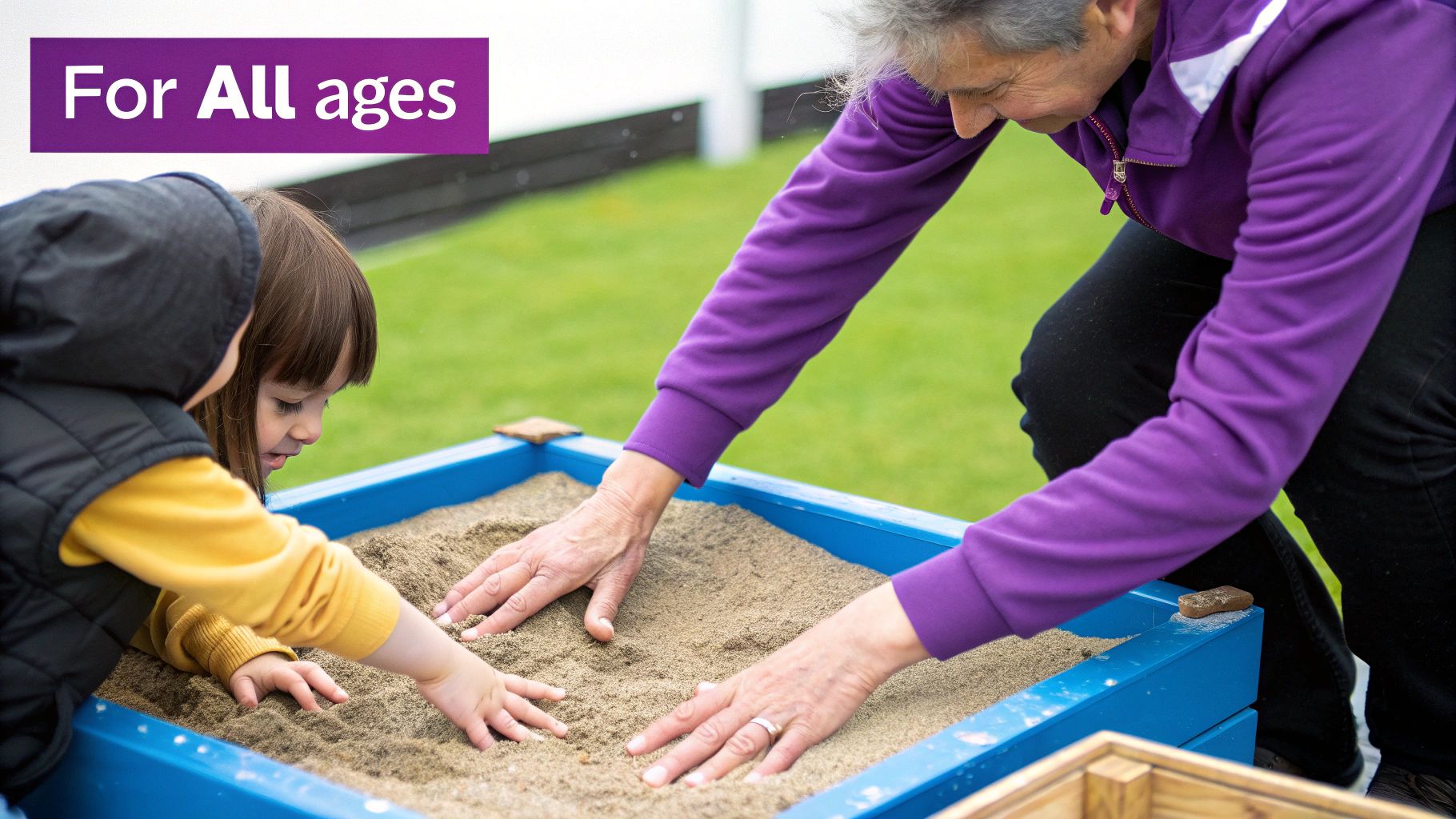
The real magic of the sand tray is its ability to bypass the logical, verbal parts of our brain. It gives a voice to feelings and memories that are often impossible to put into words. That's why it's such a breakthrough for anyone who feels "stuck" in traditional talk therapy or just can't find the words to describe what they're going through.
Children and Teenagers: Expressing the Unspoken
For a child who hasn't developed a rich emotional vocabulary, the sand tray becomes their language. Imagine a child struggling with anxiety after their parents' divorce. They might create a scene with one small figure isolated in a corner, while a jumble of chaotic animal figures takes over the rest of the tray. This visual story says more about their loneliness and overwhelm than words ever could.
Teenagers, too, find a safe space in the sand tray to explore things like family conflict or peer pressure without direct confrontation. A teen might build a world full of walls and barriers, placing figures in ways that show how trapped or misunderstood they feel. By getting the conflict out of their head and into the tray, it suddenly feels more manageable and opens up new ways of thinking about it. To learn more about how expressive therapies can help younger clients, check out our guide on play therapy for kids.
Adults: Processing Trauma, Grief, and Big Life Changes
Sand tray therapy is exceptionally powerful for adults, especially those who have experienced trauma. The reason for this is rooted in how our brains store difficult memories—often in sensory, non-verbal areas. This is why just talking about a traumatic event can feel disconnected or fail to bring relief. The memory isn't just a story; it's a felt, physical experience.
The sand tray acts as a bridge to these non-verbal memories. By creating a world in the sand, you can safely access and process traumatic experiences without having to relive them through a detailed verbal retelling, which can often be re-traumatizing.
This approach is also incredibly effective for navigating other complex adult experiences:
- Grief and Loss: Creating a world can help you express the messy, contradictory feelings of grief. It's a way to honor a loved one's memory while also carving out a space for your own healing.
- Anxiety and Burnout: An adult feeling crushed by work stress might build a scene that visually captures the feeling of being buried or pulled in a million directions. Seeing it laid out provides instant clarity and a starting point for change.
- Major Life Transitions: Whether you're changing careers, starting a new relationship, or becoming a parent, the sand tray offers a space to explore your shifting identity and navigate uncertainty.
A Powerful Complement to Other Therapies
Sand tray therapy doesn't have to be a standalone treatment. In fact, it shines when integrated with other therapeutic approaches, creating a more holistic healing experience.
It’s a fantastic partner for Eye Movement Desensitization and Reprocessing (EMDR), for example. Someone might use the sand tray to create a scene of a traumatic memory before or after an EMDR session. This can help "contain" the memory, making it feel less overwhelming and allowing the EMDR processing to be even more effective.
The simple, tactile act of working with sand is also grounding and helps regulate the nervous system—a huge benefit for anyone doing deep emotional work. By combining different methods, a therapist can help you heal from all angles—cognitive, emotional, and physical—leading to more integrated and lasting change.
The Science Behind Why Sand Tray Therapy Works
It might look like simple, creative play, but building a world in a sand tray is a process deeply rooted in science. Sand tray therapy isn't just an imaginative outlet—it’s a powerful, brain-based therapy that taps into our nervous system and reaches parts of the mind that words alone often can't. It builds a bridge between what we know consciously and what we hold unconsciously, opening the door for profound healing.
This approach is so effective because it speaks the brain's native language: the language of symbols, images, and senses. When you run your hands through the sand or pick up a miniature that just feels right, you're not just playing. You're activating a powerful mind-body connection that allows for deep therapeutic work.
Calming the Nervous System Through Touch
The simple act of touching and shaping the sand has a direct, calming effect on the nervous system. Sifting sand through your fingers is an incredibly grounding activity that helps activate the parasympathetic nervous system—our "rest and digest" mode. This provides a natural antidote to the "fight or flight" response that fuels anxiety, stress, and trauma.
By physically interacting with a safe, contained, and controllable element, you send a powerful signal to your body: you are secure right now. This sensory input dials down hypervigilance and quiets an overactive mind, creating the perfect internal conditions for emotional processing to begin.
The sand tray is unique because it engages both sides of your brain at once. Your right brain—the home of emotion, visuals, and sensory input—is activated as you create your scene. Later, your left brain—the center for logic and language—comes online to help you find words and meaning for what you've built.
Making the Unspoken Visible
Difficult, painful, or traumatic memories are often stored in the non-verbal, sensory parts of our brain. This is a huge reason why people can feel "stuck" for years, even after talking endlessly about an experience. The words just don't seem to connect with the raw, core feelings of the memory.
Sand tray therapy gets around this verbal roadblock completely.
By choosing miniatures and arranging them in the sand, you're literally pulling your inner world out into the open. You give physical form to feelings, memories, and relationships that might have felt too big, messy, or overwhelming to put into words. This process makes it possible to:
- Gain Distance: Seeing a difficult situation contained within the four walls of the tray makes it feel less consuming and more manageable.
- Find New Perspectives: You can physically walk around the tray, see your world from different angles, and discover insights you never would have considered.
- Process Without Re-traumatization: You can work with potent symbols of a painful event without having to verbally relive every single detail.
Evidence of Its Impact on Mental Health
The healing power of this method isn't just something therapists see in their offices—it’s backed by a growing body of research. Study after study shows that sand tray therapy leads to real, measurable improvements, including significant reductions in symptoms of anxiety, depression, and PTSD.
A great example is a landmark 2023 study in South Korea that looked at group sand play therapy for adolescents. After just eight weekly sessions, the participants showed a significant drop in their anxiety scores, along with notable improvements in depression and self-esteem. You can dive deeper by reading the full study on adolescent mental health.
This kind of research confirms what clinicians have known for decades: creating worlds in the sand helps people rebuild their sense of self and learn to regulate their emotions. It’s an imaginative therapy built on solid psychological principles that create real, lasting change.
How to Get Started with Sand Tray Therapy

Starting a new kind of therapy, especially one as personal as sand tray therapy, all comes down to finding the right guide. The relationship you build with your therapist is the bedrock of your progress. It's crucial to find someone who not only has the right credentials but also fosters a space where you feel genuinely safe and understood.
When searching for a therapist, look for licensed mental health professionals with specialized training in sand tray or sandplay work. Certifications in play therapy or expressive arts therapy are usually good signs of their expertise. A great therapist won't interpret your world for you; they'll act as a compassionate witness, honoring your unique process without judgment.
Finding a Supportive Environment for Healing
The setting for therapy is just as important as the therapist. You need a space that feels welcoming and private—a place where you can truly let your guard down and dive into the creative process. A cold, clinical office can be intimidating, which is why a warm, comfortable atmosphere can make all the difference in your ability to open up.
At reVIBE Mental Health, we’ve put a lot of thought into designing our offices to be calming sanctuaries for healing. We want to remove any barriers to getting help and make your experience feel supportive from the very first call. We know life gets hectic, so we also offer flexible scheduling to work with you.
Your path to healing should be as accessible as possible. That’s why we offer appointments seven days a week, provide telehealth options for convenience, and accept most major insurance plans to make care more affordable.
Your First Step with reVIBE Mental Health
Taking that first step can feel like the biggest hurdle, but we’re here to make it easy. Our team is ready to answer your questions, help you verify your insurance, and connect you with a therapist who not only specializes in sand tray therapy but also feels like the right fit for your personality and goals. Your well-being is everything to us, and we're committed to creating a personalized plan that meets you right where you are.
Find a reVIBE Location Near You! We currently have five locations for your convenience.
- reVIBE Mental Health – Chandler: 3377 S Price Rd, Suite 105, Chandler, AZ
- reVIBE Mental Health – Phoenix Deer Valley: 2222 W Pinnacle Peak Rd, Suite 220, Phoenix, AZ
- reVIBE Mental Health – Phoenix PV: 4646 E Greenway Road, Suite 100, Phoenix, AZ
- reVIBE Mental Health – Scottsdale: 8700 E Via de Ventura, Suite 280, Scottsdale, AZ
- reVIBE Mental Health – Tempe: 3920 S Rural Rd, Suite 112, Tempe, AZ
When you feel ready to start, just give us a call at (480) 674-9220 to schedule a consultation. We look forward to supporting you.
Your Questions About Sand Tray Therapy, Answered
It's completely normal to have a few more questions, even after learning the basics. When you're considering a new kind of therapy, you want to know exactly what you’re getting into. Let's tackle some of the most common things people ask about sand tray therapy.
Is This Therapy Just for Kids?
That's a common misconception, but the simple answer is no. While it's a fantastic approach for children who may not have the words to describe their feelings, sand tray therapy is incredibly powerful for adults, couples, and families, too.
Think about it—sometimes the biggest challenges we face as adults are the hardest to talk about. Grief, trauma, or complicated relationship patterns can be tough to put into words. Creating a scene in the sand tray often provides a way to express those feelings when language just isn't enough, making it a valuable tool for anyone, at any age.
Do I Need to Be Creative or Artistic?
Not at all. This is probably the biggest myth we hear! The point of sand tray therapy isn't to create a perfectly sculpted work of art. It’s about honest expression.
There’s no right or wrong way to build your world in the sand. You’re simply following your intuition and letting your inner experience guide you. The real magic happens in the insights you gain from the process, not in the final product.
The sand tray isn’t a test of your artistic talent. It's an invitation to make your inner world visible so you can explore it.
How Long Does Sand Tray Therapy Take to Work?
Everyone's healing journey looks different. Some people feel a sense of relief or have a major "aha!" moment in their very first session. For others, lasting change is a more gradual process built over time. The timeline really depends on your personal goals and the complexity of what you're working through.
Your therapist will work with you to figure out a pace that feels right. This is your journey, and you’re always in the driver's seat when it comes to how fast or slow you want to go.
Is Sand Tray Therapy Covered by Insurance?
Most of the time, yes. Because sand tray therapy is an established therapeutic method used by licensed mental health professionals, insurance companies typically cover it under your standard mental health benefits. It's not seen as a separate service, but rather as a tool used during a regular therapy session, similar to how a therapist might use EMDR or CBT techniques.
Of course, it’s always a good idea to check the details of your specific plan to be sure. The team here at reVIBE Mental Health can help you verify your insurance to make everything as straightforward as possible. Our goal is to remove any barriers standing between you and the support you deserve.
Ready to explore a new path to healing? The compassionate team at reVIBE Mental Health is here to guide you. We have five convenient locations to serve you. (480) 674-9220
- reVIBE Mental Health – Chandler: 3377 S Price Rd, Suite 105, Chandler, AZ
- reVIBE Mental Health – Phoenix Deer Valley: 2222 W Pinnacle Peak Rd, Suite 220, Phoenix, AZ
- reVIBE Mental Health – Phoenix PV: 4646 E Greenway Road, Suite 100, Phoenix, AZ
- reVIBE Mental Health – Scottsdale: 8700 E Via de Ventura, Suite 280, Scottsdale, AZ
- reVIBE Mental Health – Tempe: 3920 S Rural Rd, Suite 112, Tempe, AZ
Call us at (480) 674-9220 or visit us online at https://revibementalhealth.com to schedule your consultation today.