

Find a reVIBE Location Near You!
We currently have five locations for your convenience. (480) 674-9220
reVIBE Mental Health – Chandler
3377 S Price Rd, Suite 105, Chandler, AZ
reVIBE Mental Health – Phoenix Deer Valley
2222 W Pinnacle Peak Rd, Suite 220, Phoenix, AZ
reVIBE Mental Health – Phoenix PV
4646 E Greenway Road, Suite 100, Phoenix, AZ
reVIBE Mental Health – Scottsdale
8700 E Via de Ventura, Suite 280, Scottsdale, AZ
reVIBE Mental Health – Tempe
3920 S Rural Rd, Suite 112, Tempe, AZ
Who Can Diagnose In Arizona
Absolutely. In Arizona, licensed therapists can assign formal diagnoses using DSM or ICD standards right within their professional scope. This authority means they can identify conditions, note them in clinical records, and jumpstart your path to the right treatment without delay.

During your first intake at reVIBE Mental Health, a therapist will listen closely and ask targeted questions to understand your experience. The home-like atmosphere helps clients relax, setting the stage for an accurate diagnosis built on trust and openness.
Here’s What You’ll Find In This Guide:
- Licensing rules and scope for counselors and social workers
- How therapists walk through diagnostic steps with real-world examples
- Clarification on who holds legal authority to diagnose and prescribe
- Advice on choosing therapy versus psychiatry based on your needs
- Tips to prepare for an assessment, including questions to ask
- How reVIBE’s integrated team can simplify insurance checks and scheduling
Key Takeaway: Knowing who can diagnose helps you find the right provider fast.
Summary Of Diagnostic Authority
Below is a quick overview of which mental health professionals can diagnose, where they typically work, and the scope of their practice in Arizona.
| Provider Type | Can Diagnose | Practice Setting |
|---|---|---|
| Licensed Counselor | Yes | Private clinics, reVIBE offices |
| Clinical Social Worker | Yes | Community agencies, reVIBE centers |
| Psychologist | Yes | Clinics, hospitals |
| Psychiatrist | Yes | Medical practices, hospitals |
With that foundation in place, we’ll dive into licensing rules next—think of it like exploring different driver’s licenses, each granting unique permissions. Then we’ll map out diagnostic steps through concrete examples, from anxiety checklists to mood assessments.
Once you understand who’s authorized to diagnose and prescribe, we’ll walk you through choosing the right path—therapy, psychiatry, or a combination. Afterward, you’ll learn how to prepare for your appointment with smart questions and insider tips on navigating insurance.
Finally, we wrap up with answers to your most pressing FAQs and practical next steps. By the end, you’ll feel confident about where to turn and what to expect on your mental health journey.
Think of therapists as navigators who chart your course. Every detail you share becomes a waypoint, refining your treatment plan. With this guide in hand, you’re ready to move forward with clarity, confidence, and purpose.
Understanding Licensing And Scope
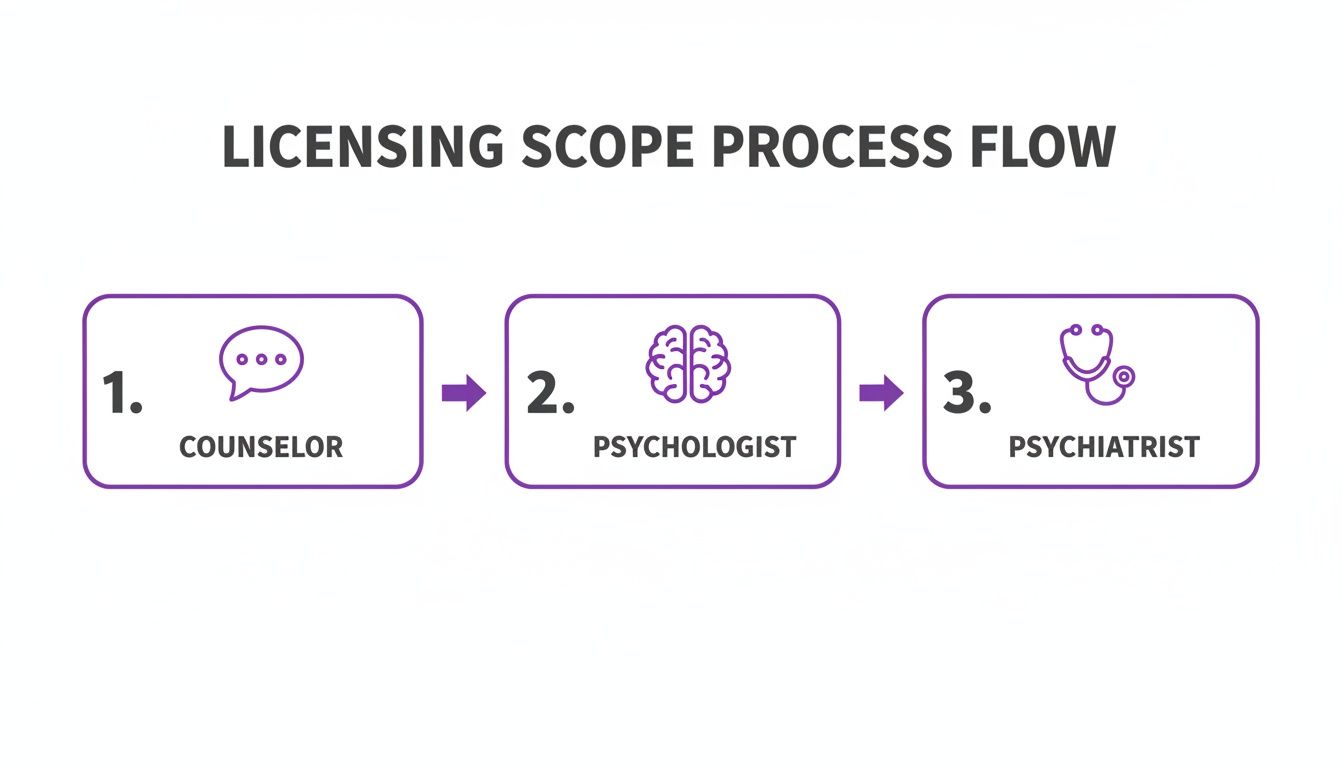
In Arizona, mental health professionals work under clearly defined licenses. These licenses determine who can make formal diagnoses and outline the services each provider offers.
This structure ensures you’re matched with the right expert—whether you need talk therapy, testing, or medical treatment.
- Licensed Professional Counselor (LPC) assigns diagnoses within a talk-therapy framework
- Licensed Clinical Social Worker (LCSW) diagnoses and connects clients to social support
- Psychologist uses in-depth assessments and testing protocols
- Psychiatrist holds medical diagnosis, prescription, and medication-management authority
License Categories Explained
Licensed Professional Counselors finish a master’s degree plus supervised practice. They’re authorized to record DSM or ICD codes in clinical notes.
Clinical Social Workers blend therapy skills with community-based support. Their social work background shapes both diagnosis and recommendations.
Psychologists earn a doctoral degree and complete intensive internships. They bring advanced testing tools that sharpen diagnostic clarity.
“Understanding license scope is like choosing the right toolkit for a project,” notes a reVIBE clinician. “Each professional brings unique diagnostic tools.”
Psychiatrists graduate from medical school and complete a residency. With that background, they can diagnose complex conditions, prescribe medications, and oversee long-term treatment plans.
Analogy Of Driver’s Licenses
To see how licensing works, imagine driving:
- A car license lets you handle most roads (LPCs diagnosing in therapy sessions).
- A motorcycle license adds two-wheel expertise (psychologists offering specialized testing).
- A commercial license allows operation of heavy vehicles (psychiatrists managing medical treatment).
This analogy makes it clear: not every provider has the same diagnostic “vehicle.”
State Rules And Supervision
Arizona’s regulations spell out who can diagnose independently and who must work under oversight. Employers often layer on additional credential checks before granting full diagnostic authority.
For instance, 47.2% of adults with mental illness receive treatment, and non-physician providers conduct a large share of outpatient assessments. Read the full research on these utilization gaps at the CDC.
Learn more about utilization gaps at CDC
Typical supervision requirements include:
- LPCs often need 2,000 supervised hours before practicing solo
- LCSWs complete 3,000 supervised hours plus social-service mandates
- Psychologists require 1,500 internship hours and licensure exams
- Psychiatrists finish a 4-year residency program
Beyond these state rules, agencies and hospitals may:
- Conduct periodic peer-review sessions
- Require insurance panels to verify credentials
This multi-layered oversight keeps diagnostic quality high and clients safe.
Why License Matters
Knowing your provider’s license helps set clear expectations. It tells you which treatments are on the table and how insurance billing will work.
Before you book an appointment:
- Check your therapist’s credentials on the Arizona Board of Behavioral Health Examiners.
- Ask about their license type and supervision status.
- Verify that your insurer covers services based on that license.
Key Insight: Always verify your provider’s license type and diagnostic scope.
Now that you understand these layers of regulation, you can confidently seek an assessment. Next, we’ll walk through diagnostic steps with real examples so you can see how these licenses come into play in everyday practice.
Diagnostic Process With Real Examples
When you sit down with a therapist, they’re not guessing—they’re gathering clues. First comes an open-ended conversation about what’s on your mind and how long you’ve been dealing with it. Think of it as mapping your own mental terrain, one story at a time.
Next, clinicians turn to symptom checklists. These tools translate your experiences—restless nights, racing thoughts, or foggy concentration—into data points they can track. It’s a bit like using GPS coordinates before choosing the best route forward.
“DSM-5 and ICD-10 are our roadmaps,” says a reVIBE clinician. “They help turn scattered details into a precise diagnostic code.”
In fact, 60% of psychologists rely on these systems to guide assessments and billing practices. Explore more therapy stats on My Denver Therapy
Structured Interview And Symptom Mapping
During the structured interview, therapists probe for how long symptoms last, their intensity, and how they disrupt daily life. It’s not a yes-or-no quiz—it’s detective work.
Case Study 1
A client reports six months of relentless worry. Her detailed responses tick off several Generalized Anxiety Disorder criteria. Then a GAD-7 checklist score of 15 seals the diagnosis.
This process plays out like a dot-to-dot puzzle: each symptom adds a line, and suddenly a clear picture emerges.
After anxiety, we turn to mood scales. Tools like the PHQ-9 ask simple questions about sleep patterns, appetite shifts, and whether you’ve lost interest in favorite activities.
Bullet Points:
- Therapists merge self-report scores with personal narratives
- Scale results highlight where to focus treatment
- Combined insight shapes a personalized care plan
Case Study 2
A teacher describes three weeks of low mood and fatigue. Her PHQ-9 tally of 12 meets the threshold for Major Depressive Disorder.
PTSD Screening After Trauma
Not all responses to trauma look the same. That’s why therapists use PTSD checklists probing flashbacks, avoidance behaviors, and hypervigilance.
Case Study 3
A firefighter struggles after a critical incident. On a checklist scored out of 80, he reaches 45, confirming Post-Traumatic Stress Disorder.
Key Insight Looking At Records
Symptoms, scales, and checklists merge into one diagnostic code in your clinical file.
Numbered Steps For Diagnostic Workflow:
- Conduct a structured interview with targeted symptom questions
- Apply relevant checklists (GAD-7, PHQ-9, PTSD)
- Match checklists to DSM-5 or ICD-10 criteria
- Record the diagnostic code in clinical records
- Use the code to shape treatment goals and insurance claims
Mapping Labels To Treatment
A diagnosis isn’t just a label—it's a roadmap for your care. That code guides therapy goals, unlocks insurance benefits, and populates your medical record. Think of it as your treatment compass.
Every worksheet, homework assignment, and progress check refers back to this code. It turns abstract symptoms into measurable milestones.
Practical Example Of Insurance Use:
| Diagnosis Code | Treatment Focus | Coverage Notes |
|---|---|---|
| F41.1 | Anxiety Coping | Typically covered for 12 sessions |
| F32.1 | Depression Relief | Requires re-evaluation every 6 months |
| F43.10 | Trauma Recovery | EMDR often approved as a separate benefit |
Next Steps:
- Ask your therapist which checklist they use
- Find out how scores inform your care plan
- Discover how reVIBE’s integrated team can support you on every step
Your diagnostic map is as unique as you are. Always.
Comparing Who Can Diagnose In Arizona
Navigating mental health care is a bit like choosing the right crew for a challenging expedition. In Arizona, four main professionals can give you an official diagnosis, and each brings its own toolkit to the table. Knowing who can assign DSM or ICD codes, who prescribes medication, and who focuses on talk therapy makes a world of difference in charting your treatment plan.
License And Training
Every provider follows a rigorous path, but the details differ:
- Licensed Professional Counselors (LPCs) earn a master’s degree and complete 3,000 supervised hours under a board-approved mentor before practicing independently.
- Licensed Clinical Social Workers (LCSWs) also hold a master’s degree and log 3,000 hours of community or clinical service, adhering to state guidelines along the way.
- Psychologists go one step further: doctoral degrees, 1,500 internship hours, plus passing the EPPP and state exams give them full diagnostic authority.
- Psychiatrists start as MDs or DOs, then add a 4-year residency after medical school, enabling both medical diagnosis and prescribing rights from day one.
Comparing Provider Diagnostic Roles
Below is a quick look at how each provider type stacks up in Arizona:
| Provider | License Required | Diagnostic Authority | Medication Management |
|---|---|---|---|
| Licensed Professional Counselor | Master’s + 3,000 supervision hours | Assign DSM/ICD codes | No prescription rights |
| Licensed Clinical Social Worker | Master’s + 3,000 service hours | Assign DSM/ICD codes | No prescription rights |
| Psychologist | Doctorate + 1,500 internship hours | Independently diagnose | No prescription rights |
| Psychiatrist | MD/DO + 4-year residency | Independently diagnose | Full prescribing authority |
Diagnostic Authority And Supervision
In real-world practice, 57.4% of psychologists report making diagnoses solo. LPCs and LCSWs earn similar autonomy once their supervision hours are complete, but employer or insurance guidelines sometimes add extra layers of oversight.
- LPCs track hours with a board-approved supervisor until they reach full scope.
- LCSWs may stay under agency review until state criteria for independence are met.
Though counselors and social workers share a parallel path to independent diagnosing, the settings they work in—community centers versus private clinics—can influence how much oversight they actually experience.
Medication Management And Care Settings
If you need prescriptions, psychiatrists are your best bet—they’re the only ones in Arizona who can diagnose and prescribe in one stop. Therapists and psychologists often partner with a psychiatrist when medications are on the table, but they can’t write scripts themselves.
Typical environments include:
- LPCs & LCSWs: Private practices, community centers
- Psychologists: Hospitals, specialty clinics, research labs
- Psychiatrists: Medical offices, inpatient wards, telepsychiatry platforms
Check out our guide on psychiatric mental health practitioners at reVIBE for more details.
When you’re ready to book, keep these steps in mind:
- Match your primary need: talk therapy vs. specialized testing.
- Confirm licensure and diagnostic scope.
- Ask about supervision hours if you opt for an LPC or LCSW.
- Verify prescription services if medication is part of your plan.
- Schedule your appointment at a convenient reVIBE location.
With this clear breakdown, you can confidently choose the right Arizona mental health professional—whether you’re seeking insightful conversations, in-depth assessments, or full-spectrum care with medication.
When To Seek Psychiatry Versus Therapy

Deciding between therapy and psychiatry can feel like choosing a general mechanic or an engine specialist. A therapist handles routine tune-ups—talk sessions, coping tools, stress management—whereas a psychiatrist digs into more complex “engine” problems, like chemical imbalances or serious mood disorders.
You might lean toward a psychiatric evaluation first if any of these red flags apply:
- Severe Mood Swings that derail daily routines
- Medication Management questions or past dose changes
- Suicidal Thoughts or self-harm ideation
- Perceptual Shifts such as hallucinations or rapid cognitive changes
In many cases, talk therapy and behavioral tools like Cognitive Behavioral Therapy (CBT) are enough to smooth out mild to moderate symptoms. Simple habits—journaling, guided breathing, weekly check-ins—act like oil changes for your emotional well-being, preventing small stressors from turning into major breakdowns.
A side-by-side look often clarifies things:
| Therapy | Psychiatry |
|---|---|
| Focuses on talk-based approaches and coping strategies | Diagnoses conditions, prescribes medication, monitors meds |
| Ideal for mild to moderate anxiety, stress, life events | Best for severe mood disorders, psychosis, medication plans |
| Techniques: CBT, mindfulness, EMDR | Tools: Psychopharmacology, neurobiological assessments |
Counselors and psychiatrists frequently work hand in hand. If talk therapy isn’t resolving your core concerns, your therapist can refer you for a medication evaluation. This teamwork makes sure no part of your “mental engine” goes unchecked.
Decision Steps For Your First Appointment
- Assess Your Symptoms by checking which red flags resonate.
- Research Providers by license type and scope of practice.
- Verify Scope by asking if they can diagnose and prescribe.
- Schedule Intake by calling reVIBE at (480) 674-9220.
- Prepare Questions by listing your goals and mental health history.
Key Insight Starting with a therapist helps map out your symptoms before a specialist steps in.
Following these steps will clarify whether you need talk therapy, medication, or both. Early tuning or targeted repairs keeps your mental “engine” running smoothly—and gets you back on the road to feeling your best.
Practical Next Steps With reVIBE
Starting your mental health journey is a bit like packing for a trip—you want your essentials at the ready. At reVIBE Mental Health, our integrated team guides you through every step so that your first assessment feels comfortable and organized.
When you call to book your intake at (480) 674-9220, keep these questions handy:
- Which license type (therapist, psychologist, psychiatrist) will lead my assessment?
- How long does a typical first session run?
- What does my insurance coverage include, and what might I pay out of pocket?
- Are there any intake forms or symptom trackers to complete before our meeting?
- Can I choose the specific provider for my diagnosis?
Think of your mood and sleep logs as a personal health journal. Spend about two weeks jotting down daily notes—mood swings, sleep patterns, stress triggers. These small entries add up to big insights, helping your provider zero in on what matters most.
| Location | Address | Phone |
|---|---|---|
| Chandler | 3377 S Price Rd, Suite 105, Chandler, AZ | (480) 674-9220 |
| Phoenix Deer Valley | 2222 W Pinnacle Peak Rd, Suite 220, Phoenix | (480) 674-9220 |
| Phoenix PV | 4646 E Greenway Road, Suite 100, Phoenix, AZ | (480) 674-9220 |
| Scottsdale | 8700 E Via de Ventura, Suite 280, Scottsdale | (480) 674-9220 |
| Tempe | 3920 S Rural Rd, Suite 112, Tempe, AZ | (480) 674-9220 |
Verifying Insurance Benefits
Before your intake, double-check your plan’s mental health benefits online or by phone.
- Review covered services and provider types.
- Ask if referrals or pre-authorizations are needed.
- Note copays, session limits, and any prior-approval steps.
- Confirm virtual visit eligibility and different provider options.
This simple prep helps you avoid surprises down the road.
Booking Your First Appointment
- Call (480) 674-9220 and run through your checklist.
- Select the right provider—therapist, psychologist, or psychiatrist.
- Pick your preferred reVIBE location and time slot.
- Complete intake paperwork and submit symptom logs in advance.
- Look out for an email confirmation with prep tips and next steps.
Learn how our team can diagnose you on the Meet Our Team page.
We’re here to help you take that confident first step.
Frequently Asked Questions
Can Any Therapist Provide A Formal Diagnosis
In Arizona, only certain licensed professionals have the authority to assign a DSM or ICD code. That means Licensed Professional Counselors, Clinical Social Workers, Psychologists, and Psychiatrists can diagnose independently. Unlicensed counselors must work under supervision and cannot hand you a formal diagnosis on their own.
How Does A Therapist Diagnose You
Think of diagnosis like assembling a puzzle. Each symptom you share is a piece, and the DSM-5 or ICD-10 criteria provide the picture on the box.
Therapists guide you through a structured conversation, then plug your answers into symptom checklists—such as the GAD-7 for anxiety or the PHQ-9 for depression—to see which code fits best.
- Conducting a structured interview with open-ended questions
- Using symptom scales (GAD-7, PHQ-9, PTSD screen)
- Reviewing your clinical history for context
- Matching your experience against DSM or ICD guidelines
- Recording diagnostic codes for treatment planning and insurance
Will My Insurance Cover A Therapist’s Diagnosis
Most health plans that include mental health services accept diagnoses from licensed therapists and psychologists. A quick call to your insurer before booking can save you from surprise bills later.
Tips For Confirming Coverage
- Call your insurer to verify mental health benefits and in-network requirements
- Ask about session limits, copays, and any pre-authorization steps
- Note the date, representative name, and reference number for your records
- Check if telehealth visits are covered under your plan
Can Diagnoses Change Over Time
Absolutely. As your symptoms shift or improve, your clinician will revisit the diagnosis. Regular check-ins make sure your treatment plan stays in sync with where you are now.
“A diagnosis isn’t set in stone. Periodic reviews help us fine-tune care and track real progress.”
With clarity on who can diagnose, how the process works, and what insurance covers, you’ll step into your session feeling confident. For more details, explore our comprehensive FAQ page.
Ready to take the next step? Contact reVIBE Mental Health to schedule your assessment and get matched with the right provider for accurate diagnosis and supportive care.
https://revibementalhealth.com