
Most advice about couples therapy covered by insurance starts with the wrong answer: “No, insurance doesn't cover it.” That's too blunt to be useful. The answer depends on who the identified patient is, what diagnosis is being treated, which billing code the clinician uses, and whether the session is documented as medically necessary care.
A joint session can look identical in the therapy room and receive a different insurance decision afterward. If the visit is documented as stand-alone relationship counseling, denial is likely. If one partner has a covered mental health condition and the session supports that person's treatment plan, coverage may be possible. That distinction drives nearly every billing conversation I've handled.
Why the Coverage Question Is More Complicated Than You Think
Insurance decisions rarely come down to a simple yes or no. Couples Therapy Covered by Insurance depends on the service billed, the diagnosis attached to the claim, the provider's network status, and the clinical record supporting the visit. Relationship distress by itself is commonly excluded because it is not a reimbursable mental health diagnosis. Joint therapy has a stronger coverage path when it supports treatment for one partner's diagnosed condition and the clinician documents why the other partner's participation is clinically relevant.
Ask your insurer a precise question: “How does my plan handle family psychotherapy when my spouse attends?” That wording points the representative toward the applicable benefit, claim code, and documentation requirements. Asking whether the plan covers “marriage counseling” can produce a misleading answer because the representative may search for a benefit under that exact label, find nothing, and stop there.
The session is not the whole claim
The payer evaluates more than what happened in the therapy room. The identified patient, diagnosis, treatment plan, provider network status, submitted code, and clinical note all affect the decision. A couple may spend much of a session addressing communication because one partner's anxiety is worsening conflict. The record still needs to show how that work treats the anxiety and advances the patient's treatment goals.
A painful relationship crisis can remain outside reimbursable benefits when no covered diagnosis is being treated. Coverage descriptions consistently point to conditional access when one partner's diagnosis and treatment plan support the joint work. Connected Couples summarizes the diagnosis, coding, and documentation factors.
Practical rule: A therapist directory listing that says “accepts your insurance” is not enough. Confirm that the plan covers the specific family psychotherapy service, under the circumstances you need.
The appointment label matters less than the clinical purpose of the visit. A therapist cannot ethically assign a diagnosis solely to make a claim payable, and clients should not request a different code to disguise relationship counseling. Accurate documentation protects both partners, the clinician, and the integrity of the claim.
How Medical Necessity Determines What Gets Covered
Couples Therapy Covered by Insurance is decided less by the couple's reason for seeking help than by the diagnosis, treatment plan, and documentation attached to the claim. Insurers generally reimburse mental health treatment when a clinician treats a diagnosable condition, such as depression, anxiety, PTSD, or adjustment disorder, through an appropriate plan of care. Relationship conflict, communication problems, or marital distress alone often fall outside that standard because the relationship is not the identified medical condition. For a broader explanation of therapy benefits, see reVIBE's guide to insurance-covered therapy.
Two couples can describe the same problem, yet receive different coverage decisions. Suppose frequent arguments began after one partner developed panic symptoms. If the therapist documents communication coaching as the main service and lists no diagnosed condition, the payer may classify the visit as relationship counseling and deny it. If the therapist identifies the partner with panic-related symptoms as the patient, connects the joint work to symptom management and treatment goals, and explains the other partner's clinical role, the claim can be reviewed under an eligible mental health benefit.
What the payer needs to see
A defensible claim connects four elements:
- An identified patient: One partner receives treatment as the patient under the health plan.
- A covered diagnosis: The diagnosis must match the clinician's assessment, not serve as a billing convenience.
- A treatment plan: The plan should state therapeutic goals tied to that diagnosed condition.
- A documented reason for conjoint care: The clinical note should explain how the partner's participation supports treatment.
This framework does not guarantee payment. Network status, plan exclusions, authorization rules, and the payer's medical-necessity review can still determine the outcome. It does explain why the same type of appointment may be approved in one case and denied in another. The billing record must show why joint treatment was appropriate for the identified patient.
When one partner has the diagnosis
This arrangement causes frequent confusion. One partner may have depression, anxiety, PTSD, or adjustment disorder, while both partners attend because the symptoms affect trust, communication, routines, or emotional safety. The spouse's presence does not automatically make the appointment noncovered. The deciding question is whether the session treats the diagnosed patient's condition.
A clinician might document the patient's effect on daily functioning, the partner's role in practicing coping strategies, or the way joint work addresses triggers in the treatment plan. That record differs from a note describing general marriage counseling without a connection to the patient's clinical needs.
Before scheduling, ask the practice whether it verifies benefits and how it documents a spouse's participation in a covered session. Also ask which diagnosis and service the practice expects to submit, because those details determine how the payer evaluates the claim.
Understanding CPT 90847 and Family Psychotherapy Billing
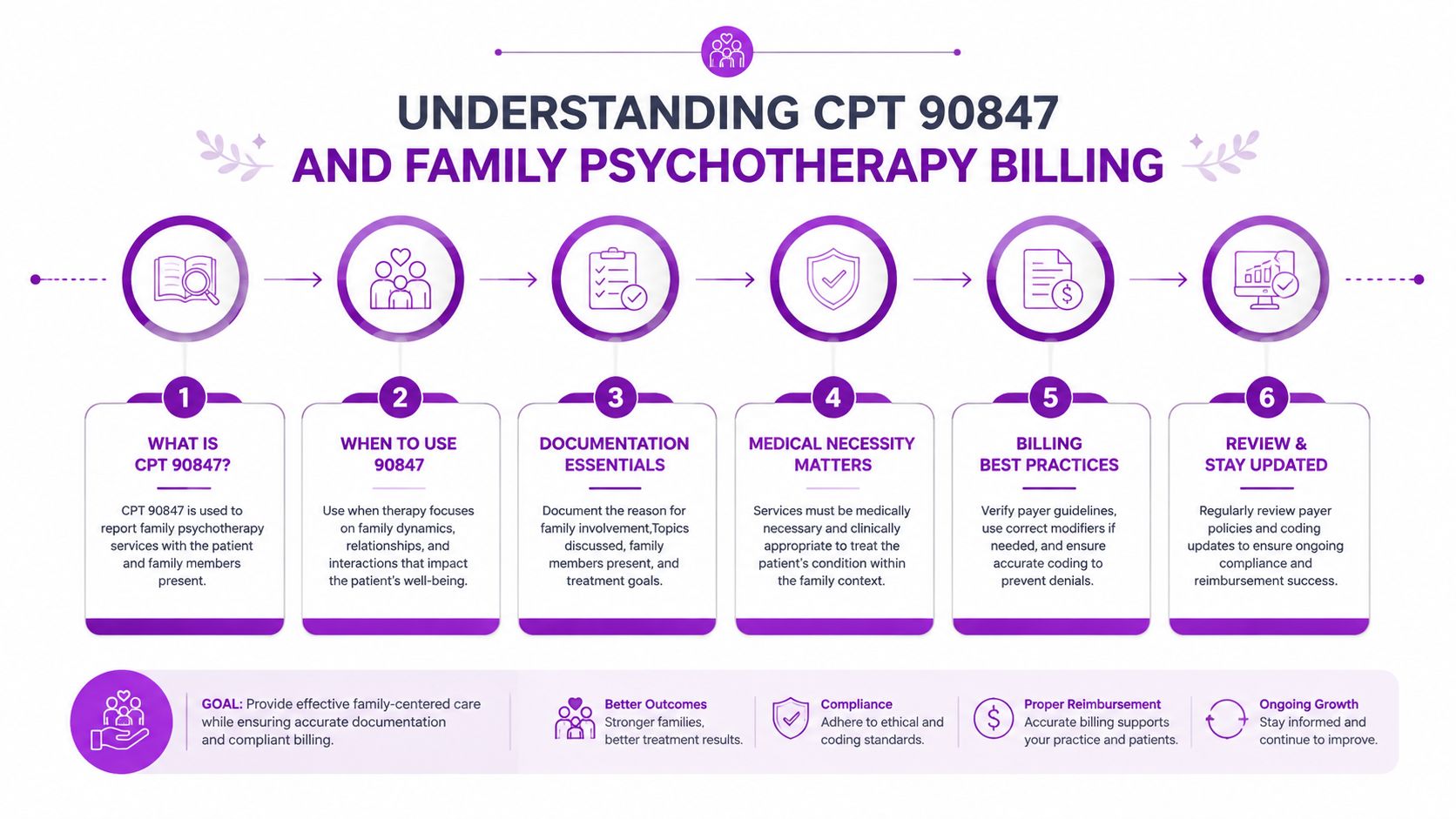
CPT 90847 is the standard code most often associated with covered conjoint work. It describes family psychotherapy with the patient present for 50 minutes, and it's generally used when the identified patient attends with a partner or family member. Medsoler RCM explains the purpose of CPT 90847.
The code doesn't mean “couples therapy” in the broad, cash-pay sense. It identifies a family psychotherapy service in which the clinician treats an identified patient while another person participates. That distinction affects the note, the diagnosis attached to the claim, and the insurer's review.
How the billing pathway works
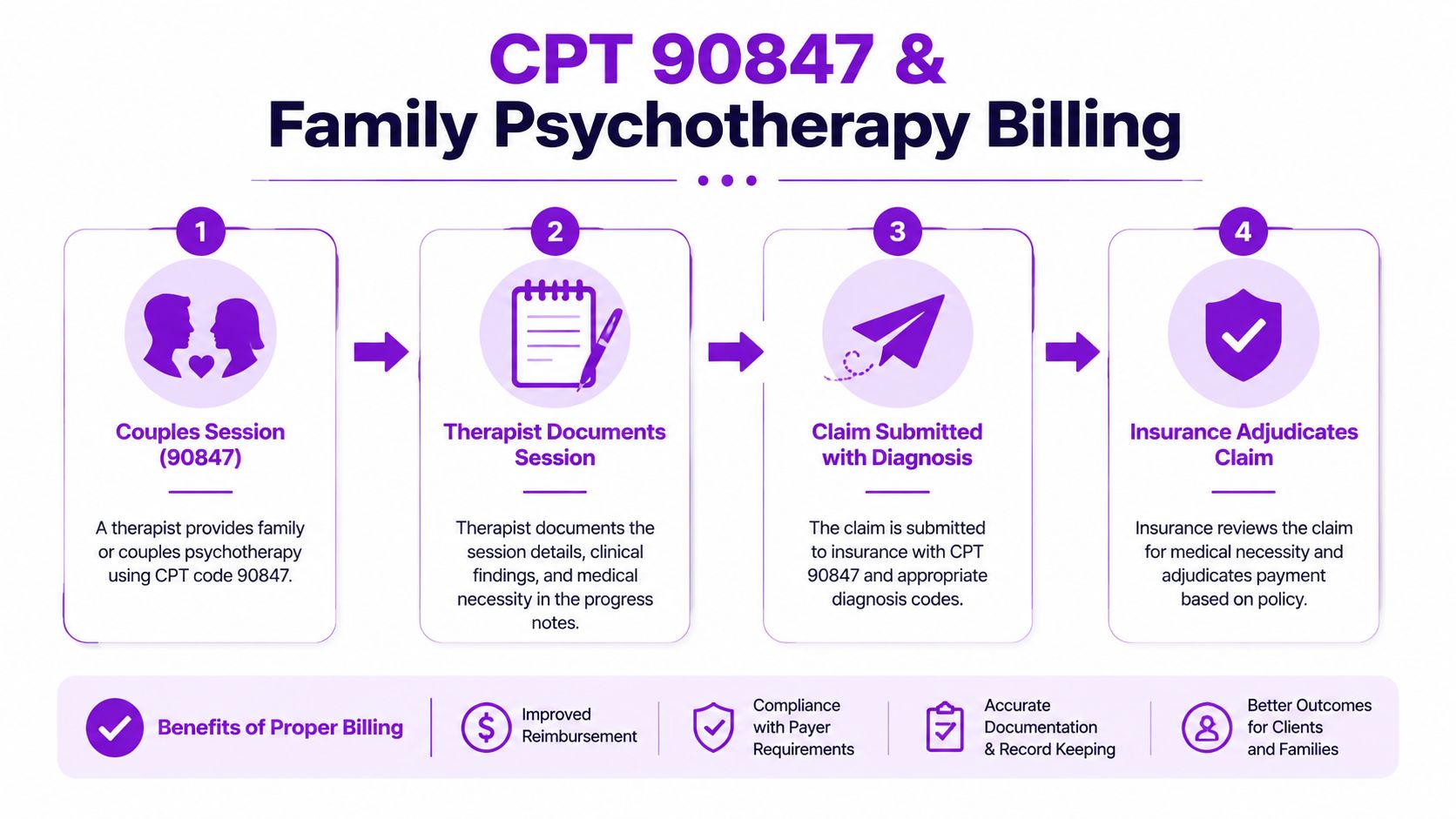
First, the therapist determines whether one partner meets criteria for a diagnosable condition and whether conjoint treatment fits that person's plan. The clinician then identifies the patient whose insurance will be billed. The attending spouse participates, but that participation should have a clinical purpose tied to the patient's care.
Next, the therapist documents the actual service. A strong note should address the patient's symptoms or functional difficulties, the interventions used, the partner's role, progress toward treatment goals, and the reason a joint format was appropriate. The record must reflect what happened, not a more convenient description designed to satisfy a payer.
Finally, the practice submits the claim using the applicable code and diagnosis. The insurer adjudicates it under the plan's rules. Even accurate coding can result in a denial if the provider is out of network, the benefit excludes the service, prior authorization was required, or the payer decides the documentation doesn't establish medical necessity.
What couples should ask the therapist
Ask these questions before the first appointment:
- Which partner will be the identified patient?
- Is the clinician considering CPT 90847 for joint sessions?
- What diagnosis, if any, is being treated?
- How will the spouse's participation support the treatment plan?
- Will the practice verify benefits, or will the couple need to call the insurer?
- What happens if the claim is denied?
The therapist must choose a code that matches the service provided. Billing a joint relationship session as individual treatment because the plan pays more readily creates ethical and compliance problems. Coverage should never depend on disguising the purpose of care.
Medicare Coverage and the 2024 Policy Shift
Medicare changed the practical situation for older adults on January 1, 2024, when marriage and family therapists became recognized Medicare providers. This expanded the possibility of outpatient family and couples counseling under Medicare Part B when a licensed therapist who accepts Medicare provides medically necessary treatment. Medicare coverage guidance explains the provider and medical-necessity requirements.
The change is meaningful, but it isn't universal coverage for relationship counseling. Medicare still requires the service to be reasonable and necessary for treating a diagnosed mental health condition. Stand-alone counseling focused only on improving a relationship remains outside that pathway.
What Part B can pay
After the annual deductible is met, Medicare Part B generally pays 80% of approved outpatient behavioral health costs, leaving the beneficiary responsible for the remaining approved share and any applicable plan responsibilities. The Medicare policy reference provided for this topic describes this payment structure and the 2024 provider milestone.
That makes joint care more accessible when one partner's treatment plan supports the session. It doesn't remove the need to confirm that the therapist accepts Medicare, that the service is covered, and that the diagnosis and documentation meet Medicare requirements.
Comparing common payment routes
Individual therapy can sometimes use a diagnosed partner's behavioral health benefit, but splitting a couple's work into separate sessions may change the clinical process and won't automatically make relationship-focused care covered. EAP benefits can offer a short-term entry point, but they're designed as a bridge rather than a full course of treatment. Out-of-network claims may provide partial reimbursement when a plan includes those benefits, but the couple must manage the claim process and pay according to the therapist's policy.
The Medicare shift improves access for eligible beneficiaries, but the same principle remains: coverage follows medically necessary treatment, not the appointment label.
Practical Workarounds When Direct Coverage Falls Short
A denial for stand-alone couples counseling does not end the conversation. It means the billing route, diagnosis, documentation, or plan rules need closer review. Choose an option that protects the couple's clinical goal while making the payment responsibility explicit.
Individual therapy can fit coverage when each partner has a separate mental health need. Anxiety, depression, trauma symptoms, or another condition may affect the relationship and support medically necessary treatment. The limitation is clinical: separate appointments may address each person's symptoms without treating the couple's interaction patterns together.
An employee assistance program can provide a short-term entry point. EAP benefits often limit the number of sessions and may require use of an approved provider, so confirm the session allowance, referral process, and whether the program connects you with ongoing care.
Out-of-network benefits may allow reimbursement through a superbill. The couple usually pays the clinician first, then submits documentation for possible reimbursement. Sliding-scale fees and self-pay plans can be more predictable when a claim is uncertain or the therapist's documentation does not match the plan's requirements. Review reVIBE's insurance information for online counseling services before booking online care, then confirm the exact service and billing arrangement with the practice.
| Approach | How It Works | Pros | Limitations |
|---|---|---|---|
| Individual therapy | One partner receives covered treatment for a diagnosed condition | Supports personal symptoms and may fit standard benefits | It may not replace direct couples work |
| EAP counseling | Employer-sponsored support provides a limited number of sessions | Offers an accessible short-term starting point | Sessions are limited and provider rules apply |
| Out-of-network claims | You pay the clinician and submit a superbill | May provide reimbursement under eligible benefits | Requires paperwork and payment upfront |
| Sliding scale or self-pay | The therapist sets a reduced or private-pay arrangement | Keeps the treatment focused on the couple | No insurance reimbursement may apply |
Verify before choosing a workaround
Call the behavioral health number on your insurance card. Ask whether the plan covers CPT 90847 when a spouse attends, whether it requires an identified patient with a diagnosed mental health condition, and whether the therapist is in network for your specific plan. Confirm the deductible, copay, coinsurance, prior authorization rules, and any telehealth or conjoint-session limits. Request a reference number for the call.
Ask the therapist's office to verify the same details. Keep the representative's name, call date, reference number, and benefit language. The insurer's estimate is not a guarantee of payment, because the final claim can depend on the clinician's diagnosis, code, and documentation. Get the financial terms in writing before the first session.
How to Verify Your Insurance Benefits Before Your First Session
A Phoenix couple might call a practice ready to begin, only to discover that “mental health coverage” doesn't answer the question at hand. The useful call is more specific. Ask about CPT 90847, family psychotherapy with the patient present, and whether the plan requires a diagnosis tied to medical necessity.
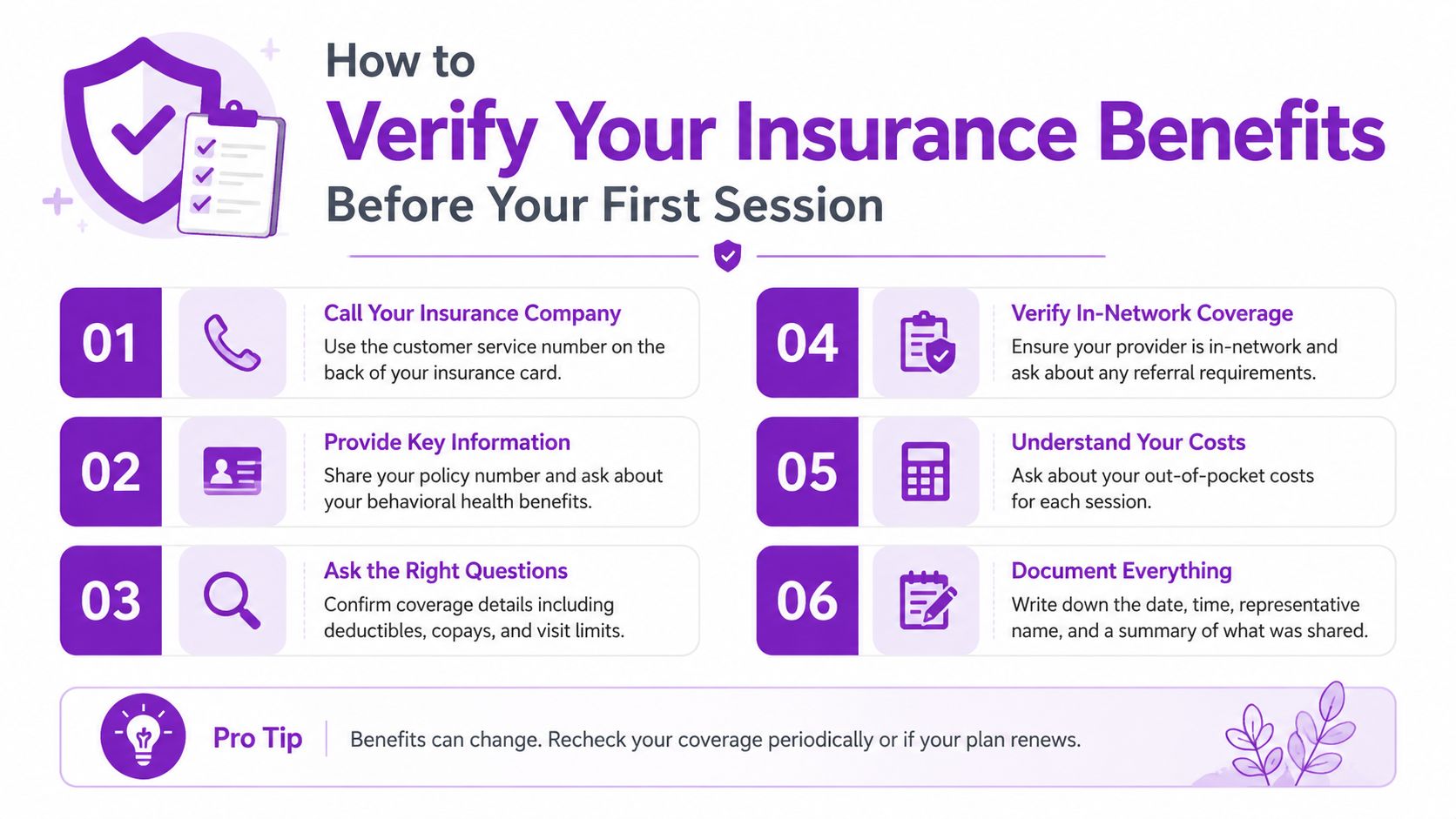
Start with the insurer, then confirm with the practice. Write down the representative's name, the call date, the benefit language, network status, authorization requirements, and any reference number. A benefits representative can describe coverage, but the final claim decision can still depend on the clinician's documentation and the plan's review.
A practical verification script
Use this order so the conversation stays focused:
- Identify the benefit: “Does my plan cover family psychotherapy with the patient present?”
- Name the code: “Is CPT 90847 covered under my outpatient behavioral health benefit?”
- Clarify the patient: “Can my spouse attend if one partner is the identified patient?”
- Ask about payment: “What applies before and after my deductible, and what is my responsibility for an in-network visit?”
- Confirm the provider: “Is this clinician in network at this location and for telehealth?”
- Check authorization: “Do I need a referral or pre-authorization before the first session?”
- Document the call: “Can you provide a reference number and explain any exclusions?”
Keep the therapist's office informed about what the insurer said. Practices that handle benefits verification can help identify missing information before the first claim is submitted, but they can't promise payment. For additional help understanding claim timelines and follow-up steps, use these FindMyScript insurance claim tips.
The safest approach is to treat every estimate as an informed expectation, not a guarantee. If the plan excludes the service, ask for the self-pay fee, sliding-scale availability, EAP options, and whether the practice can provide a superbill.
Finding Couples Therapy Support in the Phoenix Area
Phoenix-area couples need a practice that can discuss both the clinical fit and the billing route. reVIBE Mental Health serves clients through locations in Chandler, Phoenix Deer Valley, Phoenix Paradise Valley, Scottsdale, and Tempe, with therapy, EMDR, psychiatry, and medication management available through an integrated team. The practice accepts most major insurance plans and helps clients verify benefits before care begins.
Appointments are available seven days a week, with in-person and secure online sessions. That flexibility can make it easier to coordinate schedules, especially when one partner needs individual treatment and the couple also wants joint support.

Use reVIBE's couples counseling resource to start the conversation, then ask directly about the identified patient, CPT 90847, diagnosis requirements, network status, and expected out-of-pocket responsibility.
Find a reVIBE Location Near You
We currently have five locations for your convenience. (480) 674-9220
reVIBE Mental Health, Chandler
3377 S Price Rd, Suite 105, Chandler, AZreVIBE Mental Health, Phoenix Deer Valley
2222 W Pinnacle Peak Rd, Suite 220, Phoenix, AZreVIBE Mental Health, Phoenix PV
4646 E Greenway Road, Suite 100, Phoenix, AZreVIBE Mental Health, Scottsdale
8700 E Via de Ventura, Suite 280, Scottsdale, AZreVIBE Mental Health, Tempe
3920 S Rural Rd, Suite 112, Tempe, AZ
Visit reVIBE Mental Health to discuss couples therapy, individual mental health treatment, insurance verification, and online or in-person care. Call (480) 674-9220 to get matched with a provider and clarify the billing path before your first session.