
You're ready to leave the house, but doubt stops you at the door. You checked the stove, yet you mentally replay turning the knob, consider going back, and ask someone whether they're sure everything is safe. The reassurance helps briefly. Then you wonder whether you explained the situation clearly enough.
Being told to try exposure and response prevention, or ERP, can sound like another instruction to resist harder. It isn't. The important question is whether you'll receive a structured, individualized treatment with someone who understands both the visible rituals and the private mental work that keeps you stuck.
Why Exposure and Response Prevention Matters in Psychiatry
The exhausting part of the checking scene isn't feeling afraid. It's having daily decisions depend on reaching a level of certainty that never seems to last. You might recognize the same pattern around washing, reviewing conversations, confessing thoughts, or asking someone to confirm that you haven't done anything wrong.
ERP is a structured form of cognitive behavioral therapy for obsessive-compulsive disorder, or OCD. Within psychiatric care, it provides a specific psychological treatment rather than a general instruction to manage stress. A psychiatric professional may also assess whether medication belongs in the care plan.
More than talking through a worry
Consider an illustrative therapy conversation. Someone describes repeatedly checking an appliance, and the clinician responds by explaining why an accident is unlikely. The person feels understood, but leaves needing the same explanation again.
An ERP-oriented conversation asks a different question: what happens when doubt appears, and what does the person do to settle it? That distinction matters because discussing a fear and practicing a different response to it aren't interchangeable.
General anxiety counseling can still have a place. When comparing types of therapy for anxiety, ask what each approach would involve during an ordinary appointment, not just which label appears on a provider's website.
A useful distinction: Feeling supported during a conversation and learning to respond differently to an OCD trigger are related, but they aren't the same treatment task.
Why fit matters as much as the name
ERP is a first-line treatment for many people with OCD, but that doesn't make it universally simple or immediately comfortable. Someone with manageable symptoms and someone whose avoidance disrupts daily life may need different levels of support.
If you're searching for exposure and response prevention psychiatry services, look for more than a promise to help you face fears. Look for an explanation of how the clinician will assess your symptoms, choose exercises with you, and recognize when the approach needs adjustment.
The standard shouldn't be instant calm. It should be a clear, collaborative treatment whose methods match the problems you're experiencing.
How Exposure and Response Prevention Actually Works
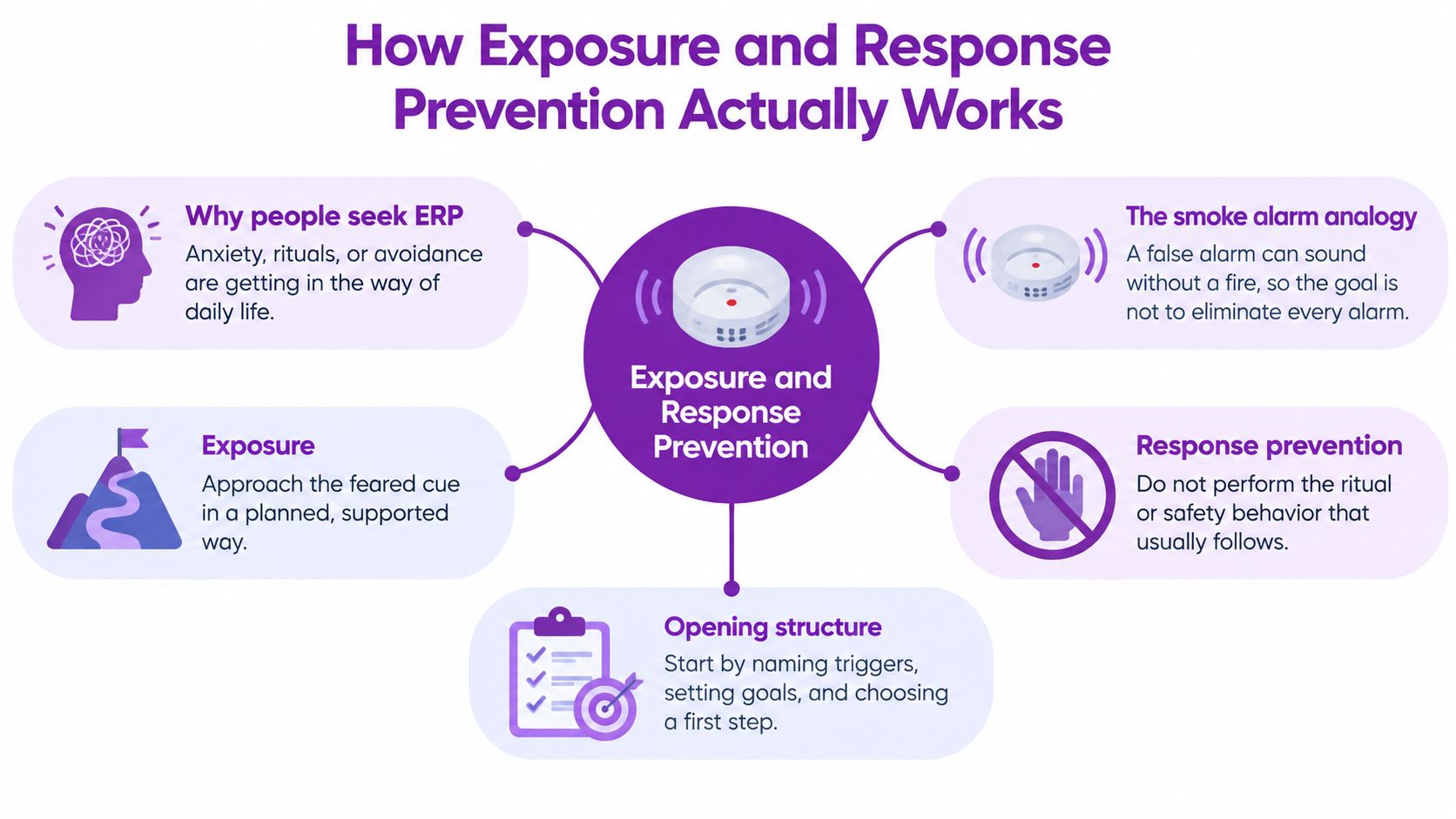
Think of a smoke alarm that sounds when there isn't a fire. The noise is real and uncomfortable, but the signal alone doesn't establish an emergency. As an analogy for OCD treatment, the task isn't to smash the alarm or guarantee it will never sound again.
Instead, you practice responding differently when an alarm appears. Exposure means approaching a selected trigger. Response prevention means resisting the ritual or avoidance that would ordinarily follow, including after the exercise ends.
What happens before exposure begins
Treatment commonly starts with 2–3 sessions of education and detailed assessment of obsessions, compulsions, and avoidance, followed by building an exposure hierarchy, as described in the International OCD Foundation's ERP treatment guide.
That assessment should get specific. A clinician needs to understand not only what frightens you, but also what you do afterward, what you avoid altogether, and what happens privately in your mind. Otherwise, an exercise might address the obvious behavior while missing the response that matters most.
The broader framework is cognitive behavioral therapy, but its applications differ. For comparison, Addiction Resource Center LLC offers a resource on changing thoughts that fuel substance use. That's a different treatment context, not a substitute for OCD-specific assessment.
Turning the assessment into practice
A planned exercise connects several decisions:
- Choose a trigger: Identify a situation, object, thought, or uncertainty relevant to your symptoms.
- Name the response: Specify what you ordinarily do to escape, neutralize, or settle the discomfort.
- Agree on practice: Decide how you'll approach the trigger and which responses you'll resist.
- Review the experience: Discuss what happened without turning the review into another search for certainty.
ERP is designed to help you learn that anxiety can decline without performing the ritual. It isn't reassurance delivered while you stand near something frightening.
Nor is competent ERP coercive flooding. You shouldn't be surprised with an exercise or required to attempt the most frightening item immediately. Planning, consent, and a clear explanation of the purpose belong in the treatment.
Building a Hierarchy and Preventing Rituals
An exposure hierarchy translates a broad concern into workable situations. “I'm afraid of contamination” doesn't yet tell a therapist which surfaces you avoid, what washing involves, or which daily activities you've stopped doing.
You and the therapist rank relevant triggers from more manageable to harder. The ranking should reflect your experience rather than someone else's assumptions about what ought to be easy. A useful starting exercise is challenging enough to practice a different response, without being chosen merely because it sounds dramatic.
Make the hidden responses visible
Response prevention needs to cover more than what an observer can see. Someone might stop returning to check an appliance but spend the journey mentally reconstructing whether it was switched off.
Possible targets include:
- Visible rituals: Repeated washing, checking, arranging, or asking for confirmation.
- Mental rituals: Reviewing memories, neutralizing a thought, or repeatedly analyzing whether something feels certain.
- Avoidance: Skipping an activity, delegating it, or arranging the day so the feared situation never arises.
Between-session practice helps connect treatment to everyday life. The plan should specify what to practice, how to recognize substitute rituals, and what to discuss if an exercise proves unworkable.
Measurement also belongs in competent care. Alongside symptom tracking, a clinician should ask about functioning: are you leaving home more freely, completing responsibilities, or spending less of your day on rituals? Relapse planning makes room for future difficulties by identifying warning signs and a practical response.
ERP intensity by adult functional impairment
Not every course requires the same amount of therapist contact. NICE's adult OCD treatment recommendations distinguish low-intensity ERP of up to 10 therapist hours from more intensive CBT including ERP of more than 10 therapist hours.
| Impairment and fit | What may be offered | Therapist time |
|---|---|---|
| Mild functional impairment when low-intensity care is suitable | Psychological treatment including ERP, such as structured self-help, telephone CBT with ERP, or another brief format | Up to the NICE low-intensity threshold |
| Low-intensity care is unsuitable or insufficient | An SSRI or more intensive CBT including ERP | Above that threshold for the intensive therapy option |
The threshold is a clinical distinction, not a promised schedule or a deadline for recovery. Medication and therapy may also be combined when impairment, coexisting conditions, or previous treatment response make that a better fit.
A prescribing discussion should remain individualized. This comparison helps you ask about intensity, not choose or change medication yourself.
Everyday ERP Examples That Show the Method
These are illustrative scenes, not case studies or exercises to copy without assessment. Each shows how a therapist might connect a manageable trigger with a specific response to resist. The appropriate task depends on the person's symptoms, circumstances, and safety.

Contamination fears during an ordinary task
A person avoids touching a household surface unless washing can happen immediately afterward. With their therapist, they choose an agreed surface that feels challenging but manageable, then practice delaying the washing response while continuing an ordinary activity.
The therapist also asks what happens internally. Repeating that the surface is definitely clean could become another way of neutralizing uncertainty.
The task isn't to abandon appropriate hygiene. It's to work on an identified OCD-related response within agreed boundaries, rather than treating every uncomfortable sensation as a reason to wash.
Checking before leaving home
Another person repeatedly returns to inspect the stove. A graded exercise might involve completing the agreed ordinary safety check, leaving the house, and continuing toward a planned destination without returning for another inspection.
The response-prevention plan could also address substitutes, such as asking a household member to check again or mentally replaying the departure. Instead, the person practices continuing the chosen activity while doubt remains unresolved.
The point isn't to prove that nothing bad could ever happen. It's to practice leaving without adding the extra checking that the treatment has identified as compulsive.
Intrusive harm or taboo thoughts
For someone distressed by unwanted thoughts, the selected exposure may involve allowing an agreed thought or reminder to be present. The response to resist might be mental review, confession, or asking someone to confirm what the thought means.
Here, there may be little outward action to observe. The practice could consist of noticing the thought and returning attention to an ordinary, meaningful task without conducting an internal investigation.
A conversation about an intrusive thought isn't automatically ERP. The treatment needs to address what the person does in response to that thought.
Across these scenes, the recognizable pattern is a planned trigger, a specified ritual to resist, and an opportunity to continue without immediate neutralization. None requires dangerous behavior or proof of absolute safety. If there's uncertainty about genuine risk, the clinician should assess that before designing exposure.
What Progress Looks Like When Anxiety Stays
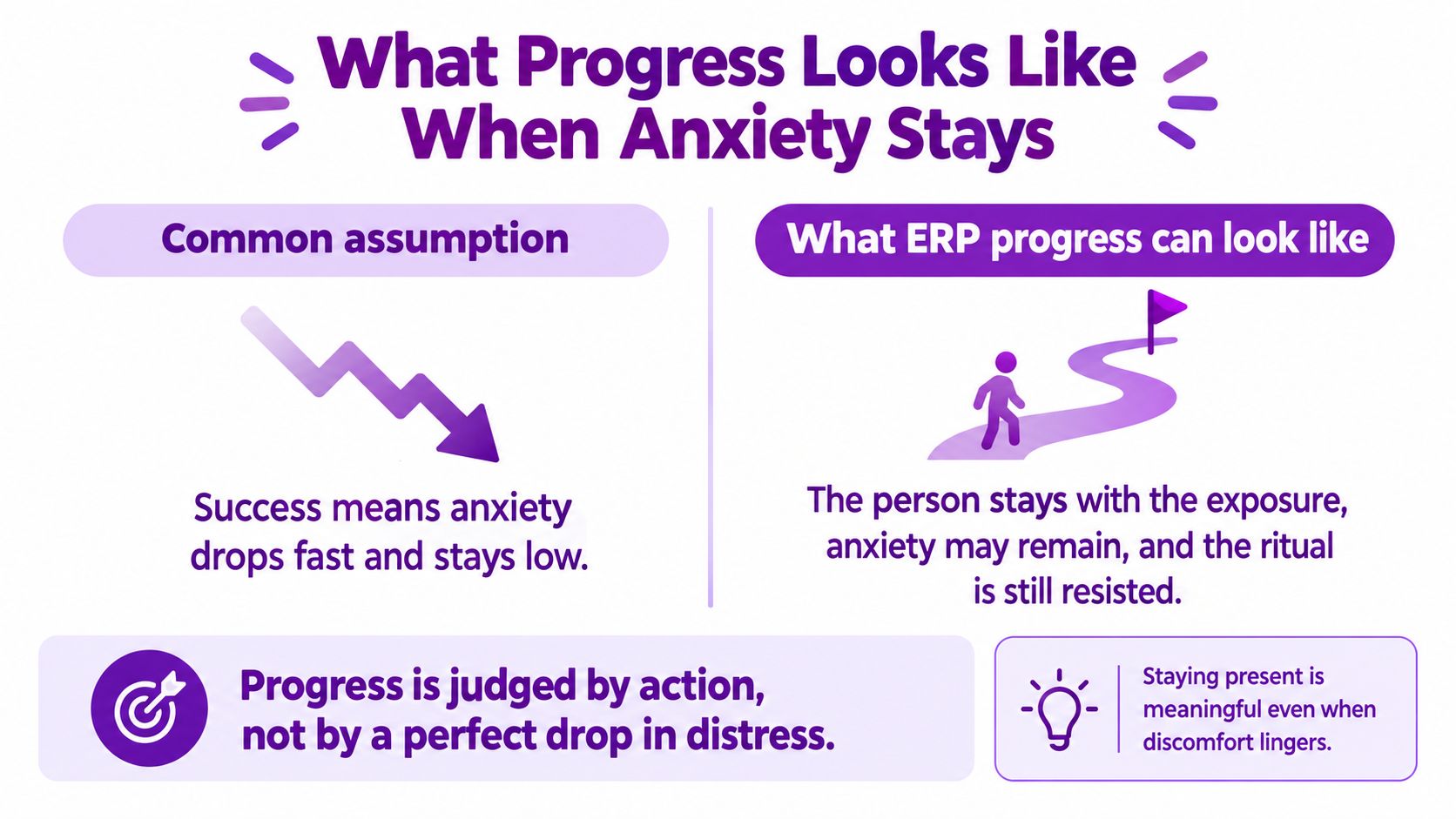
A person finishes an exposure still anxious, yet leaves the checking ritual undone and returns to a planned activity. That can be progress. Anxiety that stays high doesn't, by itself, mean ERP has failed. Judging each exercise only by how calm someone feels afterward can hide changes in behavior and daily life.
Distress still matters. A therapist should consider it alongside compulsions, functioning, and whether the person can use skills beyond the session.
Learning without requiring immediate relief
If treatment treats a drop in anxiety during exposure as the only sign of success, it may miss other important factors. Poor insight, severe avoidance, depression, trauma history, mental rituals, and difficulty engaging can all call for adjustments. They are not evidence that someone needs to try harder.
A clinical discussion of personalized exposure approaches considers willingness, values-consistent action, dropout, partial response, and relapse. It also describes a randomized protocol evaluating six-session mixed-reality ERP against self-guided exposure. That comparison does not establish that the formats are equivalent.
ACT, or acceptance and commitment therapy, offers a useful way to consider progress: can you take an action connected to what matters while uncomfortable thoughts and uncertainty remain? Someone might join a family activity without waiting to feel completely settled.
Progress can include:
- Less compulsive responding: You notice an urge without automatically carrying out the ritual.
- More flexibility: You continue a task without reaching complete certainty.
- Better functioning: You return to responsibilities or relationships that avoidance had restricted.
- Broader use of skills: You apply what you practiced in places beyond the therapist's office.
When to adjust the plan
Persistent distress deserves a conversation with the therapist. They may need to reassess the exposure, check for hidden rituals, address coexisting problems, or change the level of support. A well-guided plan is individualized, and difficulty is a reason to review how treatment is working, not to repeat the same exercise.
Self-guided and digital approaches should not be assumed to suit everyone equally. In-person care, telehealth, guided digital tools, medication, or combined care can be considered in light of symptoms, safety, privacy, readiness, and other mental health needs.
A shorter format may ease practical burdens, but length alone does not show whether care is adequate. The key question is whether the guidance fits the person and the challenges they face.
How to Tell Real ERP From General Anxiety Care
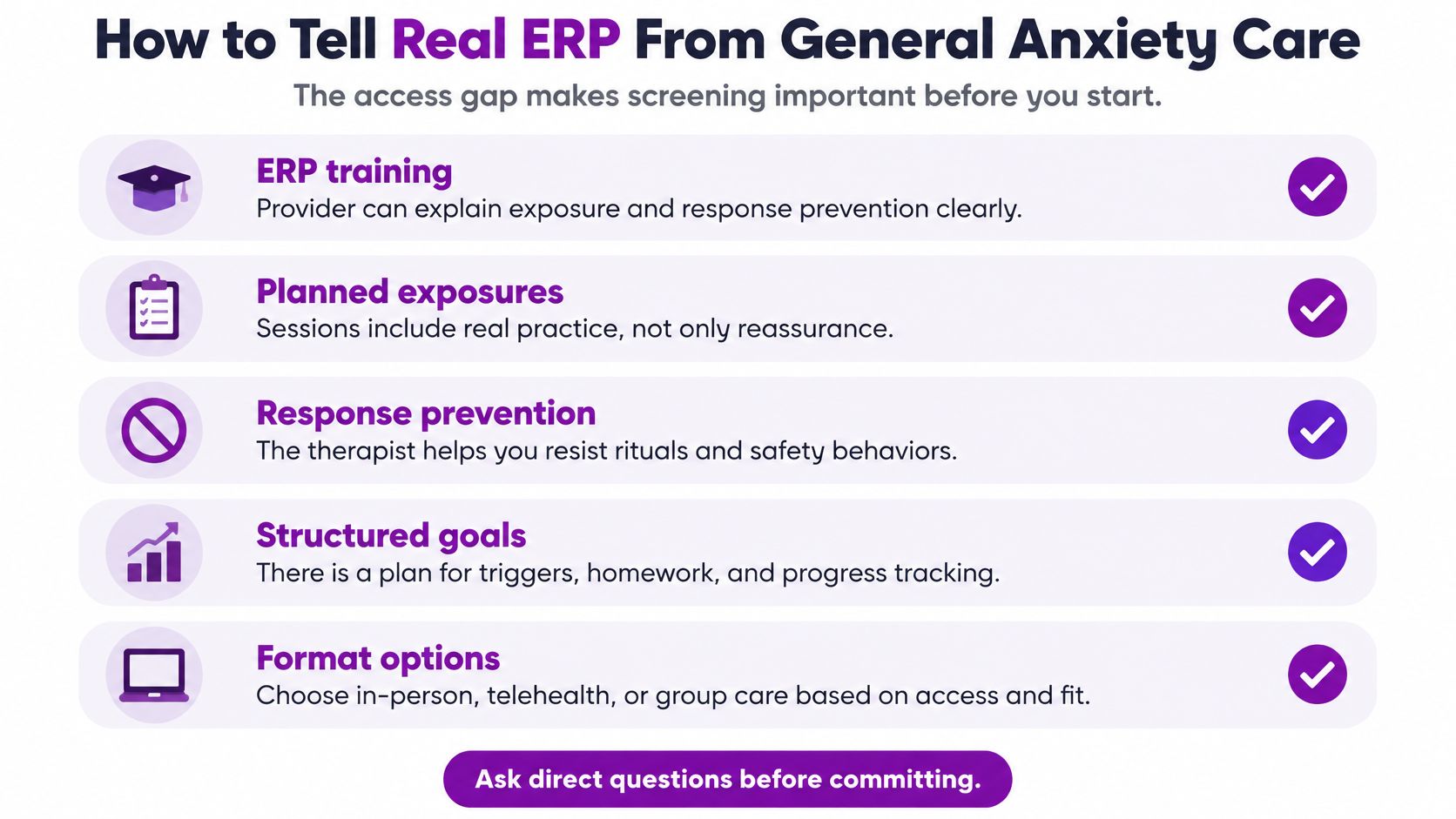
A therapist may describe their approach as CBT, yet the sessions might not include ERP. If you have spent time discussing fears without practicing exposure and response prevention, ask what the treatment will involve before committing.
Access to competent OCD care can be difficult. A discussion of barriers to competent OCD treatment describes challenges related to clinician training and access. Those barriers make it useful to ask specific questions, rather than relying on the label “CBT.”
Questions that reveal what treatment involves
Ask the provider to describe the work in plain language:
- Training and experience: What OCD-specific ERP training and supervision have you received?
- Individual hierarchy: How will we shape practice around my triggers and goals?
- Planned exposures: Will sessions include exposure practice, not only discussion or encouragement?
- Mental response prevention: How will we identify reviewing, neutralizing, or seeking reassurance?
- Measurement and maintenance: How will we track symptoms and daily functioning, and prepare for setbacks?
- Collaborative pacing: If an exercise feels unmanageable, how will we adjust it?
A clear answer should explain what happens during treatment and how the therapist will guide practice. Supportive conversation can help, but it does not by itself show that therapy includes ERP.
When weighing research, clinical judgment, and your preferences, the three pillars of evidence based practice offer a broader framework for understanding how treatment decisions are made.
Check access and coordination too
Training and availability can limit your choices. Insurance, travel, and scheduling may also affect whether treatment can start and continue, so ask about these practical details before choosing a format.
One Phoenix-metro option is reVIBE Mental Health, where therapists and licensed psychiatric professionals provide talk therapy, EMDR, and psychiatry with medication management. The practice offers in-person and secure online sessions, appointments seven days a week, and help verifying most major insurance plans. Ask specifically whether an ERP-trained provider is available.
For a psychiatric consultation, you can also review reVIBE's information on ADD and OCD medication. Medication management may accompany ERP. Clarify who will provide the therapy and how sessions will include ERP practice.
Start Exposure and Response Prevention at reVIBE
You don't need to arrive with a completed hierarchy or a polished explanation of every symptom. Start by describing what interrupts your day, what you do to get relief, and what you've begun avoiding.
When contacting reVIBE, ask to be matched with a provider who fits your goals, preferences, and insurance. Say specifically that you're seeking therapist-guided ERP for OCD, and ask whether psychiatric consultation can be coordinated if medication management is part of your plan.
Find a reVIBE Location Near You!
We currently have five locations for your convenience. (480) 674-9220
reVIBE Mental Health – Chandler
3377 S Price Rd, Suite 105, Chandler, AZreVIBE Mental Health – Phoenix Deer Valley
2222 W Pinnacle Peak Rd, Suite 220, Phoenix, AZreVIBE Mental Health – Phoenix PV
4646 E Greenway Road, Suite 100, Phoenix, AZreVIBE Mental Health – Scottsdale
8700 E Via de Ventura, Suite 280, Scottsdale, AZreVIBE Mental Health – Tempe
3920 S Rural Rd, Suite 112, Tempe, AZ
Make the first contact useful
Appointments are available seven days a week. Secure online sessions provide another option when travel or scheduling creates a barrier, provided you have a suitable private space; if privacy is difficult at home, discuss whether an office appointment would fit better.
Keep the provider-screening questions nearby when you call. Ask about ERP qualifications, how treatment is personalized, insurance verification, and the practical expectations for appointments and between-session work.
You can expect a welcoming, non-judgmental setting and a discussion of your needs, not a requirement to describe distressing thoughts perfectly. A personalized plan should make room for questions and adjustments rather than guarantee that treatment will feel easy immediately.
Call (480) 674-9220 to discuss provider matching and appointment options. You can begin by asking for an assessment of whether ERP fits your symptoms and what guided care would involve.
reVIBE Mental Health offers therapy and psychiatric medication management through in-person and secure online appointments. Visit the practice to explore care options, ask about therapist-guided ERP for OCD, and find a provider whose approach fits your needs.