
When we talk about the EMDR therapy success rate, the numbers are genuinely impressive. Research has shown that up to 100% of people with single-incident trauma and 77% of those with multiple traumas can find such significant relief that they no longer meet the clinical criteria for PTSD after only a handful of sessions.
This isn’t just about feeling a little better for a while; it's about a fundamental shift in how the brain stores and relates to a traumatic event, leading to a measurable, clinical resolution of symptoms.
What a High EMDR Success Rate Actually Means
It's one thing to hear impressive statistics, but what does "success" really look like after EMDR? Is it just a temporary fix or a deep, lasting change?
In the world of trauma therapy, success isn't a vague feeling of improvement. It’s a concrete milestone. It means that the symptoms that once disrupted your life—the flashbacks, the anxiety, the hypervigilance—have diminished so profoundly that you no longer fit the diagnosis for a condition like Post-Traumatic Stress Disorder (PTSD).
Think of it this way: a traumatic memory is like a deep, infected wound. You can put a bandage on it, but it still throbs with pain and limits your movement. EMDR doesn't just cover the wound; it cleans it out and allows it to heal properly from the inside out. The memory of the injury remains, but it's just a scar—it no longer hurts to the touch or dictates how you live.
How Does the Healing Happen?
At its heart, EMDR taps into the brain's own incredible capacity for healing. It’s a bit like giving a super-charged boost to the natural processing that happens during REM sleep. When you dream, your mind works to sort through the day's events and make sense of them. EMDR uses bilateral stimulation (like guided eye movements) to help your brain do the same thing with a stuck traumatic memory.
The goal is to take a memory that feels like a clear and present danger and file it away where it belongs—in the past. You don't forget what happened, but you can recall it without reliving the intense emotional and physical pain that came with it.
One of the most powerful illustrations of this comes from a landmark study sponsored by Kaiser Permanente. The findings were striking: after just six 50-minute EMDR sessions, 100% of participants with single-trauma PTSD and 77% of those with multiple traumas no longer met the diagnostic criteria for the disorder. This research really shines a light on how efficient EMDR can be, often delivering results much faster than many traditional talk therapies.
This chart breaks down those powerful findings visually.
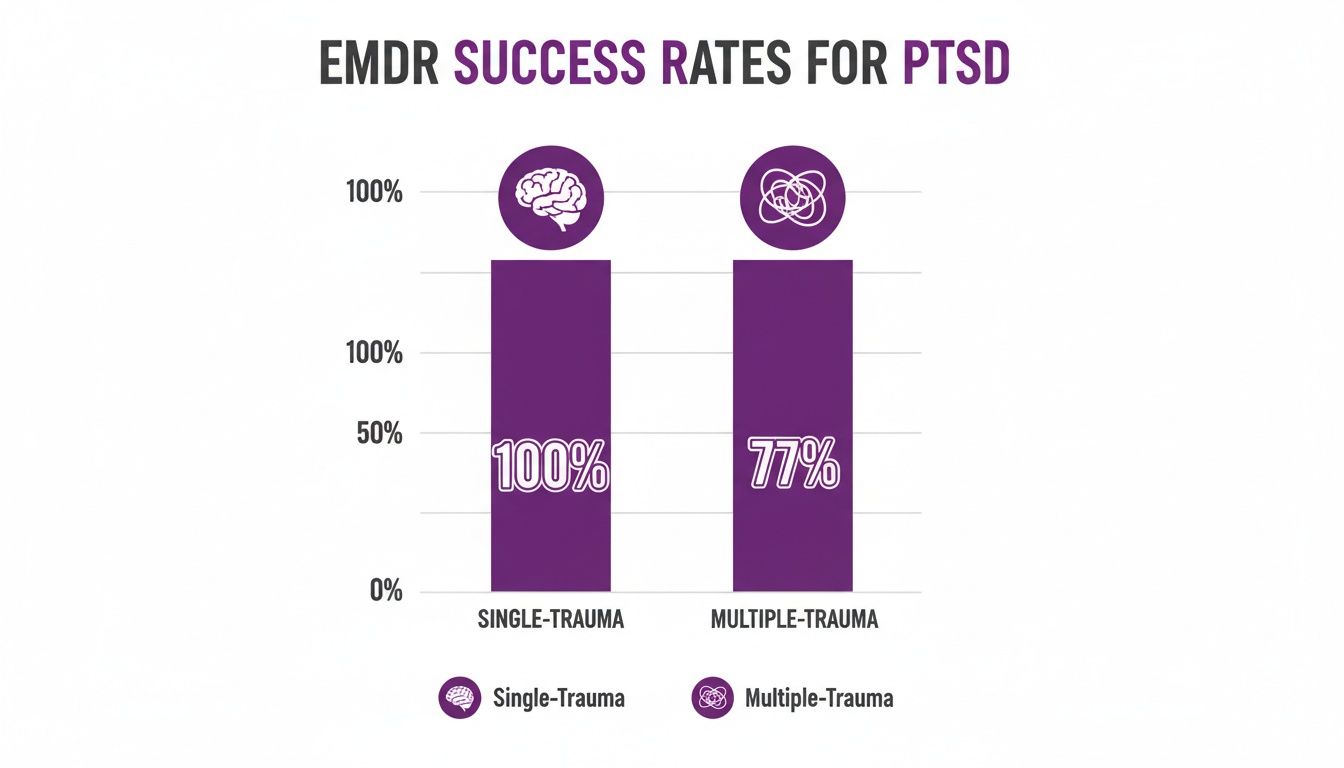
As you can see, every single person in the study dealing with a one-time traumatic event found complete resolution. These aren't just abstract numbers; they represent real people finding lasting relief and reclaiming their lives from trauma.
EMDR Success Rates for PTSD at a Glance
The Kaiser Permanente study is just one piece of a large body of evidence. To give you a broader perspective, here’s a summary of success rates from several key studies on EMDR for PTSD.
| Study Population | Reported Success/Remission Rate | Number of Sessions |
|---|---|---|
| Single-Trauma PTSD (Kaiser) | 100% no longer met PTSD criteria | 6 |
| Multiple-Trauma PTSD (Kaiser) | 77% no longer met PTSD criteria | 6 |
| Combat Veterans | 77.7% no longer met PTSD criteria | 12 |
| General Civilian Trauma | 84%-90% reported significant relief | 3-7 |
These figures, drawn from different groups and scenarios, consistently point to the same conclusion: EMDR is a highly effective and often rapid treatment for PTSD. Understanding this evidence-based potential is the first step toward seeing how this therapy can help you, too.
How We Actually Measure Your Progress in EMDR

It's one thing to hear about a high EMDR therapy success rate, but it's another to understand how we actually get to those numbers. How do we translate that feeling of "getting better" into something tangible and scientifically valid? The process is both deeply personal and highly systematic, using established tools to map out your healing journey.
This isn't just about ticking boxes. Measuring progress gives us a clear, objective look at how far you’ve come, ensuring the changes you're feeling are real and lasting.
Think of it like a physical therapist who measures your range of motion before and after treatment. In mental health, we use standardized assessments to get a clear picture of your symptoms at the start and then track how they decrease over time.
The Tools We Use
Your therapist will use several well-researched scales to quantify what you're experiencing. These aren't just generic surveys; they're precise instruments designed to measure the specific symptoms tied to trauma, anxiety, and distress.
One of the gold standards is the Clinician-Administered PTSD Scale (CAPS-5). It's a detailed interview that lets your therapist assess the frequency and intensity of your PTSD symptoms. This gives us a baseline score before EMDR begins. As you move through therapy, we'll do the assessment again to measure the change. A major drop in your CAPS-5 score is a powerful, data-backed sign that the treatment is working.
We also use tools right in the middle of a session:
- Subjective Units of Disturbance (SUD) Scale: This is a simple but powerful tool. We'll ask you to rate how disturbing a specific memory feels on a scale from 0 (neutral) to 10 (the worst). The goal is to watch that number come all the way down to a 0 or 1.
- Validity of Cognition (VoC) Scale: This measures how much you believe a new, positive thought about yourself (like "I am in control now"). You'll rate it on a scale of 1 (feels completely false) to 7 (feels completely true). We work until that new belief feels like a solid 7.
These tools help turn your internal shifts into objective data, creating a clear and encouraging roadmap of your healing.
What "Success" Really Means: Clinical Remission
When studies talk about high success rates, they're often talking about something called clinical remission. This isn't a fuzzy term—it means your symptoms have diminished so much that you no longer meet the diagnostic criteria for a condition like PTSD.
Clinical remission is the data-driven proof that your healing has reached a deep, stable point. It means the therapy didn't just help you manage your symptoms; it resolved the underlying distress that was causing them.
This is what we're aiming for with EMDR. The goal isn't just to help you cope, but to help you truly heal. The consistently high rates of clinical remission are exactly why EMDR is considered a first-line treatment for trauma. If you want to dive deeper into what progress feels like, our guide on how to know if therapy is working is a great resource.
By using these structured, evidence-based methods, we can confidently track your path to recovery. It builds trust in the process and shows that the incredible results of EMDR are grounded in real, measurable change.
Exploring EMDR for Depression and Anxiety

While EMDR first made its name as a powerhouse treatment for PTSD, its applications are proving to be much broader. We're now seeing just how profoundly it can help people dealing with depression and anxiety by getting to the very source of the problem.
It's common for conditions like depression and anxiety not to be standalone issues. Instead, they’re often the surface-level symptoms of deeper, unresolved life experiences. These don't always have to be the "Big T" traumas, like a car crash or combat. More often, they're rooted in a series of "small t" traumas that have piled up over the years.
The Hidden Roots of Depression and Anxiety
Picture your emotional health as a tree. The anxiety and depression you feel are like wilted leaves or brittle branches—they're the symptoms you can see. While some therapies focus on trimming the branches, EMDR goes deeper to heal the roots.
"Small t" traumas are those events that, while not life-threatening, still packed a big emotional punch and negatively shaped how you see yourself and the world.
These can be experiences like:
- Persistent criticism or bullying in your formative years.
- Emotional neglect, where your need for support and affection went unmet.
- A deeply embarrassing or humiliating event.
- The chronic stress of a painful breakup or ongoing family conflict.
Any one of these experiences can plant a negative belief deep in your mind—"I'm not good enough," "I'm unlovable," or "The world isn't safe." These unprocessed memories fester over time, eventually showing up as a constant hum of anxiety or a heavy fog of depression. This is where EMDR comes in. It helps the brain finally process these old memories, healing the roots so the whole tree can finally flourish.
How EMDR Helps Process These Root Causes
EMDR offers a unique way to access and work through these painful memories without needing to re-live them by talking about them in exhaustive detail. Instead of just managing the symptoms of anxiety, you and your therapist will pinpoint the specific life events that installed those feelings in the first place.
Using bilateral stimulation (like eye movements), EMDR helps kickstart your brain's own information processing system, getting it "unstuck." That memory of being harshly shamed by a teacher can be reprocessed so it no longer triggers feelings of worthlessness today. The memory doesn't disappear, but its emotional charge is neutralized.
This is the critical distinction: EMDR doesn't just put a bandage on the symptoms of anxiety or depression. It targets the underlying memories that fuel them, leading to lasting, sustainable relief.
The emdr therapy success rate for these conditions is backed by strong research. One study, for instance, found a 71% remission rate for depression right after EMDR treatment. A wider meta-analysis confirmed its significant impact, solidifying its place as a powerful therapeutic tool.
By going after the foundational experiences that contribute to these conditions, EMDR opens up a path to genuine healing. If you're dealing with anxiety, you might find our specific article on EMDR therapy for anxiety helpful. And while EMDR works on the roots of these issues, learning practical techniques to let go of negative thoughts can be a great complementary skill. This dual approach offers real hope, especially for those who feel like they've tried everything else without seeing real change.
Comparing EMDR to Traditional Talk Therapy
When you're looking for the right therapy, it's easy to get lost in a sea of acronyms. Most people have heard of traditional talk therapy, like Cognitive Behavioral Therapy (CBT), but aren't as sure where EMDR fits in. Let's be clear: this isn't about which one is "better," but about understanding how they work differently so you can find the best fit for you.
Think of it this way. Traditional talk therapy often works from the top down. With CBT, you learn to identify, challenge, and reframe the negative thoughts that spin out from a painful memory. It’s a powerful, conscious process of rewriting your internal script, giving you practical tools to change your thinking and behavior.
EMDR, on the other hand, works from the bottom up. It goes directly to the source.
A Different Approach to Healing
Instead of focusing on the conscious thoughts about the memory, EMDR targets the raw, unprocessed memory itself. If CBT helps you edit the story you tell yourself, EMDR is like a technician going into your brain's filing system to correctly store a distressing file that was put in the wrong place.
The process itself feels very different. There’s less talking and more focused internal work. As you hold a memory in mind, your therapist will guide you through bilateral stimulation (like side-to-side eye movements). This simple action helps unlock your brain’s own information processing system, allowing the memory to be properly integrated. The memory itself doesn't vanish, but its painful emotional charge gets neutralized for good.
The core difference is how change happens. Talk therapy changes your relationship with the memory through conscious effort. EMDR changes the memory’s neurological footprint so it no longer triggers a fight-or-flight response.
This fundamental distinction is a big reason why the EMDR therapy success rate is often so high and why many people find relief faster than they expected.
Looking at the Comparative Data
When we dig into the research, the numbers really highlight EMDR's effectiveness. While CBT is an incredibly valuable and proven therapy, studies often show EMDR having a slight edge in overall success rates for a number of conditions.
For instance, one major meta-analysis looked at 29 different studies and found EMDR therapy had an overall success rate of 49.4%. This was higher than several other well-known therapies, including CBT at 40.5%, Hypnosis at 39.2%, and Dialectical Behavior Therapy (DBT) at 22.4%. You can dive deeper into these findings in the comprehensive research analysis.
This isn't to discount other methods at all. It just shows that EMDR is a uniquely powerful tool, especially when dealing with issues rooted in distressing life experiences.
Choosing the Right Path for You
So, what’s the right choice? It really comes down to you—your history, your comfort level, and what you’re hoping to heal. The table below breaks down the key differences to help you see where each approach shines.
| Feature | EMDR Therapy | Cognitive Behavioral Therapy (CBT) |
|---|---|---|
| Primary Focus | Reprocessing the stored memory itself. | Changing conscious thoughts and behaviors about the memory. |
| Process | Uses bilateral stimulation with minimal talking. | Involves structured talk, analysis, and homework. |
| Client Role | Active internal processing and observation. | Active verbal engagement and skill practice. |
| Typical Pace | Often achieves results in fewer sessions. | Can be a longer-term, structured process. |
Ultimately, neither approach is universally superior. They are just different tools for different jobs. Some people thrive with the logical, skill-based structure of CBT. For others, particularly when trauma is at the heart of their struggles, the deep, neurological reprocessing of EMDR offers a more direct and lasting path to feeling better. Understanding the difference is the first step in making an empowered choice for your well-being.
What Your EMDR Journey Might Look Like: The Personal Factors

While the high success rates for EMDR are fantastic news, they don't tell the whole story. Numbers and studies give us a broad picture, but your path to healing is uniquely yours. Understanding the factors that can shape your journey will empower you to be an active participant in your own recovery.
It’s less about EMDR being something that is done to you and more about it being a process you move through with a skilled guide. The impressive statistics are the destination, but knowing the terrain ahead helps you navigate it with confidence.
Let's break down the key elements that influence how EMDR therapy unfolds for each individual. These aren't roadblocks; they're simply parts of your personal landscape that you and your therapist will explore together.
The Power of Your Connection With Your Therapist
This is a big one. In fact, it might be the most critical piece of the puzzle. The therapeutic alliance—that feeling of safety, trust, and genuine connection with your therapist—is the foundation for all the healing work to come. Without it, it’s tough to feel secure enough to approach difficult memories.
When you feel truly seen, heard, and respected, you can dive deeper into the process. Think of it like this: your therapist is an expert guide leading you on a challenging hike. Their knowledge of the trail is crucial, but it's the trust between you that gives you the courage to follow them through unfamiliar territory.
Here at reVIBE Mental Health, we put a huge emphasis on finding the right fit. Our teams across Chandler, Phoenix, Scottsdale, and Tempe are committed to creating that warm, non-judgmental space where a strong therapeutic alliance can truly grow.
The Nature of the Trauma
The type of trauma you've experienced also plays a major role in what your therapy journey looks like. Processing a single, isolated event is very different from healing from years of distress.
Single-Event Trauma: This is a one-time incident, like a car accident, a physical assault, or a natural disaster. For these situations, the path to healing can be more direct and often quicker. It’s in these cases that we see success rates reaching as high as 100% after just a few sessions.
Complex or Developmental Trauma: This involves traumatic events that were prolonged, repeated, or happened during critical developmental years in childhood. This might include ongoing neglect, abuse, or growing up in a chaotic environment. Healing from complex trauma is a more layered process. It takes more time because we're not just processing one memory, but untangling a web of interconnected experiences and beliefs.
Healing isn't a race. The goal is to be thorough and compassionate with yourself, not to finish first. Whether your trauma is a single event or a complex history, the process is always tailored to your specific needs, ensuring you move at a pace that feels safe and right for you.
Your Own Readiness for Change
Your personal mindset and commitment are powerful forces in your own healing. Therapy is a partnership, and the work you put in—both inside and outside of your sessions—makes a huge difference. This doesn't mean you need to be fearless or "perfect." It just means showing up, being open, and staying curious about the process.
This readiness often looks like:
- Willingness to Engage: Being open to trying the techniques and trusting the process, even when it feels new or strange.
- Commitment to the Work: Attending sessions consistently is key, as each appointment builds on the one before it.
- Practicing Self-Care: Your therapist will teach you skills to stay grounded. Using them between sessions is vital for managing any emotions that come up.
Understanding these personal factors helps shift the perspective from being a passive recipient of a treatment to an active collaborator in your own healing journey. You bring incredible strengths to the table—your courage, your resilience, and your commitment. By recognizing this, you can see yourself as a powerful agent in your own recovery, working side-by-side with your therapist toward lasting change.
Find a reVIBE Location Near You!
Reading about the EMDR therapy success rate is a great first step, but the real healing happens when you take action. Here at reVIBE Mental Health, we make that next step feel as safe, simple, and supportive as possible. With five locations across the Phoenix metro area, compassionate and effective EMDR therapy is closer than you think.
We currently have five locations for your convenience. (480) 674-9220
reVIBE Mental Health – Chandler
3377 S Price Rd, Suite 105, Chandler, AZreVIBE Mental Health – Phoenix Deer Valley
2222 W Pinnacle Peak Rd, Suite 220, Phoenix, AZreVIBE Mental Health – Phoenix PV
4646 E Greenway Road, Suite 100, Phoenix, AZreVIBE Mental Health – Scottsdale
8700 E Via de Ventura, Suite 280, Scottsdale, AZreVIBE Mental Health – Tempe
3920 S Rural Rd, Suite 112, Tempe, AZ
Our process is built on compassion and clarity, right from your very first call. It all begins with a confidential conversation where a member of our team will take the time to listen, understand what you’re going through, and answer your initial questions. We want you to feel seen and heard from the moment you reach out.
A Clear and Supportive Path Forward
Getting help shouldn't add more stress to your life. Once you connect with us, we'll walk with you through each step, making sure you feel informed and confident the entire time.
Here’s what that looks like:
- Answering Your Questions: We'll give you straight, clear information about what EMDR therapy involves so you can feel comfortable with the process.
- Verifying Your Insurance: Our team will handle the confusing part—figuring out your benefits and coverage—so there's no guesswork about the financial side.
- Matching You with the Right Therapist: We put real thought into finding a clinician whose skills, personality, and approach are the best fit for your unique story and goals.
This careful, structured approach is about more than just logistics; it's about building the strong, trusting relationship between you and your therapist that is so crucial for successful EMDR. It’s also important to have the right support systems in place, which is a hallmark of modern, collaborative mental health therapy practices.
Your journey is yours alone, and it deserves a plan that honors that. We're committed to creating a path to wellness that respects your individual needs and moves at a pace that feels right for you.
To get more details, you can find more information about our EMDR therapy near you.
Your Questions About EMDR Therapy, Answered
It's completely normal to have a lot of questions before starting any new kind of therapy. Even with all the data and success rates, you want to know what it will actually be like for you. We get it.
This section tackles the most common questions we hear from people just like you. We want to clear up any confusion and help you feel confident about exploring EMDR.
How Long Does EMDR Take to Show Results?
This is probably the number one question on everyone's mind, and the honest answer is: it depends. Your personal history and the nature of your trauma play the biggest roles.
For a single-incident trauma, like a car accident or a specific assault, some people find profound relief in as few as 3 to 6 sessions. These memories are often more distinct and can be targeted directly.
On the other hand, if you're dealing with complex or developmental trauma—things like ongoing childhood neglect or a long-term abusive situation—the process naturally takes more time. Your treatment is always paced to your needs, ensuring you feel supported every step of the way, never rushed.
Is EMDR Therapy Actually a Safe Process?
Yes, absolutely. When conducted by a properly trained and certified therapist, EMDR is a highly controlled and safe therapeutic method. In fact, a huge part of the initial work is focused on safety.
Before you even begin to process a difficult memory, your therapist will equip you with a toolkit of grounding techniques and coping resources.
These skills are your anchor, ensuring you feel secure and in control throughout every session. Your therapist’s job is to create a space built on trust, and they will never push you to go faster or deeper than you're ready for.
Think of it this way: you are always in the driver's seat. Your therapist is simply the experienced navigator sitting beside you, guiding the way.
What Does an EMDR Session Really Feel Like?
It's helpful to have a picture of what to expect. First things first: you are always awake, aware, and in control. This is not hypnosis.
During a session, you'll focus on a specific memory while your therapist guides you through what's called bilateral stimulation. Most often, this involves following their fingers with your eyes as they move back and forth, but it can also be done with handheld tappers or alternating sounds.
Many people describe the sensation as watching the memory from a safe distance, as if it were a movie playing on a screen. This unique process allows your brain to re-file the event and its emotions without you feeling completely re-traumatized. Over time, the memory loses its intense, painful charge.
Does Insurance Cover EMDR Therapy?
Yes, in most cases. EMDR is a well-established, evidence-based psychotherapy. It's recommended for trauma treatment by major health bodies like the World Health Organization (WHO) and the American Psychiatric Association (APA).
Because of its strong clinical standing, most major insurance plans cover EMDR as part of standard mental health care.
We know that dealing with insurance can be a headache. That’s why our team at reVIBE is happy to help you verify your benefits. We'll make sure you understand your coverage upfront so there are no financial surprises.
Your path to healing is your own, and you deserve a team that gets that. At reVIBE Mental Health, we blend clinical expertise with real, human compassion to help you find your footing again. If you're wondering if EMDR could be the right approach for you, we're here to help you figure it out.