Your chest feels tight, your thoughts keep circling, and even a simple email or conversation feels harder than it should. Maybe grief has drained your energy, burnout has left you wired and exhausted, or anxiety has pushed your attention toward every possible problem at once. In that moment, trying to “think your way out” can feel impossible because your body needs steadiness before your mind can fully engage.
Self-soothing techniques for adults are practical skills that can create enough safety and calm to help you take the next step. They can complement therapy, medication management, crisis care, and other professional treatment, but they aren't replacements for those supports when symptoms are severe, persistent, or unsafe. A 2024 U.S. population study found that meditation was used by 18.3% of adults in 2022, about 60.53 million people, while yoga was used by 16.8%, about 55.78 million adults. Guided imagery and progressive relaxation were used by 6.7%, about 22.22 million adults (PubMed).
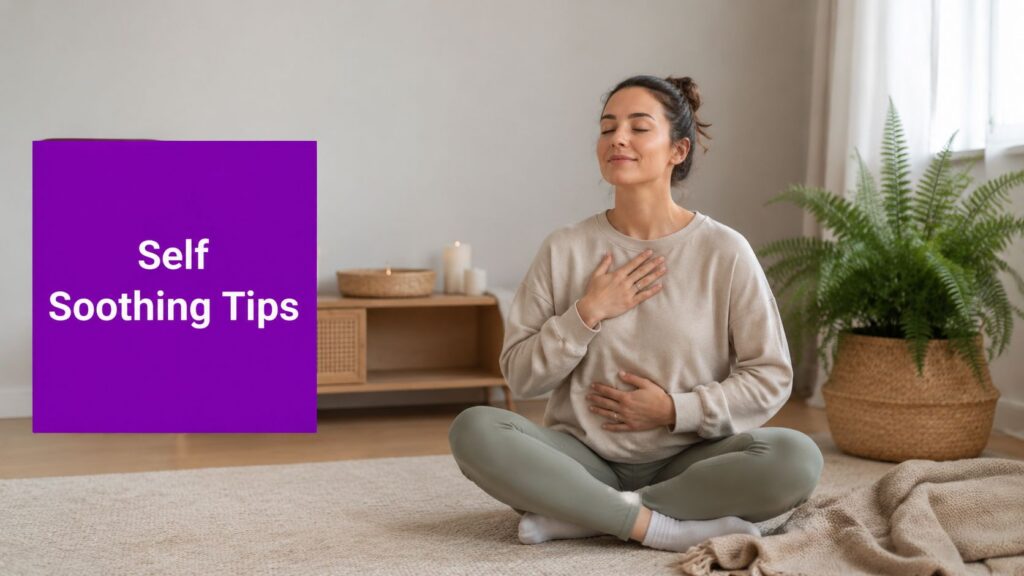
The eight options below use different pathways, including breath, muscles, attention, expression, environment, temperature, and connection. Choose one low-pressure technique to test today rather than trying to master everything at once.
1. Deep Breathing and Box Breathing
When anxiety makes your breathing shallow or hurried, a structured rhythm gives your attention one clear task. Box breathing uses four equal parts: inhale for four counts, hold for four, exhale for four, and hold again for four. A NIH-hosted breathing guide also describes this pattern, repeated three additional times, alongside a 4-7-8 method repeated three additional times (NIH breathing guide).
Try it seated with both feet supported. Let your shoulders drop, breathe in gently for four, pause for four, breathe out for four, and pause for four. The breath shouldn't feel forced. If holding your breath increases panic, skip the holds and use a comfortable inhale followed by a slightly longer exhale.
Match the breath to the moment
Use box breathing before a difficult meeting, while waiting for an appointment, or after reading a message that triggered you. During intense panic, the goal isn't to achieve perfect calm. It's to create enough control to notice your surroundings, sit safely, and decide what support you need.
Slow-paced breathing at about 0.1 Hz, roughly six breaths per minute, has been described as a possible adjunct to sleep hygiene and relaxation therapies for falling asleep and returning to sleep (breathing and sleep review). A separate randomized study found that daily five-minute cyclic sighing improved mood more and reduced respiratory rate more than mindfulness meditation, with the authors highlighting exhale-focused breathing (randomized respiration study).
Practical rule: Practice breathing when you're already relatively calm. Repetition makes the rhythm easier to access when distress is high.
Use a visual pacer or guided session in an app if counting feels difficult. Notice what changes on the exhale, such as a softer jaw or lower shoulders. Stop if you become lightheaded, distressed, or unable to breathe comfortably, and return to ordinary breathing.

2. Progressive Muscle Relaxation
An anxious body can stay braced even after the immediate problem has passed. Progressive muscle relaxation, or PMR, helps you identify that bracing by gently tensing and releasing muscle groups, usually moving from the feet upward. The contrast teaches your body what tension and release feel like.
Start with your toes. Tighten them mildly for a brief moment, release, and notice the difference. Continue through calves, thighs, abdomen, hands, arms, shoulders, jaw, and forehead. Keep the effort mild to moderate, never painful, and avoid areas affected by injury or a medical condition unless a clinician has cleared the practice.
Make the sequence sustainable
A guided recording from an app such as Calm or Insight Timer can help you learn the order without having to remember every step. If a full body routine feels too demanding, focus on the muscle groups that hold your stress, such as your jaw, hands, neck, or shoulders. Pair each release with an easy exhale rather than forcing deep breaths.
PMR can fit before sleep, ahead of a presentation, or after a tense appointment. It may be particularly useful when your mind says you're safe but your body still feels ready to fight, flee, or freeze. It also offers a practical form of body awareness for adults who struggle to notice tension until it becomes painful.
Tension is information, not a personal failure. You can respond to it without demanding that your body relax immediately.
For a broader body-based approach, explore somatic healing exercises. PMR won't resolve the source of trauma, chronic conflict, or ongoing danger. It can lower activation enough to make reflection, communication, or professional treatment more accessible.

3. Mindfulness Meditation and Grounding Techniques
Mindfulness works through attention. Instead of arguing with every anxious thought, you notice what's happening and return to the present without treating each thought as a command. Grounding makes that return concrete by directing attention toward physical sensations and the immediate environment.
Try the 5-4-3-2-1 method when you feel detached, panicked, or caught in rumination. Name five things you can see, four you can feel, three you can hear, two you can smell, and one you can taste. You can adapt the order if one sense isn't available. The point is to orient yourself to what's happening now, not to prove that you're calm.
Use attention without forcing stillness
A body scan can help you notice tightness, numbness, heat, or restlessness without immediately trying to change it. If sitting meditation makes you more agitated, walk slowly and name what you see, hear, and feel under your feet. A consistent guided practice can be useful, but a wandering mind doesn't mean you're failing.
Mindfulness-based interventions have strong research support. An individual participant data meta-analysis of randomized trials found a small-to-moderate reduction in psychological distress compared with no intervention at one to six months after treatment, with effects lasting at least six months. The reported standardized mean difference was -0.32, with a 95% confidence interval of -0.41 to -0.24 (Nature meta-analysis).
For practical structure, read how to practice mindfulness daily, or explore these beginner meditation techniques for 2025. Mindfulness can become avoidance if you use it to stay detached from a conversation or decision that needs attention. First settle your attention, then ask what action the situation requires.

4. Journaling and Expressive Writing
Sometimes the nervous system settles enough for words to become useful. Journaling gives scattered thoughts a container, while expressive writing can help you identify what you feel, what you fear, and what you need next. You don't need polished sentences, a positive attitude, or a conclusion.
Set a timer and write continuously about the immediate experience. Useful prompts include “What am I worried about?”, “What am I feeling in my body?”, and “What would help me get through today?” You can also write an unsent anger letter, record memories after a loss, or describe the difference between what happened and what you're predicting will happen.
Let writing clarify, not intensify
A private, secure journal makes honesty easier. Date entries so you can notice patterns, but don't turn journaling into a demand to document every emotion perfectly. If writing causes you to spiral, shorten the session, switch to describing your surroundings, or discuss the reaction with a therapist.
The 2020 evidence review on self-care for anxiety and depression identified 19 commonly used or recommended strategies, including relaxation, meditation or mindfulness, exercise, sunlight exposure, self-help groups, and internet self-help. It identified 12 interventions as effective or promising, most with small effect sizes, and supported bibliotherapy, internet-based self-help, and meditation for anxiety, while exercise and relaxation had support for depression (self-care evidence review).
Try journaling for anxiety when you need to organize an emotional tangle. Sharing selected entries with a therapist can deepen treatment, but you don't have to share every private thought. Writing can soothe and clarify. It shouldn't replace problem-solving, trauma treatment, or a necessary conversation.
5. Creative Arts and Expression
Creative expression gives emotion another route out when language feels too limited. Drawing, painting, music, dance, collage, sculpting, cooking, and expressive movement can help you externalize an experience without reducing it to a neat explanation. The value lies in the process, not artistic skill.
Choose the form that feels least intimidating. Use color to represent your mood, play an instrument without selecting a song, move to music that matches your energy, or make a collage around a question such as “What do I need to feel supported?” You can also create something deliberately unfinished. Completion isn't the measure of whether the activity helped.
Follow the feeling, then add structure
Creative work can be calming when it offers choice and sensory engagement. It can also bring difficult memories closer, especially for people processing trauma or grief. If you become flooded, stop, orient to the room, and shift to a simpler activity such as arranging materials, listening to familiar music, or taking a short walk.
You don't need to make something beautiful. You need a safe way to give the feeling shape.
A therapist may incorporate art, music, movement, or EMDR-related body awareness into treatment, but creative expression outside therapy should remain within your comfort level. Don't force yourself to revisit painful material alone because you believe emotional intensity equals progress. A small sketch, a few minutes of movement, or one familiar song can be enough for a first step.
Creative groups can add connection without requiring immediate disclosure. If you're grieving, angry, numb, or unable to explain what's happening, let the activity communicate privately first. Then decide whether another person needs to hear more.
6. Nature Connection and Outdoor Time
A change in environment can interrupt the closed loop of a stressed mind. Walking through a neighborhood with trees, sitting in a garden, visiting a park, or looking across an open expanse gives your senses new information and creates physical distance from the place where distress intensified.
You don't need a demanding hike. Sit outside during a work break and identify changing light, bird sounds, plant textures, or the feeling of air on your skin. A nature journal can combine observation with reflection. Gardening offers repetitive movement, sensory contact, and a task with visible results.
Make outdoor time realistic
Accessibility and safety matter. Choose a familiar local park, go with someone if you feel vulnerable, and adapt the plan for heat, mobility, allergies, or fatigue. In the Phoenix area, adults might explore places such as Desert Botanical Garden, Papago Park, or the Salt River, provided conditions and personal safety make the visit appropriate.
Nature can soothe attention, but it won't automatically resolve burnout, depression, or a painful relationship. If you spend the entire walk rehearsing the same worry, add a grounding task. Count colors, describe the shape of leaves, or match your steps to an easy breathing rhythm.
Try several versions and keep the one you'll repeat:
- A brief reset: Step outside, feel your feet, and name nearby sensory details.
- A reflective walk: Carry a journal and write one observation and one need afterward.
- A social outing: Invite a trusted friend or family member for company and accountability.
The best outdoor routine is one that fits your energy. A quiet balcony, a shaded courtyard, or a plant beside a window can still provide environmental change when leaving home isn't practical.
7. Warm Baths and Temperature-Based Sensory Soothing
Warm water can calm through several senses at once. Heat, pressure, sound, and tactile contact may help loosen physical tension and create a contained pause in a demanding day. A warm shower can be more practical than a bath when you need immediate relief or have limited time.
Use comfortable water rather than extreme heat. Dim the lights, play familiar music, or hold attention on the sensation of water across your shoulders. You might pair the shower with a slow exhale or a gentle body scan. If scents feel helpful, choose a product you already tolerate, and remember that essential oils can irritate skin or affect people with sensitivities.
Keep the ritual supportive
A bath can become a useful evening transition, but it shouldn't become the only way you permit yourself to rest. Set a timer if you tend to stay too long, keep water accessible, and avoid bathing when you're dizzy, impaired, or at risk of falling. People with medical conditions affected by heat should follow their clinician's advice.
Epsom salts, candles, eucalyptus, lavender, chamomile, and calming music are optional additions, not requirements. The water itself may be enough. If a bath leaves you more activated, choose a neutral-temperature shower, wash your face, hold a warm mug, or use a soft blanket instead.
Temperature-based soothing is particularly useful when distress feels physical. It may reduce the immediate intensity of tension, but it won't address an unsafe environment, untreated panic, severe depression, or a conflict that needs repair. Use the calm it creates to identify your next safe action.
8. Social Connection and Supportive Relationships
A trusted person can help regulate distress through presence, listening, reassurance, and practical support. Connection is especially important when anxiety, grief, depression, or burnout has narrowed your world and made isolation feel easier than reaching out.
Start with a low-demand message: “I'm having a difficult day. Can you talk for a few minutes?” Be specific about whether you want listening, distraction, help making a plan, or company while you complete an ordinary task. A brief call, video conversation, shared meal, or walk can be more useful than waiting until you can explain everything perfectly.
Choose safe connection
Not every relationship is soothing. Someone who minimizes your feelings, pressures you to disclose, or escalates conflict may leave you more activated. Set boundaries and choose people who can respect them. Support groups, grief groups, hobby groups, therapy groups, and animal companionship can offer different forms of belonging.
Online mindfulness-based interventions showed a moderate reduction in anxiety symptoms, with g = 0.35 and a 95% confidence interval of 0.09 to 0.62, while another meta-analysis found that mindfulness induction reduced state anxiety by a medium effect, g = -0.60, and increased state mindfulness by a large effect, g = 0.91 (online mindfulness meta-analysis). Digital tools can help you practice before contacting someone, but they aren't a substitute for human care when you're struggling.
If social contact feels frightening, a therapist can help you build communication and boundary skills gradually. For couples, taking a regulated pause before returning to conflict can be more constructive than pushing through while flooded. You can also explore in-home couple therapy exercises, while remembering that exercises work best when both people feel safe and willing.
8-Item Self-Soothing Techniques Comparison
| Technique | Implementation Complexity 🔄 | Resources & Time ⚡ | Expected Outcomes ⭐ | Ideal Use Cases 📊 | Key Advantages 💡 |
|---|---|---|---|---|---|
| Deep Breathing and Box Breathing | Very low, 🔄 | None; seconds–minutes, ⚡⚡⚡ | Acute anxiety reduction, calmer HR, improved focus, ⭐⭐⭐⭐ | In-the-moment stress, meetings, panic management 📊 | Free, discreet, immediate; easy to learn 💡 |
| Progressive Muscle Relaxation (PMR) | Moderate, 🔄🔄🔄 | Quiet space; 15–20 min; guided audio helpful, ⚡ | Lowers muscle tension, aids sleep, body awareness, ⭐⭐⭐⭐ | Insomnia, chronic tension, pre-sleep routines, therapy sessions 📊 | Tangible tension release; evidence-backed; pairs with breathing 💡 |
| Mindfulness Meditation & Grounding | Moderate, 🔄🔄🔄 | Flexible; 5–60+ min; guided practice recommended, ⚡⚡ | Long-term anxiety/depression reduction, emotional regulation, ⭐⭐⭐⭐⭐ | Ongoing therapy adjunct, emotional processing, relapse prevention 📊 | Evidence-based; builds resilience, attention, and insight 💡 |
| Journaling & Expressive Writing | Low, 🔄🔄 | Paper/app; 5–60+ min; minimal cost, ⚡⚡ | Clarifies thoughts, processes emotions, tracks progress, ⭐⭐⭐⭐ | Grief, depression, therapy homework, trauma processing with support 📊 | Private, creates a record, flexible prompts for self-reflection 💡 |
| Creative Arts & Expression (Art, Music, Movement) | Moderate, 🔄🔄🔄 | Materials/space may be needed; duration variable, ⚡⚡ | Nonverbal emotional processing, catharsis, somatic release, ⭐⭐⭐⭐ | Trauma processing, children/teens, nonverbal emotional work 📊 | Bypasses language, engages body and creativity; builds self-esteem 💡 |
| Nature Connection & Outdoor Time | Very low, 🔄 | Access to green spaces; 5–60+ min; low cost, ⚡⚡ | Reduced cortisol, improved mood, perspective and grounding, ⭐⭐⭐⭐⭐ | Daily mood maintenance, depression, grounding during stress 📊 | Multisensory grounding; accessible, restorative, pairs with other techniques 💡 |
| Warm Baths & Temperature-Based Soothing | Low–Moderate, 🔄🔄 | Bathroom access; 10–30 min; optional supplies (salts, oils), ⚡ | Immediate relaxation, muscle relief, improved sleep, ⭐⭐⭐⭐ | Evening routines, acute stress relief, somatic calming 📊 | Multisensory and customizable; encourages mindfulness and rest 💡 |
| Social Connection & Supportive Relationships | Moderate, 🔄🔄🔄 | People/time; variable formats (in-person, phone, groups), ⚡⚡ | Reduces isolation, boosts resilience, provides validation, ⭐⭐⭐⭐⭐ | Grief, loneliness, ongoing support, relationship repair, group therapy 📊 | Provides emotional validation, practical help, long-term coping support 💡 |
Build a Soothing Toolkit and Know When to Reach Out
You don't need one perfect technique. Build a small toolkit with options for different states. When your body is highly activated, start with a rapid body-based practice such as box breathing, a longer-exhale pattern, gentle movement, or sensory grounding. Once your arousal has lowered, journaling, mindfulness, or a conversation may help you understand what happened and what you need.
A practical plan can include four parts:
- One rapid option: Use breathing or the 5-4-3-2-1 method when you need help in the next few minutes.
- One body-based option: Keep PMR, stretching, or a warm shower available for physical tension.
- One expressive or outdoor routine: Schedule journaling, music, art, walking, gardening, or time in a natural setting.
- One trusted-person contact: Decide who you can text or call and what kind of support you'll request.
Pay attention to what each strategy does, not whether it produces instant calm. A technique may lower the intensity without removing the emotion. That's often enough to prevent an impulsive response, make a safer decision, or return to a difficult conversation with more capacity.
Self-soothing becomes avoidance when it repeatedly delays necessary action. If you journal about the same conflict but never communicate, meditate to stay detached from a decision, or use baths and walks to avoid seeking help for worsening symptoms, the practice may be protecting you from short-term discomfort while keeping the problem in place. Calm first, then ask, “What still needs to happen?”
Professional support matters when anxiety, depression, trauma symptoms, grief, burnout, or relationship distress persists, worsens, disrupts sleep or daily functioning, or feels too difficult to manage alone. Self-soothing and journaling shouldn't be your only support for severe symptoms. If you're in immediate danger or might harm yourself or someone else, seek emergency or crisis support in your area now.
Arizona readers can contact reVIBE Mental Health at (480) 674-9220 or visit reVIBE Mental Health to explore talk therapy, EMDR, psychiatry with medication management, in-person care, secure online sessions, and personalized treatment. reVIBE serves adults, couples, families, children, and teens across the Phoenix metro area, with locations in Chandler, Phoenix Deer Valley, Phoenix PV, Scottsdale, and Tempe.
Current locations include:
- Chandler: 3377 S Price Rd, Suite 105, Chandler, AZ
- Phoenix Deer Valley: 2222 W Pinnacle Peak Rd, Suite 220, Phoenix, AZ
- Phoenix PV: 4646 E Greenway Road, Suite 100, Phoenix, AZ
- Scottsdale: 8700 E Via de Ventura, Suite 280, Scottsdale, AZ
- Tempe: 3920 S Rural Rd, Suite 112, Tempe, AZ
You can begin with one technique today and still decide that you need more support. Reaching out doesn't mean your coping skills have failed. It means you're treating your wellbeing as something worth caring for with the right level of help.
reVIBE Mental Health offers talk therapy, EMDR, psychiatry with medication management, and both in-person and secure online sessions for adults and families managing anxiety, depression, trauma, grief, burnout, and relationship concerns. Visit reVIBE Mental Health to connect with a provider and build a personalized support plan that includes self-soothing skills where they fit.