
A father in Phoenix asks his teenage daughter a question, and she says nothing. He hears defiance. She experiences the silence as the only way to survive another argument. Her mother stands between them, translating every sentence until she's exhausted and nobody feels understood.
That household doesn't necessarily have one “problem child.” It has a pattern that keeps assigning the same roles: one person pursues, another withdraws, and a third tries to keep the peace. Family therapy benefits become visible when treatment changes that pattern, not just when one person learns to cope alone.
What Family Therapy Actually Treats
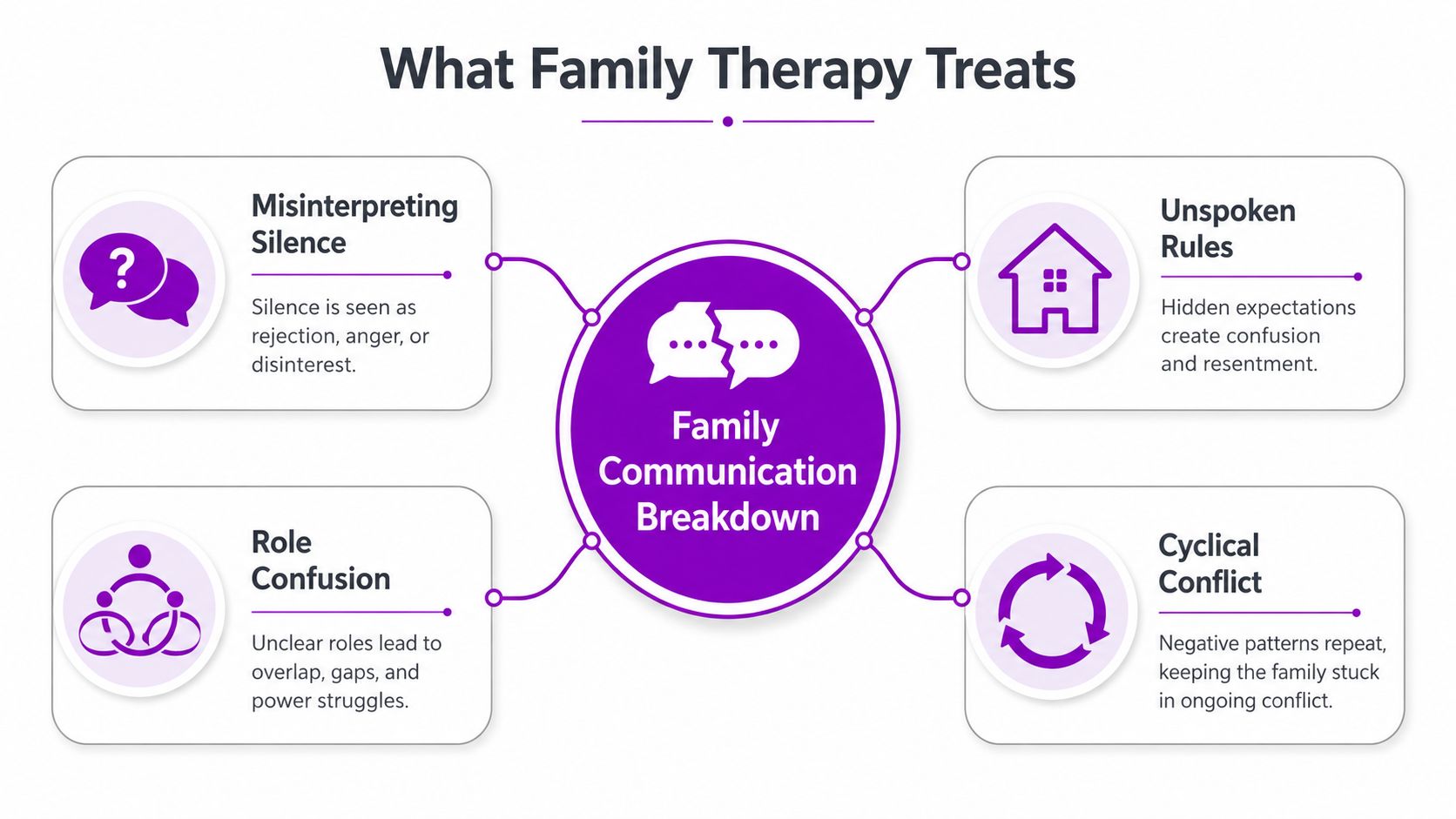
Family therapy treats the relationship system surrounding a concern. The therapist listens for who speaks first, who goes quiet, who interrupts, who sides with whom, and what the family avoids saying. The aim isn't to diagnose the loudest person in the room. It's to understand how each person's response affects everyone else.
In the Phoenix household above, the daughter's silence may trigger her father's lecture. His lecture may confirm her belief that speaking is unsafe. Her mother may step in to calm them, which temporarily lowers the tension but also prevents father and daughter from developing a direct conversation. The cycle repeats.
A family therapist might name this as triangulation, meaning tension between two people gets routed through a third. The mother becomes the messenger, the daughter becomes “the difficult one,” and the father remains focused on behavior rather than fear, hurt, or uncertainty. Another pattern, emotional cutoff, occurs when someone manages distress by withdrawing so completely that the family loses opportunities for repair.
Individual therapy can still be valuable. A child may learn breathing skills, challenge anxious thoughts, or process grief privately. But if the child returns to a home where every question feels like an interrogation, the household may keep activating the same anxiety. Family work brings the interaction into the room so the therapist can slow it down and help everyone practice a different response.
The same principle applies to adults. One partner's depression may improve when the household stops avoiding difficult conversations. A parent's substance use may need individual treatment, while family sessions address trust, boundaries, and safety. The focus remains connected, but it isn't blame-based.
A useful question: “What happens between us just before the problem gets worse?”
Families dealing with recurring arguments can also review practical guidance on resolving family conflict. The central idea is simple: therapy looks at the sequence, not just the symptom. Each benefit below comes from changing one part of that sequence.
The Four Core Benefits Families Notice First
Families often notice change through small household moments before they feel dramatically different. A conversation ends sooner. A parent asks one question instead of giving a lecture. A teenager stays in the room long enough to answer.
Communication becomes more precise
Before therapy, a parent might say, “You never care about this family,” after a teen misses curfew. The teen hears a character attack and shuts down. In therapy, the parent may practice saying, “I felt scared when you didn't come home, and I need us to agree on what happens next time.”
A 24-hour pause rule can interrupt arguments that are too heated for productive discussion. The teen's task isn't to provide a perfect explanation. It may be to name one feeling without blame, such as, “I'm embarrassed and overwhelmed,” instead of, “You're always on my back.”
Conflict gets a container
In a blended Phoenix family, Tuesday nights may turn into a fight about chores, screen time, and loyalty to different households. Rather than trying to solve every issue during the explosion, the family can schedule a problem-solving conversation, set a timer, and choose one topic.
The structure matters because it moves conflict from an emergency into a shared task. A therapist may help family members distinguish a solvable disagreement from an old injury that needs separate attention.
Bonds receive deliberate attention
A child can live in the same home as a parent and still feel emotionally overlooked. Weekly one-on-one check-ins, without phones or sibling interruptions, give the relationship a predictable place to recover. The parent might ask, “What felt heavy this week?” and listen without immediately correcting or advising.
These practices complement broader relationship habits, such as those described in this resource on how to build stronger families with Ocodile. Therapy adds clinical guidance when ordinary good intentions haven't been enough.
The family addresses the system
Suppose grandma's depression has become treated as her private burden. Everyone works around her low energy, one child takes on caregiving tasks, and another avoids visiting because the atmosphere feels tense. Family therapy can help the household create a caregiving plan, clarify responsibilities, and discuss what support each person needs.
| Benefit | Before Therapy | After Therapy |
|---|---|---|
| Communication | Lectures, silence, and accusations | Specific feelings, requests, and reflective listening |
| Conflict resolution | Arguments erupt whenever pressure builds | One issue gets discussed during an agreed problem-solving time |
| Stronger bonds | Connection depends on spare time and good moods | Regular one-on-one contact protects relationships |
| Systemic change | One person carries the label and the burden | The family shares responsibility for patterns and solutions |
The change isn't that everyone agrees. It's that disagreement stops automatically becoming disconnection.
What the Research Says About Family Therapy Outcomes
Family therapy has a measurable evidence base, although the strength of evidence varies by problem and treatment model. A major academic overview of systemic and family interventions for child-focused problems reported a post-treatment effect size of 0.59, with systemic therapy showing a 64% success rate compared with 36% for control groups. The same review reported that the average child with a psychiatric disorder treated with family therapy fared better than 72% of cases in waiting-list control groups. The academic review also found family therapy outcomes exceeded those of treatment as usual or alternative treatments across areas including family functioning, drug use, scholastic achievement, and antisocial behavior.
Those findings don't mean every family will experience the same result. They do show why clinicians treat family therapy as more than supportive conversation. The approach can influence symptoms, behavior, relationships, and the conditions that maintain distress.
The Cleveland Clinic's clinical summary reports that after treatment, almost 90% of participants report improved emotional health, nearly 66% report improved overall physical health, and in child-parent cases about 73% of parents say their child's behavior improved. The summary also notes effectiveness for adolescent substance use, depression, obesity, and family conflict. Its overview of family therapy helps translate clinical outcomes into concerns families recognize at home.
Adolescent depression has a more specific evidence base. A 2023 systematic review and meta-analysis covering 4 studies and 402 participants found reduced suicidal ideation at the end of treatment, with Hedges' g = 0.34, a 95% confidence interval of 0.12 to 0.57, and low heterogeneity of I² = 19.8. The published meta-analysis supports family-based treatment as one clinical option that deserves careful consideration alongside safety planning and other appropriate care.
An older randomized trial of attachment-based family therapy found that 81% of treated adolescents no longer met criteria for major depressive disorder after treatment, compared with 47% in a waitlist group. At 6-month follow-up, 87% of assessed treated cases still didn't meet those criteria. The trial record offers a specific example of symptom change, but it shouldn't be read as a guarantee for every family.
| Modality | Population | Effect Size | Typical Sessions |
|---|---|---|---|
| Systemic and family interventions | Children with psychiatric and behavioral problems | 0.59 post-treatment effect size | Varies by model |
| Family-based treatment | Adolescents with depression and suicidal ideation | Hedges' g = 0.34 | Varies by study |
| Attachment-based family therapy | Depressed adolescents | Outcome reported as diagnostic remission | Varies by treatment plan |
Families can track progress without expecting a dramatic turning point. A practical guide to knowing whether therapy is working is useful when improvement feels gradual or uneven.
When Families Should Consider Therapy and Which Path Fits
A family doesn't need to wait until every conversation has become hostile. Repeated conflict cycles, sudden behavioral changes in a child or teen, grief, blended-family adjustment, substance use by a parent, and infidelity recovery can all justify an initial consultation.
The right approach depends on the pattern beneath the presenting problem. A teenager acting out after a divorce may need more than behavior consequences. A couple rebuilding after infidelity may need focused work on attachment and trust, while children need clear explanations and stable boundaries.
Match the concern to the clinical lens
Structural Family Therapy fits households with unclear hierarchy, parent-child coalitions, weak boundaries, or a child carrying authority that belongs with adults. The therapist may help parents lead together rather than recruit a child into marital tension.
Bowenian therapy examines multigenerational patterns. A parent who learned to avoid conflict may recognize the same emotional cutoff in the next generation. The work emphasizes differentiation, meaning the ability to stay connected without automatically absorbing everyone else's anxiety.
Emotionally Focused Therapy, often called EFT, focuses on emotional bonds, attachment injuries, and cycles of pursuit and withdrawal. It can help partners or family members express primary emotions beneath anger, such as fear of abandonment or shame.
CBT-family work addresses thoughts and behaviors shared across the household. Families may examine assumptions such as “If we discuss this, everything will fall apart,” then practice a more manageable response.
EMDR may be considered when trauma is shaping family interactions. Often, trauma processing occurs individually while family sessions address safety, triggers, and communication around the trauma.
| Family Situation | Recommended Approach | Typical Duration | Combined with Individual Work? |
|---|---|---|---|
| Repeated conflict and unclear boundaries | Structural Family Therapy | Short-term or extended, depending on complexity | Sometimes |
| Multigenerational anxiety or emotional cutoff | Bowenian therapy | Longer-term when patterns are entrenched | Often |
| Attachment injuries, withdrawal, or infidelity recovery | EFT | Focused course or extended treatment | Sometimes |
| Shared worry cycles and behavior problems | CBT-family work | Goal-focused course | Often |
| Trauma affecting trust and reactions | EMDR with systemic support | Individual pacing with family sessions as needed | Commonly |
| Adolescent substance use or depression | Family-based treatment matched to the clinical concern | Clinician-guided | Often |
These duration labels are planning categories, not promises. A Phoenix parent can begin by asking, “Are we treating a symptom, a relationship injury, a role problem, or a trauma response?” The answer helps a clinician choose the starting point.
The Honest Trade-Offs Most Articles Skip Over
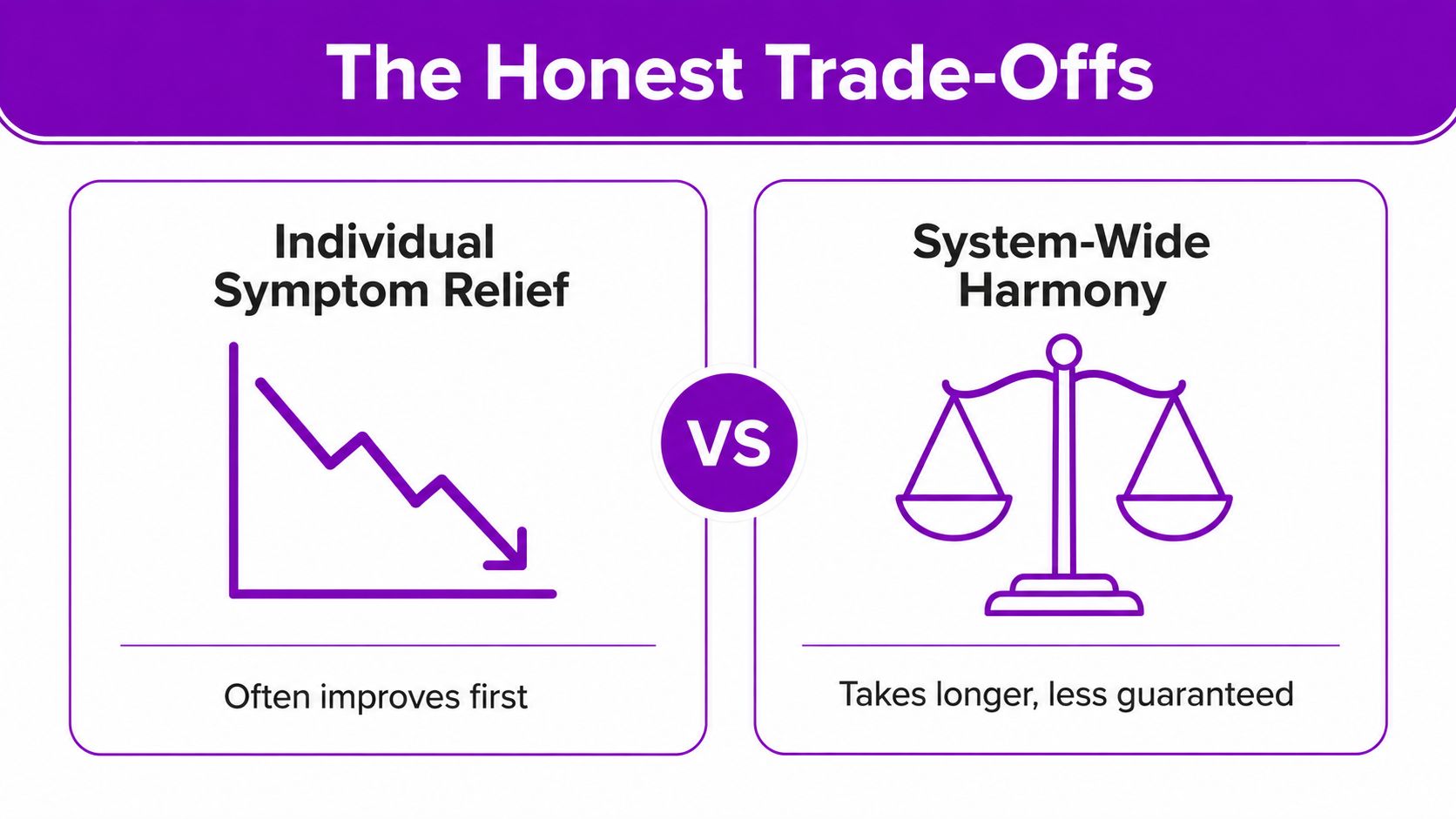
Family therapy doesn't guarantee that every member improves at the same pace. Research summarized in a 2025 meta-analysis found that family-based treatments for childhood disorders produced small but statistically significant secondary benefits for caregivers and siblings, with d = 0.25, including gains in individual adjustment, family dynamics, and relationships. The meta-analysis record also reflects a wider concern: studies often center symptom reduction more than the experience of the whole family.
A newer synthesis makes the limitation clearer. A 2026 review of multi-family therapy in East and Southeast Asia found more consistent improvements in individual symptoms and functioning than in parenting, parent-child relationships, or broader family-system outcomes. The evidence for family-level change remained mixed and less conclusive. That review challenges the convenient idea that therapy automatically repairs communication.
One highly motivated person may change quickly while the household pattern stays fixed. A mother may stop yelling, but if the father withdraws and the teenager still mediates between them, the family continues to organize itself around avoidance. Defensive alliances, scapegoating, and fear of losing control can slow collective progress.
Set goals at two levels: Track the individual symptom and the interaction that surrounds it.
Some households need separate phases of work. Early sessions may stabilize safety and reduce crisis behavior. Later sessions may address grief, trust, or parenting roles. Communication practice may come after family members can remain present without becoming overwhelmed.
Uneven progress isn't proof that therapy failed. It's information. Ask the therapist to identify which goal is moving, which is stalled, and whether the current format needs individual sessions, parent sessions, or a different family configuration.
What a Real Family Therapy Session Looks Like
A representative session might begin with everyone sitting in the same room, although family members may also join securely online. The therapist checks what happened since the last meeting, asks whether anyone feels unsafe discussing a topic, and invites each person to describe the week without interruption.
The opening question may be direct: “What's the one moment at home that you want to handle differently?” A parent chooses bedtime conflict. The teen chooses the way adults ask about grades. The therapist doesn't try to solve both immediately. The family agrees to focus on one interaction.
The pattern becomes visible
The therapist may ask the parent to make the usual request while the teen responds naturally. When the parent's voice rises and the teen looks away, the clinician slows the exchange. A speaker-listener exercise follows: one person speaks briefly, the listener reflects what they heard, and the speaker corrects the reflection without adding a new accusation.
A reluctant teen isn't forced to perform vulnerability. The therapist might offer choices: speak, write a response, or observe the first round. A silent father may be asked a concrete question about what he notices in his body during conflict rather than being labeled disengaged.
Practice continues at home
Homework could be a short daily check-in, a pause before responding, or a written agreement about curfew. The family returns with observations, not grades. If the plan failed, the therapist examines what made it hard and adjusts the task.
Sessions vary by family and treatment plan. Many clinicians review goals and progress regularly, often after several meetings, rather than waiting until the end of treatment. The family should know what it's practicing, why the exercise matters, and how the clinician will decide whether the approach is helping.

Practical Next Steps for Phoenix-Area Families at reVIBE
Starting doesn't require a perfect explanation. A parent can say, “We're stuck in the same conflict, and we need help changing how we respond to one another.” Families in the Phoenix metro can begin by calling a reVIBE location, submitting an online request, or asking about telehealth when travel, schedules, or family logistics make in-person care difficult.
A consultation can clarify the main concern, who should participate, whether individual and family sessions should be combined, and what the first appointment involves. Intake paperwork typically gathers contact details, current concerns, treatment history, safety information, and insurance details. The team can verify coverage for plans including Aetna, BCBS, Cigna, United, and AHCCCS, while uninsured families can ask about sliding-scale options.
The practice offers family therapy among its behavioral health services, with in-person and telehealth options. Families should confirm current availability, clinician fit, coverage, and appointment details directly before scheduling.
Choose a practical starting point
Use this table to compare the available locations and ask which office or virtual format best fits your household.
| Location | Address & Hours | In-Person | Telehealth | Specialty Focus |
|---|---|---|---|---|
| reVIBE Mental Health, Chandler | 3377 S Price Rd, Suite 105, Chandler, AZ. Call for current hours. | Available by appointment | Ask when scheduling | Family and relationship concerns |
| reVIBE Mental Health, Phoenix Deer Valley | 2222 W Pinnacle Peak Rd, Suite 220, Phoenix, AZ. Call for current hours. | Available by appointment | Ask when scheduling | Family and relationship concerns |
| reVIBE Mental Health, Phoenix PV | 4646 E Greenway Road, Suite 100, Phoenix, AZ. Call for current hours. | Available by appointment | Ask when scheduling | Family and relationship concerns |
| reVIBE Mental Health, Scottsdale | 8700 E Via de Ventura, Suite 280, Scottsdale, AZ. Call for current hours. | Available by appointment | Ask when scheduling | Family and relationship concerns |
| reVIBE Mental Health, Tempe | 3920 S Rural Rd, Suite 112, Tempe, AZ. Call for current hours. | Available by appointment | Ask when scheduling | Family and relationship concerns |
Call (480) 674-9220 or review family counseling near you to identify the most convenient entry point. Before the first appointment, gather each family member's concerns and agree on one interaction you want to change, rather than trying to summarize the entire family history.
- Pick a format: Choose a nearby office or ask about a virtual appointment.
- Confirm payment: Verify insurance coverage or ask whether sliding-scale eligibility applies.
- Prepare together: Schedule the first session and complete the family intake packet with each participant's perspective.
If your household is caught in repeating conflict, reVIBE Mental Health offers family therapy through in-person and telehealth appointments, with care that can be coordinated around family and individual needs. Visit reVIBE Mental Health to request support, discuss the right starting point, and take the first practical step toward changing the pattern at home.