You may be sitting in a therapist's office wondering whether EMDR means recounting every painful detail while someone moves a hand in front of your face. That uncertainty is common. EMDR therapy is more structured, collaborative, and paced than that picture suggests, and the eye movements are only one part of the work.
The question “how is EMDR therapy done” is really a question about the entire process: how a therapist decides what to address, how you prepare, what happens during memory processing, and how you leave the session feeling grounded. The standard approach follows eight phases, with room to slow down when you need more stability.
What EMDR Therapy Is and Why It Follows a Structure
EMDR, or Eye Movement Desensitization and Reprocessing, is a structured psychotherapy approach developed by psychologist Francine Shapiro in the late 1980s. By 1989, it was being discussed in professional literature as a new method for reducing traumatic stress, and major clinical guidance now presents it as an established treatment for PTSD and trauma-related symptoms. You can read more about the treatment's place in clinical guidance through the American Psychological Association's EMDR treatment overview.
A first appointment might look ordinary. You talk about what brought you to therapy, what situations trigger distress, and what you hope will change. Your therapist isn't expected to rush you into a traumatic memory. Instead, you and the therapist build a plan, discuss coping skills, and decide whether your current stability supports reprocessing.
Practical rule: You should understand what's happening, know how to signal “pause,” and feel that the pace is being decided with you, not for you.
The eight phases are history taking and treatment planning, preparation, assessment, desensitization, installation, body scan, closure, and reevaluation. The first phases establish safety and identify appropriate targets. The middle phases process the memory and strengthen a more helpful belief. Closure helps contain the work before you leave, while reevaluation checks what changed when you return.
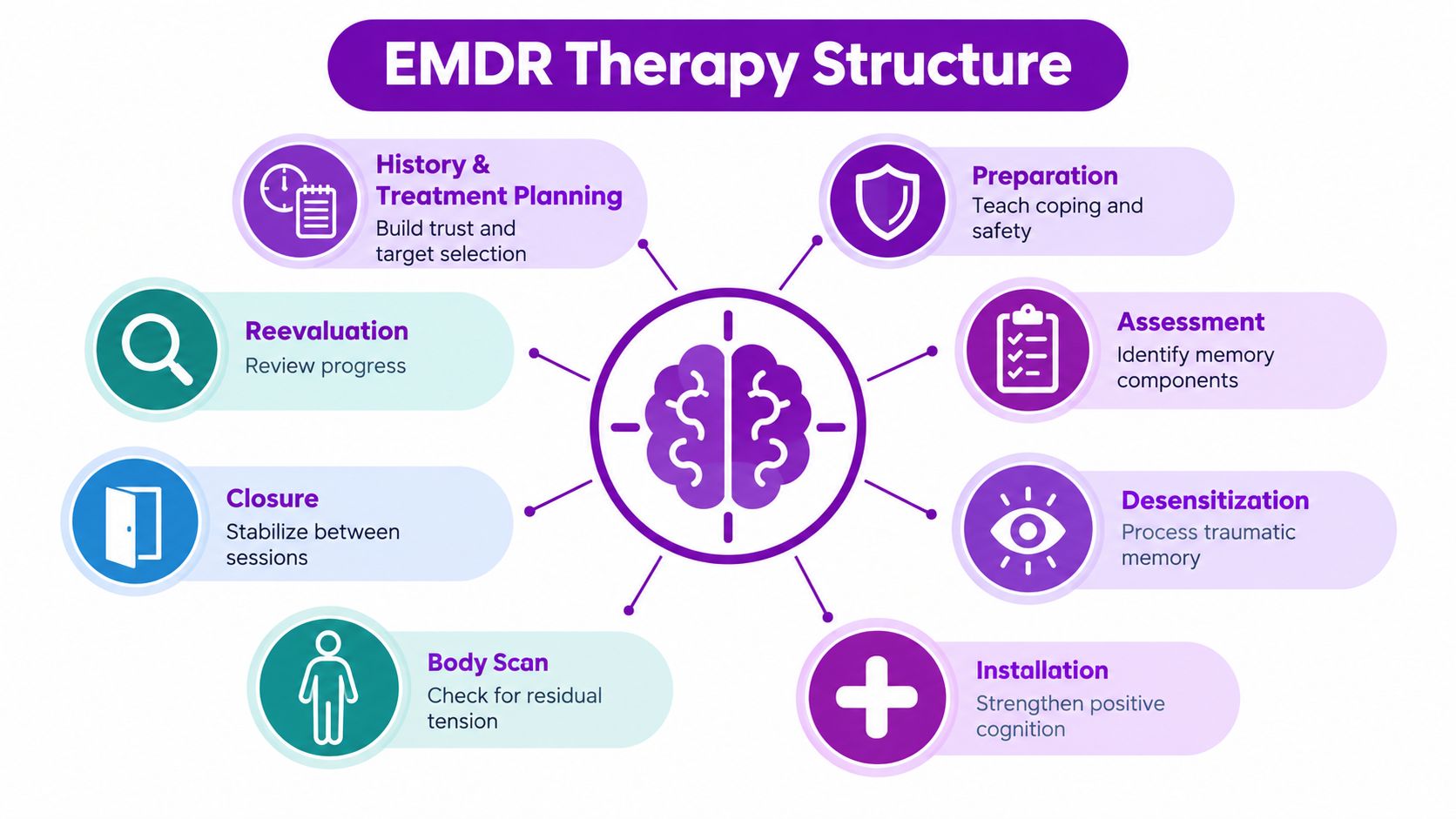
That structure distinguishes EMDR from an unstructured conversation in which the session follows whatever comes up. It also explains why treatment can be adapted for people dealing with anxiety, depression, grief, or complex trauma, especially when preparation needs to continue before memory processing begins. A broader overview of potential uses and treatment features appears in this guide to the benefits of EMDR therapy.
Before Reprocessing Begins History Preparation and Assessment
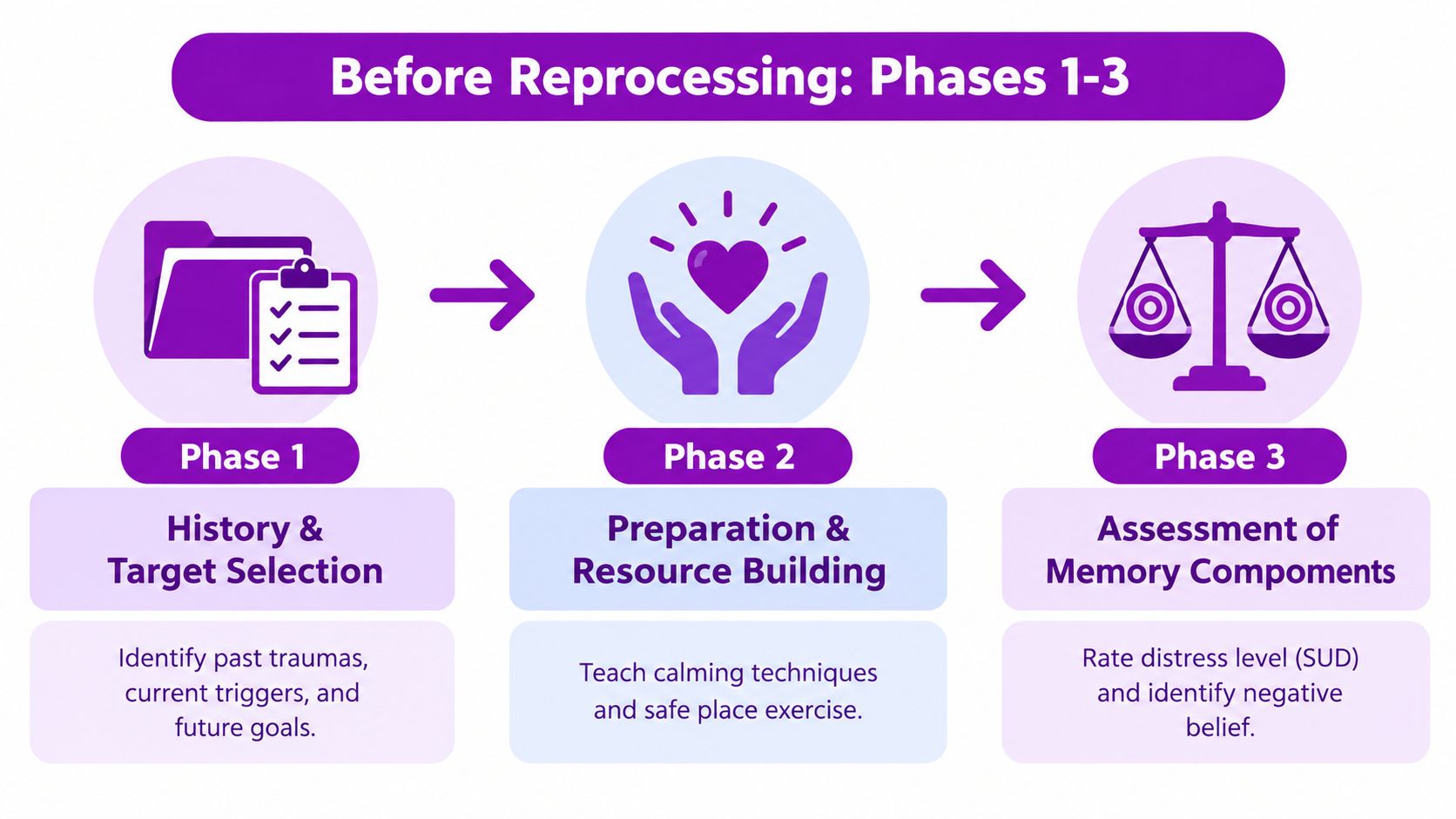
The first three phases create the foundation for later work. A therapist should be able to explain what each phase is doing and why you're moving forward, staying with preparation, or changing the plan.
Phase 1 builds the treatment map
History taking involves more than asking what happened. Your therapist considers your symptoms, relationships, current triggers, earlier experiences, strengths, support system, and treatment goals. Together, you may identify a past memory that still feels distressing, a present-day situation that activates the same response, and a future situation where you want to respond differently.
This planning matters because one event may not be the only target. For example, a current fear of criticism might connect with an earlier experience of humiliation, while a future goal could involve speaking up at work without freezing. The therapist uses this information to organize treatment rather than asking you to select memories randomly.
Phase 2 teaches you how to stay present
Preparation is where many first-time clients feel reassured. Before trauma reprocessing, the therapist may teach breathing, grounding, calming imagery, and other ways to reduce activation. Some clinicians use a “safe place” or calming-place exercise, not as a way to erase difficult emotions, but as a mental resource you can return to when you need steadiness.
Preparation can last longer than expected. If you're in an acute crisis, feel persistently unsafe, dissociate easily, or don't yet have reliable ways to regulate intense emotions, continuing to build stability may be the appropriate EMDR work for now. Not being ready to process a memory isn't failure. It's information that guides pacing.
Phase 3 identifies what the memory contains
During assessment, you and the therapist define specific parts of the target:
- Target image: The part of the memory or scene that feels most disturbing.
- Negative belief: The painful conclusion about yourself, such as feeling powerless or unsafe.
- Preferred positive belief: The belief you'd rather feel as true, such as “I have choices now.”
- SUD rating: Your Subjective Units of Distress, a numerical rating of how upsetting the memory feels.
- VOC rating: Your Validity of Cognition, a numerical rating of how true the preferred belief feels.
- Body sensations: Tightness, pressure, numbness, nausea, or other physical responses connected to the target.
These ratings don't judge your experience or determine whether you're doing therapy correctly. They give you and the clinician shared reference points for noticing change.
How Reprocessing Works Desensitization Installation and Body Scan
Phases four through six are the part of EMDR that gets the most attention, but they're only possible because the earlier groundwork is in place. You focus on the selected memory component while the therapist guides bilateral stimulation, which alternates attention from one side to the other.

Phase 4 uses repeated sets
The therapist may guide your eyes back and forth, or use alternating taps or tones. One professional description specifies 20 to 40 movements per set during bilateral stimulation (U.S. Department of Veterans Affairs EMDR protocol). After each set, the therapist usually asks what you notice now. You might report an image, emotion, thought, body sensation, memory association, or nothing obvious.
You aren't expected to force a particular result. The therapist follows your responses, offers minimal direction, and returns attention to the target when appropriate. If you become overwhelmed, lose contact with the present, or need a break, the therapist can pause the stimulation and use grounding or resourcing skills.
The purpose of desensitization is to reduce the distress connected with the target while allowing the memory to become less stuck in the present. In the standard model, target completion often means distress falls to 0, or sometimes 1 when appropriate, though your clinician also considers your overall functioning and safety.
Phase 5 strengthens the preferred belief
Once the distress linked to the target has reduced, the therapist brings attention to the preferred positive cognition. You may focus on that belief while bilateral stimulation continues. The clinician then checks how true it feels using the VOC scale.
The standard completion point for the positive cognition is often a VOC rating of 7, along with the absence of relevant body tension. That number isn't a demand to feel positive on command. It represents the point at which the adaptive belief feels fully credible in relation to the processed target.
Phase 6 checks the body
During the body scan, you bring the memory and positive belief to mind while noticing whether any physical tension remains. A clenched jaw, heaviness in the chest, or tightness in the stomach may signal material that still needs attention. The therapist may use additional processing before moving toward closure.
This sequence shows why EMDR isn't “follow the fingers.” It's a measured memory-processing protocol with explicit points for checking distress, belief strength, and physical responses.
What to Expect Before During and After an EMDR Session
A session often begins with reevaluation. You and your therapist review what happened after the previous appointment, whether the target still feels distressing, whether the preferred belief remains believable, and whether new triggers or memories appeared. If you're not sufficiently grounded that day, the therapist may return to preparation instead of beginning reprocessing.
If reprocessing is appropriate, the therapist reviews the target and asks you to notice what comes up during each bilateral stimulation set. The experience varies. Some people notice memories connecting with other memories, while others notice emotions, images, physical sensations, or small shifts in perspective. You remain awake and involved, and you can ask to stop.
The session doesn't end because the scheduled processing time is over. Closure happens in every session, even when the target hasn't reached zero distress. Your therapist may guide breathing, grounding, calming imagery, or another containment exercise so you can transition back to ordinary activities.

Afterward, you may feel tired, emotionally sensitive, or more aware of dreams and memories. Some people experience vivid dreams or continued emotional processing between appointments. These experiences should be discussed with your therapist, particularly if they interfere with sleep, work, relationships, or your sense of safety.
A simple after-session plan can help:
- Lower the demand level: Leave room for rest rather than scheduling something emotionally intense immediately afterward.
- Use familiar grounding: Try the breathing, sensory orientation, or calming imagery practiced in preparation.
- Record observations briefly: Note triggers, dreams, body sensations, or changes in the target without forcing yourself to analyze them.
- Contact the therapist when needed: Significant distress deserves attention, not silent endurance.
The next appointment begins by checking what remained settled and what needs care. That feedback shapes the following session.
Safety Adaptations and When EMDR May Need to Pause
EMDR should adjust to your nervous system, not force you to follow one fixed method. A qualified therapist may use eye movements, alternating taps, or tones. Eye movements aren't the only option. Taps or tones can suit people who experience migraines, visual strain, neurodivergence-related discomfort, or dislike tracking a moving hand. Harvard Health explains these options and addresses questions about remote treatment in its guide to who may benefit from EMDR therapy.
The therapist watches your level of orientation and distress throughout processing. If eye movements feel uncomfortable, stimulation can change in speed, direction, or form. You can also ask to pause. In online sessions, the clinician should establish privacy, reliable communication, emergency planning, and a clear way to help you stay oriented. Remote treatment still requires preparation and careful pacing.
Processing may need to wait during an acute crisis, severe instability, significant dissociation, or symptoms that make staying present difficult. Stabilization, practical support, or another treatment approach may come first. Delaying trauma processing does not permanently rule out EMDR. It gives you and the therapist time to build enough steadiness for the work. Read this overview of EMDR therapy side effects and safety considerations for more context about possible responses.
Evidence supports EMDR for some mental health concerns, while the research still has limits. A PubMed meta-analysis found better outcomes than control conditions, with g = 0.93, and a smaller advantage over other therapies, g = 0.36. The authors reported high heterogeneity and lower confidence in studies with a lower risk of bias (PubMed meta-analysis). Another analysis found reductions in anxiety, panic, phobia, and behavioral or somatic symptoms, with no significant differences based on total sessions or weekly frequency. EMDR is widely recognized for PTSD, but its core mechanism remains debated. A responsible therapist will not promise that eye movements alone explain every result.
How to Choose an EMDR Provider and Prepare for Your First Visit
Look for a licensed mental health professional with specific training in the complete eight-phase EMDR protocol, not someone who treats eye movements as a standalone technique. Ask how they handle preparation, what they do when a client isn't ready to process, and how they screen for dissociation or current instability.
A consultation can clarify practical fit:
- Training and experience: Ask about EMDR training and experience with trauma alongside anxiety, depression, grief, or other concerns you're managing.
- Pacing: Ask how you'll decide when to begin reprocessing and what happens if you need to pause.
- Stimulation options: Ask whether the provider offers eye movements, taps, or tones.
- Session format: Confirm whether in-person and secure online appointments are available and which option suits your situation.
- Communication: Ask how between-session concerns are handled.
- Cost and coverage: Verify insurance, copays, authorization requirements, and cancellation policies before treatment begins.
You don't need a polished trauma narrative for the first visit. Bring a list of current symptoms, medications, relevant diagnoses, questions, and any immediate safety concerns. It's also reasonable to say, “I want to understand the preparation phase before deciding whether to process a memory.”
For clinicians refining how they organize patient education and treatment workflows, playbooks for therapists can offer useful operational context. For people seeking care in the Phoenix metro area, EMDR therapy near you may be available through practices that offer both in-person and secure online sessions.
reVIBE Mental Health offers EMDR alongside talk therapy and psychiatry with medication management, serving clients through locations in Chandler, Phoenix Deer Valley, Phoenix PV, Scottsdale, and Tempe, as well as secure online care. The team can help you discuss preparation, pacing, insurance, and whether EMDR fits your current goals.
Find a reVIBE Location Near You!
We currently have five locations for your convenience. (480) 674-9220
reVIBE Mental Health – Chandler
3377 S Price Rd, Suite 105, Chandler, AZ
reVIBE Mental Health – Phoenix Deer Valley
2222 W Pinnacle Peak Rd, Suite 220, Phoenix, AZ
reVIBE Mental Health – Phoenix PV
4646 E Greenway Road, Suite 100, Phoenix, AZ
reVIBE Mental Health – Scottsdale
8700 E Via de Ventura, Suite 280, Scottsdale, AZ
reVIBE Mental Health – Tempe
3920 S Rural Rd, Suite 112, Tempe, AZ
If you're ready to learn whether EMDR is appropriate for your current needs, visit reVIBE Mental Health to explore therapy options and request an appointment. Ask about preparation-focused care, in-person or secure online sessions, and insurance verification so your first step feels informed and manageable.