Nearly nine in ten young couples who start a structured relationship program finish it. In the 2GETHER trial, 128 young male couples were randomized to a four-session relationship education and HIV-prevention program or an attention-matched control, and 98.5% attended at least one session while 86.4% completed all four (the 2GETHER trial report in Health Psychology). Showing up isn't the hard part. Knowing what you're walking into is.
That trial is also a useful lesson in reading evidence. Both groups improved across 12 months on relationship communication, HIV testing, alcohol-related problems, and sexual health measures, and the researchers found no statistically significant difference between the program and the control. Something helped those couples. It wasn't uniquely the curriculum.
So the honest picture has two halves. Couples therapy, in general, has a strong evidence base. The evidence for couples in their twenties specifically is thinner, assembled from a handful of trials with young couples, a much larger body of research on adults across the lifespan, and a good deal of clinical judgment in between. That gap matters when you're deciding whether to start, what to ask a therapist for, and when to come back. The research supports certain approaches, has clear limits, and points to what a first course of sessions usually looks like.
Does Couples Therapy Work for Young Couples
Couples therapy works for most couples who arrive distressed and complete a course of treatment. The strongest single estimate comes from a meta-analysis of 58 studies, 40 unique samples and 2,092 couples, which found a large improvement in relationship satisfaction from pre-treatment to post-treatment, Hedges' g = 1.12 (95% CI 0.92 to 1.31) (the couple therapy meta-analysis in the Journal of Family Psychology). Couples placed on a waitlist barely moved over the same window, g = 0.12, a change small enough to be statistically non-significant.
The scale of that evidence is worth seeing before the caveats arrive.
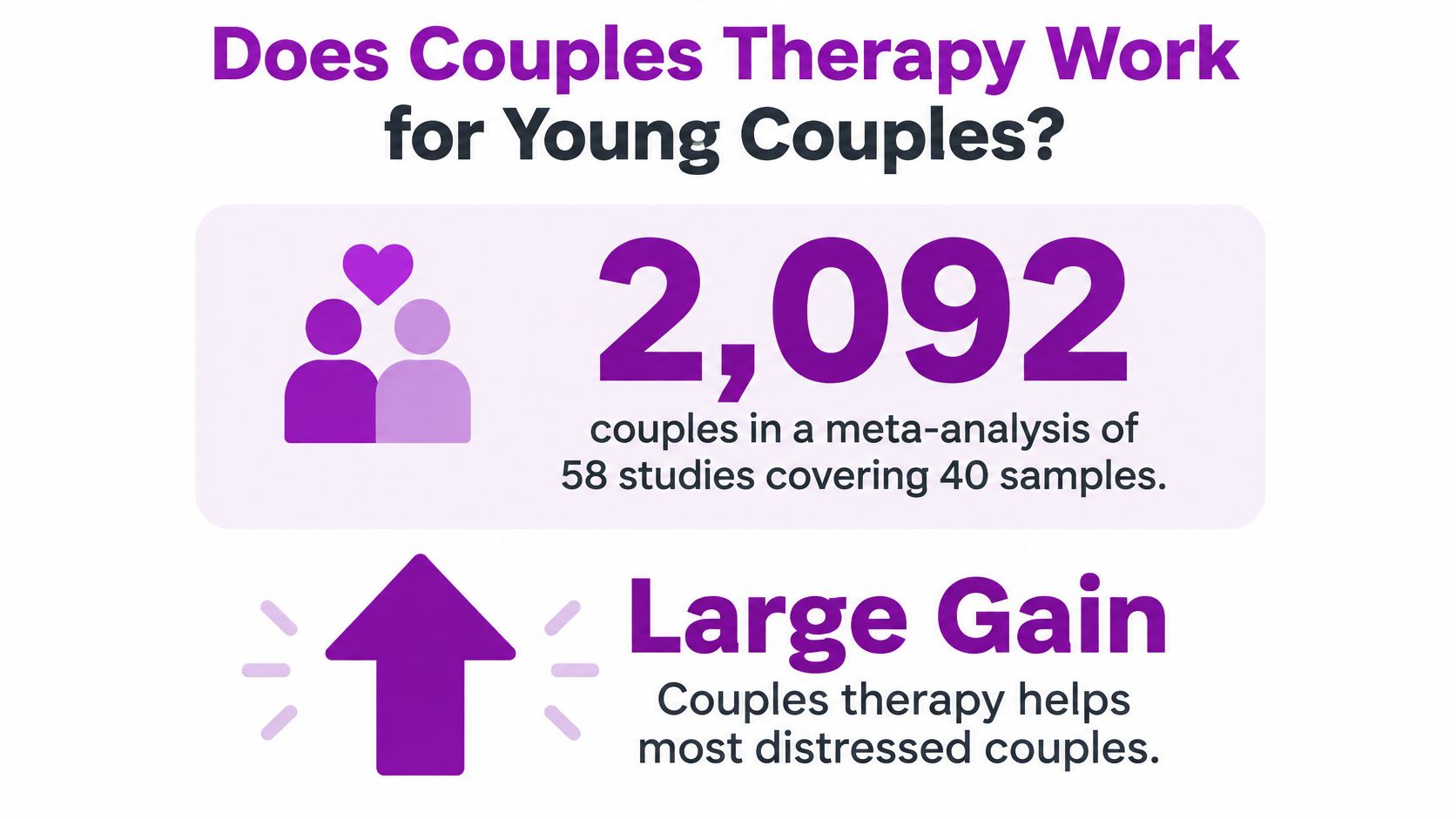
Two features make that comparison more than a pep talk. Therapy is being measured against time itself, and mildly unhappy couples don't reliably drift toward satisfaction on their own. The gain is also large enough to survive a mediocre match with an average therapist, which not every treatment can claim.
What it means in practice: the average couple starts unhappy and finishes measurably happier. The average waitlisted couple stays roughly where they started. Waiting for a calmer month has a measurable cost attached to it.
| Study finding | Result | What it means for young couples |
|---|---|---|
| Couple therapy vs. waitlist, 58 studies | g = 1.12 vs. g = 0.12 | Large gain once therapy starts; waitlists show little change |
| Distressed couples who benefit (2020 review) | 60–80% | Most couples who complete treatment improve |
| Gains still present at two years | About half | Plan follow-up and skills practice |
| Marriage and relationship programs, pooled effect | 0.53 (I² = 71.5%) | Results vary; fit and therapist skill matter |
The caveats land harder for younger couples than the headline suggests. Bradbury and Bodenmann's 2020 review found effects are generally weaker in routine clinical practice than in tightly controlled research, and most of the underlying evidence comes from adult couples across the whole lifespan rather than from couples under thirty. And when marriage and relationship programs of every kind get pooled, the average effect drops to 0.53 with substantial heterogeneity, an I² of 71.5%, which means the program you choose shapes the result as much as the decision to go.
What those numbers are good for is a baseline. Pick two or three indicators that matter to you, such as conflict frequency, how long it takes to recover after a fight, or how often either of you reaches out first. Write them down before the first session and check them again a month in. That beats trusting how a single hour felt on the way home.
Common Reasons Young Couples Seek Therapy
The problems that bring couples in their twenties and early thirties through the door fall into a handful of recognizable shapes. The topic on the surface changes constantly. The shape underneath usually doesn't, and naming it is the first useful thing therapy does.
The argument that keeps coming back
A couple fights every Sunday about whose turn it is to clean the kitchen. Neither of them cares about the kitchen. One partner feels like the only adult in the room, the other feels managed, and the Sunday fight is the only place those feelings get airtime. Underneath runs a pursue-withdraw cycle: one partner pushes for the conversation, the other goes quiet or leaves the room, and the pushing intensifies the quiet while the quiet intensifies the pushing. Couples arrive describing a topic. Therapists start working on the loop.
Transitions that rearrange the relationship
Early adulthood stacks changes on top of each other. Moving in together, an engagement, a wedding, a first baby, a job loss, a relocation, a graduate degree, a debt one partner brought into the relationship. Each one renegotiates who does what, who earns what, and whose family gets the holidays. Couples who handled a two-year long-distance stretch gracefully can come apart over a shared lease, not because the love thinned but because the logistics multiplied.
Distance, trust, and what sits underneath
Some couples come in with no fight to report. They describe parallel lives, separate screens, conversation that never leaves logistics. Others arrive after an affair or a betrayal, or before a wedding, to set expectations while things are calm. Premarital counseling is one of the better reasons to book a first session, precisely because nothing is on fire yet.
Assessment has to sort the surface from the driver, because the handling differs. Stress-related conflict, attachment insecurity, depression or anxiety, trauma symptoms, substance use, sexual concerns, and safety issues each call for different sequencing and different clinical technique. A couple whose fights are fueled by untreated depression needs the depression treated, not just sharper listening exercises.
Stop here if safety is the issue. If there is physical violence, threats, or fear inside the relationship, personal safety comes before any joint session. Contact local emergency services or a domestic violence crisis line first, and let a trained advocate help you plan what comes next.
Three signs it's time to book, rather than wait: the same argument returns with different scenery, one or both of you regularly leave conversations feeling unheard, or a known transition is close enough to see coming.
What Happens in a Typical Couples Therapy Course
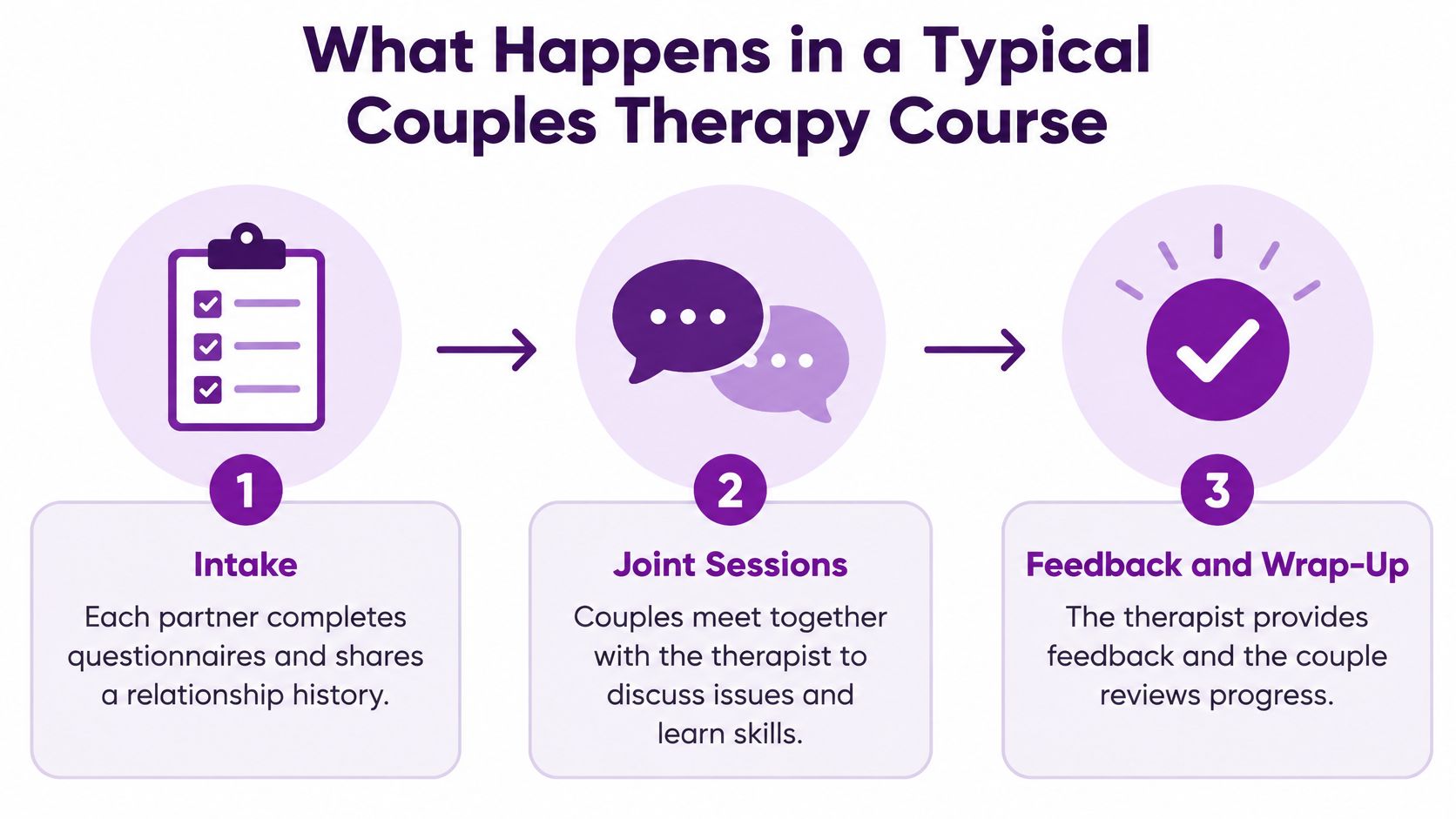
Picture a couple in their late twenties booking a first session after a fight about a wedding guest list turns into a fight about whether they should be getting married at all. Sessions usually run weekly, last around 50 minutes, and a full course often stretches across several months. The structure is fairly consistent from practice to practice, even when the labels differ.
The start, intake and assessment
Each partner completes questionnaires separately, often a validated satisfaction measure plus screens for depression and anxiety, and gives a relationship history: how you met, what drew you together, what changed, what you've already tried on your own. Many therapists then ask you to have a live conversation about a recurring conflict while they watch. That live sample is where the assessment happens, because a couple's pattern shows up in three minutes of actual arguing far more clearly than in any description of it.
The middle, goals and skills
Vague aims become measurable ones. "We want to communicate better" turns into how often the argument happens, how long recovery takes afterward, and whether either of you can call a pause and return to it. Skills come next: reflective listening, structured conversations where one partner speaks and the other summarizes before responding, and an agreed pause-and-return rule for the moments when heart rates climb and nobody can think straight. Between sessions you get one short exercise, not a workbook.
Dose matters here. An 11-session couple-based schema therapy program studied in 48 young couples produced a statistically significant improvement in marital satisfaction compared with a waiting-list control group (P = 0.001), which is roughly the span a weekly course implies (the 2024 study from the University of Tehran).
The end, review and maintenance
The final phase is quieter than couples expect. You review the measures against your baseline, name the cycle you now recognize on sight, and write down the conditions that tend to restart it. Then you decide how you'll check in later, whether that's a session after the next big transition or a short monthly conversation at home.
Before session one, write down one recurring argument and the exact moment it usually starts. "It begins when he picks up his phone while I'm mid-sentence" tells a therapist more in ten seconds than "we fight about respect" will in ten minutes.
Therapy Approaches Young Couples Are Likely to Meet
No single model owns the field, and most therapists blend two or three depending on what the assessment turns up. What matters is that the approach targets the mechanism underneath your specific cycle, not that it carries the most current name.
| Approach | Core focus | Often suits |
|---|---|---|
| Gottman Method | Friendship, conflict management, shared meaning | Couples who want practical conflict skills |
| Emotionally Focused Therapy | Negative cycles and emotional bonding | Couples feeling distant or disconnected |
| Behavioral couple therapy | Increasing specific positive behaviors | Couples with frequent everyday friction |
| Integrative behavioral couple therapy | Acceptance of differences plus behavior change | Couples stuck on the same unresolved issues |
| Schema therapy | Early beliefs and patterns shaping reactions | Couples with recurring hurts from past experiences |
Read the table from the friction outward. When the trouble is mostly everyday habits and logistics, behavioral couple therapy fits, because it works by increasing specific positive behaviors rather than excavating history. When partners describe a loss of closeness rather than a surplus of conflict, emotionally focused therapy goes after the negative cycle and the emotional bond underneath it. When the same wound keeps reopening and it clearly predates the relationship, schema therapy looks at the early beliefs that shape how each partner reads the other's behavior. Gottman Method work gives couples a shared vocabulary and concrete conflict skills. Integrative behavioral couple therapy suits couples locked on one issue that no amount of skill practice has moved, since it pairs behavior change with acceptance of the differences that won't budge.
If you want to compare the wider menu before booking, the types of relationship therapy overview lays out what each model is designed to treat.
Two questions for a prospective therapist: Which model will you use with us, and how will we know it's working? The second one carries more weight, because it forces a specific answer about the measures they'll track and how often they'll revisit them.
Tracking Progress and Knowing When to Return

A warm, productive session can leave you lighter without changing what happens at home on a Tuesday night. Feeling better and getting better are different outcomes, and the couples who hold their gains tend to be the ones who left therapy with written numbers they can check against memory.
The maintenance problem is well documented. Bradbury and Bodenmann's 2020 review found that about half of couples maintain their treatment gains at the two-year follow-up, with benefits for the rest diminishing over time (the Annual Review of Clinical Psychology). That figure comes from studies spanning couples of all ages, and research that isolates young partners is thinner, so treat it as a benchmark rather than a forecast for your relationship. What it does tell you is that drift is common enough to plan for. Young couples are unusually exposed, because the years right after therapy are exactly when cohabitation, marriage, parenting, financial strain and career moves arrive and reactivate the old pattern.
Treat your measures like a shared budget you review together. It belongs to both of you, and the point of checking it is to steer, not to assign blame.
The four-step loop
- Record the baseline at the first session. Conflict frequency, recovery time after an argument, repair attempts, constructive responses, and a satisfaction score from a validated questionnaire. Five numbers, written down once, kept somewhere you both can see.
- Review every four sessions. A flat or falling line tells you to change the plan, the goal, or the exercise between sessions. It is information, plain and simple.
- Schedule the check-in before you finish. Pick the next known transition, a move, a wedding, a first baby, and put a session on the calendar before it lands.
- Return early when the old pattern reappears. Two or three booster sessions beat waiting for a crisis to force the issue.
A couple finishes therapy in March, relocates in August for a job, and notices by October that the Saturday argument is back. Booking two sessions in October costs a fraction of what a February crisis costs, in money and in goodwill.
If you want help phrasing your targets before the first appointment, this guide to setting couples therapy goals shows what a measurable goal looks like in plain language. The most reliable signals are the ones nobody performs for the therapist: how fast you recover after a real argument, and whether the pause-and-return rule gets used when nobody is refereeing.
Choose a Therapist and Book Your First Session
Match beats credentials, and the research backs that ordering. A systematic review and meta-analysis comparing marriage and relationship programs found therapy-based programs produced a pooled effect of 0.53 on couple relationship satisfaction (95% CI 0.35 to 0.71), and the authors were direct that fit, therapist competence, treatment model, dosage and the couple's readiness all shape the outcome (the systematic review in Systematic Reviews). That review pooled couples across ages and stages, so it supports a general claim about therapy working, not a promise about one program for a couple in their twenties. The authors also warn against treating a generic communication course as equivalent to therapy built around the couple's actual mechanism, which is why a therapist's training matters more than the frame on the office wall.
Run this checklist before you commit.
- A current license. Verify the therapist is licensed to practice as a mental health professional in your state, and check for any public disciplinary record.
- Specific couples training. Ask about supervised training in a named model that matches the problem in front of you, whether that is infidelity, recurring conflict or a premarital decision.
- The format you need. In-person sessions or secure telehealth, whichever your schedules and comfort allow, since a course you can't attend consistently won't work.
- Cost clarity. Ask about fees, insurance, benefit verification, sliding scale, and out-of-network billing before the first appointment rather than after the third.
Ask for the total cost of a typical course in writing. Surprises about money are the fastest way to turn a useful therapy hour into a source of resentment.
Four steps get you from a shortlist to a booked appointment. Pick two or three therapists whose training fits the problem. Call each and ask which model they use and how they measure progress. Book a first session with both partners present, because a course built on one partner's version of events starts from a handicap. After two or three sessions, check in privately with each other about whether you both feel heard, and say so out loud to the therapist if the answer is no.
Comparing providers is the step where the search tends to stall, and the guide to finding a couples therapist covers the questions worth asking before you commit. At reVIBE Mental Health, therapists are trained in the Gottman Method and Emotionally Focused Therapy, and couples therapy is available in person at offices in Scottsdale, Tempe, Chandler, Phoenix, and Paradise Valley, or through secure telehealth sessions. The practice also publishes a free guide titled "5 Ways to Know You've Found a Good Match with Your Therapist," and you can get matched through its website with a therapist who fits your relationship and your insurance.
Couples therapy for young couples works best when it starts before the pattern hardens, and reVIBE Mental Health makes that first step simple with couples therapy in person at its Arizona offices or through secure telehealth, delivered by therapists trained in the Gottman Method and Emotionally Focused Therapy. If you're tired of having the same argument in different rooms, visit reVIBE Mental Health to get matched with a therapist who fits your relationship and your insurance.