To begin managing health anxiety, you first have to recognize its signature patterns—the endless symptom checking, the constant need for reassurance—and then start applying skills to short-circuit them. The most effective strategies usually involve learning to question your worst-case-scenario thoughts, using grounding techniques to calm your body’s alarm system, and gently exposing yourself to health-related triggers to reclaim your power over them.
What Is Health Anxiety and How Does It Feel?
We all worry about our health from time to time. A sudden headache might make you wonder if you've had enough water, or a cough that just won't quit might finally send you to the doctor. Those are completely normal, rational responses.
But for some of us, that reasonable concern morphs into something much bigger—a relentless, all-consuming fear that takes over our lives. This is health anxiety.
Also known as illness anxiety disorder, this condition is a persistent obsession with the idea that you have, or are developing, a serious and undiagnosed illness. The fear sticks around even after medical tests come back clear and doctors tell you everything is fine. It’s an exhausting cycle, driven by an impossible search for 100% certainty that your body is perfectly healthy.
Living this way is draining. You get caught in behavioral loops that feel unbreakable.
- Constant Body Scanning: You become hyper-aware of every tiny sensation. A twitch in your eye, a gurgle in your stomach, a fleeting ache in your side—each one is immediately interpreted as a sign of something terrible.
- Excessive Reassurance Seeking: You might find yourself constantly asking friends and family, "Does this look normal to you?" or scheduling one doctor's appointment after another. The relief from hearing "you're fine" is frustratingly temporary, often lasting only a few hours or days.
- Falling Down the "Dr. Google" Rabbit Hole: What starts as a simple search for "headache" can quickly spiral into hours of deep-diving into rare diseases, with every article seeming to confirm your worst fears.
This state of high alert takes a massive toll. It can strain relationships with loved ones who don't know how to offer the "right" reassurance. It can hurt your performance at work because you're distracted and constantly leaving for appointments. Your world starts to shrink, walled in by your health-related fears.
Health Concern vs Health Anxiety Key Differences
It can be tough to tell where normal concern ends and clinical anxiety begins. This table breaks down some of the key differences I see in my practice.
| Behavior/Thought | Normal Health Concern | Health Anxiety Pattern |
|---|---|---|
| Response to Symptoms | Notices a new symptom, monitors it for a few days, and sees a doctor if it persists. | Interprets any physical sensation as a sign of a serious disease. |
| Reassurance | Feels relieved and trusts the doctor's assessment after a negative test result. | Experiences only temporary relief; soon begins to doubt the diagnosis or look for a new symptom. |
| Information Seeking | Looks up information to understand a symptom, then stops once they have a reasonable answer. | Spends hours online researching rare illnesses, a behavior known as "cyberchondria." |
| Impact on Life | The concern is a minor part of their life and doesn't interfere with work, social activities, or relationships. | Health worries dominate thoughts, conversations, and daily activities, leading to avoidance and distress. |
Seeing these patterns laid out can be a real eye-opener. It helps you shift from self-blame to understanding that you're dealing with a recognized, and treatable, pattern of anxiety.
The True Impact of Constant Worry
This isn't an uncommon struggle. Health anxiety impacts a significant number of people, with studies showing it affects between 2.1% and 13.1% of the general population. It often emerges in early adulthood and, interestingly, affects men and women in roughly equal numbers.
If left unaddressed, it tends to become a chronic issue that flares up over the years, getting in the way of daily life, relationships, and your overall sense of well-being. Diving into more anxiety statistics can show you just how widespread these challenges are.
Let's be clear: the core of health anxiety isn't a desire to be sick; it’s an overwhelming fear of the uncertainty of health. You are not "making it up." The fear is real, the physical sensations it creates are real, and the distress you feel is completely valid.
Understanding this is the first real step toward getting better. When you can see these patterns for what they are—symptoms of a treatable condition, not a personal failing—you can start to gain some clarity. This is the foundation you'll build on as you learn new, practical strategies for responding to your body and mind, putting you back in control.
Practical Skills to Calm Anxiety in the Moment
When a health fear hijacks your thoughts, your body's alarm system—the sympathetic nervous system—kicks into high gear. It’s a primal response. Your heart races, your breathing gets shallow, and your muscles feel like they're wound tight. Honestly, learning how to manage health anxiety often starts right here, with these intense physical sensations.
The key is to have a toolkit of skills you can use the second you feel that spiral starting. These aren't magic wands, but they give you just enough breathing room to think more clearly instead of reacting from a place of pure panic.
Use Your Breath as an Anchor
The most direct way to tell your body "we're okay" is through your breath. Panicked breathing is fast and shallow, which only makes symptoms like dizziness and lightheadedness worse. Deliberate, controlled breathing does the exact opposite.
A simple but incredibly powerful technique I often recommend is box breathing. It works because it forces you to slow down and gives your mind a simple, repetitive task to focus on besides the fear.
- Inhale slowly through your nose for a count of four.
- Hold that breath for another four seconds.
- Exhale slowly through your mouth, again for a count of four.
- Hold again with your lungs empty for a final four-second count.
Just repeat this square pattern for a minute or two. You'll be surprised how quickly it can dial down the physical alarm bells.
Ground Yourself in the Present Moment
Health anxiety loves to drag you into a terrifying future filled with worst-case scenarios. Grounding techniques are your way of yanking yourself out of that "what if" headspace and planting your feet firmly in the here and now. You're using your five senses to prove to your brain that, in this exact moment, you are safe.
The 5-4-3-2-1 method is a classic for a reason—it works, and you can do it anywhere. When you feel a wave of fear, just pause and silently find:
- 5 things you can see: Look around and get specific. Don't just see a "chair," but notice the scuff mark on its leg or the pattern in the fabric.
- 4 things you can feel: Bring your attention to physical sensations. The texture of your shirt against your skin, your feet flat on the floor, the coolness of a glass of water.
- 3 things you can hear: Listen past the noise in your head. Can you hear the hum of the refrigerator? Traffic outside? The click of your own keyboard?
- 2 things you can smell: Try to pick up on distinct scents. Maybe it’s the lingering smell of coffee or the fresh air coming through a window.
- 1 thing you can taste: What is the very last thing you can taste? It could be mint from your toothpaste or just the neutral taste in your mouth.
This exercise forces your brain to shift from abstract fears to concrete, sensory details. It’s a pattern interrupt for an anxiety spiral. You can find more of these simple but effective tools by exploring different coping strategies for panic attacks.
Contain Your Worries with a Schedule
One of the most exhausting parts of health anxiety is its persistence. Worries pop up anytime, anywhere, derailing your day. A strategy I’ve seen work wonders for my clients is "worry time."
The goal isn't to stop worrying—that's impossible. The goal is to stop the worries from controlling your entire day. You decide when and where you engage with them.
Here’s the plan: Set aside a specific 15-20 minute period each day as your designated "worry time."
When an anxious thought about your health pops up outside of this window, you acknowledge it and then consciously shelve it. You can literally tell yourself, "Not now. I’ll think about that at 5:00 PM during my worry time."
When your scheduled time arrives, let yourself worry. Write it down, think it through, whatever you need to do. But when that timer goes off, you move on to something else—something enjoyable or engaging. Over time, this builds the mental muscle to see these thoughts as manageable concerns, not 24/7 emergencies. It’s one of many essential anxiety coping skills that puts you back in the driver's seat.
Retraining Your Brain to Challenge Anxious Thoughts
Those in-the-moment coping skills we talked about are fantastic for riding out a wave of panic. But for real, lasting change, we have to go deeper. We need to get to the root of the problem: the anxious thoughts that kick off the panic in the first place. This is where you learn to step into the driver's seat of your mind, instead of just being a passenger on a scary ride.
Health anxiety runs on a high-octane fuel of catastrophic thinking. A simple headache isn't just a headache; it’s a brain tumor. A muscle twitch isn't just from carrying groceries; it's the start of a degenerative neurological disease. These thoughts feel incredibly real and pop up automatically, but they aren't facts. They're just interpretations—and you have the power to challenge and rewrite them.
This whole process of questioning and reframing your thoughts is a cornerstone of a powerful approach called Cognitive Behavioral Therapy (CBT). It’s not about ignoring your fears or pretending they don’t exist. It’s about learning to look at them through a more realistic, balanced lens.
Become a Detective of Your Own Thoughts
The first step is simply to notice what your mind is telling you, without judgment. Put on your detective hat and start gathering clues. When you feel a new sensation in your body, what's the specific "what if" story that immediately starts playing?
A classic example I see all the time is something like this:
"I feel a little dizzy. What if this is a heart attack? I could die right now."
Once you've caught the thought, it's time to investigate. Don't just accept it as the gospel truth. Instead, get curious and start asking some tough questions.
- What’s the actual, hard evidence for this thought? (e.g., "The only evidence is that I feel dizzy.")
- What’s the evidence against this thought? (e.g., "Well, I haven't eaten in five hours, I know I'm dehydrated, I slept terribly last night, and my doctor just told me last month my heart is perfectly healthy.")
- Is there another, less terrifying (and more likely) explanation? (e.g., "It’s way more probable that I'm just dizzy from low blood sugar or being exhausted.")
This practice is called cognitive restructuring. It's all about creating a small but crucial gap between the physical feeling and your automatic, catastrophic conclusion. It gives logic a fighting chance to step in.
Identify Common Mental Traps
Health anxiety is sneaky. It tends to rely on the same set of faulty thinking patterns, or cognitive distortions, over and over again. Once you learn to spot these "mental traps," they lose a lot of their power.
Here are a few of the most common culprits:
- All-or-Nothing Thinking: Seeing everything in black-and-white. If you're not in 100% perfect health, then you must be terminally ill. There's no room for gray areas, like having a simple cold. For example: "If this blood test isn't absolutely perfect, it means I have cancer."
- Catastrophizing: Your mind automatically jumps to the absolute worst-case scenario. A minor symptom is never a common, benign issue; it’s always a sign of the most horrifying disease you can imagine.
- Emotional Reasoning: You treat your feelings as facts. "I feel terrified, so this lump must be something terrible." The anxiety itself becomes the evidence that something is wrong.
- Mental Filtering: You latch onto a single negative detail and obsess over it, completely ignoring all the positive or neutral information. You might have three totally normal test results but can only focus on the one that was slightly borderline.
When you can name the trap—"Oh, there I go again, that's just catastrophizing"—you create instant distance. The thought is no longer an undeniable truth. It's just a recognized, unhelpful habit of your anxious brain.
This isn't about beating yourself up for having these thoughts. It’s about cultivating a new, more compassionate, and logical inner voice. You can see how these techniques are part of a bigger picture by learning more about what Cognitive Behavioral Therapy is and the ways it helps people fundamentally change their mental habits.
Think of this as mental strength training. It feels awkward and difficult at first, just like lifting weights for the first time. But with consistent practice, you build a stronger, more rational voice in your head that can finally stand up to the anxiety. You're teaching your brain a new way to respond—one that leads to calm and clarity instead of a spiral of fear.
How to Face Your Fears Without Feeling Overwhelmed
If you're grappling with health anxiety, you know that a huge chunk of your day can be spent on avoidance. You might find yourself changing the channel when a medical drama comes on, frantically scrolling past a news story about a new virus, or steering conversations away from any mention of illness.
It feels like a smart move—a way to protect yourself. But in my experience, avoidance is like pouring gasoline on the anxiety fire. Every time you dodge a trigger, you're teaching your brain a very powerful lesson: "This is a real threat, and I am not strong enough to handle it."
This cycle only makes the fear bigger and more powerful over time. The only way to truly dial down health anxiety is to gently and strategically do the exact opposite. We have to show your brain, through direct experience, that these triggers are not the catastrophes you imagine. This proven approach is called Exposure and Response Prevention (ERP).
The idea isn't to just throw yourself into your worst-case scenario. It’s about taking small, deliberate steps that gradually build your confidence and your ability to sit with uncertainty.
Creating Your Personal Fear Ladder
The central tool we use in ERP is called a "fear ladder," or sometimes an exposure hierarchy. Think of it as your personal roadmap. It's simply a list of situations that kick up your health anxiety, ranked from the stuff that’s just a little uncomfortable to the things that feel downright terrifying.
Let's imagine someone's fears are centered on their heart health. Their ladder might look something like this:
- Rung 1 (Least scary): Notice the urge to check my pulse, but wait five full minutes before doing it.
- Rung 2: Jog in place for 30 seconds to get my heart rate up, then just sit with that thumping feeling without immediately checking my pulse.
- Rung 3: Read the first paragraph of an online article about benign heart palpitations.
- Rung 4: Watch a one-minute YouTube video explaining how a stethoscope works.
- Rung 5 (Most scary): Watch a scene from a TV show where a character has a heart attack, and then not Google any symptoms afterward.
The process is to start at the bottom and hang out on each rung until your anxiety naturally starts to come down—and it always will. This is a process called habituation, and it's how your brain learns the alarm was false. You got through it, nothing terrible happened, and you are far more capable of handling the discomfort than you thought.
The mental side of this work involves actively retraining your thought patterns as you go.
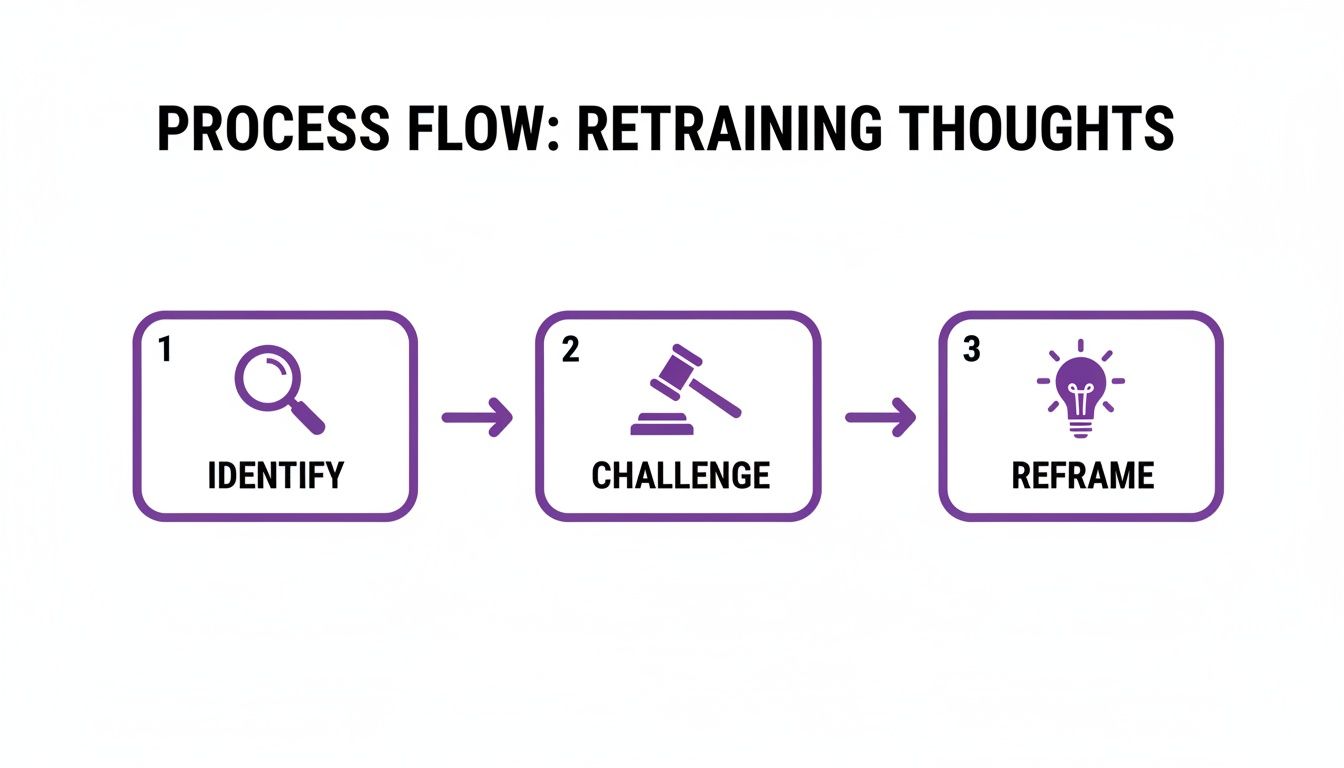
This simple flow—Identify, Challenge, Reframe—is the cognitive work you pair with the real-world exposure, creating a powerful one-two punch for real, lasting change.
The "Response Prevention" Part Is Key
Facing the trigger is only half the work. The other, absolutely critical piece is preventing the response. That means resisting the urge to do the safety behavior you normally rely on to get a moment of relief.
True progress happens when you learn to sit with the anxiety without "fixing" it. This is how you prove to yourself that the feeling of fear is just a feeling; it's uncomfortable, but it's not dangerous.
So, when you jog in place (the exposure), you must also fight the urge to check your pulse, ask your partner if you look okay, or immediately book a doctor's visit (the response prevention). It's in that gap—that moment of tolerating uncertainty—that your brain finally gets the memo that it can stand down.
Trying to climb a fear ladder on your own is possible, but it can feel incredibly daunting. This is where having an experienced therapist in your corner makes all the difference. They can help you design a ladder that’s just right for you, coach you through the tough spots, and make sure you're taking steps that are challenging but not completely paralyzing.
At reVIBE Mental Health, our team has helped countless clients in Chandler, Phoenix, Scottsdale, and Tempe do this work, face their fears, and take back their lives from health anxiety.
Finding Professional Treatment for Lasting Relief
While self-help tools are fantastic for managing anxiety in the moment, sometimes they just aren't enough to break a deeply ingrained cycle. Taking the step to find professional help isn't a sign of weakness; it's a powerful move toward getting lasting relief from health anxiety. It's so important to remember that your mental health needs support, just like any physical issue would.
Working with a therapist gives you a safe, structured space to finally untangle the complex roots of your fear. They bring personalized strategies, accountability, and the kind of compassionate guidance that helps you make real, sustainable changes.
Gold Standard Therapies for Health Anxiety
As you start looking for a therapist, you'll see a few different approaches mentioned. When it comes to health anxiety, a couple of evidence-based therapies have proven to be incredibly effective. The goal here isn’t to make you stop caring about your health entirely, but to dial down the anxiety so it no longer runs your life.
Here are the most successful methods you'll come across:
- Cognitive Behavioral Therapy (CBT): This is often the first and most recommended line of treatment. As we've touched on, CBT is all about learning to identify and challenge the catastrophic thought patterns that fuel the anxiety spiral. A therapist will work with you to examine the actual evidence for your fears, explore other possibilities, and fundamentally shift your relationship with those scary thoughts.
- Exposure and Response Prevention (ERP): This is a specialized form of CBT that sounds intimidating but is a game-changer. With your therapist's guidance, you'll gradually and safely face your triggers. This could mean reading an article about an illness you fear or resisting the urge to check your body for symptoms, all while learning to sit with the anxiety until it passes—without resorting to your usual safety behaviors.
When Trauma Is Part of the Picture
Sometimes, health anxiety isn't just about random worries; it's deeply connected to something that happened in the past. A frightening medical diagnosis, a difficult surgery, or even watching a loved one go through a serious illness can leave a traumatic imprint that fuels today's fears.
When that's the case, a therapy called Eye Movement Desensitization and Reprocessing (EMDR) can be exceptionally helpful. EMDR is specifically designed to help the brain process and heal from traumatic memories. By using bilateral stimulation (like guided eye movements), it can significantly reduce the emotional intensity tied to those past events, helping sever the link between old trauma and your current health worries.
The key takeaway here is that good therapy is never one-size-fits-all. A great therapist works with you to understand your unique story and create a plan that gets to the root of your anxiety, whether it's driven by thoughts, behaviors, or unresolved trauma.
The Role of Medication Management
For some, therapy is all that's needed. For many others, medication can be a crucial piece of the recovery puzzle. It's a common misconception that medication "cures" anxiety. A better way to think about it is that it can turn down the volume on the constant, intrusive worry.
Medications like SSRIs (Selective Serotonin Reuptake Inhibitors) work by helping to regulate chemical messengers in the brain, which can take the edge off your anxiety. This often creates just enough breathing room to fully engage in therapy. It's a lot easier to practice challenging your thoughts or facing your fears when you aren't in a constant state of overwhelm.
This is exactly why an integrated approach can be so powerful. At reVIBE Mental Health, our therapists and psychiatric team work side-by-side. This kind of collaborative care ensures your treatment is seamless. Your therapist and medication provider are always on the same page, building a cohesive plan that’s built just for you.
Unfortunately, even with such effective treatments available, many people never seek help. Anxiety disorders are the most common mental health condition across the globe, yet only about 27.6% of people who have them ever receive treatment. Stigma and a simple lack of awareness keep millions from finding relief, which just highlights how badly accessible, compassionate care is needed. You can dig into some of these global mental health trends on who.int.
Find a reVIBE Location Near You!
Taking that first step toward getting help can feel like the biggest hurdle. We get it. That’s why we’ve made connecting with our team at reVIBE Mental Health as straightforward as possible. We currently have five locations for your convenience. (480) 674-9220
- reVIBE Mental Health – Chandler
3377 S Price Rd, Suite 105, Chandler, AZ - reVIBE Mental Health – Phoenix Deer Valley
2222 W Pinnacle Peak Rd, Suite 220, Phoenix, AZ - reVIBE Mental Health – Phoenix PV
4646 E Greenway Road, Suite 100, Phoenix, AZ - reVIBE Mental Health – Scottsdale
8700 E Via de Ventura, Suite 280, Scottsdale, AZ - reVIBE Mental Health – Tempe
3920 S Rural Rd, Suite 112, Tempe, AZ
Navigating Logistics Like Insurance
Let's be honest—figuring out insurance can be a headache, and it's the last thing you need when you're already stressed. Our team can handle the insurance verification for you.
We’ll help you make sense of your benefits so you know exactly what to expect. The goal is to make the financial piece of this completely transparent, freeing you up to focus on what really matters: your health.
Care That Meets You Where You Are
Your life is busy, and therapy needs to fit into it, not the other way around. We offer both in-person appointments and secure online therapy sessions. You get to choose what feels right for you—the connection of meeting face-to-face or the convenience of a virtual visit from home.
Finding a therapist you genuinely connect with is the most critical part of this process. We’re committed to matching you with a professional who not only specializes in health anxiety but also gets you and your goals.
Each location is a safe, non-judgmental space where you can feel heard and empowered. If you find that past medical experiences or other traumas are fueling your health fears, specialized approaches might be a good fit. You can learn more about how we use EMDR therapy near you to help clients process difficult memories and find relief.
Reaching out is a brave first step toward reclaiming your peace of mind. We're here when you're ready.
Your Health Anxiety Questions, Answered
As you start putting these new strategies into practice, it's completely normal for a few questions to pop up. Feeling confident on this journey often starts with getting some clear, straightforward answers.
Can Health Anxiety Actually Cause Real Physical Symptoms?
Absolutely, and this is probably one of the most maddening parts of the experience. The constant, intense stress and the laser-focus on every little thing your body does—a state we call hypervigilance—can trigger very real physical sensations.
You might feel dizzy, get tension headaches, have an upset stomach, or experience chest tightness. This creates a vicious cycle: the physical symptoms feel like proof that your worst fears are true, when in reality, the anxiety itself is often the culprit.
The feelings are 100% real. The crucial shift is realizing they're often caused by anxiety, not a life-threatening illness. Grasping this connection is a huge turning point in breaking the cycle.
How Long Does It Take to Get Over Health Anxiety?
There's no one-size-fits-all answer here; recovery looks different for everyone. That said, when people consistently engage with proven methods like Cognitive Behavioral Therapy (CBT) and Exposure and Response Prevention (ERP), many start to feel a real difference in just a few months.
What matters most is your commitment to the process. Real, lasting change doesn't happen overnight. It comes from patiently practicing new ways of thinking and responding, ideally with a professional who can guide you and celebrate the small wins along the way.
Is It Okay to Still See My Doctor if I Have Health Anxiety?
Yes, of course. Having a primary care doctor you trust is essential for routine check-ups and to rule out any actual medical concerns. The goal isn't to make you swear off doctors for good.
The real aim is to fundamentally change how you interact with them and the healthcare system. It's about learning to sit with uncertainty, breaking the habit of seeking constant reassurance for every minor sensation, and using medical care in a balanced, rational way—driven by genuine need, not by fear.
If you're ready to find lasting relief from health anxiety, the compassionate team at reVIBE Mental Health is here to help you get started. Learn more and schedule an appointment online.