
When you see someone you care about in the throes of a panic attack, your first instinct is to help. But what does "helping" actually look like in that moment? It all starts with recognizing what's happening and then responding with a calm, steady presence. Your goal isn't to fix it, but to be an anchor until the storm passes.
Recognizing the Signs of a Panic Attack
If you’ve never seen one up close, a panic attack can look terrifying. It’s an abrupt and overwhelming wave of fear or distress that comes on without warning and peaks within minutes. The signs are intensely physical and emotional, and learning to spot them is the first step to offering real support.
It's incredibly common for both the person experiencing it and those around them to think it's a heart attack or another life-threatening medical emergency. That's because the physical symptoms—a pounding heart, chest pain, and a terrifying feeling of not being able to breathe—are not just in their head. They are very, very real.
Panic Attack Signs: What You See vs. What They Feel
To offer meaningful help, you need to appreciate the gap between what you can see on the outside and the sheer terror they're experiencing on the inside. This is exactly why telling someone to "just calm down" or "breathe" often falls flat. Their body has hijacked their brain, flipping the fight-or-flight switch into overdrive.
The table below breaks down this difference, which can help you respond with more empathy and understanding.
| Observable Sign (What You Might See) | Internal Experience (What They Might Feel) |
|---|---|
| Rapid, shallow breathing or gasping for air | Feeling of suffocation, choking, or inability to get enough air |
| Shaking, trembling, or shivering | Uncontrollable fear, feeling like their body is betraying them |
| Sweating, pale skin, or flushed face | A sudden hot flash or cold chills, feeling dizzy or faint |
| Pacing, fidgeting, or appearing frozen in place | An intense urge to escape, but feeling trapped or paralyzed |
| Looking dazed, confused, or disconnected | A sense of unreality (derealization) or feeling detached from oneself (depersonalization) |
| Clutching their chest or stomach | Sharp chest pains (often mistaken for a heart attack), nausea, or abdominal cramping |
Seeing both sides of the coin—the visible distress and the invisible terror—is what allows you to show up for them in a way that truly helps.
A panic attack feels like a sudden, complete loss of control. The world can feel unreal, and the fear of dying, fainting, or losing your mind can be all-consuming. Your support can act as an anchor, helping them find their way back to safety.
These experiences are far more common than most people think. In the United States, up to 11% of people have a panic attack each year. Looking globally, studies show over 13% of adults have had one at some point. Knowing how to respond isn't just a niche skill; it's a vital one.
For us at reVIBE Mental Health, serving communities across Arizona, these numbers highlight why it's so important for families and friends to have these basic support tools. When someone you love is having a panic attack, your informed, calm presence can make all the difference in the world. Learn more about the prevalence of panic attacks from Cleveland Clinic.
Your First Actions to Provide Calm Support
When you recognize the signs of a panic attack, your immediate reaction can be a powerful anchor in their storm. The absolute first thing to do? Check your own response. If you look scared or start to panic yourself, it just confirms their brain’s false alarm that something is catastrophically wrong.
Take a breath. Seriously. Your calm presence communicates more than words ever could—it sends a clear signal that this is a manageable moment, not a life-threatening emergency. Your job isn't to fix it; it's to be a steady, reassuring force.
Create a Safe Space
The surrounding environment can either fuel the panic or help extinguish it. A loud, bright, or crowded space is sensory overload for a brain already in overdrive. If you can, gently guide them somewhere quieter.
Try a simple, calm suggestion like, "Hey, let's step over here for a minute," or "Would you like to find a place to sit down?" This offers them a choice and a sense of control while dialing down the stimulation. The key is to invite, not to force. Never grab or pull someone; a gentle invitation works best.
This infographic does a great job of showing the link between the physical symptoms you can see and the intense internal experience they're having.
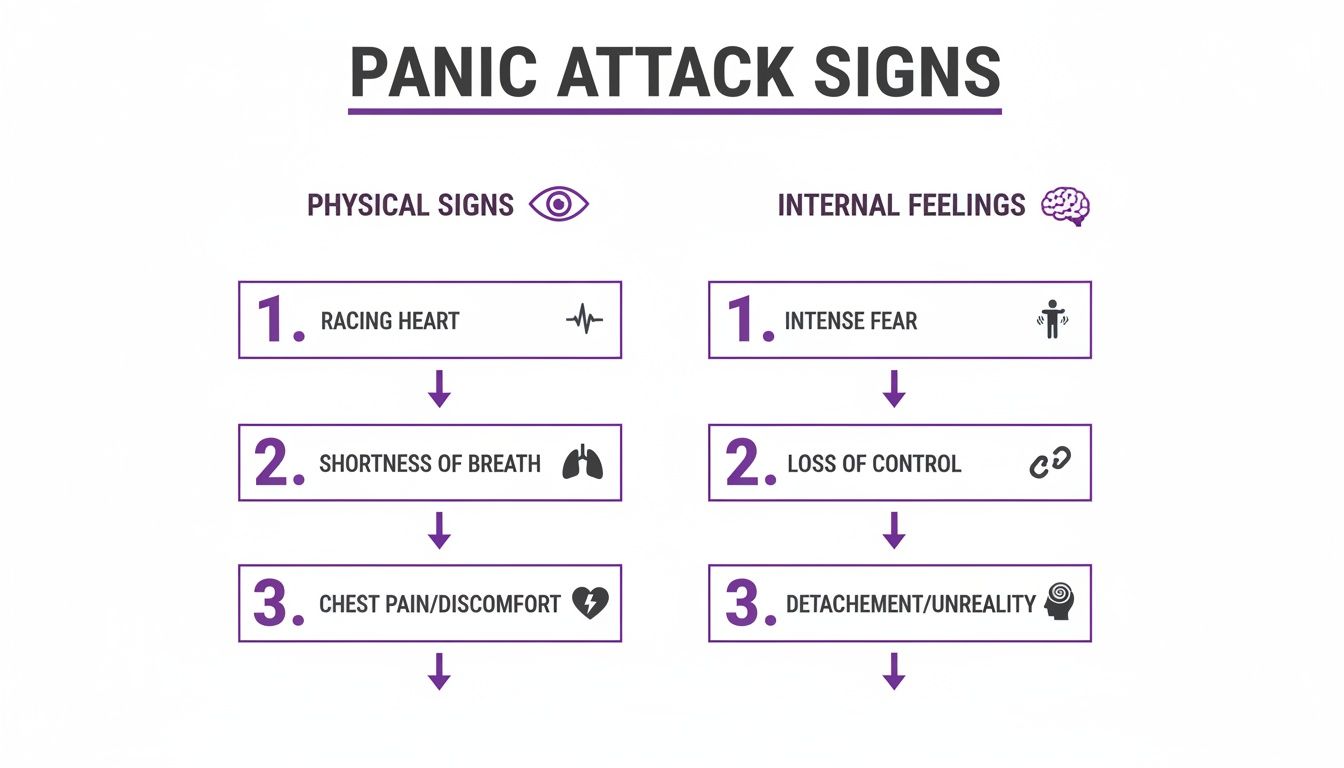
As you can see, what looks like shaking on the outside is connected to a terrifying internal feeling of losing control. That’s why creating a calm, safe environment is so critical.
Use Simple, Reassuring Language
During a panic attack, the brain’s higher-level thinking goes offline. It’s all survival instinct, no complex reasoning. Trying to have a detailed conversation is pointless and can even make things worse.
This means you need to keep your language incredibly simple, clear, and direct. Avoid big, open-ended questions like "What's wrong?" which can feel overwhelming. Instead, stick to short statements and gentle questions that only require a simple nod or a "yes/no" answer.
Here are a few phrases I've seen work well in the real world:
- "You are having a panic attack. I know it's scary, but you are safe."
- "I'm right here. I'm not going anywhere."
- "This will pass. It feels awful right now, but it's temporary."
- "Can I get you some water?"
Your tone of voice is just as important as the words. Speak slowly, calmly, and in a lower pitch. It’s incredibly soothing.
Your goal isn't to stop the panic attack—it's to help the person ride it out without feeling abandoned. Your calm presence and simple words are an anchor, reminding them that safety is real and close by.
One last tip: don’t crowd them. Your instinct might be to offer a hug, but for many people, this can feel restrictive and trapping. Respect their personal space, but stay close enough that they know you're there for them. Often, just your quiet presence is the most powerful support you can offer. These initial actions build a foundation of safety, making it possible for them to start coming back to themselves.
Using Grounding and Breathing Techniques That Work
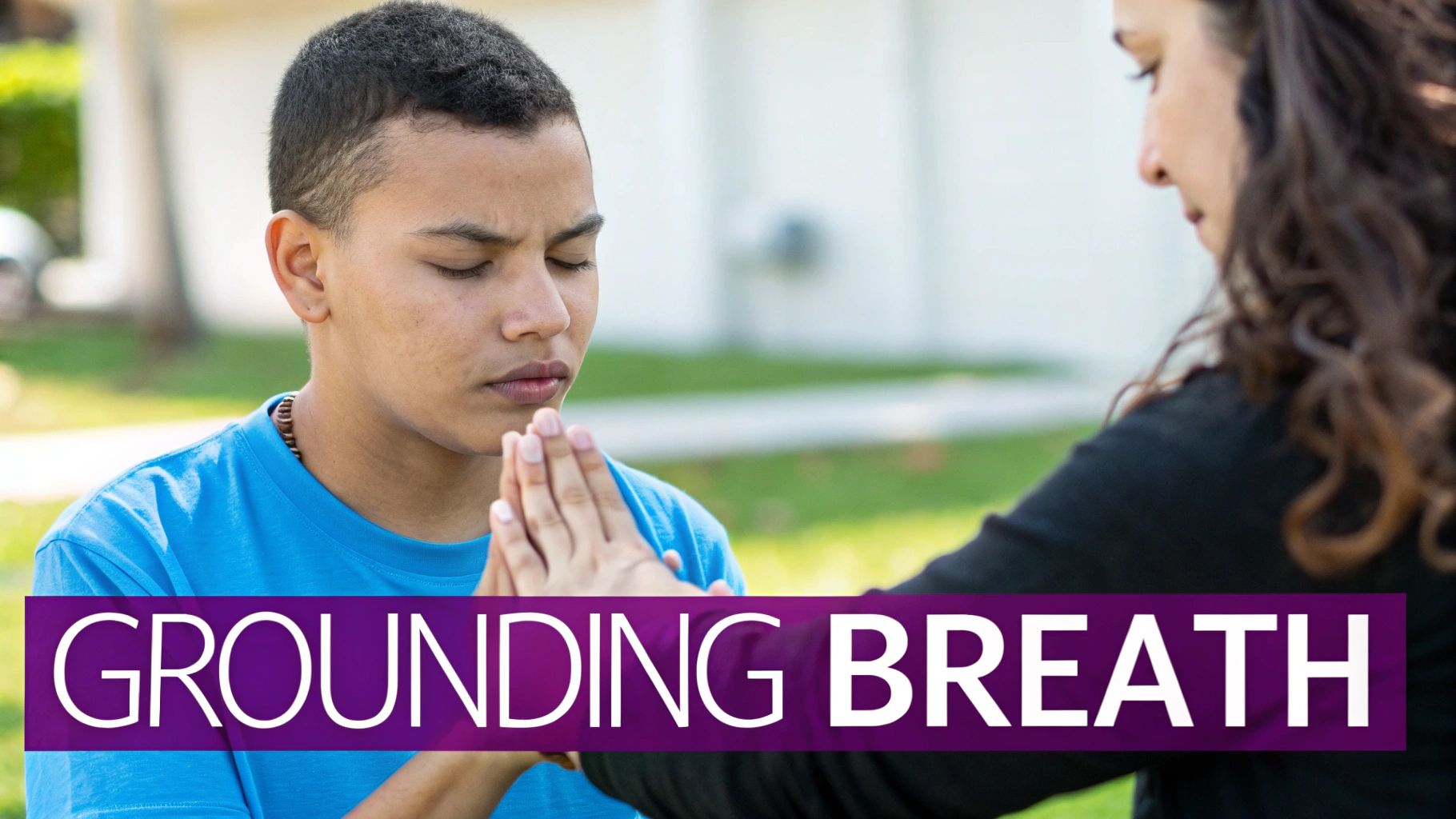
Once you've offered a calm, steady presence, you can start to introduce gentle tools to help the person reconnect with their body and the room around them. A panic attack essentially hijacks the nervous system, throwing it into a full-blown "fight-or-flight" response. Grounding and breathing techniques are designed to interrupt that alarm cycle and signal to the brain that the danger isn't real.
These aren't just simple distractions; they are proven methods for down-regulating a system that's completely overwhelmed. Your job here is to be a patient guide, not a drill sergeant. If one technique isn't helping, that’s perfectly fine. The goal is to offer options, never to force a solution.
Guiding Them Back to the Present Moment
Grounding techniques work by pulling a person out of the tornado of thoughts in their head and anchoring them to the physical reality of the here and now. One of the most effective and widely known methods is the 5-4-3-2-1 technique.
You can introduce it softly, saying something like, "I'm going to walk you through something simple to help. Can you try it with me?" Then, speaking slowly and calmly, guide them:
- "Can you name 5 things you can see right now?" You can point them out together. "I see the blue chair over there. I see the light on the ceiling. What's something else you see?"
- "Now, what are 4 things you can feel?" Offer suggestions if they're struggling. "Can you feel your feet on the floor? Or the texture of your shirt against your skin?"
- "Let's listen for 3 things we can hear." Listen along with them. "I can hear the hum of the refrigerator. And a car just went by outside. Can you hear one more thing?"
- "Can you find 2 things to smell?" This one can be tricky, so feel free to get creative. "Can you smell my coffee? Or maybe the scent of the hand soap we used earlier?"
- "Finally, what is 1 thing you can taste?" "Is there any taste in your mouth? Even just noticing the feeling of your tongue is enough."
This process gently forces the brain to shift its focus from abstract fear to concrete sensory information, which is a natural way to dial down the intensity of panic.
The Power of Paced Breathing
During a panic attack, breathing often becomes shallow and incredibly fast, which can lead to dizziness and make the feeling of panic even worse. That's why just telling someone to "take a deep breath" rarely works. A much better approach is to guide them through structured breathing techniques for anxiety attacks.
"Box breathing" is one of the most reliable methods. The key is to do it with them.
- Breathe in slowly through your nose for a count of four.
- Hold your breath gently for a count of four.
- Breathe out slowly through your mouth for a count of four.
- Hold the breath out for a count of four.
By modeling the rhythm yourself, you give them a clear, steady pace to follow. This slow, intentional breathing pattern is a powerful tool for regulating their heart rate and calming the nervous system.
Remember, these techniques are skills drawn from established therapies. They work because they directly address the physiological chaos of a panic attack, helping someone regain a sense of control one sense and one breath at a time.
While these strategies are incredibly helpful in the moment, their effectiveness grows when they're practiced and reinforced with professional support. Structured anxiety therapy provides a safe space for individuals to learn and master these skills, making them much easier to access when a crisis hits.
Communicating with Compassion During and After

When someone is in the throes of a panic attack, your words can either be a lifeline or an anchor. The goal isn't to fix the situation, but to offer a calm, validating presence that helps them ride the wave until it passes.
It’s a natural human impulse to try and reason someone out of fear. But phrases like "Just calm down," "You're overreacting," or "There's nothing to be scared of" can do more harm than good. To the person experiencing the attack, their brain is firing off every alarm bell it has. Telling them there’s no danger feels dismissive and can actually heighten their sense of isolation and shame.
Your job is to meet them where they are, validating their terror while anchoring them in the reality that they are physically safe.
Helpful vs Unhelpful Phrases During a Panic Attack
Knowing what to say can feel like navigating a minefield. The key is shifting from giving commands to offering support. This table offers some practical swaps that can make a world of difference.
| Instead of Saying This… | Try Saying This… |
|---|---|
| "Just calm down." | "I'm right here with you. Take your time. You are safe." |
| "You're being irrational." | "I know this feels terrifying. This is a panic attack, and it will pass." |
| "There's nothing to worry about." | "I can see you're really scared. I'm not going to leave you." |
| "Snap out of it!" | "Let's just focus on your next breath. I can breathe with you." |
These alternatives communicate that you’re a safe ally, not another source of pressure or judgment.
Communication After the Attack Subsides
The aftermath of a panic attack often leaves a person feeling physically drained, emotionally fragile, and sometimes embarrassed. This is a time for gentle reassurance, not a deep-dive analysis.
Avoid asking questions that can feel like an interrogation, such as "What was that all about?" It puts them on the spot when they’re at their most vulnerable.
Instead, try offering simple, open-ended support.
- "That looked incredibly difficult. I'm so glad you're feeling a bit better now."
- "Is there anything you need right now? A glass of water, maybe?"
This kind of quiet support helps dismantle the stigma that has surrounded anxiety for decades. Historically, it was seen as a weakness, a perception that still keeps people from getting help. Shockingly, many people live with symptoms for 10 years or more before ever reaching out for support. You can review key anxiety data on SingleCare.com to learn more.
Your non-judgmental reaction can be the very thing that helps break that cycle of silence, encouraging them to finally seek lasting relief.
The moments after an attack are a critical opportunity to build trust. Your calm acceptance and offer of support—without pressure or judgment—communicates that they are not a burden, and their experience is valid.
By being a compassionate presence, you can help someone move from a moment of crisis toward a path of ongoing support. It's this foundational approach to care that we practice every day at our reVIBE Mental Health locations across Arizona, creating a welcoming space where people can find their way back to balance.
Finding Professional Support for Lasting Relief
Your support during a panic attack is an incredible gift. You’re the anchor in a massive storm. While those immediate, in-the-moment actions are vital, they're like first aid—essential for the crisis, but not the long-term cure.
For real, lasting relief, a person needs to get to the root of what’s causing the panic. That’s where a professional comes in. Encouraging someone to take that step is one of the most caring things you can do. It's about shifting from just managing crises to building a life with less fear and more freedom.
Therapy and Psychiatry: The Path to Healing
Professional mental health care provides a roadmap for understanding the triggers and thought patterns that fuel panic attacks. A therapist can equip someone with personalized coping skills that go far beyond the immediate grounding techniques we've discussed.
There are a few incredibly effective, research-backed approaches for this:
- Cognitive Behavioral Therapy (CBT): This is all about identifying and rewiring the negative thought loops that often kickstart panic. It's practical and hands-on.
- EMDR (Eye Movement Desensitization and Reprocessing): If past trauma is the underlying cause, EMDR can be a powerful tool for processing those memories so they no longer have the same hold.
- Psychiatry and Medication Management: Sometimes, brain chemistry is a major factor. Medication can provide stability, making it much easier for someone to do the hard work in therapy. A skilled psychiatric mental health practitioner works with the individual to find what's right for them.
These aren't just about managing symptoms; they empower a person to regain a sense of control over their life.
Accessible, Compassionate Care in Arizona
We get it. Taking that next step can feel overwhelming, which is why finding a welcoming and straightforward practice is so important. At reVIBE Mental Health, we believe getting help should feel supportive from the very first phone call.
Our team of therapists and psychiatric professionals works together across the Phoenix area, creating personalized care plans that treat the whole person. We are committed to making professional support feel as easy and accessible as possible.
Seeking professional help is an act of strength. It’s a commitment to moving beyond just surviving panic attacks to building a life where you feel balanced, understood, and in control.
Find a reVIBE Location Near You!
We currently have five locations for your convenience. (480) 674-9220
reVIBE Mental Health – Chandler
3377 S Price Rd, Suite 105, Chandler, AZ
reVIBE Mental Health – Phoenix Deer Valley
2222 W Pinnacle Peak Rd, Suite 220, Phoenix, AZ
reVIBE Mental Health – Phoenix PV
4646 E Greenway Road, Suite 100, Phoenix, AZ
reVIBE Mental Health – Scottsdale
8700 E Via de Ventura, Suite 280, Scottsdale, AZ
reVIBE Mental Health – Tempe
3920 S Rural Rd, Suite 112, Tempe, AZ
Answering Your Questions About Panic Attacks
When you're trying to help someone through a panic attack, it's natural to have questions. You want to do the right thing, but every situation feels a little different. Let's walk through some of the most common concerns so you can feel more confident and prepared to be a supportive ally for your loved one.
When Is It Time to Call for Emergency Help?
Most panic attacks, as frightening as they are, aren't medically dangerous on their own. However, some symptoms overlap with serious medical emergencies, and it’s critical to know the difference.
You should call 911 immediately if the person loses consciousness, complains of severe chest pain that spreads into their arm or jaw, or if you know they have a heart condition. These can be signs of a heart attack, and it's not a risk worth taking.
Also, call for help if the attack doesn't start to wind down after 20-30 minutes, or if they say anything about wanting to hurt themselves.
Trust your gut. If the situation feels like it's getting worse, or if you feel you can't keep them safe, calling for professional help is always the right move. It’s better to be cautious and let a medical team make the call.
What if They Push Me Away When I Try to Help?
This happens more often than you'd think, and it's important not to take it personally. When someone is in the grip of a panic attack, their brain is in full-on survival mode. Any extra input—even a well-intentioned touch or question—can feel like a threat.
If they reject your help, don't argue or insist. Just back off a little.
Give them some physical space, but let them know you’re still there for them. Try saying something gentle like, "That's okay. I'm just going to be right over here if you need anything. You're not alone." Your calm, steady presence, even from a few feet away, can be a powerful anchor.
How Can I Help Them Prevent Future Panic Attacks?
Long-term, your role is about support, not being their therapist. The single most helpful thing you can do is encourage them to seek professional care to get to the root of the anxiety. If you're looking for more information, this guide offers some great actionable steps on how to calm panic attacks.
You can make this step less intimidating by offering to help them find local therapists, like our teams at reVIBE, or even going with them to their first appointment. When things are calm, you can also practice grounding exercises or breathing techniques together so it becomes second nature.
For many people, panic is tied to past experiences. Specialized treatments like EMDR therapy for anxiety can be incredibly effective in helping process underlying trauma that might be fueling the panic attacks.
At reVIBE Mental Health, our compassionate team is here to provide the professional support needed for lasting relief from anxiety and panic. To learn more or schedule an appointment at one of our five Arizona locations, visit https://revibementalhealth.com.