

You’ve taken the brave step of starting therapy. That’s huge. But now comes the big question: How can you tell if it's actually working?
The truest sign isn't just that temporary feeling of relief you get after a good session. Real progress shows up in your day-to-day life—in how you think, feel, and act when you’re out in the world. It’s those tangible shifts that really count.
Recognizing Real Progress in Your Therapy Journey

Starting therapy is a serious investment in your well-being, so it makes sense to look for a return. But here's the thing: progress rarely looks like a single, dramatic breakthrough. It’s much more common to see a series of small, quiet victories that build on one another over time.
Instead of holding out for a life-altering epiphany, it’s far more useful to tune into the subtle but significant signs that things are changing for the better. These little clues are powerful indicators that your hard work is paying off.
What Early Progress Looks and Feels Like
While everyone's timeline is different, you should begin to feel some kind of positive shift within the first couple of months. Healing isn't a straight line—there will be ups and downs—but you should be able to spot some forward movement. In fact, research shows that clients who notice improvements early on are far more likely to stick with it and reach their long-term goals.
So, what should you be looking for? It often comes down to a few key things:
- A flicker of hope: Your problems haven’t magically disappeared, but you start to feel a little more optimistic that change is actually possible.
- Getting better at handling your emotions: You might notice you’re not as easily knocked over by waves of anger, sadness, or anxiety. The feelings are still there, but you’re navigating them better.
- A clearer picture of yourself: You begin to connect the dots and understand your own patterns, triggers, and motivations in a way you couldn't before.
One of the best signs that therapy is working is when you feel more capable of handling what life throws at you. You might realize you’re navigating stress better or recovering from setbacks more quickly, which are classic signs you’re building strategies for strengthening emotional resilience.
Sometimes, it’s helpful to see these signs laid out clearly. Here’s a quick summary of what to watch for in those crucial first few months.
Early Signs Your Therapy Is on the Right Track
| Indicator Category | What to Look For (Examples) |
|---|---|
| Relational Changes | You notice shifts in your relationships—setting a boundary, communicating a need, or responding differently in a conflict. |
| Emotional Regulation | You're able to sit with a difficult emotion without immediately reacting, or you can self-soothe more effectively. |
| Cognitive Shifts | You catch a negative thought pattern and challenge it, or you begin to see a situation from a new, more helpful perspective. |
| Behavioral Activation | You start doing things you’ve been avoiding, like making that phone call, going for a walk, or tackling a small project. |
| Increased Self-Awareness | You have "aha" moments where you understand why you do something or what a particular trigger is all about. |
Looking for these indicators can give you confidence that you’re on a productive path. If you can check off a few of these, even in small ways, it’s a great sign.
The Data Behind Early Gains
This isn't just about a gut feeling; there's solid data to back it up. In national surveys, a significant 78% of patients report seeing results within just two to eight sessions.
What's more, 93% of clients said therapy provided them with practical tools to cope better with daily life—a core goal of any effective treatment. These early gains are incredibly important. They signal that the therapeutic relationship and the methods being used are a good fit for you. If you’re about two months in and feel completely stalled, it's more than okay to bring it up and talk about adjusting the plan.
Seeing Real Changes in Your Day-to-Day Life
Good therapy doesn’t just happen in the therapist's office. Its real value shows up in your everyday world—in the small, tangible ways you start to think, act, and react differently. This is where the rubber meets the road.
The most powerful proof that therapy is working isn't some dramatic, overnight transformation. Instead, it's about connecting the dots between your sessions and your actual life. You're not just talking about change; you're living it.
Turning "Aha!" Moments into Action
A huge sign of progress is when the insights you gain in therapy start to fuel real behavioral shifts. You’re moving from understanding your patterns to actively changing them.
For instance, you might notice yourself:
- Navigating conflict with more grace. Instead of that old habit of shutting down or blowing up during a disagreement, you find yourself pausing, taking a breath, and actually saying what you mean, calmly. You can hear your partner's side without immediately getting defensive.
- Setting boundaries without the guilt. That request for you to take on yet another project at work? You say "no," and you don't spend the next week agonizing over it. You're starting to see that protecting your own energy isn't selfish—it's necessary.
- Tackling things you used to avoid. Maybe it’s that pile of bills that’s been giving you anxiety for weeks. One day, you just sit down and handle it. Therapy gives you the tools to face challenges head-on, which slowly chips away at their power over you.
These aren't earth-shattering events, but they are solid, concrete proof that the internal work you’re doing is making a real difference in how you move through the world.
Better Relationships, Smoother Days
Another place to look for progress is in your relationships and your general ability to get through the day. When therapy is clicking, you’ll often see a positive ripple effect in how you interact with others and manage your responsibilities.
Therapy isn't about making all your problems disappear. It's about building your capacity to handle them. When you find yourself managing stress more effectively or feeling less overwhelmed by your to-do list, that’s a clear signal your coping skills are getting stronger.
You might just find your connections with friends and family feel more genuine and less draining.
Improvements in your overall functioning are also a fantastic sign. This could look like finally sleeping through the night, being able to focus better at work, or rediscovering the energy for hobbies you used to love. These practical shifts are undeniable evidence that what you're learning is directly improving your quality of life.
Using Objective Tools to Track Your Progress
Feelings are powerful, but let’s be honest—they can also be fickle. One week you might feel like you’re on top of the world, and the next, it feels like you've slid all the way back to square one. That's completely normal, and it’s precisely why we can't rely on feelings alone to measure progress in therapy.
Supplementing your own self-reflection with more objective measures gives you a much clearer, data-informed picture of your journey. Think of it like a fitness plan: you wouldn't just go by "feeling" stronger; you'd track the miles you run or the weights you lift. It's a useful mindset, and you can see a great example of how to track progress effectively in other areas of self-improvement.
Clinical Questionnaires Explained
Many therapists use brief, evidence-based questionnaires to get a handle on symptom severity. These aren't tests you pass or fail. They're simply snapshots of how you're doing at a specific moment in time, creating a baseline we can measure against as you move through treatment.
You'll likely come across two of the most common ones:
- The GAD-7 (Generalized Anxiety Disorder 7): This is a quick seven-question scale that looks at anxiety symptoms like excessive worry, irritability, and restlessness over the last two weeks.
- The PHQ-9 (Patient Health Questionnaire 9): Similarly, this nine-question tool assesses the frequency and severity of depression symptoms, from low mood and loss of interest to changes in sleep or appetite.
These assessments help both you and your therapist zoom out and see the bigger picture, moving beyond the ups and downs of a single week or session.
What the Numbers Mean for You
So, what are we looking for? A really significant milestone is seeing a 20-50% reduction in your scores on tools like the GAD-7 or PHQ-9 after a few months. That’s a measurable, tangible decrease in symptom severity and a strong sign that the treatment is on the right track. If you start with a score of 15, seeing it drop to a 7 or 8 is a concrete win.
This data-driven approach is more important than you might think. Getting into therapy is a huge step, but making sure that care is actually working is the real goal. Shockingly, some research has found that fewer than 7% of people with a mental health or substance use disorder receive care that meets the criteria for being "effective." That makes it absolutely essential for you to be an active participant in tracking your own progress.
Taking an active role in your treatment empowers you to ensure your care is working for you. Don't hesitate to ask your therapist, "Can we use a tool like the PHQ-9 to track my progress over time?" This collaborative approach ensures your therapy is guided by data, not just intuition.
This infographic shows some of the real-world benefits that go hand-in-hand with those improved clinical scores.
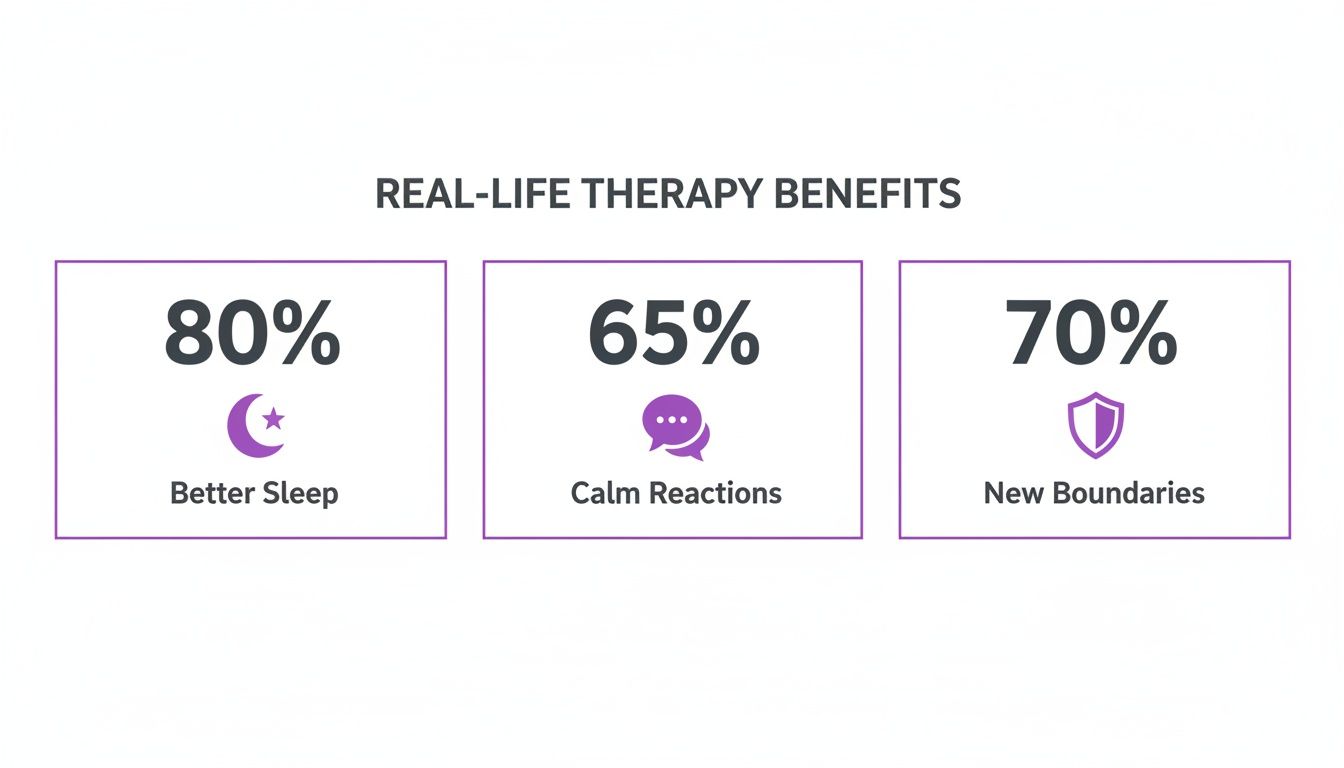
When those numbers on the page start to drop, it often translates directly into tangible life changes—like getting better sleep, reacting more calmly under pressure, and finally holding those new boundaries you've been working on.
How to Talk to Your Therapist About Progress

The single most important part of good therapy is open, honest communication. It might feel a little awkward or even confrontational to bring up your progress—or what feels like a lack of it—but it’s one of the most powerful things you can do for yourself. This isn't about calling them out; it's about collaboration.
Think of it as a team huddle. You and your therapist are partners, both working toward your goals. Sharing your perspective ensures you’re both on the same page and that your treatment plan is actually doing what it's supposed to.
Preparing for the Conversation
Walking into that conversation with a few thoughts already sorted out can make a world of difference. You don't need a perfectly rehearsed speech, but a little prep helps you get your point across clearly and confidently.
Before your next session, take a few minutes to think about these things:
- What are some specific wins? Think about a recent moment where you handled something better than you might have a few months ago. Make a mental note to share it.
- Where do you still feel stuck? Is there a goal that feels just as distant today as it did on day one? That's important information.
- How's the connection? Do you feel heard, understood, and supported in your sessions? The strength of your therapeutic relationship is a massive factor in your success.
Just doing this simple gut-check can turn a vague, anxious feeling of "Is this even working?" into a focused, productive conversation that can get things moving again.
Key Questions to Ask Your Therapist
Okay, so you're in the room. Now what? Kicking off the conversation is often the hardest part. The best way to do it is with open-ended questions that invite your therapist into a dialogue, rather than putting them on the defensive.
Don't be afraid to be direct. A good therapist will welcome these questions. Seriously. It shows you're engaged and invested in your own healing, which is exactly what they want to see.
Here are a few questions you can borrow or adapt to get the ball rolling:
- "From your perspective, how am I progressing toward the goals we initially set?"
- "Are we on the track you would expect for someone with my challenges at this point in therapy?"
- "I’ve noticed I'm doing better with [specific area], but I still feel really stuck when it comes to [another area]. Could we revisit our strategy for that?"
- "I'm curious—how do you typically measure progress with your clients?"
- "What signs of improvement are you seeing that I might be overlooking?"
Posing questions like these opens the door to review your treatment plan together. It might even lead to a discussion about adding other layers of support. For some, that might mean talking to a psychiatric mental health practitioner to see if medication could be a helpful tool alongside talk therapy, particularly for things like persistent depression or anxiety. The whole point is to find the right mix of support that works for you.
When to Adjust Your Treatment Plan or Consider New Options
It can be really disheartening to realize your therapy isn't working as well as you’d hoped. But this isn't a sign of failure—it's just a piece of data. Recognizing that you've hit a plateau is actually a huge step forward in finding the care that truly fits you. A good therapeutic relationship means being honest enough to know when it's time to pivot.
Sometimes, even with your best efforts and a great connection with your therapist, progress just stalls. If you've been consistent for several months and still aren't seeing meaningful change, it's time to have a conversation about the strategy. It's not about blame; it's about course-correcting.
Red Flags That Your Approach Needs a Change
There are some clear signs that your current treatment plan might not be the best path forward anymore. Ignoring them will only leave you feeling stuck and frustrated, so it pays to be honest with yourself if these start to pop up.
A few key red flags to watch for:
- No change in crisis frequency: You’re still finding yourself in the same high-distress situations just as often as when you started.
- Daily life isn't getting easier: Your ability to handle work, school, or relationships hasn't improved.
- Your self-ratings are flat: The scores on tools like the PHQ-9 or GAD-7 haven't moved, or you just don't feel any better in your day-to-day life.
Acknowledging these signs isn't giving up. It's taking ownership of your mental health journey and advocating for what you need to move forward. The goal is to find an approach that creates real, positive results.
Exploring Different Therapeutic Avenues
If your current approach isn't getting you anywhere, the answer isn't to ditch therapy altogether. It might just mean it's time to explore a different modality or add another layer of support. Therapy is definitely not a one-size-fits-all solution, and different issues often respond better to specific methods.
For instance, if you're dealing with trauma, traditional talk therapy might only get you so far. A more specialized approach like Eye Movement Desensitization and Reprocessing (EMDR) could be the key. You can learn more about how EMDR helps with anxiety and trauma to see if it resonates with your experience. It's a targeted method designed specifically to help the brain process and heal from distressing memories that keep you stuck.
Likewise, for something like chronic depression or severe anxiety, bringing in psychiatry and medication management can be a total game-changer. Medication can help stabilize your brain chemistry, which makes it much easier for you to actually use the skills you’re learning in therapy. This combined approach often works far better than either treatment on its own.
Using Data to Guide Your Decision
We know therapy works. Multiple long-term studies show that when it's effective, the benefits are significant and you can actually measure them. Research highlighted by the American Psychological Association shows that the average person in therapy is better off than about 75–80% of untreated individuals with similar issues.
If you’re not seeing any of those measurable benefits—like fewer crisis moments or improved daily functioning—after a few months, the data is telling you it's time to talk about a change. This isn't just about "feeling good" after a session; it's about getting tangibly better in a way that truly impacts your life.
Ready to Find the Right Support in Arizona?
Recognizing that your current therapy plan needs a tweak—or a total overhaul—is a huge step. It shows you're invested in your own well-being. If you're in the Phoenix area and feel like it’s time for that next step, we’re here to help you figure it out.
At reVIBE Mental Health, our therapists and psychiatric team all work under one roof. This makes it so much easier to adjust your care. You can add EMDR, explore medication, or switch therapy styles without the headache of finding a whole new practice and starting from scratch.
Getting help shouldn't feel like another hurdle. We accept most major insurance plans and offer appointments seven days a week, both in-person and online, to fit your life.
Taking action is the most powerful part of understanding your mental health journey. The right team can provide the personalized, compassionate care you need to feel better and regain your balance.
We have five convenient locations across the Valley, so great care is never too far away. You can see all of our offices and get to know our providers by exploring the reVIBE Mental Health locations.
Ready to talk? Give us a call at (480) 674-9220 or find a reVIBE location near you!
We currently have five locations for your convenience.
- reVIBE Mental Health – Chandler: 3377 S Price Rd, Suite 105, Chandler, AZ
- reVIBE Mental Health – Phoenix Deer Valley: 2222 W Pinnacle Peak Rd, Suite 220, Phoenix, AZ
- reVIBE Mental Health – Phoenix PV: 4646 E Greenway Road, Suite 100, Phoenix, AZ
- reVIBE Mental Health – Scottsdale: 8700 E Via de Ventura, Suite 280, Scottsdale, AZ
- reVIBE Mental Health – Tempe: 3920 S Rural Rd, Suite 112, Tempe, AZ
Your Top Questions About Therapy Progress, Answered
It's completely normal to have questions as you navigate therapy. You want to know what to expect and how to tell if you're on the right track. Let's tackle some of the most common concerns people have when they're figuring out if therapy is truly making a difference.
How Long Until I Should Feel a Difference?
Everyone's journey is unique, but a good rule of thumb is that many people start noticing small, yet significant, shifts within the first 8 to 12 sessions. For most people seeing a therapist weekly, that’s about two or three months into the process.
These early wins—maybe you’re a little less anxious, or you handled a tough situation better than you would have before—are often great signs of future success.
If you’ve hit that three-month mark and feel like absolutely nothing has changed, that's a perfect reason to bring it up with your therapist. It's not a criticism; it's a crucial part of the process to check in on your treatment plan and make sure it’s still right for you.
What If I Really Like My Therapist, But I Still Feel Stuck?
This is such a common and important question. Having a good connection with your therapist is fundamental, but it doesn't automatically guarantee progress. If you're feeling stalled, it’s not only okay to say something—it's productive.
You could try saying, "I feel really comfortable working with you, but I'm worried I'm not making as much progress on my goals as I'd hoped. Could we talk about our approach and see if there's anything we could adjust?"
A skilled therapist will welcome this kind of honesty. It's an opportunity to collaborate, maybe try a new technique, or even discuss whether a different type of therapy might be a better fit for what you need right now.
Is It Normal for My Progress to Be Up and Down?
Yes, one hundred percent. Healing isn’t a straight line upward; it’s more like a series of peaks and valleys. You’ll likely have weeks where you feel on top of the world, followed by sessions that are tough or feel like a step backward.
This is completely normal.
The trick is to zoom out and look at the overall trend. Are the hard times getting a little less intense? Are you bouncing back faster? Are you using the skills you’ve learned, even when things are difficult? Looking at your journey over several months, rather than just from one week to the next, gives you a much clearer picture of your growth.
If you're looking for a therapy team that partners with you every step of the way, reVIBE Mental Health is ready to help. You can explore our mental health services and let us help you find the provider who's right for your journey.