
You've agreed to try couples therapy, but now you're wondering what to say. One of you may already have a list of painful moments, while the other worries the appointment will become an argument with an audience. You don't need a polished explanation or a complete relationship history to begin.
Learning how to prepare for couples therapy means getting clear about your hopes, gathering useful examples, and checking that the setting is safe for both of you. Preparation isn't about making the strongest case against your partner. It's about giving the therapist enough information to recommend an appropriate next step.
Preparation Timeline Before the First Session
| When | Task | Done when |
|---|---|---|
| Two weeks before | Agree on each partner's primary goal and one recent example of a recurring argument | Both partners can state the goal in one sentence |
| One week before | Check insurance, fees and whether the format is in person or telehealth | You know the cost range and the session setting |
| Three days before | Complete intake forms honestly and note any urgent concerns | Safety, substance use or medication questions are written down |
| Day before | Write one desired change and one measurable sign of progress | Each partner has a private written list |
| Session day | Arrange transport, childcare or work time and bring the goal sheet and top three questions | Both partners arrive on time with the goal sheet in hand |
Treat these dates as a planning aid, not a requirement to postpone care. A partial checklist still helps. If your appointment is coming up quickly, start with goals and logistics.
Make each task small enough to finish
Two weeks before, identify what each person wants help with, provided a joint conversation feels safe. You're finished when you can explain your own hope without correcting your partner's answer.
One week before, get concrete booking information rather than assuming your insurance covers the appointment. Confirm the expected out-of-pocket cost, session setting, and payment arrangements so neither person encounters a financial surprise.
Three days before, complete forms independently where possible. Don't edit your answers to make them match; different accounts give the clinician important information.
The day before, keep reflection brief. If you use spiritual reflection personally, Tarot Chats' guide on how to prepare for a relationship reading offers a separate context for organizing relationship questions, but a reading doesn't replace clinical assessment or safety screening.
On session day, protect the appointment from avoidable interruptions. Set aside quiet time afterward rather than immediately scheduling a demanding meeting or family commitment.
Copy the table into a phone note and tick off each task before the appointment. Keep private concerns somewhere your partner can't access if sharing them could put you at risk.
Check Safety and Choose a Format Before Booking
If one partner monitors the other's phone, speaking openly together may not be safe. Each person should have a chance to raise safety concerns privately with the clinician before deciding what to share in a joint session.

Check consent before convenience
Ask for a private conversation. Use a safe way to contact the provider and ask how private disclosures are handled. Share concerns such as coercion, threats, financial control, severe depression, substance use, or fear of disagreeing. Individual support, crisis care, or a referral may be a better first step than joint sessions. If danger is immediate, seek emergency assistance.
Choose a workable format. A 2025 systematic review of digital relationship interventions found that digital options can reduce financial and other access barriers, though engagement and accessibility challenges remain. For telehealth, consider whether you can use a private room and headphones, whether someone could enter unexpectedly, and whether your device activity is monitored. Avoid changing device settings if that could increase risk. You can browse online dating safety advice for a separate perspective on digital privacy.
Check practical arrangements. In a Veterans Affairs treatment-engagement study, approximately 60% of 177 referred veterans and family members discontinued before active treatment, most between phone screening and the first appointment. The finding is specific to that study, but it illustrates why it helps to check availability, transportation or online access, insurance, cost, and confidentiality before booking.
Be clear about consent. If either person feels pressured to attend, tell the provider. Ask whether individual check-ins or another approach could help determine whether joint therapy is a voluntary and appropriate starting point.
If controlling behavior is a concern, read about couples therapy with a narcissist to help frame questions without diagnosing your partner.
reVIBE Mental Health offers couples therapy in person or through secure telehealth for couples dealing with infidelity, trust issues, or major life changes, as well as those seeking premarital counseling or long-term relationship guidance. Its five Valley locations serve Scottsdale, Tempe, Chandler, Phoenix, and Paradise Valley.
Ask yourselves: Is joint therapy safe, voluntary, and appropriate for our situation?
Agree on a Shared Goal Before You Book
One partner books therapy hoping to rebuild the relationship. The other agrees because they want help deciding whether to stay. Neither goal is dishonest, but each person may leave disappointed if they assume the other wants the same outcome.
In a naturalistic study of 249 couples, 7.8% of couples entering therapy with a shared improvement goal had separated at six-month follow-up, compared with 56% of couples whose shared goal was clarification. The groups were unequal in size, and the study doesn't establish that choosing an improvement goal causes better outcomes.
The practical lesson isn't to promise reconciliation. It's to tell the therapist what each of you wants, including uncertainty.

Write goals that describe observable change
Write one desired change privately. Replace a broad judgment, such as wanting a more caring partner, with a behavior you could recognize: being able to explain a concern without interruption.
Name one recurring interaction pattern. Describe the sequence, not a personality flaw. For example, after dinner, one person raises an unfinished household task, the other hears criticism, and both begin defending themselves.
Choose one measurable sign of progress. Possible targets include fewer escalated arguments, repairing a disagreement within a day, or completing a weekly conversation without interrupting. These are proposed goals, not deadlines the therapist should guarantee.
Compare the lists when it's safe. Look for overlap without negotiating away important differences. Perhaps one person wants renewed closeness and the other wants clarity, but both want to stop arguing in front of their children.
Tell the therapist where you differ. Don't present a shared statement that hides one partner's uncertainty. The clinician needs to know whether you're seeking repair, a decision about the relationship, or help reducing conflict while deciding.
Our guide to couples therapy goals can help you turn broad hopes into specific discussion points. Bring your own wording rather than choosing a goal because it sounds like the correct answer.
If your partner is uncertain about staying together, don't make certainty a condition of participation. You can ask for honesty and respectful involvement without asking them to promise an outcome they don't yet want.
A minimum shared objective is enough to begin. You don't need identical expectations, but the therapist needs an accurate picture of both.
Gather Examples, History and Private Concerns
A 2020 meta-analysis of 58 studies involving 2,092 couples found a large pre-to-post improvement in relationship satisfaction among couples receiving therapy, Hedges' g = 1.12, while waitlisted couples showed no statistically significant improvement, g = 0.12. Those findings support seeking help, but they don't prove that preparing notes improves outcomes or guarantee what will happen for your relationship.
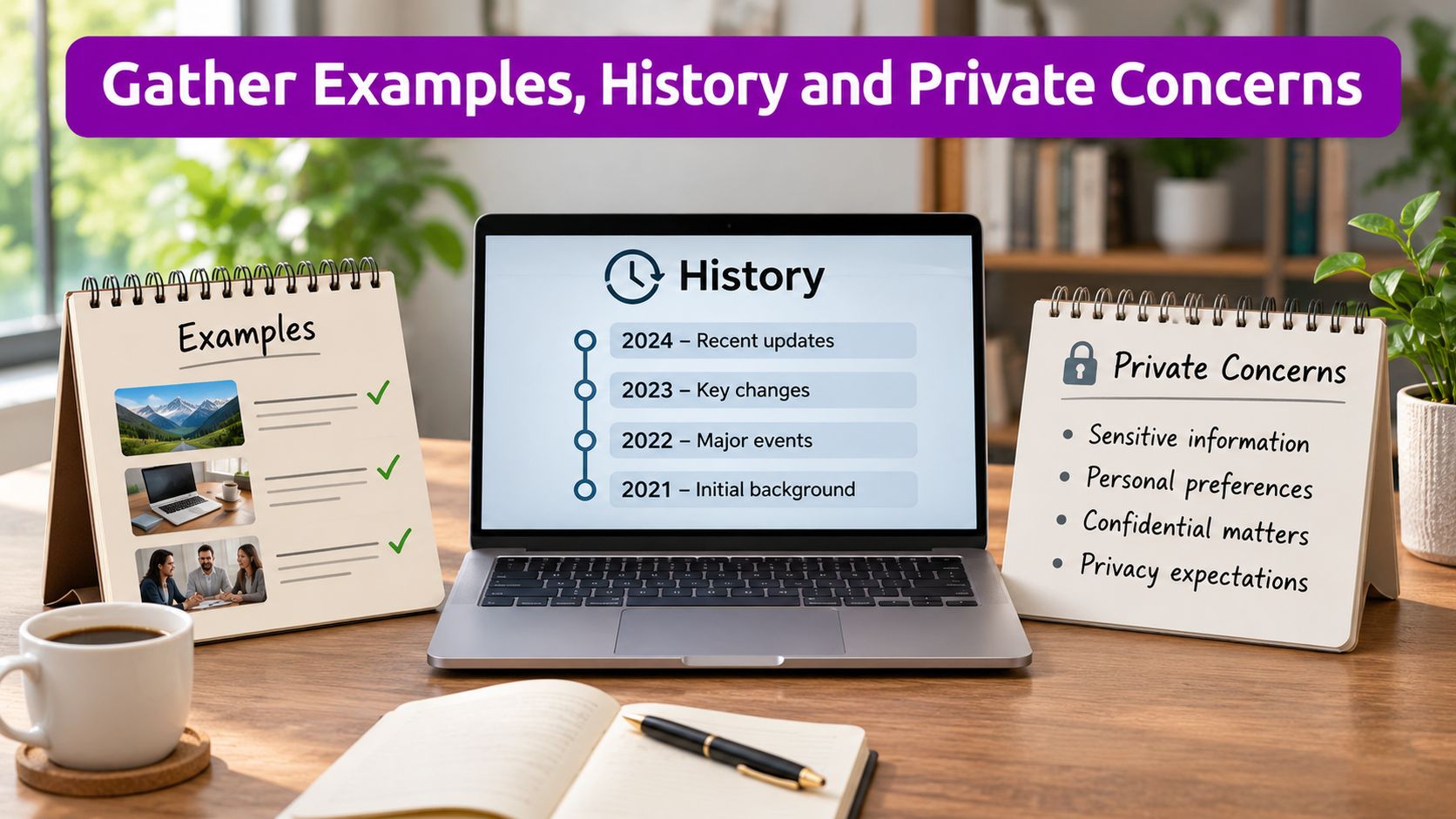
Useful notes make your concerns easier to explain. Bring a short account of what happens, when problems intensified, and what you may need to discuss privately.
Build a snapshot, not a complaint file
- Recurring problems: Choose three representative events. For each, describe the trigger, what each person said or did, and how the interaction ended. Separate observations from interpretations.
- Relationship history: Create a short timeline of major changes, such as moving, job loss, becoming parents, illness, or betrayal. Approximate dates are enough when exact ones aren't available.
- Private concerns: Write down questions about commitment, past betrayal, substance use, mental health, or safety. Mark anything you need to discuss with the clinician before sharing jointly.
Say you argue about money on Sunday evenings. One partner recently changed jobs, the household budget shifted, and reviewing bills now ends with accusations and withdrawal.
A useful note describes that sequence and the unresolved decision about spending. A less useful note lists every purchase as proof that your partner is irresponsible. Include your own actions where relevant, but don't assume that responsibility for harmful behavior is equal.
For paperwork preparation, our overview of therapy intake questions can help you identify information you may want readily available. The BlokNotes client records guide addresses professional record organization, a different task from your personal preparation; you don't need client-management software or an exhaustive dossier.
Keep it factual: Write enough to recognize the pattern, not enough to prosecute the entire relationship.
When it's safe, decide together which shared examples to introduce. Neither partner should have to reveal confidential notes at home or obtain permission to raise a private safety concern with the clinician.
What Happens in the First Assessment
An assessment works like a first appointment with a physician: examination before prescription. Many practices assess the relationship before moving into ongoing treatment, asking what brought you in, how the relationship developed, and how each person experiences conflict. The clinician is gathering information, and part of that work is checking whether joint sessions are the right and safe starting point for both of you.
One structured example in An Overview of Gottman Method Couples Therapy describes an assessment of approximately 4.5 hours across four stages: a 90-minute joint session, separate 45-minute individual interviews for each partner, and a 90-minute conjoint feedback session. Practices vary in how they schedule this, so ask at booking whether the appointments will be split across several days.
| Stage | Length | What happens |
|---|---|---|
| Joint session | 90 minutes | Relationship history and observed interaction |
| Individual interview, partner one | 45 minutes | Commitment, possible abuse, betrayal history, substance use and mental health |
| Individual interview, partner two | 45 minutes | The same private topics from the second partner |
| Conjoint feedback session | 90 minutes | Strengths, growth areas and a treatment roadmap with measurable steps |
The timed stages above follow the linked Gottman assessment overview; your practice may schedule them differently.
Arrive ready to describe, not perform
During the joint appointment, explain what you remember and allow room for a different account. You don't need to force agreement about every detail. Arrive rested where possible, since an hour and a half of structured conversation takes more energy than a typical argument at home.
The individual interviews give each partner private space. They also serve a safety function: in these sessions, the clinician hears about commitment doubts, betrayal, possible abuse, substance use, or mental health concerns that might change the treatment plan or mean joint therapy needs adjustments first. Plan what you need to say privately.
Before disclosing sensitive information, make sure you understand the clinician's policy for handling it. A private interview doesn't automatically mean every disclosure stays separate from the couples work, so ask how private information is treated before you share it.
Expect feedback to guide the next step
The feedback appointment is where everything comes together. The therapist explains strengths, growth areas, and proposed treatment priorities, and the Gottman Institute's explanation of couples therapy describes developing a roadmap with measurable steps.
Your home-written targets give that conversation practical starting points. Rather than accepting a vague plan to communicate better, ask which behavior you'll practice and how you'll review whether it helped.
Questions to Ask the Therapist in Session One
A useful first session includes your questions, not just your problems. You're learning how the clinician works and whether both partners understand the proposed care.
Bring questions you need answered. You don't have to cover every item before the conversation can begin.
What approach do you use? Ask the practice which models its therapists use, including whether they work with the Gottman Method or Emotionally Focused Therapy. Ask how that approach would apply to your concerns rather than relying on a model's name alone.
How does confidentiality work when we're both clients? At reVIBE Mental Health, the therapist explains the limits of confidentiality during the first session. Ask for plain-language examples if you're unsure what those limits mean for your situation.
Will we meet together and separately? Clarify how individual meetings fit into the work and how private disclosures are handled. Ask what happens if someone shares information that substantially changes the treatment plan.
What happens if one of us participates less? Ask whether individual check-ins, motivational interviewing, or between-session exercises are available and appropriate. Describe the actual difficulty, such as freezing during conflict or feeling pressured to attend, rather than labeling someone unmotivated.
What are the fees, and are sliding-scale options available? Clients can ask their therapist about sliding-scale fee options during the initial consultation. Clarify the arrangements before agreeing to an ongoing schedule.
How many sessions might we need? A 2024 therapy-practice summary citing the American Association for Marriage and Family Therapy puts the average at approximately 11.5 couples therapy sessions. An average isn't a treatment prescription; ask when your clinician will review the plan with you.
What would progress look like for us? Ask which changes you'll practice between appointments and how the therapist will respond if you're not improving. Progress might involve clearer decisions or safer boundaries, not necessarily staying together.
Make room for the questions that matter most
Write your top three questions in a phone note and bring them up early, rather than spending the opening minutes searching for words. If an answer is unclear, ask the therapist to explain it differently.
You don't need to leave feeling that everything is fixed. You should have a clearer understanding of the proposed next step, what participation involves, and whether you can consent to that plan.
reVIBE Mental Health offers couples therapy in person and through secure telehealth, with care focused on your relationship concerns and goals. Visit reVIBE Mental Health to explore care options and arrange an appointment, and let us know if you need a private conversation about safety before meeting together.