
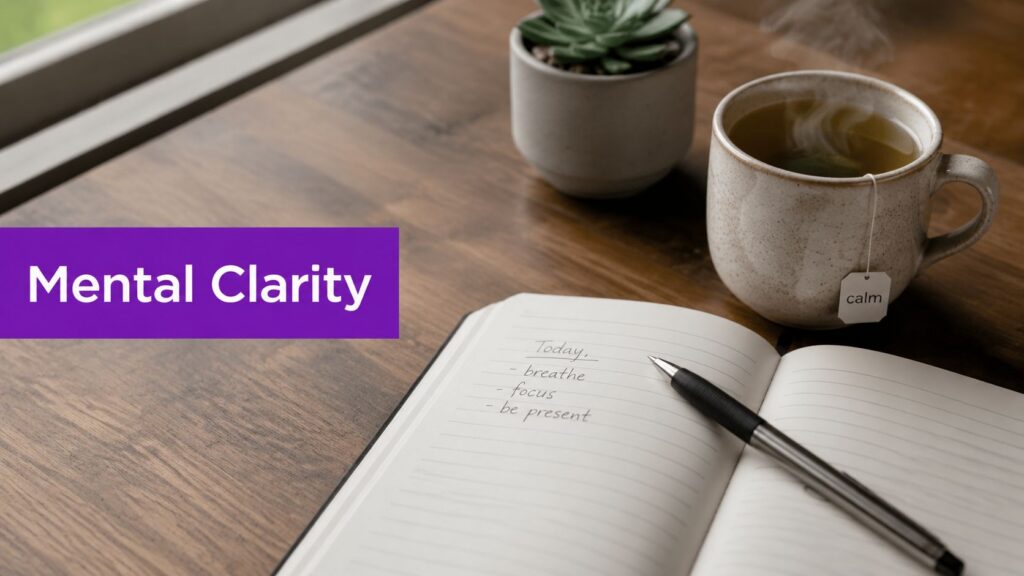
Some nights, your mind won't settle. You replay a conversation, worry about tomorrow, and feel pulled in six directions at once. You open a blank notebook or notes app, then close it because you don't know what to write.
That's a common place to start.
A journal can become a private place where scattered thoughts begin to make sense. It doesn't need to be polished, deep, or even consistent at first. It just needs to give your mind somewhere to put what it's carrying.
Your Path to Clarity Through Mental Health Journaling
When life feels mentally crowded, journaling can help you slow the traffic. It gives thoughts a place to land outside your head, which often makes them feel less tangled and less urgent. For many people, that shift alone is a relief.
Mental health strain is not rare or isolated; globally, 1 in every 8 people lives with a psychiatric disorder, and over the past decade there has been a 13% rise in such conditions according to the American Journal of Epidemiology mental health overview. Accessible tools are vital, as many people need support before they ever feel ready to ask for help.
A journal is one of those tools. It's low pressure, private, and flexible. You can use it to vent, notice patterns, track symptoms, practice gratitude, or prepare for therapy. You can write one sentence or three pages. Both count.
Journaling works best when you stop trying to do it “right” and start using it honestly.
What often gets in the way
People usually don't quit journaling because they're lazy. They stop because they feel intimidated by the blank page, unsure what kind of journaling fits them, or disappointed when writing doesn't instantly make them feel better.
That's especially true if you're dealing with anxiety, depression, trauma, grief, or burnout. On hard days, even simple habits can feel heavy. If your emotional life is also connected to spirituality, some people find it helpful to explore resources like mental health and faith, which can add another layer of reflection without replacing clinical care.
What makes journaling sustainable
The most useful journals for mental health are the ones you'll return to. That usually means:
- Keeping it simple so the habit doesn't feel like homework
- Matching the method to the goal instead of copying someone else's routine
- Using it as support, not proof of discipline
- Letting it change over time as your needs change
A journal doesn't need to fix everything. It can help you hear yourself more clearly.
Understanding How Journaling Rewires Your Brain
Writing things down changes the job your brain has to do. Instead of trying to store every feeling, fear, memory, and to-do item at once, your mind can begin sorting. That's why journaling often feels like a release even before you solve anything.
Think of journaling as an external hard drive for your thoughts. When worries stay trapped in your head, they tend to loop. Once they're on paper, you can see them, organize them, question them, and respond to them with more intention.

Writing creates a little distance
A thought in your head can feel like a fact. A thought on paper becomes something you can observe.
That small distance matters. Instead of “I'm failing at everything,” you might write, “I noticed I'm having the thought that I'm failing because I missed one deadline and I'm exhausted.” The second version is more accurate, more compassionate, and easier to work with.
Here's what journaling often helps people do:
- Name emotions clearly when everything feels blended together
- Spot patterns in stress, sleep, conflict, or avoidance
- Slow reactivity by giving feelings structure and language
- Notice thinking habits like catastrophizing, all-or-nothing thinking, or self-criticism
Your brain shifts from spinning to sorting
When people are overwhelmed, they often move into repetition. The same fear runs over and over, but doesn't move anywhere. Journaling turns repetition into processing.
You might start with, “I'm anxious.” Then after a few lines, you realize the anxiety is tied to one meeting, one relationship, or one uncertainty. That's useful information. It gives shape to what felt vague.
Practical rule: Don't ask your journal to make you feel calm immediately. Ask it to help you get specific.
Self-awareness grows through repetition
Journaling becomes more powerful over time because it creates a record. You begin to see what triggers you, what helps, what drains you, and what gives you relief. That's self-awareness in action, not as a personality trait but as a skill.
A short comparison makes this easier to picture:
| What happens in your head | What happens in a journal |
|---|---|
| Thoughts blur together | Thoughts get separated into parts |
| Emotions feel urgent | Emotions become easier to describe |
| Problems feel global | Problems become more specific |
| Patterns stay hidden | Patterns become visible over time |
You don't need perfect insight for journaling to help. You just need enough honesty to get the first few words down.
Choosing Your Journaling Method for Mental Health
The best journaling style depends on what you need from it. Some people need emotional release. Others need structure. Others freeze unless they have a prompt. If you've stopped journaling before, the problem may not have been you. It may have been the method.

If your goal is to understand your emotions
A mood journal is often the easiest starting point. You don't need long entries. You just record what you felt, when you felt it, and what was happening around you.
This works well for people who say, “I know I'm off, but I don't know why.” Over time, patterns become easier to spot. You may notice that your anxiety spikes after poor sleep, or that your mood crashes after certain social interactions.
Try including:
- The emotion you noticed
- The trigger or situation
- The body signal such as tight chest, restlessness, or fatigue
- The response you had, helpful or unhelpful
If your goal is to challenge negative thought loops
A CBT-style journal is more structured. It's useful when your mind jumps quickly to conclusions or gets stuck in shame, fear, or self-criticism.
A basic entry might include the situation, the automatic thought, the feeling it created, and a more balanced response. This method is less about venting and more about examining the story your mind is telling.
For people who like guidance, a resource on guided journals for anxiety, depression, and trauma can help narrow down formats that feel easier to stick with.
If your goal is to create more emotional balance
Gratitude journaling and positive affect journaling aren't the same thing as pretending everything is fine. Used well, they help you widen your attention so pain isn't the only thing your mind rehearses.
This can be especially helpful for anxiety. Research shows journaling has different effects depending on the condition. It can lead to a 9% reduction in anxiety symptoms but only a 2% reduction for depression, which suggests journaling is best used as a complementary tool alongside clinical therapy for depression in the published review on journaling and mental health outcomes.
That difference matters. If you have anxiety, journaling may be a stronger stand-alone support. If you have depression, journaling can still help, but it's wiser to treat it as one tool inside a bigger care plan.
If your goal is to stay organized when your mind is busy
A bullet journal can help if your stress comes from mental clutter more than emotion alone. This style blends lists, habit tracking, short reflections, and planning.
It's useful for people who think in fragments. If full paragraphs feel draining, a bullet format can make journaling feel more approachable. You can track sleep, medication, habits, appointments, moods, and stress triggers without needing to write much.
If your goal is to process difficult experiences gently
Freeform journaling gives you room to write without rules. For some people, that freedom feels relieving. For others, especially trauma survivors, it can feel too open and emotionally intense.
A softer option is prompted journaling, where a question gives you a starting point. Trauma-informed journaling often works better when it includes grounding, pacing, and clear boundaries. You don't have to dig up every painful memory for journaling to be meaningful.
The right journal method should make it easier to return, not harder.
A simple way to choose is to ask yourself one question: What do I most need from writing right now?
| Need right now | Journaling method that may fit |
|---|---|
| “I need to understand my mood shifts” | Mood journaling |
| “I need to challenge harsh thoughts” | CBT journaling |
| “I need something lighter and steadier” | Gratitude or positive affect journaling |
| “I need structure” | Bullet journaling |
| “I freeze without guidance” | Prompted journaling |
| “I need open space to unload” | Freeform journaling |
You don't have to pick one forever. Many people use one style during anxious periods and another during depressive episodes or life transitions.
How to Start Journaling Today in Four Simple Steps
Starting matters more than setting up the perfect system. It's common to overthink journaling before ever beginning. The easiest way in is to lower the pressure.
Pick a format you won't avoid
Choose the tool that feels least annoying. That might be a lined notebook, a notes app, a document on your laptop, or a guided journal with prompts already built in.
Paper can feel more personal and grounding. Digital tools can be faster and more convenient. If routine helps you stay consistent, some people like reviewing systems before committing. If habit-building is your main hurdle, evaluating this habit tracking app may help you think through what kind of reminder structure fits your life.
Make the bar low enough to clear
Don't start with “I'll write every night for half an hour.” That goal sounds admirable and fails quickly.
Start with five minutes. Or one prompt. Or three sentences. A tiny routine teaches your brain that journaling is safe, manageable, and repeatable.
A helpful setup looks like this:
- Choose one time anchor such as after coffee, after work, or before bed.
- Set one small target like five minutes or half a page.
- Keep your journal visible so you don't rely on memory.
- Stop while it still feels doable instead of forcing a marathon entry.
Create enough privacy to be honest
People stop journaling when they feel watched, even if no one is reading. You'll write more truthfully when you trust the space.
That might mean keeping your notebook in a drawer, using a password-protected app, writing in your car before going inside, or putting on headphones to make the moment feel contained. Privacy isn't a luxury here. It supports honesty.
If the blank page makes you freeze, start by finishing one sentence: “Right now, I notice…”
Use a starting line, not inspiration
Waiting to “feel like journaling” is frequently ineffective. A starting line works better than motivation.
Keep a short list of go-to openers such as:
- “Today I feel…”
- “What's been taking up space in my mind is…”
- “The moment I keep replaying is…”
- “What I need but haven't said is…”
You don't need depth every day. Some entries will be useful because they reveal something important. Others will be useful because they keep the habit alive. Both matter.
Sample Prompts for Anxiety Depression and Self-Discovery
Prompts help when your mind feels full but unfocused. They also help when you want journaling to be supportive instead of overwhelming. If trauma-focused writing feels too intense, there's good reason to consider a gentler path. A 2018 trial found positive affect journaling significantly improved well-being for patients with mild anxiety, and 95% of participants completed the intervention, as reported in the JMIR Mental Health trial on positive affect journaling.
That high completion rate matters because a journal only helps if you can stick with it. A positive structure can feel less intimidating than writing directly into painful material.
For more anxiety-specific ideas, this guide on how to journal for anxiety offers additional prompts and structure.
Prompts for anxiety
What is actually within my control today?
What story is my anxiety telling me, and what evidence supports or challenges it?
If I felt 10 percent safer right now, what would I do next?
Where do I feel tension in my body, and what might that part of me need?
Prompts for depression
Depression often drains motivation and makes reflection feel heavy. Keep prompts small, concrete, and compassionate.
What felt hard today, without judging myself for it?
Was there one moment of ease, comfort, or relief today?
What did I do today that helped me keep going?
If I spoke to myself kindly for one paragraph, what would I say?
Prompts for self-discovery
These work well when you're not in crisis but want deeper clarity.
When do I feel most like myself?
What am I pretending not to know?
Which relationships leave me feeling more grounded, and which leave me depleted?
What values do I want my daily choices to reflect?
A simple journal template
If prompts still feel too open, use a fill-in-the-blank format:
- Situation I noticed this when __________
- Thought The thought I had was __________
- Feeling I felt __________
- Body response In my body, I noticed __________
- Need What I may need right now is __________
- Next step One small helpful action is __________
That structure gives you enough support to begin without overcomplicating the entry.
Making Your Journal a Tool for Therapy and Medication
You sit down in therapy and your mind goes blank. You know the week felt hard, but the details blur together. A journal helps you walk in with something more solid than memory alone.

What to track between appointments
A useful treatment journal is less like a diary and more like a symptom map. You are not trying to write beautifully. You are gathering clues your therapist or prescriber can use.
Keep your notes brief and consistent. A few lines after a tough moment, before bed, or when you notice a change is enough.
You might track:
- Mood shifts across the week
- Repeated triggers at work, home, or in relationships
- Sleep patterns and changes in energy
- Medication effects, including side effects, benefits, or timing issues
- Questions for your provider so they do not disappear by appointment day
reVIBE Mental Health offers in-person care and secure online therapy, which can make it easier to bring journal patterns into sessions whether you meet with a provider at a clinic or from home.
Journaling can improve medication check-ins
Medication appointments are often short. A journal gives structure to that time. Instead of saying, “I think I felt a little different,” you can point to patterns such as increased fatigue after a dose change, better sleep on certain days, or a return of anxious thoughts in the evening.
That kind of tracking matters because anxiety and depression do not always shift in obvious ways. The change may show up first in appetite, concentration, irritability, or how hard it feels to get out the door. If you want plain-language education about one commonly prescribed medication, you can discover how amitriptyline works.
If you are considering prescription support, reVIBE's medication management services explain what evaluation, follow-up, and monitoring usually involve.
Bring patterns, not perfection. Honest notes about what changed, when it changed, and how strongly you felt it give your treatment team something concrete to work with.
Your journal is not a substitute for therapy or medication. It is a tool that helps both become more specific, collaborative, and grounded in your real daily experience.
Connect with a Therapist in Arizona
Journaling can help you notice what hurts, what triggers you, and what support you need. Sometimes that clarity is enough to get moving on your own. Sometimes it shows you that it's time to bring in another person.
If your journal keeps circling the same pain, if symptoms are getting harder to manage, or if writing helps only a little, therapy can add structure, safety, and real-time guidance. That's especially true for anxiety, depression, trauma, and burnout, where patterns often run deeper than a journal can fully untangle alone.

reVIBE Mental Health has five convenient locations to serve you: Chandler (3377 S Price Rd), Phoenix Deer Valley (2222 W Pinnacle Peak Rd), Phoenix PV (4646 E Greenway Road), Scottsdale (8700 E Via de Ventura), and Tempe (3920 S Rural Rd). Call (480) 674-9220 to connect with the team, as listed on the reVIBE Mental Health locations page.
Find a reVIBE Location Near You!
We currently have five locations for your convenience. (480) 674-9220
reVIBE Mental Health – Chandler
3377 S Price Rd, Suite 105, Chandler, AZ
reVIBE Mental Health – Phoenix Deer Valley
2222 W Pinnacle Peak Rd, Suite 220, Phoenix, AZ
reVIBE Mental Health – Phoenix PV
4646 E Greenway Road, Suite 100, Phoenix, AZ
reVIBE Mental Health – Scottsdale
8700 E Via de Ventura, Suite 280, Scottsdale, AZ
reVIBE Mental Health – Tempe
3920 S Rural Rd, Suite 112, Tempe, AZ
If journaling has helped you realize you want more support, it's okay to take that next step. Writing can open the door. A therapist can help you walk through it with more support, more structure, and a plan that fits your life.
If you're ready for support beyond self-guided journaling, reVIBE Mental Health offers therapy, EMDR, psychiatry, and medication management with in-person and secure online care across the Phoenix metro area.