
Let's be upfront: one of the biggest questions people have when starting therapy is, "How much is this going to cost?" It's a completely fair question, and the answer isn't always straightforward.
Without insurance, the average price of a therapy session in the U.S. lands somewhere between $100 to $250. In the Phoenix metro area, including places like Chandler and Scottsdale, you’ll find that costs are right in line with these national averages.
What Is the Average Price of a Therapy Session
Thinking about the cost of therapy is a bit like hiring any other highly skilled professional. You wouldn't expect a master auto mechanic in a big city to charge the same as one in a small town, and the same logic applies here. The final price tag depends on their specific expertise, the kind of support you need, and where they practice.
A therapist in a high-cost-of-living area like Scottsdale will naturally have different overhead than one in a less dense region. Therapy isn't an off-the-shelf product; it’s a personalized, professional service shaped by real-world factors.
National vs Phoenix Metro Area Costs
Across the country, you can generally expect to see that $100 to $250 range for a standard one-hour therapy session if you're paying out-of-pocket. This is a pretty wide window, and we'll dig into the reasons why in a moment. Interestingly, some states with fewer mental health providers, like North Dakota, can see average session costs creep over $200, whereas states with more therapists might have more competitive pricing.
Here in the Phoenix metropolitan area, the price of a therapy session reflects those national numbers. The great thing about living in a bustling area with cities like Phoenix, Tempe, and Chandler is the sheer number of options. You have a robust network of providers, including practices like reVIBE Mental Health, and that healthy competition helps keep prices fair while maintaining high standards of care.
It's crucial to remember that these figures are the out-of-pocket costs. The amount you actually end up paying could be significantly lower once your health insurance kicks in, often dropping your responsibility to a simple copay.
A Quick Look at Typical Session Prices
To give you a clearer picture, it helps to see the numbers side-by-side. The table below offers a quick overview of what you might expect to pay for different types of therapy sessions without insurance. Think of this as a baseline for understanding the market rate before you factor in your insurance plan or other cost-saving options.
Therapy Session Price at a Glance
| Therapy Type | Typical Price Range (Per Session) |
|---|---|
| Individual Therapy | $100 – $250 |
| Couples/Family Therapy | $150 – $300+ |
| Group Therapy | $40 – $100 |
| Psychiatry (Initial) | $250 – $500 |
Knowing these baseline costs is the perfect starting point. Now, let’s explore the specific factors that make these numbers go up or down, so you can get a better handle on what your personal investment in mental wellness will look like.
The Six Key Factors That Determine Your Therapy Cost
Ever looked at the price of a therapy session and wondered why there isn't one simple answer? It's a fair question. The truth is, therapy isn't a simple product with a fixed price tag; it's a professional service, and its cost is shaped by a handful of key factors.
Think about it like hiring any other expert. A top-tier corporate lawyer handling a complex merger is going to have a different rate than a local attorney reviewing a simple lease. Mental health works the same way. The therapist's background, the specific kind of support you need, and even where you live all factor into the final cost.
Getting a handle on these variables is the first step. It empowers you to find high-quality care that fits your life and your budget.
Provider Credentials and Expertise
The single biggest driver of cost is the provider's level of education, specialized training, and licensure. Different credentials mean different skill sets and scopes of practice, which naturally comes with different price points.
- Psychiatrists (MD or DO): These are medical doctors. Their ability to prescribe and manage medication puts them at the top of the price scale, especially since their work often involves complex psychopharmacology.
- Psychologists (PhD or PsyD): With a doctorate in psychology, these professionals are experts in psychological testing and various forms of in-depth psychotherapy.
- Licensed Therapists (LCSW, LMFT, LPC): Holding master's degrees, these counselors and therapists are the backbone of the talk therapy world and are often the most accessible for ongoing support.
A psychiatrist is like a medical specialist—their expertise commands a higher rate. A licensed therapist is more like a dedicated coach, focused on guiding you through emotional and behavioral challenges. If you're curious to learn more about these roles, our guide on therapists vs. psychologists vs. counselors breaks it down further.
Type of Therapy and Session Length
What you're actually doing in therapy matters, too. The format and complexity of your sessions directly influence the price.
Individual talk therapy is the baseline. But when you add more people or specialized techniques, the therapist's job becomes more complex, and the price reflects that. For instance, couples or family therapy requires a clinician to navigate multiple viewpoints and tangled dynamics, which often bumps up the session fee.
Likewise, specialized modalities like EMDR (Eye Movement Desensitization and Reprocessing) for trauma require the therapist to get advanced certifications, and that investment is factored into their rates. The session length is another simple variable: a standard 50-minute hour will cost less than an extended 90-minute deep-dive session.
Location and Mode of Delivery
Where you are—both in the real world and online—plays a big role. Therapists practicing in major cities with a high cost of living (think Scottsdale or parts of central Phoenix) naturally have higher overhead. Their rates have to account for rent and other business expenses.
This infographic gives you a snapshot of how national averages stack up against what we see here in Phoenix.
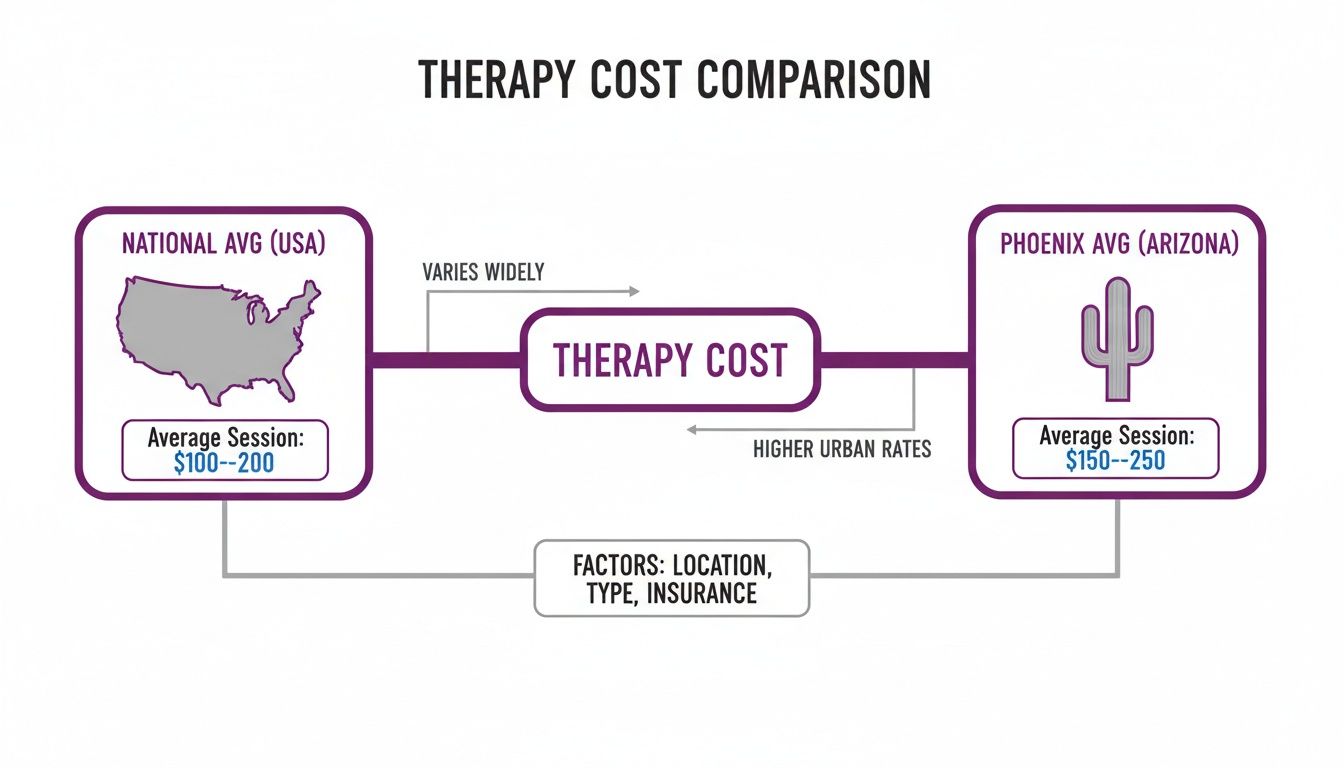
As you can see, while Phoenix is fairly aligned with the rest of the country, things like insurance and provider type are what really move the needle on price.
The rise of telehealth has also changed the game. Online therapy is often a more affordable route because it cuts down on overhead for the practice and eliminates your travel time and costs. At reVIBE Mental Health, we offer both in-person sessions across our five Valley locations and secure telehealth appointments to give you that flexibility.
Insurance Coverage
At the end of the day, your insurance plan is often the final piece of the puzzle that determines what you actually pay. When a therapist is in-network, they've agreed to a pre-negotiated, lower rate with your insurance company. This means your responsibility is usually just a predictable copay or coinsurance.
Going out-of-network, on the other hand, means you pay the therapist's full fee yourself and then file a claim for partial reimbursement from your insurer—a process that can be unpredictable and leave you with a much higher bill. This is why finding a practice that takes your insurance, like reVIBE, is one of the easiest ways to make therapy more affordable.
How Insurance Can Radically Lower Your Therapy Bill

While the sticker price of a therapy session can feel daunting, insurance is hands-down the most powerful tool for making it affordable. When you know how to use your benefits, you can turn what seems like a major expense into a predictable, manageable part of your budget.
Think of it like this: your insurance plan is a partnership. You contribute a bit, and your insurance company contributes a lot more, allowing you to access consistent, high-quality care without bearing the full cost alone. The trick is simply understanding how that partnership works.
Decoding Your Insurance Plan
Navigating your insurance policy can feel like learning a new language, but it really boils down to three key terms. Once you get these, you’ll have the confidence to use your benefits effectively.
- Deductible: This is the amount you have to pay out-of-pocket for your healthcare each year before your insurance company starts chipping in. Once you hit that number, your insurer takes over most of the cost.
- Copay: This is a simple, flat fee you pay for each session after your deductible has been met. For example, your plan might require a $30 copay for every therapy visit, making your cost consistent and easy to plan for.
- Coinsurance: Instead of a flat fee, coinsurance is a percentage of the total bill that you're responsible for after your deductible is met. If a $150 session is covered at 80%, your 20% coinsurance would be $30. Your insurance covers the other $120.
Of course, all of this is contingent on your health insurance premium, the monthly fee that keeps your plan active. Paying that premium is what gives you access to these cost-saving benefits in the first place.
In-Network vs. Out-of-Network Providers
Another huge factor in your final cost is whether a therapist is "in-network" or "out-of-network."
An in-network provider is a therapist or clinic that has a contract with your insurance company. They've already agreed to accept a lower, pre-negotiated rate for their services. This is why sticking with in-network providers is almost always the cheapest route.
An out-of-network provider has no such contract. This means you'll likely have to pay their full fee upfront. While some plans offer reimbursement for out-of-network care, it’s often a smaller percentage and requires you to handle all the paperwork yourself.
Choosing an in-network practice like reVIBE Mental Health is one of the most direct ways to control costs. We work with most major insurance plans to ensure our clients in Phoenix, Chandler, Scottsdale, and Tempe can access affordable care without financial surprises.
Essential Questions to Ask Your Insurance Company
To get a crystal-clear picture of what you’ll actually pay, you need to ask your insurance company a few specific questions. Just call the member services number on the back of your card and have this list ready:
- Do I have mental or behavioral health benefits? First, confirm that your plan actually covers therapy.
- What is my deductible, and how much of it have I met this year? This tells you if you'll be paying the full session fee for a while or if your copay/coinsurance will kick in right away.
- What is my copay or coinsurance for an outpatient mental health visit? This will be your exact per-session cost after the deductible is paid.
- Do I need pre-authorization for therapy? Some plans require a green light from them before they'll agree to cover your sessions.
- Is [Provider/Clinic Name] in-network with my specific plan? This is the single most important question to guarantee the lowest cost.
Getting answers to these questions removes all the guesswork. It empowers you to budget for your care so you can focus on what really matters—your well-being. And for those interested in specific treatments, we've put together a guide on how insurance may cover EMDR therapy.
Finding Affordable Therapy Without Insurance
Trying to figure out how to pay for therapy can feel like a huge hurdle, especially if you don't have insurance or prefer to pay out-of-pocket. But here’s the good news: not having a great insurance plan doesn’t mean quality mental health care is off the table. There are plenty of accessible, budget-friendly paths to get the support you need.
The truth is, many therapists got into this field to help people, and they genuinely believe cost shouldn't stop you from getting that help. Because of this, several options exist specifically to make therapy more affordable. Let's walk through them so you can find a solution that works for you without breaking the bank.
Explore Sliding-Scale Fee Structures
One of the most direct ways to find affordable care is to look for a therapist who offers a sliding-scale fee. Think of it as a flexible price tag for therapy. Instead of a single, fixed rate for everyone, the cost of your session is adjusted based on your income and what you can realistically afford.
A sliding scale is a commitment to equity in mental health. It ensures that everyone, regardless of their financial situation, has a fair opportunity to access professional support. Many private practices and community clinics offer this option if you ask.
To get on a sliding scale, you'll usually need to show some proof of your income, like a recent pay stub. Based on that, the practice will determine your session rate, which could fall anywhere from $30 to $120. It’s a simple, respectful way to make sure you’re not overextending yourself financially to prioritize your mental health.
Look Into Community and University Clinics
Beyond individual therapists in private practice, some institutions are built around providing low-cost mental health services. These are fantastic resources, especially if you're on a tight budget.
- Community Mental Health Centers: These are often non-profit or state-funded clinics with a mission to serve the local community. They provide all kinds of support, from one-on-one counseling to crisis services, almost always on a sliding scale.
- University Counseling Centers: If there’s a university near you with a psychology or counseling graduate program, they likely have a training clinic. You’ll work with a graduate student who is supervised by a licensed, senior professional. It’s a win-win: you get high-quality care at a much lower cost, and they get valuable hands-on experience.
Consider Group Therapy and EAPs
There are a couple of other great options that can significantly reduce the cost of getting support. They work differently but both offer incredible value.
Group therapy is a powerful and surprisingly affordable alternative to individual sessions. You get to share your experiences and gain perspective from others who are navigating similar issues, all guided by a professional therapist. Because the cost is split among all the members, it’s one of the most cost-effective ways to get professional guidance. If you're weighing what format is right for you, it can be helpful to explore the differences between online and in-person sessions.
An Employee Assistance Program (EAP) is another route to explore. This is a confidential benefit offered by many employers that provides a set number of free, short-term counseling sessions. It’s designed to help employees deal with personal challenges that might be affecting their well-being and work. Your first stop should be your HR department to see if this is part of your benefits package.
Making room in your budget for therapy is an investment in yourself. If you need some help getting your finances organized to make it happen, checking out some essential budgeting tips can be a great starting point.
How reVIBE Mental Health Makes Therapy Accessible in Phoenix

Knowing what goes into the cost of therapy is one thing. Finding a practice that actually helps you navigate it is another. At reVIBE Mental Health, our entire mission is built around breaking down the walls that stand between you and the mental healthcare you deserve here in Phoenix.
We get it. Juggling insurance, finding the right person to talk to, and just making time for an appointment can feel like a full-time job. That's why we’ve focused on solving the biggest hurdles—cost, convenience, and finding a genuine connection—so you can put your energy where it matters most: your well-being.
We Take the Headache Out of Insurance
One of our biggest priorities is making sure you can actually use your insurance benefits without a hassle. We accept most major insurance plans, which for the majority of our clients, significantly lowers the out-of-pocket price of a therapy session.
Instead of leaving you to figure out confusing policies alone, our team jumps in to help verify your benefits right from the start. We'll help you get a clear picture of your coverage, so you know exactly what your copay is and where you stand with your deductible. No more guessing games or surprise bills.
Flexible Care That Fits Your Real Life
Life in the Valley moves fast, and getting to a therapist's office shouldn't add another layer of stress. We offer both in-person sessions at our comfortable clinics and secure telehealth appointments, letting you choose what works best for you.
This isn't just about fitting into your calendar. Choosing telehealth can make therapy more affordable by cutting out travel time, gas money, and the need for childcare. And because we offer appointments seven days a week, you can find a time that works, not just a time that's available.
At reVIBE, making therapy accessible goes beyond the price tag. It means creating a warm, non-clinical space where you feel seen and respected from the moment you walk in. We designed our offices to feel more like a living room than a clinic.
The Right Therapist Makes All the Difference
A good therapeutic relationship is everything. A low price doesn't mean much if you don't click with your therapist. Our team is made up of a diverse group of counselors, therapists, and licensed psychiatric professionals who bring a wide range of expertise and life experience to the table.
This allows us to match you with someone who not only understands your clinical needs but also fits your personality and budget. Whether you need talk therapy, specialized trauma work like EMDR, or psychiatry and medication management, we work together to build a care plan that feels right for you. We take the time to get it right so your investment in yourself truly pays off.
Find a reVIBE Location Near You!
We currently have five locations for your convenience. (480) 674-9220
reVIBE Mental Health – Chandler
3377 S Price Rd, Suite 105, Chandler, AZ
reVIBE Mental Health – Phoenix Deer Valley
2222 W Pinnacle Peak Rd, Suite 220, Phoenix, AZ
reVIBE Mental Health – Phoenix PV
4646 E Greenway Road, Suite 100, Phoenix, AZ
reVIBE Mental Health – Scottsdale
8700 E Via de Ventura, Suite 280, Scottsdale, AZ
reVIBE Mental Health – Tempe
3920 S Rural Rd, Suite 112, Tempe, AZ
Common Questions About the Cost of Therapy
Let's be honest—figuring out the financial side of therapy can feel almost as daunting as making the decision to start. It’s a huge, and often confusing, part of the puzzle. To help you move forward with confidence, we’ve put together some straight answers to the most common questions we hear about the price of a therapy session.
Think of this as the final pre-flight check. You’ve learned what makes up the cost and how to fuel your journey with insurance or other options. Now, let’s tackle those last few lingering questions so you can feel completely ready for takeoff.
What’s the Going Rate for a Therapy Session in Arizona?
Here in Arizona, especially around the Phoenix metro, the cost of therapy is pretty much in line with the national average. If you're paying out-of-pocket, you can generally expect a standard one-hour individual session to run somewhere between $100 and $160. We have a competitive market with lots of great providers, which helps keep prices from getting out of control.
Of course, an "average" doesn't tell the full story. The price you see in Scottsdale might differ from one in Chandler, depending on a therapist’s specific expertise and years of experience. But the single biggest factor that will change this number is, without a doubt, your insurance plan.
This is where accessible, in-network practices like reVIBE Mental Health really make a difference. With locations across the Valley, we work to ensure that even with normal market changes, top-tier care is still affordable for people using their insurance benefits. For most, this brings the cost down to a simple, manageable copay.
Is Online Therapy Cheaper Than Meeting in Person?
In most cases, yes. Online therapy, or telehealth, often ends up being a more budget-friendly option than traditional, in-person appointments. It really just comes down to simple economics for everyone involved. A practice with a strong telehealth program has lower overhead costs—less office space, fewer front-desk staff—and those savings often get passed on to you.
The savings for you as the client are even more direct and immediate. When you opt for a virtual session, you instantly cut out all the little "hidden" costs of an in-person visit.
- No Travel Expenses: You’re not spending money on gas, paying for parking, or buying a bus pass.
- Less Time Off Work: The sheer convenience means you don't have to block off a huge chunk of your day to travel to and from an office.
- No Childcare Costs: You can have your session right from home, so there’s no need to find and pay for a babysitter.
This makes online therapy not just a great choice for your wallet, but also an incredibly practical one for anyone with a packed schedule.
Does It Cost More for Couples or Family Therapy?
Typically, it does. Sessions that involve more than one person, like couples or family therapy, usually come with a higher price tag. You'll often see rates starting around $150 and going up to over $250 per session. The reason is pretty straightforward: the work is simply more complex.
Instead of focusing on one person’s experiences and goals, the therapist has to navigate the dynamics between two or more people. This requires specialized training and a whole different level of skill to manage the conversation, mediate disagreements, and guide the entire family system toward a healthier place. It's a much more intricate job than working one-on-one.
It's also worth noting that insurance plans can sometimes cover couples or family therapy differently than individual sessions. Be sure to check on these specific benefits with your provider ahead of time so you know exactly what to expect.
Is It Okay to Ask a Therapist About Their Prices Before Booking?
Absolutely! Not only is it okay, but you should. Talking about fees, payment policies, and insurance is a completely normal—and essential—part of finding the right therapist. Any good, reputable provider expects these questions and will be ready to give you clear, direct answers.
Financial transparency is a sign of a healthy therapeutic relationship. You should feel totally comfortable and informed about the investment you're making in yourself.
Before you even book that first session, it’s a great idea to ask a few simple questions during your initial phone call or consultation:
- What is your standard rate per session?
- Do you happen to be in-network with my insurance plan?
- Do you offer a sliding scale or any other payment options?
- What is your cancellation policy?
Getting these details sorted out from the start means no awkward surprises later on. It frees you up to focus on what really matters—your mental health journey—with the peace of mind that comes from knowing you’re on solid financial footing.
At reVIBE Mental Health, our whole goal is to make your path to feeling better as clear and supportive as we can. Our team is here to help you verify your insurance, find a therapist who’s the right fit, and get you started with care that works for your life. With five convenient locations and flexible appointment options, great support is right around the corner.
Find a reVIBE Location Near You! Give us a call at (480) 674-9220 or learn more at https://revibementalhealth.com.